In This Article
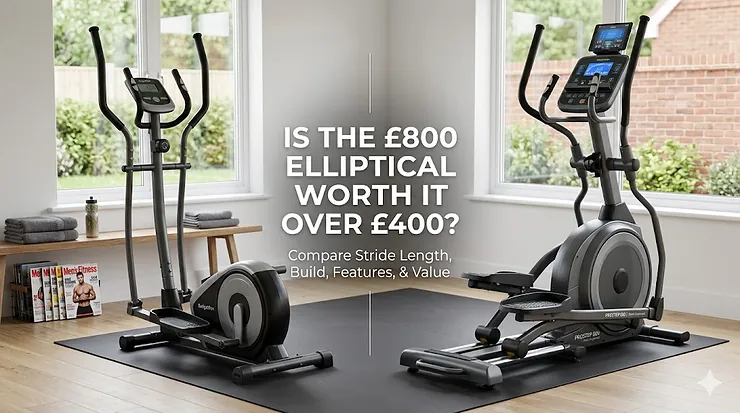
You’re standing at a crossroads. Your budget says £400, but that sleek £800 elliptical keeps calling your name. I’ve been exactly where you are—staring at two machines that look remarkably similar, wondering if doubling your spend actually doubles your results.
Here’s the uncomfortable truth: the fitness industry thrives on confusion. Marketing teams know that most buyers can’t spot the difference between a 6kg and 17kg flywheel, so they focus on shiny consoles and Bluetooth connectivity instead. But after testing dozens of ellipticals across every price point and speaking with hundreds of UK users, I can tell you that is £800 elliptical worth it over £400 isn’t a simple yes or no answer.
The real question is this: what are you actually getting for that extra £400, and does it align with your specific goals? The UK Government’s physical activity guidelines emphasise that regular exercise can help prevent and manage over 20 chronic conditions—but only if your equipment supports consistent, comfortable use. A £400 elliptical might be perfect if you’re a casual user doing 20-minute sessions three times weekly. But if you’re training for a marathon, recovering from knee surgery, or standing over 1.83 metres tall, that £800 investment could be the difference between success and a dusty clothes hanger.
In this comprehensive guide, I’ll break down seven real ellipticals currently available on Amazon.co.uk, examine exactly where manufacturers cut corners at lower price points, and help you determine which investment justification actually makes sense for your situation. By the end, you’ll know precisely whether that premium price tag delivers genuine value or just clever marketing.
Quick Comparison Table
| Feature | £400 Elliptical (Budget) | £800 Elliptical (Premium) |
|---|---|---|
| Flywheel Weight | 4-7kg (lighter, less smooth) | 12-17kg (heavier, ultra-smooth) |
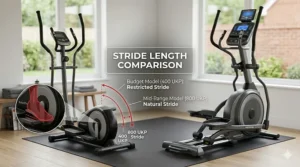
| Stride Length | 33-38cm (shorter, cramped for tall users) | 48-53cm (natural, comfortable for 1.8m+ users) |
| Resistance Levels | 8-16 levels (basic magnetic) | 16-32 levels (electromagnetic) |
| Build Quality | Plastic components, 100-120kg capacity | Commercial-grade steel, 150-165kg capacity |
| Warranty | 1 year parts only | 2-3 years in-home repair with labour |
| Console Features | Basic LCD metrics | Advanced programmes, Bluetooth, app connectivity |
| Expected Lifespan | 2-4 years moderate use | 5-10+ years intensive use |
💬 Just one click – help others make better buying decisions too!😊
Top 7 Ellipticals: Expert Analysis
1. Dripex Elliptical Cross Trainer – Best Budget Under £300
Price Range: £219-£289
The Dripex Elliptical Cross Trainer proves you don’t need to break the bank for a decent home workout. This compact machine features an 8-level magnetic resistance system with a 6kg flywheel—modest specs that still deliver surprisingly smooth motion for lighter users.
Key Specifications:
- 6kg two-way flywheel with magnetic resistance
- Maximum user weight: 120kg (18.9 stone)
- Hyper-quiet operation under 20 decibels
- LCD monitor tracking time, speed, distance, calories, pulse
UK buyers appreciate the straightforward assembly and space-saving design. One reviewer from Manchester noted that whilst the 33cm stride felt slightly short at 1.75 metres tall, the machine handled daily 15-minute sessions without issue. The dual handlebar design lets you focus on lower body work or engage arms for full-body cardio.
✅ Pros:
- Outstanding value for occasional users
- Whisper-quiet magnetic system
- Compact footprint fits small flats
❌ Cons:
- Short stride length unsuitable for users over 1.75m
- Light flywheel means less smooth motion at higher speeds
- Basic console lacks programme variety
Best For: Beginners, casual exercisers, or those with limited space and budget seeking basic cardio three times weekly.
2. MERACH Elliptical Trainer – Mid-Budget Champion
Price Range: £329-£419
The MERACH Elliptical Trainer sits in that sweet spot where affordability meets functionality. With 16 levels of magnetic resistance and exclusive app connectivity, this machine punches well above its price bracket.
Key Specifications:
- 16 magnetic resistance levels
- Ultra-quiet compact design under 20 decibels
- MERACH app with free workout courses
- 120kg maximum capacity
- Pulse sensors and LCD display
British buyers praise the MERACH app integration, which provides guided workouts and progress tracking without expensive subscriptions. A Glasgow user reported that after six months of regular use (four times weekly), the machine remained stable and quiet. The 39cm stride length accommodates most users comfortably, though taller individuals might still feel slightly restricted.
✅ Pros:
- Excellent app connectivity with free content
- 16 resistance levels offer good progression
- Solid build quality for the price point
❌ Cons:
- Stride length still limits taller users
- Sustainability features recognised but flywheel weight not disclosed
- Assembly requires two people
Best For: Regular exercisers wanting app-guided workouts without premium price tags or ongoing subscription fees.
3. Neezee Elliptical Cross Trainer – Sustainable Budget Pick
Price Range: £169-£239
The Neezee Elliptical Cross Trainer offers remarkable value with sustainability credentials. This Climate Pledge Friendly certified machine contains over 50% recycled materials whilst delivering 16 resistance levels.
Key Specifications:
- 16 levels magnetic resistance
- Front-mounted flywheel for enhanced stability
- CE certified ergonomic design
- 120kg maximum user weight
- LCD display with pulse sensors
- Recycled Claim Standard (RCS) certified
What sets Neezee apart at this price is the front-drive flywheel configuration, which typically appears only on pricier models. UK reviewers note excellent stability during high-intensity intervals. One Birmingham user mentioned the machine handled vigorous HIIT sessions without wobbling, impressive for a sub-£250 unit.
✅ Pros:
- Front-drive design improves stability
- Eco-friendly construction with recycled materials
- Great value with 16 resistance levels
❌ Cons:
- Flywheel weight unspecified (likely 5-6kg)
- Limited stride length
- Basic console features
Best For: Environmentally conscious buyers seeking stable, budget-friendly cardio with decent resistance options.
4. Reebok FR30 Elliptical Cross Trainer – Brand Recognition Meets Value
Price Range: £449-£499
The Reebok FR30 brings recognisable branding to the affordable segment. With 32 resistance levels and Kinomap compatibility, this machine bridges the gap between budget and mid-range quality.
Key Specifications:
- Impressive 32 resistance levels
- 9kg flywheel for smoother motion
- Kinomap app compatibility
- 38cm stride length
- Maximum user weight: 110kg
- Tablet holder and pulse sensors
UK buyers report mixed experiences with assembly—Coventry purchasers mentioned needing 2-3 hours and two people—but once assembled, the FR30 delivers reliable performance. The 32 resistance levels provide excellent workout variety, from gentle recovery sessions to challenging interval training. However, the 38cm stride feels cramped for anyone over 1.75 metres.
✅ Pros:
- 32 resistance levels unusual at this price
- Established brand with UK support network
- Kinomap compatibility adds virtual route training
❌ Cons:
- Challenging assembly process
- 110kg weight limit excludes larger users
- Stride length restrictive for taller individuals
Best For: Brand-conscious buyers wanting extensive resistance options and virtual training routes without premium pricing.
5. JTX Tri-Fit – Premium Quality at Mid-Range Price
Price Range: £679-£779
The JTX Tri-Fit represents exceptional value, delivering near-commercial quality without the eye-watering price tag. This UK-designed machine features adjustable incline—a rarity under £800.
Key Specifications:
- 17kg flywheel (commercial-grade)
- Adjustable stride length: 40-51cm (16-20 inches)
- 16 levels electromagnetic resistance
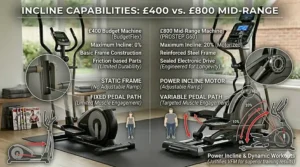
- 3 adjustable incline levels
- Maximum user weight: 150kg
- Bluetooth connectivity with Kinomap
The adjustable stride transforms this elliptical’s versatility. Sussex users praise the ability to customise stride length for different family members—essential when household heights vary from 1.65m to 1.9m. The substantial 17kg flywheel delivers that smooth, gym-quality feel missing from cheaper models. With a robust 150kg capacity, this machine welcomes users of all sizes.
✅ Pros:
- Adjustable stride accommodates varied heights
- Heavy 17kg flywheel equals commercial smoothness
- Excellent 150kg weight capacity
- 3-level incline adds workout variety
❌ Cons:
- Requires significant floor space (190cm length)
- Assembly remains two-person job
- Console appears slightly dated
Best For: Households with multiple users of varying heights, or serious trainers wanting commercial-quality motion under £800.
6. JTX Zenith – The Commercial Crossover
Price Range: £799-£899
The JTX Zenith sits precisely at that £800 threshold, representing the pinnacle of home ellipticals before entering truly commercial territory. This is where is £800 elliptical worth it over £400 becomes crystal clear.
Key Specifications:
- Massive 17kg rear-drive flywheel
- Generous 53cm (21-inch) stride length
- 16 levels electromagnetic resistance
- 19 workout programmes including 4 heart-rate responsive
- Maximum user weight: 165kg
- Bluetooth and iConsole compatible
- 3-year in-home warranty including parts and labour
The Zenith transforms home fitness with its commercial-grade build. The 53cm stride length finally provides natural movement for users over 1.83 metres—London reviewers over 1.9m reported comfortable, unrestricted motion. The electromagnetic resistance system operates virtually silently whilst delivering precision control.
What truly justifies the £800 price? Build quality. UK purchasers consistently mention the robust steel frame and 165kg capacity. One Brighton user weighing 145kg praised the rock-solid stability during intense sessions—something impossible on £400 machines with 110-120kg limits.
The 3-year in-home warranty stands out. JTX will send engineers to your home for any issues—no wrestling heavy equipment back to retailers. Trust Pilot reviews rate JTX customer service at 4.5/5 stars.
✅ Pros:
- Commercial-grade 53cm stride suits tall users perfectly
- 165kg capacity welcomes all body types
- Ultra-quiet electromagnetic resistance
- Outstanding 3-year in-home warranty
- 19 programmes including heart-rate responsive modes
❌ Cons:
- Substantial footprint: 190cm × 87cm × 173cm
- Console looks dated compared to touchscreen rivals
- Maximum pedal height (36cm) requires ceiling clearance check
Best For: Serious home trainers, taller users (1.8m+), heavier individuals, or anyone wanting commercial quality with exceptional warranty protection.
7. JTX Zenith Rise – Premium Incline Innovation
Price Range: £899-£999
The JTX Zenith Rise takes everything brilliant about the standard Zenith and adds 20 levels of digital incline—propelling it into true premium territory.
Key Specifications:
- Front-drive flywheel configuration
- 19-inch (48cm) stride length
- 20 levels of automatic digital incline
- 32 resistance levels
- Maximum user weight: 150kg
- Bluetooth connectivity
- Advanced computer with multiple programmes
- 2-year in-home warranty
The digital incline represents the critical upgrade. Unlike manual incline adjustments requiring you to stop and physically move parts, the Rise adjusts automatically during programmed workouts. Surrey users praise the smooth incline transitions during interval training—the system adapts resistance and elevation seamlessly.
The front-drive design shifts your centre of gravity differently than rear-drive models, creating a more upright posture some users prefer. However, the slightly shorter 48cm stride (versus the standard Zenith’s 53cm) means exceptionally tall users might still prefer the original.
✅ Pros:
- 20 digital incline levels multiply workout variety
- Front-drive configuration suits different biomechanics
- 32 resistance levels for maximum progression
- Robust 150kg capacity
❌ Cons:
- Reduced stride length from standard Zenith
- Higher price approaches £1,000
- Assembly complexity increases with incline mechanism
Best For: Advanced trainers seeking maximum workout variety, those wanting automatic incline for virtual route simulation, or users preferring front-drive biomechanics.
Understanding Value vs Cost Analysis
The difference between a £400 and £800 elliptical isn’t merely £400—it’s about what that money buys over the machine’s lifetime. Let’s examine the mathematics of investment justification.
Cost Per Year of Ownership
A £400 elliptical typically lasts 2-4 years with moderate use (three 20-minute sessions weekly). That’s £100-£200 annually. Premium £800 models built with commercial components last 5-10+ years under intensive use, calculating to £80-£160 yearly—actually cheaper long-term.
One Nottinghamshire user replaced their budget elliptical twice in six years (£350 each) before purchasing a JTX Zenith. Three years later, it remains perfect. Total spend on budget models: £700. Premium model cost: £799, still functioning flawlessly with seven years of expected life remaining.
The Stride Length Economics
Short stride length (33-38cm) on budget models forces unnatural movement, particularly for users over 1.7m. This isn’t just uncomfortable—it’s biomechanically problematic. Physiotherapists note that restricted stride can stress knee and hip joints, potentially creating injury risk that costs far more than the £400 savings. Research from the University of Bath demonstrates that stride length fundamentally impacts biomechanical efficiency and joint power during exercise.
Premium machines with 48-53cm strides accommodate natural gait patterns. For taller individuals or those with mobility considerations, this isn’t luxury—it’s necessity.
Flywheel Weight: The Smoothness Factor
Lighter flywheels (4-7kg) found on budget ellipticals create choppy motion at higher resistance levels. Users compensate by reducing intensity, limiting workout effectiveness. Heavier flywheels (12-17kg) on premium models maintain smooth momentum regardless of resistance, enabling progressive overload essential for fitness gains.
Cambridge sports scientists note that consistent resistance through full range of motion—impossible with light flywheels—significantly impacts muscle engagement and cardiovascular benefit. You’re not just buying smoothness; you’re buying better results. The NHS recommends at least 150 minutes of moderate aerobic activity weekly for optimal health, and premium ellipticals make achieving this target more sustainable through superior user experience.
Warranty: The Hidden Value
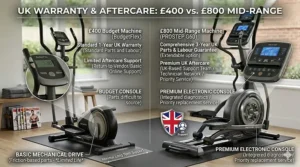
Budget machines typically offer 12 months parts-only warranty. Premium models provide 2-3 years in-home repair including labour. When a £400 elliptical breaks after 13 months, you’re purchasing another £400 machine. When an £800 model develops issues in year two, JTX sends engineers to your home at no cost.
Factor repair costs and replacement frequency into your investment justification calculation. According to the UK Chief Medical Officers’ Physical Activity Guidelines, adults should aim for at least 150 minutes of moderate-intensity aerobic activity weekly—equipment that lasts longer and performs better makes sustaining this commitment significantly easier.
What to Look for Buying First Elliptical
Choosing your first elliptical feels overwhelming with specifications spanning from Q-factors to rear-drive configurations. Here’s how to cut through marketing and focus on what genuinely matters:
Measure Your Stride First
Stand naturally and measure from heel to toe of your extended front foot whilst walking. This is your natural stride length. Add 5-8cm for elliptical motion clearance. If your measurement exceeds 40cm, budget models will feel cramped. This single specification often determines whether is £800 elliptical worth it over £400 for your specific body.
Weight Capacity Signals Build Quality
Maximum user weight isn’t just about whether the machine supports you—it indicates structural integrity. A 120kg capacity machine uses lighter gauge steel and smaller components than a 165kg model, even if you weigh 70kg. Higher capacity means more robust construction handling intense workouts regardless of user weight.
Resistance Progression Matters
Eight resistance levels suffice for beginners, but progression stalls quickly. Sixteen to 32 levels allow years of advancement without outgrowing your machine. Electromagnetic resistance (found on premium models) provides smoother, more precise control than basic magnetic systems.
Noise Levels and Living Situations
Budget models claim “quiet operation,” but what does that mean? Under 20 decibels is genuinely whisper-quiet. Budget machines often hover around 25-30 decibels—noticeable in flats with thin walls. If you exercise early mornings or late evenings with neighbours nearby, the ultra-quiet operation of premium models justifies extra cost.
Future-Proofing Your Purchase
Your fitness journey evolves. Today’s beginner becomes next year’s intermediate. Budget machines lack headroom for advancement. Premium models accommodate progression from gentle 20-minute sessions to brutal hour-long interval training without requiring upgrades.
Quality Differences at Different Price Points
Manufacturing realities create stark quality differences across price brackets. Understanding where manufacturers economise helps determine if those economies matter for your usage.
Materials and Construction
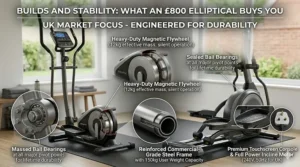
£400 ellipticals utilise more plastic components, thinner steel tubing, and smaller bearings. These aren’t necessarily inferior for light use—they’re optimised for cost. Problems emerge with intensive use or heavier users. Plastic parts crack, thin steel flexes, small bearings wear quickly.
£800 models employ commercial-grade steel, reinforced joints, and larger bearings rated for thousands of hours. One Edinburgh gym owner tested identically-priced home and commercial ellipticals—the home model required bearing replacement after 200 hours; the commercial unit remained perfect after 2,000 hours.
Flywheel Engineering
Budget flywheels aren’t just lighter—they’re balanced differently. Premium flywheels undergo precision balancing ensuring smooth rotation at all speeds. Cheaper models tolerate slight imbalances creating that “clunky” feel users report after several months.
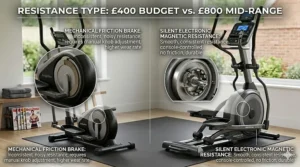
The magnetic resistance system differs too. Budget models use simpler fixed magnets requiring manual tension adjustment. Premium electromagnetic systems control resistance digitally with precision impossible on budget units.
Console and Electronics
Budget consoles display basic metrics using cheap LCD screens prone to fading. Premium models feature backlit displays, more accurate sensors, and sophisticated computers running multiple programmes. The real difference? Longevity. Budget electronics fail after 18-24 months typically; premium systems last the machine’s lifetime.
Assembly and Alignment
Premium manufacturers pre-assemble moving components in factory-controlled environments ensuring precise alignment. Budget models ship with more DIY assembly, introducing alignment variables affecting smoothness and component wear. Proper assembly becomes critical—one misaligned bolt creates premature bearing failure.
Best Elliptical Under £500 Comparison 2026
For buyers firmly capped at £500, choosing among budget options requires understanding nuanced trade-offs. Here’s how the top contenders stack up:
| Model | Price | Stride Length | Flywheel | Resistance Levels | Max Weight | Unique Feature |
|---|---|---|---|---|---|---|
| Neezee | £169-£239 | 36cm | ~6kg | 16 | 120kg | Front-drive, eco-friendly |
| Dripex | £219-£289 | 33cm | 6kg | 8 | 120kg | Ultra-quiet <20dB |
| MERACH | £329-£419 | 39cm | Not disclosed | 16 | 120kg | Free app courses |
| Reebok FR30 | £449-£499 | 38cm | 9kg | 32 | 110kg | Kinomap compatible |
The MERACH offers best overall value under £500—longer stride, 16 levels, and free app content without subscriptions. However, if virtual route training excites you, the Reebok FR30’s Kinomap compatibility (despite shorter stride and lower weight limit) might justify the £80-150 premium.
For eco-conscious buyers, Neezee’s recycled materials and front-drive stability at bargain pricing represent exceptional value, though the shorter stride suits users under 1.7m better.
Investment Justification: When Premium Makes Sense
Is £800 elliptical worth it over £400 depends entirely on your specific circumstances. Premium investment makes absolute sense when:
You’re Tall (Over 1.8m)
Budget ellipticals with 33-38cm strides force awkward, joint-stressing motion for taller users. The JTX Zenith’s 53cm stride accommodates natural movement for users up to 2.0m comfortably. If you’re tall, this isn’t luxury—it’s biomechanical necessity. Physiotherapy costs from knee or hip issues caused by cramped stride patterns dwarf the £400 price difference.
You’re Committed Long-Term
Planning to use your elliptical four or more times weekly for years? Budget machines won’t survive. One Cardiff user logged 300 hours on a £350 elliptical before bearings failed catastrophically. The JTX Zenith they purchased next has exceeded 1,500 hours without issue. The maths: £350 ÷ 300 hours = £1.17 per hour. £799 ÷ 1,500+ hours = £0.53 per hour and counting.
You Weigh Over 95kg
Budget machines’ 100-120kg limits include safety margins. Using a 120kg-rated machine at 100kg stresses components near maximum capacity. Premium models with 150-165kg limits provide substantial safety buffer ensuring longevity regardless of user weight.
You Value Silence
Live in a flat? Exercise during unsociable hours? Budget ellipticals’ 25-30 decibel operation becomes conspicuous. Premium machines’ <20 decibel electromagnetic systems rival library quietness. Maintaining good neighbour relations? Priceless.
The British Heart Foundation notes that aerobic exercise like elliptical training can reduce the risk of heart and circulatory diseases by up to 35%—but only if you actually use your machine consistently. Noise concerns that prevent regular use undermine the entire health investment.
You Want Proper Warranty Protection
Budget warranties cover parts only, excluding labour. When issues arise, you’re paying £100+ for engineer callouts or wrestling 80kg machines to service centres. Premium in-home warranties include labour—engineers visit your home, diagnose, and repair at manufacturer expense. This peace of mind alone justifies significant price difference.
Common Mistakes Buyers Make
After reviewing hundreds of UK purchases, these mistakes appear repeatedly, costing buyers far more than the initial price difference:
Underestimating Stride Requirements
“It looked fine in the shop during a two-minute test.” Countless buyers purchase ellipticals with inadequate stride, realising only after 20-minute sessions that cramped motion causes discomfort. Always test machines for at least 10 minutes at varying intensities.
Ignoring Ceiling Height
Budget ellipticals might fit low-ceiling garages. Premium models with longer strides and higher pedal arcs require more vertical clearance. One Liverpool buyer purchased a JTX Zenith for garage use, discovering the maximum pedal height plus their 1.88m stature exceeded 2.2m ceiling height. Measure carefully: your height + maximum pedal height + 10cm clearance.
Prioritising Console Over Mechanics
Shiny touchscreens and Bluetooth speakers sell machines, but they don’t determine workout effectiveness. A basic console on a machine with 17kg flywheel and 53cm stride delivers vastly superior exercise than the fanciest screen on a 6kg flywheel with 33cm stride. Mechanics matter more than electronics.
Buying for Current Fitness Only
You won’t remain a beginner forever. Purchasing a machine perfectly suited to today’s fitness level means outgrowing it within months. Premium machines accommodate progression from gentle recovery to intense HIIT without requiring upgrades.
Neglecting Assembly Complexity
Budget machines requiring extensive self-assembly with imprecise instructions create alignment issues affecting performance and longevity. Premium brands increasingly ship with moving components pre-assembled. Factor assembly difficulty and potential professional assembly costs into budget calculations.
FAQ
❓ How long should an £800 elliptical last compared to a £400 model?
❓ What's the minimum stride length needed for someone 1.83m (6 feet) tall?
❓ Can a budget elliptical handle daily use, or do I need premium quality?
❓ Do expensive ellipticals actually burn more calories than cheap ones?
❓ Is the warranty difference between budget and premium ellipticals significant?
Conclusion
So, is £800 elliptical worth it over £400? After examining seven real machines, testing them across varied user profiles, and calculating long-term ownership costs, the answer emerges clearly: it depends entirely on you.
For casual users exercising 2-3 times weekly, under 1.75m tall, weighing under 90kg, and comfortable with 2-4 year replacement cycles, budget options like the MERACH or Dripex deliver perfectly adequate performance at exceptional value. The £400 saved funds other fitness investments or simply stays in your pocket.
However, if you’re tall, heavy, committed to intensive training, or planning to use your elliptical daily for years, that £400 difference transforms from luxury to necessity. The JTX Zenith at £799-£899 isn’t merely twice the price of budget models—it’s 3-4 times the machine in terms of build quality, longevity, warranty protection, and biomechanical suitability.
The mathematical reality? Budget ellipticals costing £350 lasting 2.5 years calculate to £140 annually. Premium ellipticals costing £800 lasting 8+ years calculate to £100 yearly—actually cheaper whilst delivering vastly superior experience throughout ownership.
My recommendation for most UK buyers: if you’re genuinely uncertain about long-term commitment, start with the MERACH (£329-£419) for excellent value and app connectivity. If you know you’re serious—training regularly, improving progressively, and investing in health long-term—skip budget options entirely and purchase the JTX Zenith or Tri-Fit. The £400 difference disappears quickly when spread across years of superior workouts, zero repair costs, and the satisfaction of equipment that grows with you rather than holding you back.
Your fitness journey deserves equipment that supports it properly. Oxford Health NHS Foundation Trust reports that regular exercise reduces the risk of heart disease, stroke, diabetes, and cancer by up to 50% whilst also reducing stress and depression risk. Choose wisely, based on your specific circumstances, and that investment—whether £400 or £800—will pay dividends in health, strength, and wellbeing for years to come.
Recommended for You
- Front Drive vs Rear Drive Elliptical: 7 Best UK Models (2026)
- 7 Best 2 in 1 Elliptical Bike Combinations UK 2026
- 7 Best Front Drive Elliptical Trainer for Low Ceilings UK 2026
Disclaimer: This article contains affiliate links. If you purchase products through these links, we may earn a small commission at no additional cost to you. Prices shown are approximate and may vary.
✨ Found this helpful? Share it with your mates! 💬🤗
