In This Article
You’ve decided to bring the gym home—brilliant choice. But now you’re staring at dozens of cross trainers online, and one question keeps popping up: does it actually matter where the flywheel sits?
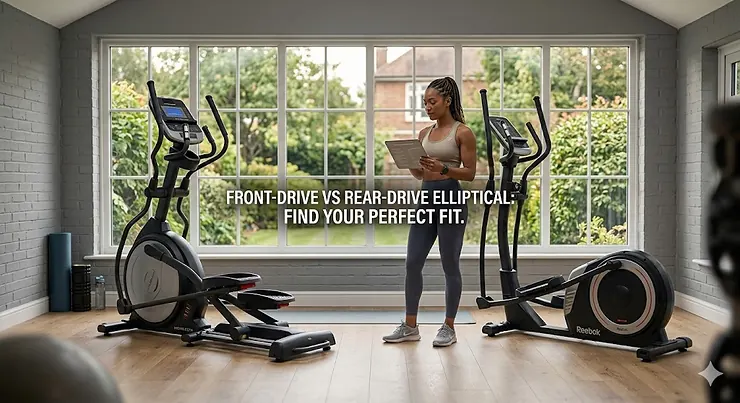
Turns out, it matters quite a bit. The placement of that hefty metal disc—whether it’s positioned at the front or rear of your machine—fundamentally changes how your workout feels, how much space you’ll need, and even which muscles you’ll engage most effectively. Front drive vs rear drive elliptical isn’t just fitness jargon; it’s the difference between a machine that feels natural and one that leaves you feeling a bit… off.
Having tested both configurations extensively (and having made my share of purchasing mistakes), I can tell you that understanding these differences will save you hundreds of pounds and potential buyer’s remorse. According to research from Wikipedia, elliptical trainers entered the market in the 1990s when Precor developed the first commercial models, initially using rear-drive systems to create the most natural stride pattern.
In this comprehensive guide, we’ll dissect every aspect of front drive vs rear drive elliptical machines, examine seven real models available on Amazon.co.uk, and help you determine which configuration suits your fitness goals, body type, and living space. Whether you’re recovering from a knee injury, training for a marathon, or simply trying to shift those stubborn pounds, the right drive system makes all the difference.
Quick Comparison Table
| Feature | Front Drive Elliptical | Rear Drive Elliptical |
|---|---|---|
| Footprint | More compact (typically 140-160cm) | Longer (typically 160-190cm) |
| Stride Feel | Flatter, stair-climber motion | Rounded, natural walking/running motion |
| Posture | Slight forward lean | More upright stance |
| Best For | Glute activation, small spaces | Joint comfort, natural movement |
| Price Range (UK) | £110-£600 | £180-£1,200+ |
| Incline Options | Often adjustable | Usually fixed stride |
| Maintenance | More moving parts | Fewer components |
| Noise Level | Can be slightly louder | Generally quieter |
💬 Just one click – help others make better buying decisions too!😊
Top 7 Cross Trainers: Expert Analysis
1. Dripex Elliptical Cross Trainer (Front Drive)
Price: £109.99-£138.99
This front-drive marvel from Dripex punches well above its weight class. With an 8-level magnetic resistance system and a 6kg flywheel, it’s remarkably quiet for the price point—perfect if you’re in a flat and don’t fancy annoying the neighbours during your 6am workout sessions.
Key Specifications:
- 8 magnetic resistance levels
- 6kg flywheel
- Maximum user weight: 120kg (265lbs)
- LCD monitor with pulse sensors
UK buyers consistently praise its sturdy construction and surprisingly smooth operation. One reviewer noted it’s “robust enough for daily use” whilst remaining light enough to manoeuvre between rooms when needed.
Pros:
✅ Budget-friendly entry point
✅ Compact design fits smaller spaces
✅ Hyper-quiet magnetic drive system
Cons:
❌ Shorter stride length may feel restrictive for taller users
❌ Basic console without app connectivity
2. JLL Fitness CT200 Home Elliptical Cross Trainer (Front Drive)
Price: £179.99-£199.99
JLL Fitness, a Birmingham-based company, has built a solid reputation across the UK for delivering reliable equipment at sensible prices. The CT200 represents excellent value with its 8-level magnetic resistance and bi-directional 5kg flywheel.
Key Specifications:
- 8 magnetic resistance levels
- 5kg bi-directional flywheel
- Console display with heart rate sensor
- Tablet holder included
- Maximum user weight: 100kg (220lbs)
British customers appreciate the straightforward assembly and the fact that bolts need periodic tightening—a minor inconvenience that’s easily managed. One user mentioned using it daily whilst watching telly, noting it’s helped with weight management when combined with proper nutrition.
Pros:
✅ UK-based company with responsive customer service
✅ Effective for daily cardio routines
✅ Works upper arms, shoulders, and back muscles
Cons:
❌ Requires periodic bolt adjustments
❌ Lower weight capacity than some competitors
3. MERACH Elliptical Trainer (Rear Drive)
Price: £199.99-£299.99
MERACH has made waves in the UK fitness market with their ultra-quiet designs. This rear-drive model features 16 levels of magnetic resistance—double what you’ll find on most budget machines—and integrates seamlessly with their exclusive app for tracking workouts.
Key Specifications:
- 16 magnetic resistance levels
- Ultra-quiet compact design
- LCD display with pulse sensors
- MERACH app connectivity via Bluetooth
- Maximum user weight: 120kg (265lbs)
UK purchasers highlight the smooth, natural stride that comes from the rear-drive configuration. The app connectivity is particularly popular with younger users who enjoy gamifying their fitness routines.
Pros:
✅ Exceptionally quiet operation
✅ Double the resistance levels of entry models
✅ App integration for workout tracking
Cons:
❌ Takes up more floor space than front-drive equivalents
❌ Assembly can be time-consuming
4. DKN XC-190 Magnetic Elliptical Cross Trainer (Rear Drive)
Price: £799.99-£899.99
Now we’re entering premium territory. The DKN XC-190 is a beast of a machine with a 10kg (22lbs) flywheel and an impressive 32 levels of silent magnetic resistance. It’s the sort of equipment you’d expect to find in a proper gym.
Key Specifications:
- 32 digital resistance levels
- 10kg (22lbs) flywheel
- 53cm (21″) stride length
- 16 pre-programmed workouts
- Bluetooth connectivity (Kinomap, Vescape compatible)
- Maximum user weight: 130kg (286.6lbs)
The XC-190’s narrow 5cm Q-factor (spacing between pedals) provides exceptional comfort and mimics natural movement patterns. UK buyers frequently mention the machine’s substantial weight—83kg (183lbs)—which translates to rock-solid stability during intense sessions.
Pros:
✅ Commercial-grade build quality
✅ Extensive resistance range for progressive training
✅ Compatible with popular fitness apps
Cons:
❌ Significant investment (£800+)
❌ Requires dedicated space due to size
5. THERUN 3-in-1 Cardio Climber Elliptical Machine (Front Drive)
Price: £249.99-£299.99
This innovative front-drive design combines elliptical, cardio climber, and stair stepper functions in one machine. With 16 levels of adjustable silent magnetic resistance and an 8kg flywheel, it’s ideal for users wanting workout variety.
Key Specifications:
- 16 magnetic resistance levels
- 8kg flywheel
- 3-in-1 functionality
- LCD display with full data tracking
- Pulse tracking sensors
British customers appreciate the versatility, noting it’s “brilliant for targeting different muscle groups” without purchasing multiple machines.
Pros:
✅ Three workout modes in one machine
✅ Silent operation suitable for flats
✅ Good value for multi-function capability
Cons:
❌ Stride length might feel different in various modes
❌ Heavier flywheel means steeper learning curve
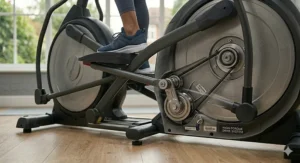
6. Cardiostrong EX60 Elliptical Cross Trainer (Rear Drive)
Price: £1,199.00
The Cardiostrong EX60 sits at the top end of home elliptical equipment in the UK. Featuring dual flywheels and a modern design, it offers exceptional movement quality that rivals machines costing twice as much.
Key Specifications:
- Dual flywheel system
- 16 pre-programmed functions
- Low step-through height (easy access)
- Built-in console with pulse sensors
- Adjustable treads and pendulum arms
UK purchasers highlight the seamless motion and the machine’s ability to accommodate users of varying fitness levels within the same household.
Pros:
✅ Best-in-class movement quality
✅ Space-saving storage after workouts
✅ Suitable for all fitness abilities
Cons:
❌ Premium price point
❌ May be overkill for casual users
7. Neezee Elliptical Cross Trainer (Front Drive)
Price: £159.99-£189.99
Neezee offers solid mid-range performance at an accessible price. With 16 levels of magnetic resistance and app compatibility, it bridges the gap between budget and premium models effectively.
Key Specifications:
- 16 magnetic resistance levels
- Ultra-quiet operation
- App compatible (various fitness apps)
- LCD monitor with pulse sensors
- Device holder for tablet/phone
- Maximum user weight: 120kg (265lbs)
British reviewers note it’s particularly good value, describing it as “the sweet spot” for home users who want quality without breaking the bank.
Pros:
✅ Excellent mid-range value
✅ App compatibility at modest price
✅ Quiet enough for apartment living
Cons:
❌ Not as robust as premium models
❌ Stride length may feel short for users over 1.8m (6ft)
Understanding Drive Systems: The Mechanical Foundation
The position of your elliptical’s drive system—essentially where the hefty flywheel sits—determines far more than you might initially think. It’s the mechanical heart of the machine, influencing everything from your stride pattern to how your joints feel after a 45-minute session.
Front Drive Configuration
Front drive ellipticals position the flywheel at the machine’s front, typically beneath the console you’ll be staring at during those final agonising minutes of interval training. This arrangement creates a unique biomechanical experience that some people adore whilst others find slightly unnatural.
When you step onto a front-drive model, you’ll notice your body naturally leans forward slightly—not dramatically, but enough to shift your centre of gravity. This forward tilt mimics the body position you’d adopt whilst climbing stairs, which is precisely why front-drive machines excel at targeting your posterior chain (that’s fitness-speak for your glutes, hamstrings, and lower back).
The design typically results in a flatter elliptical path—think more oval than circular. Whilst this might sound like a drawback, it actually provides distinct advantages for certain training goals. The motion pattern places considerable emphasis on glute activation, making front-drive ellipticals particularly popular with people focused on lower body development.
According to biomechanics research from Consumer Reports, the forward-leaning posture can sometimes create increased loading on the quadriceps whilst the flatter motion path may feel less natural to some users, particularly those transitioning from outdoor running.
Rear Drive Configuration
Rear drive ellipticals—the original design patented by Precor when they introduced elliptical trainers in the 1990s—place the flywheel behind you. This positioning fundamentally changes your relationship with the machine.
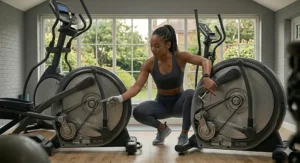
Stand on a rear-drive elliptical and you’ll immediately notice the difference: your posture remains more upright, closely mimicking your natural walking or jogging stance. The pedal motion follows a longer, more rounded elliptical path that feels decidedly more fluid. Many users describe it as “smoother” or “more natural,” particularly during longer workout sessions.
The biomechanical advantages are significant. With the flywheel positioned at the rear, your weight distributes more evenly, allowing you to maintain a neutral spine position. This is particularly beneficial for people with lower back concerns—the upright posture reduces compressive forces on your lumbar spine compared to the slight forward lean of front-drive models.
The longer stride length typical of rear-drive machines also tends to engage your hamstrings and glutes more effectively during the backward phase of each rotation. You’re essentially getting a more balanced workout across your entire posterior chain without the emphasised forward lean.
Biomechanics and Body Positioning: How Your Body Responds
Your body doesn’t exist in isolation from the machines you use—it adapts to them. Understanding how front and rear drive systems affect your biomechanics helps you choose equipment that supports your body rather than fighting against it.
Joint Loading Patterns
Both front and rear drive ellipticals are classified as low-impact exercise equipment, but “low-impact” doesn’t mean “identical impact.” The drive system affects how forces distribute through your joints during each stride.
Front drive machines, with their characteristic forward lean, tend to place slightly more emphasis on your knees and quadriceps. The flatter motion path means your knee joint moves through a somewhat different range of motion compared to natural walking. For most people, this poses no problems whatsoever. However, if you’re managing patellar (kneecap) tracking issues or recovering from specific knee injuries, the slight differences in knee mechanics might feel more pronounced.
Rear drive ellipticals, conversely, promote a more neutral joint alignment. The upright posture and rounded motion path distribute forces more evenly across your ankle, knee, and hip joints. Many physiotherapists recommend rear-drive machines specifically for this reason—the biomechanics closely approximate natural gait patterns, reducing compensatory movement patterns that sometimes develop with front-drive designs.
Muscle Recruitment Differences
Here’s where things get interesting for fitness enthusiasts. The drive system significantly influences which muscles work hardest during your training session.
Front drive ellipticals, with their stair-climber-like motion, create enhanced glute and quadriceps activation. That forward lean isn’t just postural—it’s functional. Your glutes must work harder to propel you through each stride, whilst your quads fire more intensely to control the descent phase. If you’re specifically targeting lower body strength and development, this enhanced posterior chain engagement can be advantageous.
Rear drive machines provide more balanced muscle recruitment across your entire lower body. The upright position and natural stride pattern engage your hamstrings, glutes, calves, and quadriceps more evenly throughout the complete range of motion. You’re less likely to experience the quad-dominant fatigue that some users report with front-drive models.
For upper body engagement, both systems work reasonably well when you actively use the moving handles. However, the more upright posture of rear-drive ellipticals often allows for better scapular (shoulder blade) positioning, potentially leading to more effective upper back and shoulder engagement.
Stride Length and Motion Quality: The Feel Factor
Stride length represents one of the most critical yet frequently overlooked specifications when purchasing an elliptical. Get it wrong, and you’ll feel like you’re either taking tiny mincing steps or uncomfortably overextending with each rotation.
Front Drive Stride Characteristics
Front drive ellipticals typically offer stride lengths ranging from 30cm to 45cm (12″ to 18″), though some premium models extend slightly longer. The flatter elliptical path means each stride feels more compressed—you’re covering less vertical distance but maintaining forward momentum.
This works brilliantly for users between 1.5m and 1.75m tall (5′ to 5’9″). However, if you’re taller—particularly over 1.8m (6′)—you might find the stride length restrictive. I’m 1.83m (6’0″), and I’ve definitely experienced that “running in place” sensation on shorter front-drive machines where my natural stride wants to extend further than the machine permits.
The solution? If you’re taller and considering a front drive model, aim for machines with at least 45cm (18″) stride length. Some higher-end front-drive ellipticals now offer adjustable stride lengths, which brilliantly solves the problem for households with users of varying heights.
Rear Drive Stride Characteristics
Rear drive ellipticals generally provide longer strides—typically 40cm to 56cm (16″ to 22″)—with that characteristically rounded elliptical path. The additional length isn’t just about accommodating taller users; it’s about motion quality.
The longer, more circular stride pattern allows your legs to move through a fuller range of motion, which feels decidedly more natural, particularly during extended workout sessions. You’ll notice the difference especially during longer cardio sessions—20 minutes into a steady-state workout, that natural stride pattern reduces the mental fatigue that sometimes accompanies more constrained motion paths.
According to fitness equipment research, rear-drive ellipticals guide feet through a longer oval path that many users describe as smoother and more fluid compared to the flatter motion of front-drive models.
For families or shared living situations, the longer stride length of rear-drive machines typically accommodates a wider range of user heights comfortably—from about 1.6m to 1.95m (5’3″ to 6’5″) without anyone feeling cramped or overextended.
Space Considerations: The Footprint Reality
Here’s the uncomfortable truth nobody mentions in those glossy marketing materials: elliptical trainers are massive. Even “compact” models demand significant floor space, and the drive system dramatically affects just how much of your living room they’ll colonise.
Front Drive Space Requirements
Front drive ellipticals win decisively on footprint. Most models measure approximately 140-160cm in length (4’7″ to 5’3″), considerably shorter than their rear-drive counterparts. If you’re working with a spare bedroom, conservatory, or dedicated corner of your living room, this difference might determine whether an elliptical actually fits in your space.
The compact design stems from the front-mounted flywheel—all the mechanical gubbins cluster near the console, allowing manufacturers to create shorter machines without compromising structural integrity. I’ve successfully fitted front-drive models into spaces that simply couldn’t accommodate rear-drive alternatives.
However, remember to account for clearance. You’ll need approximately 50cm (20″) of space around the machine for comfortable mounting/dismounting and to avoid that claustrophobic feeling during workouts. Nobody wants to knock into walls mid-stride.
Rear Drive Space Requirements
Rear drive ellipticals demand more real estate—typically 160-190cm in length (5’3″ to 6’3″). That extended footprint houses the longer stride mechanism and rear-mounted flywheel, providing those biomechanical advantages we discussed earlier.
The trade-off is spatial. You’re committing a larger chunk of your home to fitness equipment, which matters enormously in typical UK homes where space is at a premium. Before purchasing a rear-drive model, physically measure your intended space. Use painter’s tape to mark out the machine’s dimensions on your floor—this simple exercise has prevented countless purchasing regrets.
Interestingly, whilst rear-drive machines are longer, they’re often narrower than front-drive models, which can be advantageous in certain room configurations. A long, narrow space might actually accommodate a rear-drive elliptical better than a shorter but wider front-drive alternative.
Some rear-drive models now feature folding mechanisms or transport wheels, partially mitigating the space issue. Models like the MERACH can be relocated after workouts, though at 70-80kg, “easily moved” is perhaps overly optimistic marketing speak.
Resistance Systems: Magnetic vs Electromagnetic Cross Trainer Difference
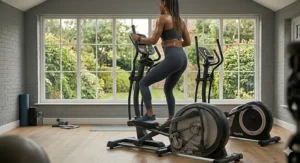
Resistance systems determine how smoothly your elliptical operates and how precisely you can adjust workout intensity. Understanding magnetic vs electromagnetic cross trainer difference is crucial for selecting equipment that matches your training style.
| Resistance Type | Operation | Noise Level | Price Range (UK) | Best For |
|---|---|---|---|---|
| Manual Magnetic | Manual knob adjustment | Very quiet | £100-£300 | Budget buyers, beginners |
| Motorised Magnetic | Electronic button control | Very quiet | £250-£800 | Most home users |
| Electromagnetic | Instant electronic adjustment | Silent | £800+ | Serious athletes, premium users |
Magnetic Resistance: The Standard Bearer
Magnetic resistance employs permanent magnets positioned around your elliptical’s flywheel. When you adjust resistance—either via a manual knob or electronic controls—the magnets move closer to or further from the flywheel, creating varying levels of magnetic resistance without any physical contact.
This non-contact system delivers several practical advantages. Firstly, it’s remarkably quiet—there’s no friction, no grinding, just smooth, silent operation. If you live in a flat or have family members with different schedules, this matters enormously. I’ve used magnetic resistance machines at 5:30am without waking anyone in the household.
Maintenance requirements remain minimal. Without contact between moving parts, there’s virtually nothing to wear out. You’re not replacing brake pads or lubricating contact points—the system simply works, year after year.
According to JLL Fitness technical documentation, magnetic resistance systems provide smooth, quiet operation with minimal maintenance requirements, making them ideal for home use or shared spaces.
Most magnetic systems offer 8-16 resistance levels, which provides adequate range for progressive training. You’ll start at lower levels as a beginner and gradually increase resistance as your fitness improves. For the majority of home users, this range proves entirely sufficient.
The limitation? Magnetic resistance typically caps out at moderate to high resistance levels. If you’re an advanced athlete seeking maximum resistance for power development, you might eventually outgrow what standard magnetic systems can deliver.
Electromagnetic Resistance: Premium Precision
Electromagnetic resistance—sometimes called eddy current braking—represents a technological step up. Instead of mechanically moving permanent magnets, these systems use electromagnets whose strength varies based on electrical current from the console.
The advantages are substantial. Resistance adjusts instantly and precisely via button press—no waiting for motors to reposition magnets. You can seamlessly transition between resistance levels during interval training, which proves invaluable for HIIT protocols where you’re alternating between high-intensity bursts and recovery periods.
The resistance range extends considerably higher than standard magnetic systems, often offering 20-32 levels or even infinite variability. For competitive athletes or users with advancing fitness levels, this expanded range prevents you from outgrowing your equipment.
According to fitness equipment specialists, electromagnetic systems allow precise control of resistance by varying electrical current to electromagnets, providing instant adjustments and wider resistance ranges compared to manual magnetic systems.
The trade-off? Cost and complexity. Electromagnetic systems typically appear only on machines costing £800 or more. They also require constant electrical supply—you can’t simply position the machine anywhere and start pedalling. It needs a power outlet nearby.
For most home users, standard magnetic resistance delivers everything needed. However, if you’re serious about progressive training, competing in endurance sports, or simply want the smoothest possible experience, electromagnetic systems justify their premium pricing.
✨ Don’t Miss These Exclusive Deals!
🔍 Take your home fitness to the next level with these carefully selected cross trainers. Click on any highlighted product above to check current pricing and availability on Amazon.co.uk. These machines will help you create authentic cardiovascular improvements your body will thank you for!
Elliptical Features That Matter Most
Beyond drive system and resistance type, several features dramatically impact your long-term satisfaction with an elliptical trainer. Here’s what actually matters based on real-world usage.
Flywheel Weight: The Smoothness Factor
Flywheel weight directly correlates with how smooth your elliptical feels during operation. Heavier flywheels—think 8kg and above—create greater momentum, producing that luxurious, fluid motion you experience on premium machines. Lighter flywheels under 5kg can feel slightly choppy, particularly at lower speeds or during transitions between forward and reverse motion.
However, heavier isn’t universally better. Weightier flywheels require more initial effort to get moving, which can actually benefit certain training protocols. If you’re doing explosive sprint intervals, that resistance to acceleration provides additional training stimulus.
For general home use, aim for flywheels between 6-10kg. This range delivers smoothness without excessive bulk or the astronomical price tags attached to 12kg+ commercial-grade flywheels.
Console and Connectivity
Modern elliptical consoles range from basic LCD displays showing time, distance, and calories (of questionable accuracy, frankly) to sophisticated touchscreens with streaming workouts and virtual courses.
For basic needs, a simple console displaying workout metrics suffices perfectly. However, Bluetooth connectivity for syncing with fitness apps has become increasingly valuable. Apps like Kinomap, Vescape, or manufacturer-specific platforms add entertainment and structure to training sessions, dramatically improving adherence.
Heart rate monitoring via pulse grip sensors remains standard, though chest strap compatibility delivers superior accuracy if you’re training in specific heart rate zones for cardiovascular development.
Adjustability and Customisation
Premium ellipticals increasingly offer adjustable stride lengths or incline angles, dramatically expanding workout variety without purchasing multiple machines. Adjustable incline essentially transforms your elliptical into a stair climber, shifting emphasis to different muscle groups.
For households with multiple users of varying heights and fitness levels, adjustability isn’t luxury—it’s necessity. The alternative is compromising someone’s workout experience, which inevitably leads to the machine becoming an expensive clothes rack.
Build Quality and Weight Capacity
Maximum user weight ratings indicate build quality and structural integrity. Machines rated for 100kg might function adequately for lighter users but feel unstable during intense workouts. Models rated 120-130kg provide reassuring stability regardless of user weight.
Machine weight matters too—heavier ellipticals feel more planted during vigorous training. The DKN XC-190’s 83kg bulk isn’t accidental; it’s engineered stability.
Drive System Comparison: Key Decision Factors
Let’s synthesise everything into practical decision criteria that match real-world buying situations.
Best for Small Spaces
Winner: Front Drive
Unequivocally, front drive ellipticals suit compact living situations better. The shorter footprint means they’ll actually fit in typical UK spare bedrooms, converted conservatories, or that awkward corner in your living room that’s too small for proper furniture.
Models like the Dripex and JLL Fitness CT200 measure under 150cm, making them genuinely practical for space-constrained homes. Some users successfully move these lighter front-drive models between rooms after workouts, though I’d question whether you’ll actually bother after the novelty wears off.
Best for Natural Movement
Winner: Rear Drive
If stride quality matters most—perhaps you’re transitioning from outdoor running or have specific joint concerns—rear drive systems deliver superior biomechanics. The longer, more rounded stride pattern and upright posture simply feel more natural during extended cardio sessions.
The DKN XC-190 and MERACH rear-drive models exemplify this advantage. Users consistently report being able to sustain longer workout durations comfortably compared to front-drive alternatives.
Best for Budget Constraints
Winner: Front Drive
Front drive machines dominate the budget-friendly segment. Excellent options exist between £110-£200, making fitness accessible without requiring serious financial commitment. The Dripex at under £140 delivers remarkable value—you’re getting a proper elliptical trainer, not a flimsy toy.
Rear drive machines rarely appear below £180, with quality models typically starting around £250-£300. If budget represents your primary constraint, front drive offers the pragmatic solution.
Best for Glute Development
Winner: Front Drive
The characteristic forward lean and flatter motion path of front drive ellipticals creates enhanced posterior chain activation. If you’re specifically targeting glute development or seeking that stair-climber-style workout intensity, front drive delivers superior muscle recruitment patterns for your goals.
Best for Joint Comfort
Winner: Rear Drive
For users managing arthritis, recovering from injuries, or simply prioritising joint longevity, rear drive’s neutral spine positioning and longer stride length reduce joint stress. Physical therapists frequently recommend rear-drive configurations specifically for rehabilitation settings.
Best for Families
Winner: Rear Drive (with reservations)
The longer stride length of rear-drive ellipticals accommodates a wider range of user heights comfortably—from petite teenagers to tall adults. Everyone can use the machine without feeling cramped or overextended.
However, this assumes you’ve got the space. If your home genuinely can’t accommodate a longer machine, a front-drive model with 45cm+ stride length represents a reasonable compromise.
Choosing Right Configuration: A Practical Framework
Right, you’ve absorbed considerable information. Now for the genuinely useful bit: a straightforward decision framework based on your actual situation.
The Space-First Approach
Measure your available space first, not last. This single step prevents 90% of purchasing regrets. Length, width, and ceiling height (for tall users on machines with higher step-on heights) all matter.
If you have less than 170cm length: Front drive represents your realistic option. Don’t torture yourself browsing rear-drive models that simply won’t fit.
If you have 180cm+ length: Both options remain viable. Proceed to other decision factors.
The Goal-Based Approach
Primary goal: General fitness and weight management → Either system works perfectly. Prioritise build quality, comfort, and features over drive configuration.
Primary goal: Glute and lower body development → Front drive’s enhanced posterior chain activation suits your objectives.
Primary goal: Long cardio sessions (45+ minutes) → Rear drive’s natural stride quality becomes increasingly valuable during extended workouts.
Primary goal: Joint-friendly exercise → Rear drive’s neutral positioning offers marginal advantages, though both systems remain low-impact.
The Budget-Reality Approach
Under £200: Front drive dominates this segment with genuinely capable machines from Dripex, JLL Fitness, and Neezee.
£200-£500: Both options available. Compare specific models rather than ruling out categories entirely.
£500+: Rear drive machines offer superior build quality and features at this price point. The DKN XC-190 or Cardiostrong EX60 deliver exceptional value in premium brackets.
| Price Range | What to Expect | Best Models | Drive Type |
|---|---|---|---|
| £100-£200 | Basic magnetic resistance, 5-8kg flywheel, manual controls | Dripex, JLL CT200 | Front Drive |
| £200-£400 | Enhanced resistance (16 levels), app connectivity, better build | MERACH, Neezee, THERUN | Both |
| £400-£800 | Premium features, longer stride, electromagnetic options | DKN XC-190 | Rear Drive |
| £800+ | Commercial-grade, dual flywheels, advanced programmes | Cardiostrong EX60 | Rear Drive |
The Practical Considerations Approach
Living in a flat with noise-sensitive neighbours? → Prioritise magnetic resistance systems (both drive types) and check user reviews specifically mentioning noise levels.
Multiple household users of varying heights? → Rear drive’s longer stride accommodates everyone better, or select front-drive models with adjustable stride.
Planning to actually use this thing consistently? → Invest in better build quality and features you’ll engage with (app connectivity, varied programmes). A £300 machine you use beats a £100 machine gathering dust.
Common Misconceptions and Reality Checks
Let’s dispel some persistent myths that complicate elliptical purchasing decisions.
Myth: “Rear Drive is Always Superior”
Reality: Rear drive offers biomechanical advantages for specific use cases, but “superior” depends entirely on your goals and constraints. If you need a compact machine for a small space, front drive isn’t inferior—it’s appropriate.
Myth: “You Need Electromagnetic Resistance to Get Fit”
Reality: Standard magnetic resistance provides entirely adequate training stimulus for 95% of users. Electromagnetic systems offer refinement and convenience, not fundamentally different fitness outcomes. Don’t dismiss excellent machines simply because they lack the premium resistance system.
Myth: “Heavier Flywheels are Always Better”
Reality: Whilst heavier flywheels generally feel smoother, they also require more effort to accelerate, which can interfere with certain interval protocols. For explosive training, moderate flywheel weights (6-8kg) sometimes suit better than 10kg+ monsters.
Myth: “All Ellipticals Provide the Same Low-Impact Workout”
Reality: Whilst all ellipticals reduce impact compared to running, the quality of that low-impact experience varies enormously. Cheap machines with short strides and light flywheels can feel choppy and uncomfortable, potentially creating compensatory movement patterns that stress joints. Quality matters.
Myth: “Calorie Counters Are Accurate”
Reality: Every elliptical console dramatically overestimates calorie expenditure. They’re useful for tracking relative effort between sessions (if the machine consistently overestimates, at least it’s consistent), but don’t base nutritional decisions on those numbers. A heart rate monitor provides more reliable data.
Maintenance and Longevity: What to Expect
Even low-maintenance ellipticals require some attention to maximise lifespan and maintain smooth operation.
Routine Maintenance Tasks
Weekly: Wipe down frame, console, and handles after sweaty sessions. Sweat is corrosive—it will damage electronics and degrade frame coatings over time.
Monthly: Check and tighten all bolts. Elliptical motion creates vibration that naturally loosens fasteners. The JLL Fitness CT200 users specifically mentioned periodic bolt tightening, which is entirely normal across all brands.
Quarterly: Inspect cables, pedals, and moving parts for wear. Address small issues before they escalate into expensive repairs or, worse, injuries.
Annually: If you’re using your elliptical heavily (5+ hours weekly), consider professional servicing. They’ll properly lubricate bearings, check drive belt tension, and identify potential problems.
Front Drive Maintenance Considerations
Front drive machines typically have more moving parts clustered in the front mechanism, theoretically requiring slightly more maintenance attention. However, in practical terms, the difference proves negligible with proper care.
The main vulnerability involves cables and linkages at the front—they’re more exposed to sweat drips, so wiping down after workouts matters more.
Rear Drive Maintenance Considerations
Rear drive systems, with fewer moving parts and a simpler mechanical arrangement, often prove slightly more robust long-term. The rear-mounted flywheel sits further from the sweat zone (your torso), reducing corrosion risks.
However, the longer frame and extended stride mechanism create more opportunities for belt wear if the machine isn’t positioned on level flooring. Always use the adjustable feet to level your elliptical properly.
Top Tips for Elliptical Success
You’ve selected the perfect machine. Now maximise your investment with strategies that improve results and adherence.
Optimise Your Setup
Position carefully: Level flooring prevents uneven wear on bearings and drive components. Use an equipment mat to protect flooring and dampen any vibration.
Ergonomic placement: Ensure adequate clearance around the machine. You need space to mount/dismount safely, plus clearance for proper arm movement if using moving handles.
Entertainment sorted: Position near a television or mount a tablet holder. Long cardio sessions become dramatically more bearable with entertainment.
Training Strategies
Vary resistance regularly: Don’t just mindlessly pedal at the same level. Progressive overload—gradually increasing resistance or duration—drives adaptation and results.
Include intervals: HIIT protocols deliver superior cardiovascular benefits and time efficiency compared to steady-state cardio. Even simple 30-second sprint/60-second recovery intervals transform workouts.
Utilise reverse motion: Pedalling backwards shifts emphasis to different muscle groups, particularly hamstrings. Alternate between forward and reverse during sessions.
Actually use the handles: Don’t just let your arms go along for the ride. Actively pushing and pulling the moving handles engages upper body muscles and increases calorie expenditure.
Motivation Maintenance
Schedule sessions: Treat workouts like appointments. “When I have time” translates to “never” for most people.
Track progress: Use apps, journals, or the elliptical’s console to record workouts. Seeing improvement provides powerful motivation.
Set reasonable goals: Twenty minutes three times weekly beats ambitious plans of hour-long daily sessions that you’ll abandon after two weeks. Consistency trumps intensity for long-term results.
🎯 Ready to Transform Your Home Fitness?
🏃♂️ Browse the complete range of elliptical trainers on Amazon.co.uk. From budget-friendly Dripex models to premium DKN machines, there’s a perfect cross trainer waiting for your home gym. Click any highlighted product name to check today’s prices and customer reviews!
Frequently Asked Questions
❓ How do I know if I need a front drive or rear drive elliptical for my fitness goals?
❓ Are electromagnetic ellipticals worth the extra cost compared to magnetic resistance models?
❓ What stride length should I choose based on my height?
❓ How much space do I realistically need around an elliptical trainer?
❓ Can elliptical trainers genuinely help with weight loss compared to other cardio equipment?
Conclusion: Making Your Decision
After examining seven real UK models, dissecting biomechanics, and analysing practical considerations, what’s the verdict on front drive vs rear drive elliptical trainers?
There isn’t one.
That’s not evasiveness—it’s honesty. The “best” drive configuration depends entirely on your specific situation: available space, budget constraints, fitness goals, physical considerations, and household dynamics.
Front drive ellipticals excel in compact living situations, offer excellent value at budget price points, and deliver effective lower body engagement with that characteristic stair-climber motion. Models like the Dripex (£110-£139) and JLL Fitness CT200 (£180-£200) prove you don’t need substantial investment for quality home cardio equipment.
Rear drive ellipticals provide marginally superior biomechanics with their natural stride patterns, longer elliptical paths, and neutral spine positioning. For users prioritising joint comfort, extended cardio sessions, or simply wanting that “gym quality” feel, models like the DKN XC-190 (£800-£900) justify their premium pricing through exceptional build quality and longevity.
For most UK buyers, I’d recommend starting with these practical steps:
First, measure your available space accurately. This immediately narrows options to realistic candidates.
Second, establish your genuine budget, not your aspirational one. A £200 machine you purchase beats a £800 machine you keep postponing.
Third, if possible, test both drive types at a local gym or fitness equipment showroom. Ten minutes on each reveals more than hours of internet research.
Fourth, read recent UK customer reviews on Amazon.co.uk focusing on long-term reliability, company customer service, and whether the machine actually gets used after the initial enthusiasm wanes.
The elliptical market has matured brilliantly. Even budget models now incorporate features that premium machines exclusively offered just five years ago: magnetic resistance, pulse monitoring, reasonable build quality, and adequate warranty coverage.
Stop overthinking. Select a reputable model within your space and budget constraints, commit to using it consistently, and focus your mental energy on training rather than endlessly researching marginally better alternatives. Your fitness improves through regular training, not purchasing decisions.
Recommended for You
- 7 Best 2 in 1 Elliptical Bike Combinations UK 2026
- 7 Best Front Drive Elliptical Trainer for Low Ceilings UK 2026
- 7 Best Budget Front Drive Elliptical Under £300 | UK 2026 Guide
Disclaimer: This article contains affiliate links to products on Amazon.co.uk. If you purchase through these links, we may earn a small commission at no additional cost to you. All prices shown are approximate and were accurate at time of publication but may vary. Product availability depends on current stock levels at Amazon.co.uk.
✨ Found this helpful? Share it with your mates! 💬🤗
