In This Article
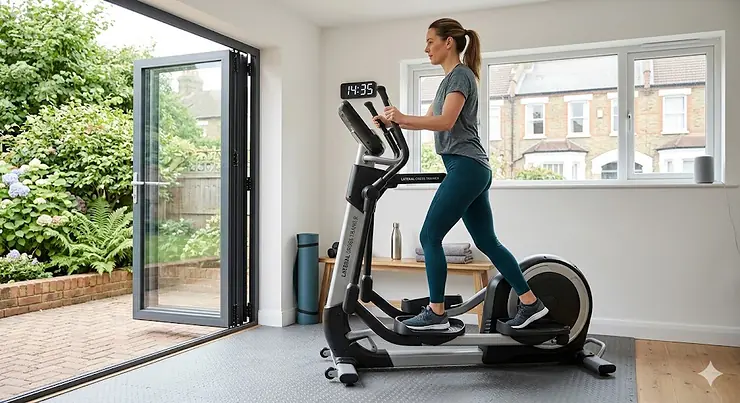
When you think about cardio equipment, treadmills and traditional ellipticals probably spring to mind. But there’s a rather clever piece of kit that’s been quietly transforming home workouts across the UK: the lateral cross trainer. Unlike conventional machines that move you forwards and backwards in a single plane, lateral cross trainers add side-to-side motion—and that changes everything.
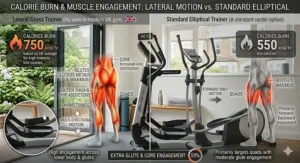
Traditional cardio equipment works primarily the front and back of your legs. The lateral cross trainer, on the other hand, engages your inner thighs, outer thighs, glutes, and core muscles through multidirectional movement. Research from universities including Northwestern and the University of Tampa has shown that lateral trainers can activate up to 55% more core muscles, 50% more outer thigh muscles, and 39% more glute muscles compared to standard ellipticals. Elliptical trainers have evolved significantly since their introduction in the 1990s, with lateral models representing the latest innovation in low-impact cardio technology. What most UK buyers overlook is how this translates to real-world benefits: you’re not just burning calories faster—you’re sculpting muscles that traditional cardio completely ignores, all whilst protecting your knees and hips from the jarring impact of running.
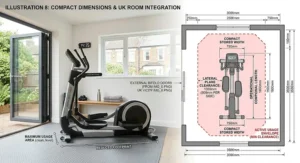
For British households with limited space, lateral cross trainers offer another advantage. Most models have a compact footprint of around 90cm x 120cm, fitting neatly into spare bedrooms, conservatories, or even larger cupboards when not in use. Rather important when you’re working with a typical British semi-detached or terraced house where every square metre counts. And because many models are self-powered, you won’t need to worry about trailing cables or positioning near plug sockets—handy for those older properties with fewer outlets.
Quick Comparison: Top Lateral Cross Trainers at a Glance
| Model | Type | Resistance Levels | Price Range (£) | Best For |
|---|---|---|---|---|
| MERACH E07 Compact | Standard Elliptical with Lateral Features | 16 | £180-£220 | Budget-conscious buyers, small spaces |
| Dripex 8KG Flywheel | Magnetic Cross Trainer | 16 | £200-£280 | Mid-range quality, home gym enthusiasts |
| Neezee 2-in-1 Cross Trainer | Hybrid Elliptical/Bike | 16 | £220-£300 | Versatility seekers, family use |
| Sunny Health SF-E905 | Compact 2-in-1 Upright | 8 | £140-£190 | Compact living, occasional users |
| MERACH Long Stride (47cm) | Professional-Grade | 16 | £350-£450 | Serious fitness enthusiasts, taller users |
| Dripex Commercial 8KG | Heavy-Duty Magnetic | 16 | £280-£380 | Intensive daily use, durability |
| Life Fitness E5 Track Connect | Premium Commercial | Adjustable Stride | £4,500-£5,000 | Professional home gyms, unlimited budget |
From the comparison above, the MERACH E07 delivers remarkable value for under £250, whilst the Dripex Commercial justifies its mid-£300s price point with build quality that’ll withstand years of British damp in an unheated garage. Budget buyers should note that the Sunny Health model sacrifices some flywheel weight and resistance levels for its lower price—a trade-off that might sting if you’re hoping to progress beyond beginner workouts.
💬 Just one click — help others make better buying decisions too!😊
✨ Don’t Miss These Exclusive Deals!
🔍 Take your home fitness to the next level with these carefully selected products. Click on any highlighted item to check current pricing and availability on Amazon.co.uk. These picks will help you find exactly what you need!
Top 7 Lateral Cross Trainers: Expert Analysis
1. MERACH E07 Compact Elliptical Trainer
The MERACH E07 has become something of a cult favourite among UK home fitness enthusiasts, and it’s not difficult to see why. This ultra-quiet magnetic cross trainer packs 16 resistance levels into a frame that weighs just 27kg—light enough to shift between rooms, yet stable enough for intensive workouts.
Key Specifications:
- 16-level magnetic resistance system
- 3.6kg flywheel (8 pounds)
- 120kg maximum user weight
- Dimensions: 111cm x 56cm x 156cm (compact footprint ideal for UK homes)
- LCD display with pulse sensors
- MERACH app connectivity for guided workouts
What the spec sheet won’t tell you is how remarkably quiet this machine runs. At under 20 decibels even during vigorous sessions, you can exercise whilst the family watches telly in the next room—rather crucial in British homes where walls aren’t exactly known for their soundproofing. The magnetic resistance eliminates the friction noise that plagues cheaper models, and the sealed bearing system means you won’t be re-greasing every few months like you would with some budget alternatives.
UK customers consistently praise the E07’s stability despite its lighter weight, though taller users (over 6ft) report that the stride length feels slightly short. The accompanying MERACH app offers professional training courses at no extra cost, which is brilliant value compared to subscription-based competitors. Assembly typically takes 30-40 minutes with the numbered parts system, and most UK buyers receive their units within 2-3 days via Amazon Prime.
✅ Pros:
- Whisper-quiet operation perfect for flats and terraced houses
- Excellent app integration with free training programmes
- Compact design suits British living spaces
❌ Cons:
- Stride length may feel restrictive for users over 183cm
- Lighter flywheel means less momentum at higher resistances
Price & Verdict: Around £190-£220 makes this a solid entry point. Ideal for UK buyers wanting reliable home cardio without breaking the bank, though serious athletes might outgrow it within 12-18 months.
2. Dripex 8KG Flywheel Magnetic Cross Trainer
If you’re after something with a bit more heft, the Dripex 8KG model steps up the game with nearly double the flywheel weight of budget competitors. That 8kg (17.6lb) flywheel creates noticeably smoother momentum, particularly at the higher resistance settings where lighter machines can feel jerky.
Key Specifications:
- 16 levels of magnetic resistance
- 8kg heavy-duty flywheel
- 39cm (15.3 inch) stride length
- 120kg weight capacity
- Dual handlebar design with pulse sensors
- LCD monitor tracking time, speed, distance, calories, heart rate
The Dripex distinguishes itself with build quality that UK reviewers describe as “commercial gym standard at home prices.” The heavy-duty steel frame provides outstanding stability—crucial when you’re working up a proper sweat and the motion gets vigorous. Unlike some cheaper cross trainers that wobble alarmingly on carpet, this stays planted even during high-intensity interval training.
What most buyers discover after a few weeks is how the 39cm stride length accommodates different heights more comfortably than compact models. If you’re sharing the machine with family members of varying heights, this versatility becomes rather valuable. The textured non-slip pedals are generously sized (larger than the MERACH E07), and the sweat-resistant handlebar coating actually lives up to its name—something you’ll appreciate during six months of British drizzle when indoor training becomes non-negotiable.
UK customers report excellent customer service from Dripex, with replacement parts readily available and queries answered within 24 hours. The 12-month parts warranty covers manufacturing defects, though you’ll want to keep it in a relatively dry environment as prolonged exposure to damp garage conditions can affect the electronics.
✅ Pros:
- Heavier flywheel creates smoother, more professional feel
- Excellent stability during intensive workouts
- Good stride length accommodates various user heights
❌ Cons:
- Heavier unit (around 35kg) makes relocation more challenging
- Requires more floor space than ultra-compact models
Price & Verdict: In the £240-£280 range, this represents the sweet spot between budget and premium. Perfect for UK households serious about home fitness but not quite ready for £1,000+ commercial equipment.
3. Neezee 2-in-1 Cross Trainer with Seat
The Neezee 2-in-1 takes a different approach entirely: it’s both a cross trainer and an exercise bike in one unit. Rather clever for British homes where storing multiple pieces of equipment simply isn’t feasible.
Key Specifications:
- 16-level adjustable magnetic resistance
- Front-mounted 2.3kg flywheel for enhanced stability
- Adjustable padded seat (removable)
- 120kg maximum user weight
- Heart rate monitoring via handlebar sensors
- LCD display with comprehensive metrics
What makes this particularly suited to UK households is its versatility for different fitness levels and family members. Elderly parents can use it as a low-impact seated bike, whilst younger family members can remove the seat for standing cross-trainer workouts. The front-mounted flywheel design—less common on budget models—genuinely does improve stability during lateral movements, something you’ll notice immediately if you’ve tried cheaper rear-flywheel alternatives.
The bi-directional motion allows both forward and backward pedalling, engaging quadriceps and hamstrings differently depending on direction. This addresses a common complaint about standard ellipticals: muscle adaptation where certain muscle groups stop responding after weeks of identical motion. UK physiotherapists have noted that this variation can be particularly beneficial for rehabilitation after knee or hip issues.
Assembly is straightforward with numbered components, though some UK reviewers mention that the instruction manual’s English could be clearer (likely a translation issue). Budget around 45 minutes for setup, or considerably less if you’ve assembled flat-pack furniture before—consider it preparation for your next trip to IKEA.
✅ Pros:
- Dual functionality saves space and money
- Adjustable seat perfect for mixed-ability households
- Front-mounted flywheel enhances stability
❌ Cons:
- Seat mechanism adds potential maintenance points
- Smaller flywheel means less momentum than dedicated models
Price & Verdict: Around £220-£300 positions this as exceptional value if you’d otherwise buy separate machines. Particularly well-suited to UK families or those sharing living spaces.
4. Sunny Health & Fitness SF-E905 Compact 2-in-1
For those working with genuinely limited space—think London flats or converted lofts—the Sunny Health SF-E905 strips away the frills to deliver basic, functional cardio in a remarkably compact package.
Key Specifications:
- 8 levels of magnetic resistance
- Belt drive system for quiet operation
- Ultra-compact design (significantly smaller than standard ellipticals)
- Maximum user weight varies by model
- No power required (self-powered)
- SunnyFit app compatibility (optional, free)
This is cardio equipment distilled to its essence. What you gain in space-saving you do sacrifice in features: 8 resistance levels rather than 16, a lighter flywheel, and a shorter stride length. But here’s the thing—for occasional users or those just starting their fitness journey, these limitations rarely matter. The magnetic belt drive genuinely is whisper-quiet, and the compact footprint means you can tuck it beside a wardrobe or under a raised bed when not in use.
UK buyers living in flats particularly appreciate that this requires no electrical connection. You can position it anywhere, regardless of socket placement, and there’s no standby power drain adding to your electricity bill. Given current UK energy prices, that’s not entirely trivial over a year of ownership.
The SunnyFit app provides basic workout tracking and guided routines at no subscription cost—refreshingly straightforward compared to equipment that tries to lock you into monthly fees. Assembly takes roughly 20 minutes, and the unit ships quickly from UK warehouses with Amazon Prime.
✅ Pros:
- Genuinely compact for space-restricted UK homes
- Self-powered eliminates cable management issues
- Budget-friendly without feeling cheap
❌ Cons:
- Limited resistance may not challenge advanced users
- Shorter stride less suitable for taller individuals
Price & Verdict: At £140-£190, this delivers honest value for occasional use. Best suited to UK buyers prioritising space-saving over advanced features, or those testing whether home cardio suits their lifestyle before investing heavily.
5. MERACH Long Stride (47cm) Self-Powered Cross Trainer
The MERACH Long Stride represents a significant step up in build quality and performance. That 47cm stride length—nearly twice that of compact models—makes an enormous difference in comfort and muscle engagement.
Key Specifications:
- 47cm (18.5 inch) stride length
- 16-level magnetic resistance with dial adjustment
- Self-powered (no electricity required)
- 180kg maximum user weight
- Bluetooth connectivity for MERACH and Kinomap apps
- Integrated water bottle and tablet holders
The generous stride mimics natural walking or running motion far more accurately than compact trainers, reducing strain on knees and hips. This becomes particularly relevant for taller UK users (over 6ft) who often find standard ellipticals force them into awkward, cramped movements. The self-generating power system means you can position this anywhere in your home—conservatory, spare bedroom, even a dry garage—without worrying about electrical outlets.
What distinguishes this from cheaper long-stride models is the build quality that justifies its mid-£400s price point. The frame can support users up to 180kg (nearly 29 stone), suggesting commercial-grade engineering rather than home-use compromises. UK buyers report that even intensive daily use produces minimal wear over 12+ months, whereas cheaper models often develop squeaks or resistance issues within six months.
The Kinomap app integration (subscription required after trial period) offers virtual courses through British countryside and global locations, turning mundane cardio into scenic exploration. Particularly appealing during those dreary British winter months when outdoor exercise loses its charm entirely.
✅ Pros:
- Superior stride length suits all heights comfortably
- Commercial-grade build quality for home prices
- Self-powered flexibility for UK home placement
❌ Cons:
- Larger footprint requires dedicated space
- Premium pricing excludes budget-conscious buyers
Price & Verdict: The £350-£450 range positions this for serious home fitness enthusiasts. Ideal for UK buyers committed to long-term training who want equipment that won’t need replacing after 18 months.
6. Dripex Commercial 8KG Heavy-Duty Trainer
The Dripex Commercial line takes the standard 8KG model and reinforces everything for users who demand gym-quality durability at home. This is the cross trainer you buy when you’re genuinely committed to daily intensive workouts.
Key Specifications:
- 16 levels of magnetic resistance
- 8kg commercial-grade flywheel
- Heavy-duty steel construction
- 120kg weight capacity
- Enhanced LCD display with comprehensive metrics
- Reinforced frame joints and bearings
Where this justifies its premium over standard Dripex models is longevity under intensive use. The commercial designation isn’t marketing fluff—it employs the same sealed bearing systems and reinforced joints you’d find in gym equipment. UK buyers who’ve owned both consumer and commercial versions report the difference becomes apparent around the six-month mark: where consumer models might develop slight wobbles or resistance inconsistencies, commercial-grade units maintain factory-fresh performance.
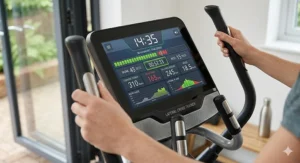
The enhanced LCD is noticeably larger and clearer than budget alternatives, tracking your workout metrics without squinting. Pulse sensors are more responsive, providing reliable heart rate data for zone training. These seem like minor upgrades until you’re actually using them daily, at which point the improved user experience becomes rather valuable.
For UK garages or conservatories where temperature and humidity fluctuate seasonally, the commercial-grade sealing better protects internal components. Several UK customers report using these in unheated spaces through British winters without the electronic gremlins that plague cheaper models.
✅ Pros:
- Commercial durability justifies higher investment
- Enhanced components improve long-term reliability
- Better weather/environment resistance for UK conditions
❌ Cons:
- Higher price point (£280-£380)
- Heavier weight makes relocation challenging
Price & Verdict: In the upper-£300s, this targets UK buyers wanting gym-quality equipment who train 5-7 days weekly. The durability premium pays off over 2-3 years of intensive use.
7. Life Fitness E5 Track Connect Elliptical
The Life Fitness E5 occupies an entirely different category: professional-grade equipment for unlimited budgets. You’ll recognise this brand from upmarket UK gyms—David Lloyd, Virgin Active, premium hotel fitness suites.
Key Specifications:
- Adjustable stride path (customisable for different users)
- Track Connect 2.0 console with touchscreen
- Commercial-grade elliptical drive system
- Exceptionally smooth operation
- Professional heart rate monitoring
- Bluetooth connectivity for fitness apps
At around £4,500-£5,000, this isn’t remotely attempting to compete with home fitness equipment. Rather, it’s for UK buyers creating genuine home gyms who want the exact experience they’d get at a premium health club. The adjustable stride path means different family members can customise the motion to their height and training style—no compromises required.
The Track Connect console provides comprehensive workout tracking, virtual courses, and integration with popular fitness platforms. Build quality is absolutely bulletproof: Life Fitness warranties these for commercial environments where machines endure dozens of users daily. In a home setting, you’re essentially buying equipment that’ll outlive your house.
Is it worth £5,000? For most UK buyers, absolutely not—you can achieve excellent fitness results with £300 equipment and dedication. But for those fortunate few who can comfortably afford it and take their training seriously, this delivers an experience that makes budget alternatives feel like toys.
✅ Pros:
- Professional gym experience at home
- Adjustable stride accommodates all users perfectly
- Virtually indestructible build quality
❌ Cons:
- Stratospheric pricing excludes 99% of buyers
- Requires professional installation (not included)
Price & Verdict: The £4,500-£5,000 range makes this purely for well-heeled fitness enthusiasts or those outfitting professional training spaces. Remarkable equipment, but consumer models deliver 90% of the benefits at 10% of the cost.
How Lateral Movement Transforms Your Training Results
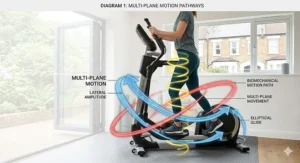
Standard ellipticals and treadmills work in the sagittal plane—forwards and backwards motion. Your quadriceps, hamstrings, and calves get thoroughly engaged, but your adductors (inner thighs), abductors (outer thighs), and obliques receive minimal stimulation. This creates the classic “runner’s physique”: strong front and back of legs, but underdeveloped sides.
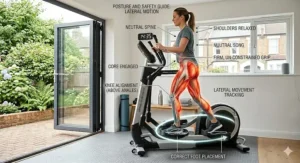
Lateral cross trainers add frontal plane movement—side-to-side motion that mimics skating, lateral lunges, or the defensive slides you’d do in tennis or football. This three-dimensional movement pattern engages stabilising muscles that conventional cardio completely ignores. Research published by exercise physiology departments at leading universities has demonstrated some rather impressive statistics: lateral training produces 42-43% more activation in inner and outer thigh muscles, 38-39% more glute activation, and up to 55% more core engagement compared to traditional ellipticals.
For UK users, this translates to practical benefits beyond aesthetics. Stronger lateral muscles improve balance and reduce fall risk—particularly relevant for older adults or those recovering from injuries. The gluteus medius, which lateral trainers target exceptionally well, plays a crucial role in knee stability. Physiotherapists at UK NHS trusts have noted that strengthening this muscle can alleviate knee pain that stems from poor tracking and stability issues. According to the NHS physical activity guidelines, adults should aim for at least 150 minutes of moderate-intensity activity weekly—lateral trainers offer an efficient way to achieve this target whilst protecting your joints.
The multidirectional motion also means you reach target heart rates approximately 23% faster than on traditional equipment, according to comparative studies. In practical terms, a 30-minute lateral training session can deliver similar cardiovascular benefits to 45-60 minutes on a standard treadmill or elliptical. For time-poor UK professionals trying to squeeze fitness around work and family commitments, that efficiency matters enormously.
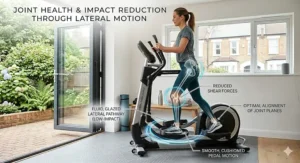
Perhaps most importantly for British weather conditions, lateral training’s low-impact nature makes it ideal for year-round indoor exercise. Running on pavements during six months of rain, sleet, and ice simply isn’t appealing—and it’s considerably harder on your joints than the smooth, controlled motion of a lateral trainer.
Real-World UK User Scenarios: Which Trainer Suits You?
Scenario 1: London Flat Dweller, Limited Space
Profile: Marketing professional, one-bedroom flat in Zone 2, no dedicated home gym space
Recommendation: Sunny Health SF-E905 Compact or MERACH E07
Reasoning: Both fit beside furniture or store in cupboards when not in use. Self-powered eliminates cable management in limited socket spaces. Quiet operation won’t disturb neighbours through thin walls. Budget-friendly (under £250) allows testing home fitness without major investment.
Scenario 2: Suburban Family, Multiple Users
Profile: Family of four in Birmingham semi-detached, ages 12-52, varying fitness levels
Recommendation: Neezee 2-in-1 with Seat
Reasoning: Adjustable seat accommodates elderly parents and young teenagers. Dual elliptical/bike functionality suits different preferences. 16 resistance levels grow with improving fitness. Mid-range pricing (£220-£300) balances quality and budget. Compact enough for spare bedroom or conservatory.
Scenario 3: Serious Fitness Enthusiast, Daily Training
Profile: Personal trainer working from home in Manchester, trains 6 days weekly
Recommendation: Dripex Commercial 8KG or MERACH Long Stride
Reasoning: Commercial-grade durability withstands intensive daily use. Higher resistance levels challenge advanced fitness. Build quality justifies premium investment over 3-5 year timeframe. Long stride (MERACH) or reinforced components (Dripex) prevent the rapid wear that plagues consumer models under professional-level training volumes.
Scenario 4: Rehabilitation After Injury
Profile: 58-year-old recovering from knee replacement in Edinburgh
Recommendation: Neezee 2-in-1 with Seat (for seated option) or Life Fitness E5 (if budget unlimited)
Reasoning: Seated bike mode allows gentle range-of-motion work during early recovery. Lateral motion strengthens gluteus medius crucial for knee stability. Low-impact movement protects surgical site whilst maintaining cardiovascular fitness. Adjustable resistance accommodates gradual progression.
Common Mistakes When Buying Lateral Cross Trainers
Mistake 1: Ignoring Stride Length for Your Height
Many UK buyers focus exclusively on price and resistance levels, overlooking stride length entirely. If you’re over 5ft 10in (178cm), compact models with 35-38cm strides will force cramped, unnatural movements. This not only reduces workout effectiveness but can actually create knee strain—the very thing you’re trying to avoid with low-impact cardio.
Solution: Match stride to height. Under 5ft 6in (168cm), 35-40cm works fine. 5ft 6in to 6ft (168-183cm), aim for 40-45cm. Over 6ft (183cm), invest in 47cm+ stride models like the MERACH Long Stride, even if it stretches your budget. Your knees will thank you.
Mistake 2: Underestimating British Damp’s Impact
UK buyers often treat cross trainers like living room furniture, forgetting that British homes can be remarkably damp—particularly in unheated garages, conservatories, or spare bedrooms during winter months. Budget cross trainers with unsealed electronics develop mysterious failures after 6-12 months in these conditions.
Solution: If storing in unheated spaces, invest in commercial-grade models with better sealing (Dripex Commercial, Life Fitness) or use dehumidifiers in storage areas. Alternatively, bring the equipment into heated living spaces during winter months. Several UK customers report covering machines with breathable dust sheets between uses to reduce moisture exposure.
Mistake 3: Buying Based Solely on Amazon Star Ratings
UK Amazon reviews can be misleading for fitness equipment because ratings often reflect delivery experience and initial assembly rather than long-term durability. A cross trainer might score 4.5 stars based largely on “arrived quickly, easy to assemble” reviews, whilst buried deeper you’ll find the critical “squeaks developed after 3 months” feedback.
Solution: Filter Amazon.co.uk reviews to show only 3-star and 2-star ratings. These tend to be more honest about real-world performance issues. Look for patterns: if multiple UK reviewers mention specific problems (wobbly frame, resistance degradation, monitor failures), consider that a red flag regardless of overall rating.
Mistake 4: Overlooking Maximum User Weight Capacity
UK buyers often assume the stated weight capacity provides comfortable usage up to that limit. In reality, you want significant headroom. A trainer rated for 120kg will feel considerably more stable and durable for an 85kg user than for a 115kg user approaching the maximum.
Solution: Choose equipment rated for at least 15-20kg above your current weight, more if weight loss is a goal (you don’t want to replace equipment as you get fitter). Commercial models rated 150kg+ provide better long-term stability regardless of user weight.
Mistake 5: Neglecting Ongoing Maintenance Requirements
Low-maintenance doesn’t mean no-maintenance. Even magnetic systems require occasional cleaning, bolt tightening, and lubrication. UK buyers accustomed to “fit and forget” approach often discover squeaks, resistance issues, or wobbly connections after 6-12 months.
Solution: Schedule quarterly maintenance checks. Tighten all visible bolts, clean dust from around resistance mechanisms, check for signs of wear on pedals and handles. Budget models may need bearing replacement after 12-18 months of intensive use—factor this into total cost of ownership.
Lateral Training vs Traditional Ellipticals: The Real Differences
The fitness industry loves creating new categories of equipment, but lateral training represents a genuinely meaningful evolution rather than mere marketing. Here’s what actually changes when you add lateral motion.
Muscle Engagement Pattern
Traditional ellipticals work muscles in a predictable, linear pattern. Your body adapts to this within 4-6 weeks, at which point you’ll notice diminishing returns—same effort, fewer results. Lateral training’s multidirectional movement prevents this adaptation. The constant adjustment required to maintain balance during side-to-side motion forces your core and stabiliser muscles to engage throughout the entire workout, not just at specific points in the stride.
For UK users recovering from injuries or managing chronic pain, this distinction matters enormously. The NHS physio departments that use Helix lateral trainers (the professional models rarely seen in homes) specifically prescribe them for hip and knee rehabilitation because the lateral motion strengthens supporting muscles that conventional cardio neglects.
Cardiovascular Efficiency
The University of Tampa’s research comparing lateral trainers to leading ellipticals found users reached target heart rates 23% faster on lateral equipment. This isn’t magic—it’s simple biomechanics. Lateral motion requires more total-body stabilisation, increasing overall energy expenditure per stride. For time-pressed UK professionals, this means a 25-30 minute lateral session can deliver cardiovascular benefits equivalent to 40-50 minutes on a traditional elliptical.
Joint Impact and Safety
Both equipment types offer low-impact cardio, but lateral trainers excel at knee protection through an unexpected mechanism: they strengthen the gluteus medius muscle that stabilises your kneecap during movement. Weak gluteus medius contributes to patellofemoral pain syndrome (runner’s knee), which conventional ellipticals don’t address particularly well. Lateral training targets this muscle specifically, providing a rehabilitative benefit alongside cardiovascular exercise.
UK physiotherapists note that patients who incorporate lateral training alongside traditional physio exercises often progress faster through rehabilitation programmes. The controlled, smooth motion allows therapeutic exercise without the unpredictability of outdoor activities where uneven pavements, wet leaves, or ice create sudden stress on healing joints.
Practical Considerations for UK Homes
Interestingly, true lateral trainers (like Helix professional models) typically have smaller footprints than full-size ellipticals whilst delivering superior results. This suits British homes where space comes at a premium. However, budget “lateral” cross trainers on Amazon.co.uk are often standard ellipticals marketed with lateral-sounding names—read specifications carefully to ensure you’re getting genuine multidirectional capability.
Maximising Your Lateral Cross Trainer in British Conditions
Cold Weather Optimisation (November-March)
British winters don’t typically reach the extreme cold of Canada or Scandinavia, but prolonged exposure to 5-10°C temperatures in unheated garages or conservatories can affect equipment performance and your own motivation.
Pre-Workout Warm-Up Strategy: Start at lowest resistance for 3-5 minutes to warm both yourself and the machine’s moving parts. Cold lubricants in bearings and resistance mechanisms operate less smoothly, and jumping straight into intensive work can strain components. Several UK users report reduced mechanical issues by allowing gradual warm-up periods during winter months.
Moisture Management: British winters bring dampness more than cold. Place a dehumidifier in your training space or position the cross trainer away from exterior walls where condensation forms. Wipe down metal components after workouts to prevent rust formation—particularly important on cheaper models with less corrosion protection.
Wet Weather Indoor Training (Year-Round Reality)
When it’s genuinely unpleasant outside—driving rain, wind, or that peculiar British drizzle that seems horizontal—your lateral trainer becomes invaluable for maintaining fitness consistency.
Motivation Techniques: Position your trainer facing a window (if pleasant view) or mount a tablet for streaming content. UK users report higher consistency when incorporating favourite programmes rather than staring at walls. The MERACH and Kinomap apps offer virtual routes through British countryside—psychologically more engaging than generic stock videos.
Ventilation Matters: British homes can become stuffy during intensive indoor exercise. Crack a window even in winter to maintain air circulation. You’re generating significant heat during workouts; inadequate ventilation makes sessions genuinely unpleasant and reduces consistency.
Compact Storage Solutions for British Homes
Vertical Storage Myth: Contrary to YouTube suggestions, you generally shouldn’t store cross trainers vertically—it stresses joints and connections not designed for that orientation. Better to use the integrated wheels to roll equipment into alcoves, behind furniture, or against walls where it takes up minimal visual space.
Dual-Purpose Space Creation: Several UK users position trainers in spare bedrooms or studies, incorporating them into room layout rather than hiding them. A decorative basket beside the machine for water bottles and towels makes it feel intentional rather than intrusive. This “visible integration” approach apparently increases actual usage—equipment you walk past daily gets used more than equipment hidden in cupboards.
Understanding UK Pricing and Value Considerations
The £150-£250 Budget Tier
This range covers compact models like Sunny Health, entry-level MERACH, and basic Neezee units. You’re getting functional equipment that delivers results if used consistently, but with compromises: lighter flywheels, fewer resistance levels, shorter warranties, and higher probability of minor issues developing within 12-18 months.
Best Value Approach: If budget-constrained, buy from Amazon.co.uk sellers offering hassle-free returns rather than third-party marketplaces. The ability to return problematic units within 30 days (extended to 90 days during certain periods) protects against the higher quality variability in this price tier.
The £250-£450 Sweet Spot
Mid-range equipment from Dripex Commercial, MERACH Long Stride, and premium Neezee models occupies this category. You’re paying for heavier flywheels, better bearings, longer stride lengths, and build quality that extends useful life to 3-5 years with proper maintenance.
ROI Calculation: At £350, if you’d otherwise maintain a budget gym membership (£25-£35 monthly), the equipment pays for itself within 12-14 months. Consider that many UK gyms now require 12-month contracts, making home equipment increasingly cost-competitive—particularly when accounting for commute time and the flexibility to exercise at 6am or 11pm without leaving home.
The £500-£5,000 Premium Tier
This encompasses commercial-grade equipment like Life Fitness E5. Unless you’re outfitting a professional training facility or money truly isn’t a concern, consumer-grade equipment delivers 90% of results at 10% of cost. The premium pays for enhanced durability under commercial use patterns (dozens of users daily), superior warranties, and professional support—rarely worth it for home environments.
Post-Brexit Import Considerations
Some cross trainers on Amazon.co.uk ship from EU suppliers, potentially incurring import duties if over certain thresholds. Check product listings for “Dispatched from UK” or “Amazon.co.uk fulfilled” to avoid unexpected customs charges. Several UK buyers report unpleasant surprises when £300 equipment triggers £60-£80 in additional fees due to EU sourcing.
Lateral Training for Specific UK Fitness Goals
Weight Loss: Maximising Calorie Burn
Lateral training’s higher muscle engagement translates to approximately 15-25% more calorie burn per session compared to traditional ellipticals at equivalent perceived exertion levels. For UK buyers focused on weight management, this means:
Realistic Expectations: A 30-minute moderate-intensity lateral session (maintaining conversation ability) burns roughly 250-350 calories for average UK adults, varying by weight and resistance level. High-intensity interval training (HIIT) on lateral trainers can push this to 400-500 calories in 30 minutes, but requires working at levels where conversation becomes difficult. The British Heart Foundation notes that regular physical activity can reduce the risk of heart and circulatory diseases by up to 35%—making consistent use of your lateral trainer a genuine investment in long-term health.
Practical Programme: Start with 3x weekly 20-minute sessions at moderate intensity. Progress to 4x weekly 30-minute sessions over 8-12 weeks. Combine with sensible nutrition (the NHS Eatwell Guide provides excellent free resources) for sustainable 0.5-1kg weekly weight loss. Rapid results rarely last; consistency over months delivers permanent change.
Inner and Outer Thigh Toning
This represents lateral training’s signature benefit. The multidirectional motion targets adductors and abductors far more effectively than conventional cardio.
Targeted Technique: Increase resistance to levels where completing 30-45 seconds feels challenging. The burn you feel in inner and outer thighs indicates effective muscle engagement. Alternate between forward and backward motion if your trainer permits—this varies muscle recruitment patterns and prevents adaptation.
Timeline Reality: Visible toning typically appears after 6-8 weeks of consistent training (4x weekly minimum). Genetics heavily influence where you store fat and build muscle; some UK users see dramatic changes within 2 months, whilst others require 4-6 months for comparable results. Consistency matters more than intensity—regular moderate sessions outperform sporadic intensive workouts.
Cardiovascular Fitness and Endurance
For UK users training for events (Park Run, charity cycles, hiking challenges), lateral trainers build cardiovascular base efficiently.
Progressive Programme: Begin with continuous 20-minute sessions at comfortable pace (able to hold conversation). Each week, add 3-5 minutes until reaching 45-60 minutes. Then maintain duration whilst gradually increasing resistance. This builds aerobic base without excessive fatigue.
Cross-Training Benefit: Lateral motion complements running, cycling, or outdoor walking by engaging different muscle patterns. Several UK runners report reduced injury rates when incorporating 1-2 lateral training sessions weekly alongside their running programmes—the lateral work strengthens stabiliser muscles that running neglects.
Frequently Asked Questions
❓ Are lateral cross trainers suitable for small British flats and terraced houses?
❓ How does lateral training compare to running for knee health?
❓ Can I achieve meaningful fitness results with budget lateral trainers under £200?
❓ Do lateral cross trainers require professional assembly, or can average UK buyers manage DIY setup?
❓ Are lateral cross trainers covered by UK consumer protection if purchased through Amazon.co.uk?
Conclusion: Finding Your Perfect Lateral Cross Trainer
The lateral cross trainer market in the UK has matured considerably over recent years, moving beyond niche fitness equipment to genuinely accessible home cardio options. Whether you’re working with a compact London flat and a £200 budget, or outfitting a dedicated home gym in a suburban Manchester semi with £500 to spend, there’s equipment available that’ll deliver results—provided you actually use it consistently.
The research is rather compelling: lateral training engages more muscle groups, burns calories more efficiently, and protects joints better than traditional cardio. For UK households where space comes at a premium and British weather makes outdoor exercise challenging six months yearly, that combination of benefits makes lateral trainers particularly well-suited to our circumstances.
Start with clear assessment of your space, budget, and realistic usage patterns. The £300 Dripex Commercial might represent better long-term value than the £150 Sunny Health if you’ll genuinely train 5 times weekly, but only if your budget comfortably accommodates the difference. Conversely, £150 equipment you actually use delivers infinitely better results than £500 equipment gathering dust in a garage.
The most successful UK buyers share a common pattern: they integrate their lateral trainer into existing routines rather than treating it as a separate “fitness project.” Position it where you’ll see it daily, perhaps facing a favourite window or TV. Make it visible, accessible, and convenient. Equipment hidden in cupboards or relegated to cold garages gets used dramatically less than equipment integrated into your living space.
Finally, remember that consistency trumps intensity. Three 20-minute sessions weekly, maintained over months, will transform your fitness more effectively than sporadic intensive hour-long sessions. The lateral cross trainer is a tool—a rather good one—but results ultimately depend on your commitment to regular use.
Recommended for You
- 7 Best Orthopedic Cross Trainers UK 2026
- 7 Best Lumbar Support Cross Trainer Reviews UK 2026
- 7 Best Cross Trainer for Bad Back UK 2026
Disclaimer: This article contains affiliate links. As an Amazon Associate, I earn from qualifying purchases. If you purchase products through these links, we may earn a small commission at no additional cost to you.
✨ Found this helpful? Share it with your mates! 💬🤗
