In This Article
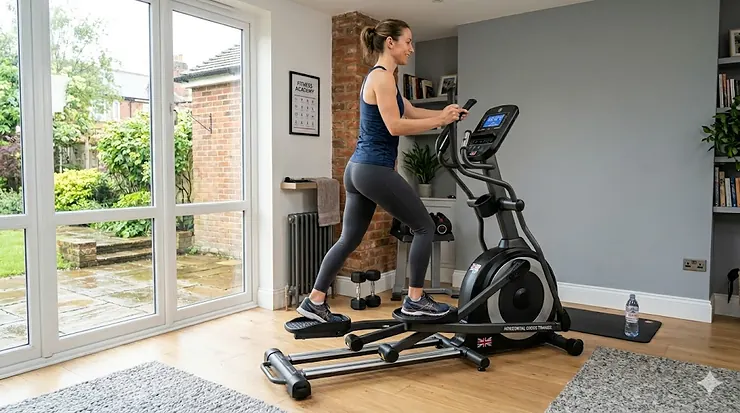
If you’ve been eyeing up cross trainers thinking they all look remarkably similar, here’s something that might surprise you: the best ones don’t just move forwards and backwards. The real game-changers in 2026 are horizontal cross trainers — machines that add side-to-side motion, engaging muscles traditional ellipticals barely touch.
What most UK buyers overlook is that standard cross trainers work in one plane of motion. Rather efficient for basic cardio, but your hip abductors and adductors — muscles that stabilise your pelvis — are practically on holiday. Research shows horizontal cross trainers with lateral movement create a 27% increase in caloric expenditure and activate 30% more of the hip abductor and adductor muscles compared to traditional ellipticals.
For UK homes where space comes at a premium, investing in equipment that works harder makes sense. According to NHS guidance on physical activity, adults should aim for at least 150 minutes of moderate aerobic activity weekly, and cross trainers offer an excellent low-impact option for achieving this. Whether you’re in a Birmingham terraced house or London flat, the right horizontal cross trainer delivers a complete workout without demanding extra floor space. This guide covers seven machines available to UK buyers in 2026, from budget models starting around £180 to professional-grade lateral trainers.
Quick Comparison: Best Horizontal Cross Trainers at a Glance
| Model | Motion Type | Resistance | Price (£) | Best For | UK Stock |
|---|---|---|---|---|---|
| Octane LateralX LX8000 | 3D Lateral + Stepping | 30 magnetic | £3,500-£4,500 | Serious athletes, rehab | Specialty |
| Helix Lateral Elliptical | True lateral (3 planes) | 20 magnetic | £3,000-£4,000 | Inner/outer thigh | Import |
| BowFlex LateralX LX5 | Adjustable lateral | 10 levels | £1,200-£1,600 | Home gym | Amazon UK |
| Capital Sport Crosswalker | Horizontal + Vertical | Manual | £180-£250 | Beginners, compact | Amazon UK |
| Dripex Elliptical | Standard elliptical | 16 magnetic | £190-£330 | Budget buyers | Amazon UK |
| JLL CT500 | Standard elliptical | 12 magnetic | £260-£320 | Mid-range | Amazon UK |
| MERACH E07 | Compact elliptical | 16 magnetic | £190-£240 | Small spaces | Amazon UK |
This comparison reveals the UK market split: true lateral motion trainers command £3,000+ premiums, whilst standard ellipticals cluster in the £180-£350 bracket. That £2,500+ gap reflects engineering complexity and biomechanical advantages of multi-plane movement. For budget-conscious UK buyers, the Capital Sport Crosswalker offers horizontal motion at entry-level pricing, though it lacks sophisticated lateral adjustment of machines like the Octane.
💬 Just one click — help others make better buying decisions too! 😊
Top 7 Horizontal Cross Trainers: Expert Analysis for UK Buyers
1. Octane LateralX LX8000 — The Professional Standard
The Octane LateralX LX8000 represents the pinnacle of cross-training technology. This commercial-grade machine combines adjustable lateral movement with vertical stepping motion in multiple planes, allowing users to move up, down, forward, back, and side to side on one machine.
The 10 adjustable lateral width settings mean starting narrow for warm-ups and gradually increasing width as workouts intensify. The 176kg machine weight ensures zero wobble even during aggressive lateral intervals — crucial when training in your converted garage during damp British weather. The self-powered design eliminates mains connection requirements, solving the “where’s the nearest socket” problem plaguing UK home gyms.
UK buyers should note this is commercial-grade kit, built for gym environments but increasingly popular for serious home users. The 181kg maximum user weight reflects robust construction. Customer feedback from UK fitness specialists highlights smooth, whisper-quiet operation and unique workout variety — seamlessly switching between elliptical motion, lateral shuffles, and stepping movements mid-workout.
Pros:
✅ Genuine 3D motion activates muscles traditional ellipticals miss
✅ Self-powered (no plug needed) — flexibility for any room
✅ Commercial durability built for daily punishment
Cons:
❌ Substantial investment (£3,500-£4,500 range)
❌ Large footprint (160cm × 106cm) — measure twice
Value verdict: Around £4,000 for refurbished or £4,500+ new. For dedicated athletes, physio clients, or households with multiple serious trainers, this delivers workout variety justifying the premium.
2. Helix Lateral Elliptical — The Glute Sculptor
The Helix Lateral Elliptical takes a fundamentally different approach. Rather than mimicking running, it focuses on lateral elliptical training which physical therapists routinely use for clients with knee or hip injuries and for rehabilitation after total hip and knee replacement surgeries.
What makes the Helix distinctive is patented motion working in three planes simultaneously. Your legs move side to side (horizontal), up and down (vertical), and front to back — creating full 3D motion. The practical benefit? Every stride activates glutes, core, inner thighs, and outer thighs far more intensely than standard ellipticals. Think skating versus walking — completely different muscle recruitment patterns.
For UK buyers, this solves a specific problem: effectively targeting inner and outer thighs at home. Traditional leg exercises (squats, lunges) primarily work front-to-back movements. The Helix’s lateral motion fills that gap. Available in upright or recumbent formats, it’s particularly worthwhile for managing joint issues — the low-impact nature combined with lateral movement actually strengthens stabiliser muscles around knees and hips.
Pros:
✅ Therapeutic value for knee and hip rehabilitation
✅ Superior inner/outer thigh engagement vs standard trainers
✅ Upright or recumbent configurations available
Cons:
❌ Import item (limited UK stock) — delivery times stretch
❌ Premium pricing (£3,000-£4,000) for specialist equipment
Value verdict: Around £3,000-£4,000. Best for buyers with specific rehabilitation needs or serious about comprehensive lower-body conditioning. The recumbent version offers comfort for older users or anyone with balance concerns.
3. BowFlex LateralX LX5 — The Home Gym Sweet Spot
The BowFlex LateralX LX5 bridges the gap between commercial lateral trainers and budget ellipticals, offering genuine side-to-side motion at a price not requiring remortgaging. This low-impact cardio machine uses side-to-side stepping motion to burn calories whilst promoting joint stability and strength.
What sets the LX5 apart is adjustable lateral range — you control stride width, customising intensity and comfort on the fly. The backlit LCD display remains clear during evening workouts. Four dynamic handgrip sets let you vary upper body position throughout sessions, preventing monotony. Performance suspension pedals provide smoother feel than rigid platforms on budget machines, whilst 10 resistance levels offer progression for most home users.
UK buyers consistently praise solid build quality — no creaking or wobbling even during intense sessions. The compact-ish footprint suits most UK living spaces reasonably well without being gym-floor massive.
Pros:
✅ Genuine lateral adjustment without commercial pricing
✅ Multiple grip positions combat workout boredom
✅ Suitable for UK home gym spaces (not enormous)
Cons:
❌ Mid-range price (£1,200-£1,600) represents commitment
❌ Limited UK retail presence — primarily online ordering
Value verdict: Around £1,200-£1,600. Hits a sweet spot for serious home users wanting lateral motion benefits without £3,000+ equipment. The most accessible entry to true horizontal cross training for UK buyers.
4. Capital Sport Crosswalker — The Budget Lateral Option
The Capital Sport Crosswalker delivers German engineering meeting affordability — available with Prime delivery, which matters when you want to start training this week. This cross trainer features vertical and horizontal swinging motion, foldable design, and built-in training computer.
Here’s the reality: this isn’t precision lateral training like the Octane. Horizontal motion comes from pushing handles sideways, creating different muscle engagement compared to purely vertical movement. Think “lateral lite” — some side-to-side action, but not sophisticated adjustable lateral stride of premium machines. For beginners exploring whether they enjoy cross-training, or UK buyers in flats where storage matters desperately, the foldable design is brilliant.
UK customer reviews highlight suitability for beginners and quiet operation (important for terraced housing). Manual tension adjustment is basic but functional. Assembly takes 30-45 minutes with two people — not the nightmare some budget equipment presents.
Pros:
✅ Foldable design for compact UK homes
✅ Horizontal motion element at entry-level pricing
✅ Amazon UK stock means quick Prime delivery
Cons:
❌ Basic construction — not for intensive daily training
❌ Limited resistance progression (manual tension only)
Value verdict: Around £180-£250. Excellent first cross trainer for beginners or supplementary equipment. Not suitable as primary training equipment for committed athletes.
5. Dripex Elliptical Cross Trainer — The Compact Performer
The Dripex range dominates Amazon UK’s cross trainer listings for good reason — packing decent functionality into compact, affordable packages. The Dripex provides low-impact cardio, runs smoothly, and has multiple intensity levels suitable for beginners whilst offering challenging workouts.
The 6kg or 8kg flywheel options (model dependent) deliver surprisingly smooth motion for the price. The 16 levels of magnetic resistance provide enough progression for months. UK buyers consistently mention quiet operation — you can watch television without cranking volume to window-rattling levels, which flatmates appreciate. The LCD monitor tracks basics (time, distance, calories) without overcomplicated menus.
What works particularly well for UK homes is compact footprint. At roughly 111cm long, it fits into spare bedrooms, conservatories, or that awkward space under the stairs. Transport wheels actually work, so you can wheel it aside when guests visit.
Pros:
✅ Genuine 16-level magnetic resistance system
✅ Compact dimensions suit typical UK room sizes
✅ Budget-friendly (£190-£330) with Prime delivery
Cons:
❌ Shorter stride may feel cramped for taller users (180cm+)
❌ Basic construction — expect bolt re-tightening after heavy use
Value verdict: Around £190-£330 depending on model. Brilliant value for UK buyers wanting reliable cardio without breaking the bank. Mid-range Dripex models (£250-£300) offer best feature and durability balance.
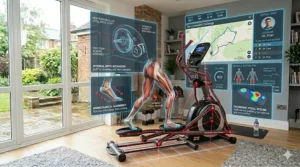
6. JLL CT500 — The British Reliable Workhorse
The JLL CT500 represents proper British engineering sensibility — does what it says, built solid, backed by UK support, priced fairly. The JLL CT500 features magnetic resistance providing smooth, quiet, seamless workout experience, with easily adjustable resistance levels suiting fitness goals from light cardio to intense training.
The 7kg flywheel delivers smooth, consistent resistance transitions. The 40cm stride length accommodates most UK users comfortably (crucial consideration — too many budget ellipticals have cramped 35cm strides feeling unnatural). The 110kg maximum user weight is conservative but reflects British engineering caution. UK customer feedback consistently praises build quality and famous JLL customer service — when you email questions, actual humans reply, usually within hours.
The monitor displays six functions (time, speed, distance, calories, pulse, odometer) without complications. Heart rate sensors built into fixed handlebars. Bottle holder properly positioned. Transport wheels make moving feasible. All rather sensibly thought through — equipment working reliably for years.
Pros:
✅ UK company with responsive customer support
✅ 40cm stride suits most body heights
✅ 12-month warranty backed by established UK presence
Cons:
❌ Conservative design — no app connectivity or fancy features
❌ Mid-range pricing (£260-£320) without standout innovations
Value verdict: Around £260-£320. For UK buyers valuing reliability, proper customer service, and straightforward functionality over bells and whistles, the JLL CT500 represents excellent value. The cross trainer equivalent of a dependable Ford.
7. MERACH E07 Elliptical Trainer — The App-Connected Compact
The MERACH E07 brings smartphone connectivity to budget-friendly cross training. The MERACH E07 features ultra-quiet magnetic resistance with 16 levels, 8-pound flywheel, and exclusive MERACH App connectivity for immersive gaming experiences and professional training courses.
The exclusive MERACH app transforms workouts from staring at walls to following virtual routes or competing in challenges. Bluetooth connectivity works reliably. LCD display tracks metrics real-time, whilst the app provides detailed analysis if you’re into data. Compact dimensions make it brilliant for UK flats where every centimetre counts — at just over 110cm long occupying roughly 6.8 square feet, it’s one of the smallest full-sized cross trainers available.
UK buyers should note compact size means shorter stride length, which taller users (175cm+) may find slightly cramped during extended sessions. The 27kg machine weight makes it light enough to move easily but raises stability questions during vigorous workouts — floor stabilisers help, but heavier users might experience wobble.
Pros:
✅ App connectivity adds motivation and variety
✅ Exceptionally compact for constrained UK spaces
✅ Budget-friendly (£190-£240) with modern features
Cons:
❌ Lighter construction may wobble for heavier/taller users
❌ Shorter stride can feel restrictive during longer sessions
Value verdict: Around £190-£240. Excellent for UK buyers in smaller properties wanting app connectivity and trading some build heft for portability and price. Works particularly well for users under 175cm and 90kg who’ll make full use of app features.
✨ Don’t Miss These Exclusive Deals!
🔍 Take your training to the next level with these carefully selected products. Click on any highlighted item to check current pricing and availability on Amazon.co.uk. These picks will help you find exactly what you need!
Real-World Scenarios: Which Trainer Fits Your Life?
Understanding specifications is one thing — matching equipment to your actual situation matters more. Here are three common UK buyer profiles.
The London Flat Dweller (Age 28, Professional)
Situation: Second-floor flat in Clapham, 650 sq ft total, downstairs neighbours complaining about noise, zero storage, budget around £300.
Perfect Match: MERACH E07 or Dripex Compact
The compact 110cm length fits between bed and wardrobe. Ultra-quiet magnetic system won’t antagonise neighbours below. App connectivity keeps 6am and 10pm workouts engaging. Both machines are light enough (25-30kg) to shift aside when parents visit. The £190-£240 price leaves budget for essential floor mat (crucial in flats — dampens vibration, protects deposit from scuffs).
The Suburban Family (Parents 40s, Two Teenagers)
Situation: Semi-detached in Reading, dedicated gym room, four users, budget £800-£1,200.
Perfect Match: BowFlex LateralX LX5 or JLL CT500
The BowFlex’s lateral motion provides workout variety keeping teenagers engaged beyond the first fortnight. Adjustable resistance accommodates fitness ranges from 14-year-old starting out to 47-year-old father cycling 100km weekends. At £1,200-£1,600, it’s an investment, but divided across four users over several years, cost-per-workout drops significantly. Alternatively, the JLL CT500 at £260-£320 offers brilliant reliability without breaking the bank — straightforward enough everyone can use it, solid enough to withstand daily use by multiple family members.
The Rehabilitation Client (Age 62, Hip Surgery)
Situation: Bungalow in Nottinghamshire, recovering from hip replacement, physiotherapist recommended low-impact equipment with lateral movement, flexible budget.
Perfect Match: Helix Lateral Elliptical (Recumbent)
Physical therapists routinely use the Helix lateral elliptical for clients with knee or hip injuries and for rehabilitation after total hip and knee replacement surgeries. Recumbent configuration provides back support whilst lateral motion gently strengthens muscles surrounding the new hip joint. The £3,000-£4,000 investment is substantial, but for rehabilitation equipment accelerating recovery and potentially preventing future complications, the value proposition changes entirely. The three-plane motion works the hip through ranges traditional physio exercises cannot replicate.
The Science: Why Biomechanics Matter for UK Home Users
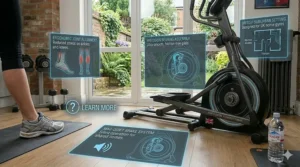
Standard cross trainers move you in the sagittal plane — forward-and-back motion. Your quadriceps, hamstrings, and calves do most work, which is fine for cardiovascular fitness but leaves significant muscle groups underutilised. Research on lateral motion trainers demonstrates measurable advantages. According to biomechanics studies published in peer-reviewed journals, lateral movement patterns engage hip stabiliser muscles significantly more than traditional forward-backward motion. Research shows a 27% increase in caloric expenditure going from lateral width 1 to lateral width 10, and a 30% increase in hip abduction, adduction and knee extension over traditional ellipticals.
Understanding Hip Abductors and Why They’re Neglected
Your hip abductors (primarily gluteus medius and minimus) stabilise your pelvis during single-leg stance — every step whilst walking involves these muscles preventing your hip collapsing inward. The elliptical trainer was introduced in 1995 and revolutionised low-impact cardio, but traditional designs primarily work in the sagittal plane. According to published research, hip abductor strength is essential for pelvic stability, lower limb alignment, and injury prevention, with weaknesses in the gluteus medius and minimus contributing to various musculoskeletal conditions. Traditional ellipticals barely challenge these muscles because you’re supported equally on both legs throughout movement. Lateral motion changes this entirely — as you push sideways, one leg abducts whilst the other stabilises, creating functional strength transferring directly to activities like hiking, climbing stairs, or maintaining balance on slippery British pavements during winter months.
Practical Implications for UK Home Users
This biomechanical advantage matters most if training with specific goals: stronger legs for hill walking in the Lake District, better balance to prevent slips on icy pavements, or more effective calorie burning in limited workout time. For general fitness maintenance, a standard elliptical does the job adequately. But if investing £200-£4,000 in equipment sitting in your home for years, lateral motion models deliver measurably superior results — provided you learn the movement pattern and consistently vary lateral width settings during workouts.
Common Mistakes When Buying in the UK
Mistake 1: Ignoring Delivery Logistics
You’ve found the perfect lateral trainer online and suddenly realise it arrives in a box measuring 170cm × 80cm × 40cm weighing 95kg. Your Victorian terraced house has a 75cm front door and staircase with 90-degree turn. This scenario plays out weekly across Britain. Measure doorways, hallways, and stairs before ordering. Many UK retailers offer “room of choice” delivery for £50-£100 extra — absolutely worth it for heavier machines.
Mistake 2: Underestimating Noise Transfer
“Whisper-quiet magnetic resistance” means different things depending on flooring. A cross trainer genuinely quiet on ground-floor rooms with concrete beneath might transmit surprising vibration through wooden joists in first-floor flats. UK building standards for sound insulation in conversions and new builds have improved, but older properties (pre-2000) often have minimal acoustic separation. Budget £30-£50 for proper 10mm rubber mat sitting beneath your cross trainer. This protects floors, reduces vibration transmission by 60-70%, and prevents machine shifting during vigorous workouts.
Mistake 3: Buying Based on “Lateral” Marketing Without Understanding Mechanism
Several budget cross trainers advertise “horizontal movement” or “lateral action” when they actually mean handlebars swing sideways. This provides slightly different upper-body engagement but doesn’t deliver biomechanical advantages of true lateral stride motion. Genuine lateral motion trainers (Octane, Helix, BowFlex) have adjustable width settings changing how far your legs move side-to-side during each stride. If product descriptions don’t mention “adjustable lateral width,” “side-to-side stride pattern,” or show feet moving laterally apart during use, you’re likely viewing a standard elliptical with marketing creativity.
Mistake 4: Overlooking UK Plug and Voltage Requirements
Most cross trainers with electronic consoles run on batteries, but programmable resistance models require mains power. Some imported equipment arrives with US plugs (Type A, 110V) or EU plugs (Type C, 230V). UK buyers need Type G plugs rated for 230V/50Hz. Reputable Amazon UK sellers include proper UK plugs, but marketplace sellers sometimes don’t. Check listings carefully — “adapter included” isn’t the same as “UK plug fitted.” According to UK electrical safety regulations, all electrical equipment sold in the UK must meet safety standards and carry appropriate certification. If buying imported equipment, factor in £15-£25 for proper electrician-fitted UK plug, or choose models confirmed for UK electrical standards with UKCA marking.
Horizontal vs Traditional: What’s Actually Different?
Marketing claims are dramatic: “revolutionary 3D motion,” “complete workout transformation,” “activate 30% more muscle.” But what does this mean for someone training in their spare bedroom in Nottingham?
Movement Pattern: Linear vs Multidirectional
Traditional ellipticals move your feet in oval patterns tilted forward. Your hips, knees, and ankles flex and extend, primarily engaging front and back of your legs. It’s remarkably efficient for cardiovascular work. Horizontal cross trainers add lateral displacement. As one foot moves outward, opposite hip stabilisers engage maintaining pelvic control. This recruits your gluteus medius, tensor fasciae latae, and hip adductors — muscles standard ellipticals barely touch. The feeling is distinctly different: less like running in place, more like speed skating.
Joint Impact: Both Are Low, But Different
Both equipment types offer low-impact exercise compared to running. Standard ellipticals keep feet on pedals throughout, eliminating ground impact. Lateral trainers add stability challenges — your body must control multidirectional forces, which strengthens joints rather than merely protecting them. For UK buyers managing typical joint niggles (dodgy knee from five-a-side, hip stiffness from too much desk sitting), the lateral option provides both immediate comfort and long-term strengthening.
Which One for British Weather Training?
If training for outdoor activities in British conditions (hiking Scottish Highlands, trail running in Peak District, winter cycling in Yorkshire), lateral motion better prepares stabiliser muscles for uneven terrain, slippery conditions, and unexpected balance challenges. Standard ellipticals build cardiovascular fitness admirably, but they don’t train your body responding to multidirectional forces. One January morning on frosty pavement demonstrates the difference between having strong forward-moving muscles versus strong lateral stabilisers — the latter keeps you upright when feet slide unexpectedly.
Maintenance: Keeping Your Trainer Working
Monthly Checks (5 minutes)
Bolt tightening: Use hex key set checking all visible bolts, particularly around pedal connections and handlebar joints. British temperature fluctuations (15°C summer garage, 5°C winter garage) cause metal expansion and contraction gradually loosening fixings. Tighten any that move even slightly. The Dripex and MERACH models particularly benefit from monthly attention, as lighter construction uses more plastic bushings wearing faster when bolts slacken.
Resistance adjustment test: Cycle through all resistance levels observing smooth transitions. Magnetic systems should move silently; if you hear clicking or grinding, magnets may be misaligned. This usually indicates loose mounting hardware rather than magnet failure.
Quarterly Maintenance (15 minutes)
Deep clean and lubrication: Use slightly damp cloth cleaning all surfaces, paying attention to flywheel housing where dust accumulates. British homes generate considerable dust even with regular vacuuming. Dust on moving parts acts as grinding paste, accelerating wear. After cleaning, apply silicone spray lubricant (not WD-40) to visible sliding components. Focus on rail systems guiding pedal motion.
Yearly Service (30 minutes)
Belt tension check: For belt-driven models, inspect drive belts for glazing (shiny, hardened surface) or cracks. Belts typically last 2-3 years with regular home use but British temperature extremes accelerate deterioration. Correct tension allows 10-15mm depression when pressed firmly at belt’s midpoint.
UK-specific corrosion check: If your cross trainer lives in unheated garages or conservatories, inspect all metal surfaces for rust. Surface rust can be removed with fine wire wool and treated with rust converter. Deep rust near weld points or structural components suggests the machine should move to drier location. A dehumidifier in your gym space prevents this issue, costing £15-£25 monthly but protecting equipment worth hundreds of pounds.
Frequently Asked Questions
❓ Are lateral motion cross trainers worth the extra cost compared to standard ellipticals?
❓ What's the minimum space needed for a horizontal cross trainer in typical UK homes?
❓ Can horizontal cross trainers be used for NHS-recommended exercise programmes?
❓ How noisy are cross trainers in British flats and terraced houses?
❓ What's the realistic lifespan of budget vs premium horizontal cross trainers?
Conclusion: Making the Right Choice
The horizontal cross trainer market in 2026 offers British buyers a genuine dilemma: invest substantially in lateral motion technology delivering measurable biomechanical advantages, or opt for reliable standard ellipticals at a fraction of the price? There’s no universally correct answer — your decision should reflect actual training goals, available budget, and honest assessment of how consistently you’ll use equipment.
For serious athletes, rehabilitation clients, or fitness enthusiasts willing to invest in long-term equipment, premium lateral trainers (Octane LateralX, Helix, BowFlex LX5) justify costs through superior muscle activation and workout variety. The £3,000-£4,500 premium models deliver professional-grade training no standard elliptical can replicate.
For the majority of UK home users — people wanting reliable cardio equipment fitting into British living spaces without demolishing household budgets — mid-range and budget options serve admirably. The JLL CT500 (£260-£320) represents brilliant value with solid British engineering and proper customer support. The Dripex range (£190-£330) delivers surprising functionality for the money. The MERACH E07 (£190-£240) adds app connectivity for tech-savvy users in compact spaces.
What matters most isn’t sophistication of lateral mechanism — it’s whether you’ll actually use the machine consistently. A £250 cross trainer used five times weekly for three years delivers vastly better value than a £4,000 lateral trainer gathering dust after initial enthusiasm fades.
Recommended for You
- 7 Best Lateral Trainer for Weight Loss UK 2026
- 7 Best Lateral Cross Trainers UK 2026
- 7 Best Orthopedic Cross Trainers UK 2026
Disclaimer: This article contains affiliate links. As an Amazon Associate, I earn from qualifying purchases. If you purchase products through these links, we may earn a small commission at no additional cost to you.
✨ Found this helpful? Share it with your mates! 💬🤗
