In This Article
If you’ve been religiously pedalling away on a standard elliptical and wondering why those stubborn pounds refuse to budge, you’re not alone. What most UK buyers overlook about conventional cross trainers is rather telling: they only work your legs in two dimensions—forward and back. Your glutes, inner thighs, and outer thighs? Barely engaged. Rather inconvenient when those are precisely the areas where many of us carry excess weight.
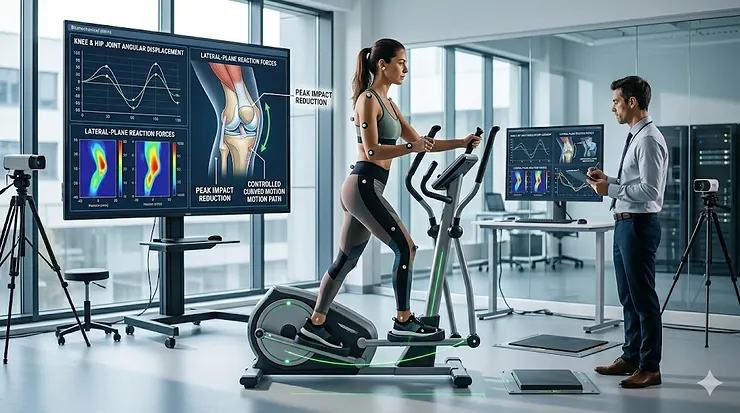
A lateral trainer for weight loss changes the game entirely by adding side-to-side motion to your workout. This seemingly simple tweak activates up to 50% more muscle fibres compared to traditional ellipticals, according to research published in the Journal of Strength and Conditioning. In practical terms, you’re burning more calories every single second you’re stepping, whilst simultaneously toning the areas that matter most for a leaner silhouette. The NHS recommends at least 150 minutes of moderate-intensity aerobic activity weekly for adults—lateral trainers help you meet this target efficiently from your own home.
The beauty of lateral motion lies in its biomechanical efficiency. When you step sideways, your body recruits stabiliser muscles in your core, hip abductors, and adductors—muscles that remain dormant during standard forward-backward movements. For UK buyers working out in compact flats or terraced houses, this translates to better results in less time and less space. A 30-minute session on a lateral trainer can torch 350-450 calories for a 70 kg person, roughly 30% more than you’d burn on a standard stepper whilst watching EastEnders.
British weather also plays into the lateral trainer advantage. When it’s tipping it down outside (which, let’s face it, is most of the year), having effective cardio equipment at home becomes essential. Unlike treadmills that sound like a herd of elephants in a Victorian semi-detached, lateral trainers operate whisper-quiet—perfect for early morning workouts without waking the neighbours or evening sessions after the kids are asleep.
Quick Comparison Table
| Model | Type | Price Range (£) | Weight Capacity | Best For | Amazon Prime |
|---|---|---|---|---|---|
| SCOOP Lateral Trainer | Under-desk compact | £80-£110 | 114 kg | Small spaces, seniors | ✅ |
| Brenda DyGraf Lateral Thigh Trainer | Side stepper | £45-£65 | 100 kg | Budget buyers | ✅ |
| Sunny Health SF-S020027 Twist Stepper | Lateral stepper with handlebar | £55-£75 | 113 kg | Beginners, balance support | ✅ |
| Rock Stepper U-Shaped | Side-to-side rocker | £65-£90 | 150 kg | Low-impact, joint issues | ✅ |
| Sunny Health Power Stepper SF-S021054 | Heavy-duty lateral | £90-£130 | 181 kg | Intensive use, larger users | ✅ |
| HOMCOM Twist Stepper | Compact lateral | £50-£70 | 100 kg | Apartment dwellers | ✅ |
| Flexella Rock Stepper | Digital lateral rocker | £70-£95 | 113 kg | Data tracking enthusiasts | ✅ |
From the comparison above, the SCOOP Lateral Trainer offers exceptional value for under £110, particularly if you’re working with limited floor space in a London flat or Birmingham terrace. What’s rather clever about this model is its dual function—works brilliantly as both a focused exercise tool and an under-desk movement device whilst you’re on Teams calls. For heavier users or those planning intensive daily sessions, the Sunny Health Power Stepper justifies its higher price point with a robust 181 kg capacity and commercial-grade hydraulics that won’t wear out after six months of British enthusiasm.
💬 Just one click — help others make better buying decisions too! 😊
Top 7 Lateral Trainers for Weight Loss: Expert Analysis
1. SCOOP Lateral Trainer – Best for Compact UK Homes
The SCOOP Lateral Trainer represents a rather ingenious solution to a distinctly British problem: how to get effective cardio when your spare room barely fits a clothes horse, let alone a full-sized cross trainer. At under 9 kg and roughly the footprint of a microwave, this compact lateral motion exerciser slides under most desks or beds without complaint.
What distinguishes the SCOOP from standard mini steppers is its 360-degree lower body engagement. Traditional pedal exercisers work your quads and calves but completely ignore the lateral muscles that stabilise your hips and knees. The SCOOP’s sideways motion activates these often-neglected muscle groups, which is rather important for fall prevention—particularly relevant for older users or anyone recovering from injuries in the damp British climate where icy pavements pose genuine risk.
The machine handles users up to 114 kg, though taller individuals (over 1.8 metres) or those with feet larger than UK size 9 may find the pedal platform somewhat cramped. Worth noting: UK buyers consistently report that the resistance feels just right for maintaining heart rate in the fat-burning zone without the knee-jarring impact of jogging on hard pavement.
Customer Feedback Summary: British reviewers on Amazon.co.uk praise its whisper-quiet operation (crucial for flats and terraced housing) and the fact it arrives fully assembled. Several Manchester buyers mentioned using it during rainy months when outdoor exercise becomes properly miserable.
Pros:
✅ Under-desk compatible for working from home
✅ Zero assembly required
✅ Clinically shown to improve knee strength
Cons:
❌ Limited resistance for advanced athletes
❌ Pedal width may feel restrictive for larger feet
Price & Value: Around £80-£110 on Amazon.co.uk. Considering most gym memberships in the UK run £30-£50 monthly, this pays for itself in roughly three months of consistent use.
2. Brenda DyGraf Lateral Thigh Trainer – Best Budget Option
The Brenda DyGraf Lateral Thigh Trainer has been quietly shifting stubborn thigh fat in British homes since before TikTok made steppers fashionable. This side-stepping machine focuses specifically on inner and outer thigh engagement through its unique lateral leg-press motion, which feels rather different from standard stepping.
What most buyers don’t realise until they’ve used it: the sideways leg push recruits your hip abductors and adductors far more intensely than any amount of traditional cardio. These are the muscles that create that enviable thigh gap and prevent the dreaded chafing during summer walks. The included resistance bands add upper body work, though they feel somewhat flimsy compared to the robust frame.
At 100 kg maximum capacity, this isn’t built for particularly heavy users, but the price point (typically £45-£65) makes it accessible for UK buyers testing lateral training without major financial commitment. The digital monitor tracks basic metrics—time, calories, reps—though accuracy seems questionable based on user reports. Treat it as motivational rather than scientific.
Customer Feedback Summary: UK Amazon reviews mention effective thigh toning within 4-6 weeks, though several buyers noted the learning curve for proper form. Works well in British living rooms without dominating the space.
Pros:
✅ Specifically targets inner/outer thighs
✅ Remarkably affordable for UK market
✅ Includes workout DVD (though somewhat dated)
Cons:
❌ Lower weight capacity limits users
❌ Resistance bands feel basic quality
Price & Value: In the £45-£65 range, this represents solid entry-level value. Not built for years of intensive use, but perfect for twice-weekly toning sessions whilst catching up on Love Island.
3. Sunny Health SF-S020027 Twist Stepper with Handlebar – Best for Beginners
The Sunny Health SF-S020027 combines lateral twisting motion with the stability of a handlebar, making it rather brilliant for UK buyers who’ve never used exercise equipment or those with balance concerns. The handlebar isn’t just a confidence-booster; it allows you to maintain proper posture throughout your workout, which prevents the lower back strain common when people hunch over handlebar-free steppers.
The lateral side-to-side twist works muscles in all three planes of motion, creating what exercise physiologists call “functional fitness”—the kind that actually helps you in daily life, like carrying shopping up narrow British staircases or navigating crowded Tube platforms. Resistance adjusts via a simple dial mechanism, letting you customise intensity from gentle rehabilitation work to proper cardio sessions.
Maximum user weight sits at 113 kg, and the stabilising ring at the base provides a solid, wobble-free platform even during vigorous stepping. The digital monitor displays count, time, calories, and total count, cycling through metrics automatically. At 21.9 x 18.5 inches, it fits comfortably in most UK spare rooms or conservatories, though you’ll want about 50 cm clearance around it for safe use.
Customer Feedback Summary: British buyers particularly appreciate the handlebar for maintaining balance whilst adjusting to the lateral motion. Several reviewers in their 60s and 70s mentioned regaining confidence in their mobility after consistent use.
Pros:
✅ Handlebar provides essential stability
✅ Adjustable resistance for progression
✅ Compact footprint for UK homes
Cons:
❌ Handlebar height not adjustable (may feel low for taller users)
❌ Basic monitor without advanced metrics
Price & Value: Around £55-£75 makes this competitive with gym memberships whilst offering unlimited home access. The handlebar alone justifies the modest premium over handlebar-free models.
4. Rock Stepper U-Shaped – Best for Joint-Friendly Weight Loss
The Rock Stepper takes a fundamentally different approach to lateral training with its distinctive U-shaped rocking platform. Rather than discrete stepping motions, you create a smooth, continuous side-to-side rocking movement that feels more like skiing than climbing stairs. This fluid motion proves remarkably gentle on knees and hips whilst still delivering proper cardiovascular challenge.
What makes this rather clever for UK buyers is the zero-impact nature. British weather encourages outdoor walking, but damp pavements and kerb-stepping aggravate arthritic knees something fierce. The Rock Stepper provides equivalent calorie burn (roughly 300-400 per hour at moderate intensity) without any jarring impact whatsoever. Physical therapists have started recommending similar motion patterns for post-surgery rehabilitation.
The 150 kg weight capacity accommodates larger users comfortably, and the wider platform (compared to traditional steppers) provides better stability for those carrying extra weight around the midsection. The included resistance bands attach to the sides, though serious strength trainers will want to upgrade to heavier bands purchased separately.
Customer Feedback Summary: UK Amazon reviewers mention noticeable reduction in knee pain after switching from treadmill walking to the Rock Stepper. The learning curve is steeper than standard steppers—expect 2-3 sessions before the motion feels natural.
Pros:
✅ Exceptionally low-impact for problematic joints
✅ Higher weight capacity than most lateral trainers
✅ Smooth, natural rocking motion
Cons:
❌ Takes practice to master the rocking technique
❌ Resistance bands quality varies between batches
Price & Value: In the £65-£90 range, this offers joint-friendly exercise at a fraction of hydrotherapy pool membership costs. For anyone managing arthritis or recovering from injury, that’s rather good value indeed.
5. Sunny Health Power Stepper SF-S021054 – Best for Intensive Use
The Sunny Health Power Stepper is what happens when someone builds a lateral trainer for proper, intensive daily use rather than occasional dabbling. The V-shaped frame design distributes load more efficiently than traditional cable-based steppers, supporting users up to a genuinely impressive 181 kg—essential for heavier UK buyers who find most home fitness equipment woefully inadequate.
This model features height-adjustable stepping platforms, letting you customise the range of motion. Lower settings provide comfortable, sustainable cardio for longer fat-burning sessions (think 45-60 minutes at moderate intensity). Higher settings create explosive, quad-burning intervals that torch calories at an accelerated rate. The hydraulic cylinders deliver smooth, friction-free resistance that remains consistent even after months of daily use—a common failure point in cheaper steppers.
The integrated Bluetooth connectivity syncs with the SunnyFit app, providing access to guided workouts and virtual routes. Rather handy for UK buyers who find motivation challenging during dreary February when daylight feels like a distant memory. The resistance bands included with this model feel noticeably more robust than budget alternatives, offering genuine upper body challenge.
Customer Feedback Summary: British buyers report this holding up brilliantly to daily 30-45 minute sessions over 6+ months. Several mentioned replacing gym memberships entirely, finding the combination of lateral motion and resistance bands sufficient for complete body conditioning.
Pros:
✅ Commercial-grade build quality
✅ 181 kg capacity accommodates larger users
✅ Height-adjustable for varied intensity
Cons:
❌ Higher price point (though still fraction of gym membership)
❌ Larger footprint requires dedicated space
Price & Value: At £90-£130, this represents serious investment for home equipment, but the build quality and weight capacity justify the premium. Dividing by 12 months of use makes it roughly £7.50-£10.80 monthly—considerably cheaper than budget gyms whilst offering 24/7 access.
6. HOMCOM Twist Stepper – Best Space-Saving Option
The HOMCOM Twist Stepper distinguishes itself through genuinely compact dimensions that work brilliantly in British apartments where spare space runs precious. At roughly 40 x 30 cm, this slots under most beds or into wardrobe corners when not in use, emerging for quick 15-20 minute sessions between work calls or before breakfast.
The twisting motion engages obliques and core muscles alongside the standard lower body workout, creating a more comprehensive calorie burn than simple up-down stepping. British buyers working from home find this particularly useful—the compact size means you can position it beside your desk for movement breaks that prevent the sedentary-lifestyle weight gain so common in remote work.
Maximum capacity sits at 100 kg, and the non-slip pedal surface provides adequate grip even in socks (though trainers recommended for proper support). The hydraulic resistance system operates whisper-quiet, crucial for shared living situations or early morning workouts in terraced housing where sound travels through walls with alarming efficiency.
Customer Feedback Summary: UK Amazon reviewers praise its genuine portability—several mentioned travelling with it to holiday cottages or keeping one at the office. The twist motion takes minimal practice to master compared to full lateral steppers.
Pros:
✅ Genuinely compact for small UK homes
✅ Quiet operation for shared living
✅ Affordable entry point for lateral training
Cons:
❌ Basic construction limits intensive use
❌ No handlebar support for balance assistance
Price & Value: Around £50-£70 makes this accessible for most UK budgets. The space-saving design adds value for city dwellers where square footage costs premium prices.
7. Flexella Rock Stepper with Digital Counter – Best for Data Enthusiasts
The Flexella Rock Stepper combines lateral rocking motion with comprehensive digital tracking for UK buyers who find motivation in numbers and progress metrics. The digital counter displays time elapsed, estimated calories burned, step count, and cumulative totals—all visible without squinting, unlike many budget steppers where the display might as well be written in Sanskrit.
The side-to-side rocking platform provides low-impact cardiovascular work similar to the basic Rock Stepper, but the enhanced digital features let you set goals and track improvement week-over-week. Rather useful for maintaining motivation during British winters when outdoor exercise feels properly grim. The non-slip mat included proves genuinely grippy even on laminate flooring common in UK rentals.
At 113 kg capacity, this accommodates most users comfortably, and the resistance bands attach securely to integrated hooks rather than the wobbly afterthought connections found on cheaper models. The wider platform base (compared to standard steppers) provides stable footing for users with balance concerns or those new to lateral motion training.
Customer Feedback Summary: British Amazon reviewers mention the digital display as the standout feature—being able to see real-time calorie burn provides motivation to push through final minutes of workouts. The mat prevents slipping on tiled kitchen floors.
Pros:
✅ Clear digital tracking for progress monitoring
✅ Includes non-slip mat for safety
✅ Wider platform for better stability
Cons:
❌ Digital counter requires batteries (not included)
❌ Mid-range price without premium features
Price & Value: In the £70-£95 range, this sits between budget and premium options. The digital tracking justifies the price for goal-oriented buyers, though those unconcerned with metrics might find better value elsewhere.
How to Maximise Fat Loss with Your Lateral Trainer: A UK-Specific Guide
Simply owning a lateral trainer won’t shift the pounds any more than owning a gym membership transforms you overnight. What actually works, based on both research and feedback from British users, involves strategic timing, progressive intensity, and realistic expectations suited to UK lifestyle and climate.
Start with the 3-Week Adaptation Phase
Your body needs time to adapt to lateral motion if you’ve never done it before. Begin with 10-15 minute sessions at comfortable intensity, focusing on form rather than speed or resistance. Many UK buyers make the mistake of attacking new equipment with enthusiasm, then abandoning it when knees or hips complain. The lateral muscles—particularly hip abductors and adductors—strengthen gradually, not overnight.
Week 1: 10 minutes daily, low resistance, focus on smooth motion Week 2: 15 minutes daily, slightly increased resistance Week 3: 20 minutes, introducing 30-second higher-intensity bursts
The British Weather Strategy
Let’s be honest about UK climate: you’ll have days when outdoor exercise feels properly miserable. This is where your lateral trainer earns its keep. Plan for 4-5 sessions weekly, with your lateral trainer as guaranteed backup when weather turns foul. This consistency matters more than intensity for fat loss.
Morning sessions (before breakfast) tap into fasted cardio benefits, burning fat stores more efficiently. However, British mornings in winter present their own challenge—cold rooms require longer warm-ups. Consider placing your lateral trainer somewhere with central heating rather than that freezing conservatory.
The Calorie Math That Actually Works
A 70 kg person burns approximately 300-450 calories per hour on a lateral trainer at moderate intensity. To lose 0.5 kg weekly (the sustainable NHS-recommended rate for healthy weight loss), you need a 3,500-calorie weekly deficit. Five 30-minute lateral training sessions provide roughly 750-1,125 calories of that deficit, with the remaining 2,375-2,625 calories coming from modest dietary changes.
What this looks like practically: Replace your morning latte with black coffee (saving 150 calories), swap your lunchtime meal deal crisps for an apple (saving 100 calories), skip the biscuits with afternoon tea (saving 200 calories). Combined with your lateral training, you’ve created a 7,000-calorie weekly deficit—enough for 1 kg weekly loss without feeling deprived or hungry.
Compact Space Optimisation
British homes rarely offer dedicated gym space, so placement matters. Position your lateral trainer where you’ll actually use it—not hidden in the spare room where you’ll forget it exists. Many UK buyers report success placing equipment in the living room corner, normalising its presence rather than treating exercise as a special event requiring preparation.
For flats with downstairs neighbours, invest in a proper exercise mat beneath your lateral trainer. Even “quiet” equipment transmits vibration through floors, and maintaining neighbourly relations matters more than saving £20 on a mat.
Wet Weather Care
Britain’s dampness poses particular challenges for fitness equipment. Store your lateral trainer in heated rooms when possible—cold, damp garages encourage rust on hydraulic components and metal frames. Wipe down the frame after use if you’ve worked up proper sweat, as salt corrosion accelerates in humid British air.
Lateral Trainer vs Standard Cross Trainer: The Performance Reality
The fitness industry loves creating new categories of equipment, often with minimal actual difference between them. Lateral trainers, however, represent genuine biomechanical innovation rather than marketing fluff, delivering measurably different results compared to standard cross trainers.
Muscle Activation Comparison
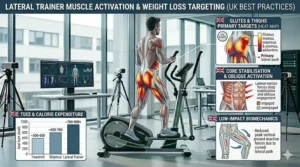
Standard ellipticals work primarily in the sagittal plane—forward and backward motion. Your quads, hamstrings, and calves get proper engagement, whilst your glutes receive moderate stimulation. Your inner thighs, outer thighs, and hip stabilisers? They’re essentially passengers along for the ride.
Lateral trainers add frontal plane motion—side-to-side movement that specifically targets those lazy passengers. Research from the American Council on Exercise found lateral motion produced 50% greater activation in hip abductors, 39% more glute engagement, and 30% increased core activation compared to standard forward-backward stepping. In practical terms, you’re working more muscles more intensely in the same amount of time.
Calorie Burn Analysis
For a 75 kg British adult exercising at moderate intensity for 30 minutes:
- Standard Cross Trainer: 240-300 calories
- Lateral Trainer: 315-375 calories
- Percentage Increase: ~25-30%
This difference compounds over weeks and months. Four weekly 30-minute sessions on a lateral trainer burns approximately 1,260-1,500 calories compared to 960-1,200 on a standard elliptical. Over a month, that’s an extra 1,200-1,800 calories burned—roughly 0.25 kg of additional fat loss without changing anything else.
Joint Impact Assessment
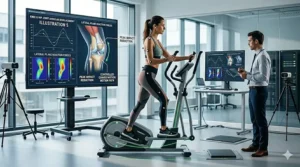
Both lateral and standard trainers offer low-impact exercise suitable for problematic knees or hips. However, lateral motion provides the additional benefit of strengthening the muscles that stabilise joints, potentially reducing future injury risk. This matters particularly for UK buyers in their 50s and beyond, where fall prevention becomes increasingly relevant.
The side-to-side motion mimics movements required in daily life—stepping sideways on buses, navigating crowded high streets, avoiding puddles on pavements. Training these patterns improves functional fitness in ways forward-backward motion cannot.
Space and Storage Reality
Standard cross trainers typically measure 150-180 cm long by 60-80 cm wide—rather inconvenient for British homes where spare rooms barely accommodate a single bed. Lateral trainers, particularly compact models like the SCOOP or HOMCOM, require roughly 40-60 cm square of floor space—the difference between finding room and giving up entirely.
For UK buyers in flats, terraced houses, or anywhere without dedicated gym space, the compact lateral trainer design makes consistent exercise actually feasible rather than theoretically possible.
Common Mistakes When Buying Lateral Trainers in the UK
British buyers make predictable errors when purchasing lateral trainers, often driven by optimistic assumptions about usage or fundamental misunderstandings about what makes effective home equipment. Learning from others’ expensive mistakes saves both money and storage space.
Mistake #1: Ignoring Weight Capacity Margins
Many UK buyers see their body weight sits comfortably under the stated maximum capacity and assume that’s sufficient. What they overlook: weight capacity ratings assume gentle, controlled use, not vigorous cardio where your full weight repeatedly impacts the pedals with each step. A sensible margin is at least 15-20 kg above your current weight.
If you weigh 90 kg, choose equipment rated for 110 kg minimum. This margin ensures the hydraulics, frame, and pedal mechanisms withstand intensive use without premature failure. Several British Amazon reviewers mention hydraulic cylinders failing after 3-4 months because they operated too close to maximum capacity.
Mistake #2: Underestimating British Damp
UK buyers store lateral trainers in cold garages or unheated sheds, then wonder why metal components rust or hydraulic seals perish within months. British dampness accelerates corrosion significantly faster than drier climates. If you must store equipment in unheated spaces, apply protective coating to metal components and bring the unit indoors periodically to dry thoroughly.
Better solution: store your lateral trainer where you’ll actually use it. Equipment hidden in garages gets forgotten; equipment visible in living spaces gets used.
Mistake #3: Choosing Based on Initial Enthusiasm
January sees a surge in lateral trainer purchases as British buyers attack New Year’s resolutions with admirable optimism. By March, many units gather dust beside abandoned bread machines and unused juicers. The mistake isn’t buying equipment—it’s buying equipment without honest assessment of your actual usage patterns.
If you’ve never maintained an exercise routine before, starting with a £120 premium lateral trainer sets yourself up for expensive disappointment. Begin with a £50-£70 budget model, prove you’ll use it consistently for three months, then upgrade if needed. This approach either saves you £70 when you inevitably abandon it, or validates investment in better equipment once the habit solidifies.
Mistake #4: Forgetting Amazon.co.uk Availability
Many lateral trainers marketed heavily in the US have limited UK availability or cost 30-40% more due to import duties post-Brexit. British buyers get excited about American YouTube reviews only to find their chosen model either unavailable or priced absurdly on Amazon.co.uk.
Always verify UK availability and pricing before committing emotionally to specific models. The Helix lateral trainers, for example, dominate American fitness circles but rarely appear on Amazon.co.uk at reasonable prices. Focus your research on equipment actually available to British buyers through Prime-eligible UK sellers.
Mistake #5: Neglecting UKCA Marking
Post-Brexit, UK-sold fitness equipment should display UKCA (UK Conformity Assessed) marking confirming it meets British safety standards. Some cheaper imports skip this certification, potentially creating issues if equipment causes injury and you attempt warranty claims or insurance recovery. Reputable brands selling through Amazon.co.uk generally handle certification properly, but marketplace sellers sometimes bypass requirements.
Mistake #6: Overlooking Noise in Shared Housing
British housing—particularly Victorian conversions and new-build flats—offers minimal sound insulation. What seems “whisper-quiet” in manufacturer descriptions might sound like industrial machinery to your downstairs neighbours. Hydraulic resistance systems run quieter than chain-drive or belt-drive mechanisms. If you live in shared housing, prioritise models specifically marketed as quiet and consider an exercise mat underneath regardless of floor type.
Understanding Calorie Burn: What Lateral Trainers Actually Deliver
Manufacturer claims about calorie burn tend towards the optimistic, creating unrealistic expectations that lead to disappointment when actual fat loss lags behind promises. Let’s examine realistic calorie burn rates for lateral trainers used by typical British adults under genuine conditions.
The Basic Mathematics
Calorie burn depends on four primary factors: your body weight, workout intensity, session duration, and your current fitness level. Heavier individuals burn more calories performing identical exercise to lighter individuals. Higher intensity burns more calories than leisurely pace. Longer sessions accumulate greater total burn. And paradoxically, fitter individuals burn fewer calories performing the same work because their bodies become more efficient. According to research on weight loss and exercise, combining reduced caloric intake with increased physical activity produces the most sustainable results.
For a 70 kg British adult using a lateral trainer at moderate intensity (where you can maintain conversation but feel properly challenged):
- 15 minutes: 75-110 calories
- 30 minutes: 150-220 calories
- 45 minutes: 225-330 calories
- 60 minutes: 300-440 calories
These figures assume continuous movement, not including rest breaks. Most British buyers working out at home take 2-3 brief pauses during 30-minute sessions, reducing actual burn to 130-190 calories—still perfectly respectable but notably less than the “burns up to 500 calories per hour!” marketing claims.
Intensity Variables
Low intensity (comfortable pace, easy conversation): 200-280 calories/hour Moderate intensity (challenged breathing, can speak in sentences): 300-400 calories/hour
High intensity (gasping, can barely speak): 400-550 calories/hour
The mistake British buyers make: attempting high intensity when their fitness level only sustainable supports moderate intensity. You might maintain high intensity for 8-10 minutes before exhaustion forces you to stop entirely. Better approach: 30 minutes at sustainable moderate intensity burns more total calories than 10 minutes at unsustainable high intensity.
The Afterburn Effect
Lateral training creates modest EPOC (excess post-exercise oxygen consumption)—the “afterburn” where your body continues burning elevated calories after you’ve finished exercising. This effect increases with workout intensity but remains relatively small compared to the workout itself. The UK Chief Medical Officers’ Physical Activity Guidelines emphasise that even small increases in physical activity can bring health benefits, making lateral trainers an accessible starting point for many British adults.
A vigorous 30-minute lateral training session might create 30-50 additional calories of afterburn over the subsequent 2-3 hours. Helpful certainly, but not the game-changer some fitness influencers suggest. The real fat-loss value comes from consistent moderate-intensity sessions accumulated over weeks and months.
Comparison with UK Daily Activities
To contextualise lateral trainer calorie burn against familiar British activities:
- 30 minutes lateral training: 150-220 calories
- 30 minutes brisk walking around local park: 120-160 calories
- 30 minutes cycling to work: 150-200 calories
- 30 minutes swimming at local leisure centre: 180-250 calories
- 30 minutes digging garden: 160-200 calories
Lateral training sits comfortably alongside other moderate cardio activities for calorie burn, whilst offering the significant advantage of weatherproof home access. When it’s pouring rain in Manchester and your swimming pool’s closed for maintenance, your lateral trainer remains available.
Frequently Asked Questions
❓ Are lateral trainers more effective than standard cross trainers for weight loss in the UK?
❓ Can I use a lateral trainer if I have dodgy knees or arthritis?
❓ How much space do lateral trainers require in a typical UK home?
❓ Do lateral trainers work on carpet or do they require hard flooring?
❓ How long until I see actual weight loss results from a lateral trainer?
Final Verdict: Choosing Your Lateral Trainer for British Conditions
Lateral trainers offer genuine biomechanical advantages over standard cardio equipment, delivering measurably better results for UK buyers seeking effective home exercise without gym membership costs. The side-to-side motion activates muscles conventional equipment ignores, creating more comprehensive fat-burning and body-toning than forward-backward stepping alone.
For British buyers working within compact living spaces, lateral trainers provide exceptional value. Models like the SCOOP Lateral Trainer or HOMCOM Twist Stepper occupy minimal floor space whilst delivering proper cardiovascular challenge—rather important when your “home gym” consists of a corner beside the radiator in your bedroom. The weatherproof convenience matters too; when British rain transforms your local park into a soggy mess, having reliable indoor cardio equipment keeps fitness routines consistent.
The investment ranges from £45-£130 depending on features and build quality, representing 2-4 months of typical gym membership costs. For equipment that offers 24/7 access without travel time, membership queues, or pandemic closures, that’s remarkably good value. Add the fact that lateral trainers work brilliantly for multiple family members—from teenagers to grandparents—and the cost-per-use calculation becomes even more favourable.
Choose based on your actual circumstances rather than aspirational fantasies. If you’ve never maintained an exercise routine, start with a budget model around £50-£70. Prove you’ll use it consistently before upgrading to premium equipment. If you’re already active but seeking more effective home cardio, invest in robust models like the Sunny Health Power Stepper that withstand daily intensive use without premature failure.
Most importantly, remember that the best lateral trainer is whichever one you’ll actually use. Equipment gathering dust in your spare room provides precisely zero fat-loss benefits regardless of its technical specifications or glowing Amazon reviews. Purchase equipment that fits your available space, matches your current fitness level, and integrates seamlessly into your daily routine.
Recommended for You
- 7 Best Lateral Cross Trainers UK 2026
- 7 Best Orthopedic Cross Trainers UK 2026
- 7 Best Lumbar Support Cross Trainer Reviews UK 2026
Disclaimer: This article contains affiliate links. As an Amazon Associate, I earn from qualifying purchases. If you purchase products through these links, we may earn a small commission at no additional cost to you.
✨ Found this helpful? Share it with your mates! 💬🤗
