
In This Article
If you’ve been trudging through the same monotonous elliptical routine, feeling every session melt into the next with the predictable drone of fixed-stride machinery, you’re not alone. Traditional elliptical trainers lock you into one movement pattern — rather like being forced to walk the same stretch of pavement for eternity. A variable motion elliptical trainer breaks that mould entirely.
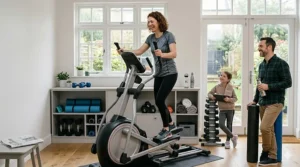
These adaptive machines let you adjust stride length, modify motion paths, and shift between multiple planes of movement — transforming a single piece of equipment into several workout experiences. For UK homes where space comes at a premium, this versatility matters. You’re getting the cardiovascular benefits of running without the joint impact, the muscle engagement of climbing without the repetitive strain, and the freedom to switch things up when motivation wanes on those grey February mornings when the rain hasn’t stopped for a week.
The British fitness market has caught onto this brilliantly. From compact models that tuck into spare bedrooms in terraced houses to premium machines with electronically adjustable strides, there’s a variable motion elliptical trainer suited to every fitness level and budget. What the manufacturers won’t tell you, though, is that not all “variable” features are created equal — some require manual adjustment between sessions, whilst others adapt on the fly mid-workout. The difference isn’t trivial when you’re six weeks into a training programme and your body’s screaming for variety.
Quick Comparison Table
| Model | Stride Range | Flywheel | Resistance Levels | Best For | Price Range |
|---|---|---|---|---|---|
| JTX Tri-Fit 2.0 | 16-20″ adjustable | 8.5 kg | 16 magnetic | Premium home gym | £700-£900 |
| MERACH Long Stride | 47-48 cm fixed | 8 kg | 8/16 options | Tall users | £300-£450 |
| JTX Strider-X7 | 16″ fixed | 12.5 kg | 16 magnetic | Mid-range reliability | £350-£450 |
| Dripex Elliptical | Standard | 6 kg | 8-16 levels | Budget-conscious | £180-£280 |
| Neezee Cross Trainer | Standard | 8 kg | 16 magnetic | Compact spaces | £200-£300 |
| Aeriflo M100 | 42 cm fixed | 8 kg | 8 levels | App connectivity | £250-£350 |
| Bluefin CURV 2.0 | Compact | 6 kg | 8 levels | Small flats | £150-£250 |
The table reveals something British buyers often miss: stride length matters more than resistance levels for natural movement simulation. The JTX Tri-Fit 2.0 stands alone in offering genuine adjustability between 16-20 inches, which means a 5’4″ user and a 6’4″ user can both find their ideal stride without compromise. For shared households — common in the UK where multi-generational living is on the rise — that’s the difference between equipment that gathers dust and equipment that earns its floor space.
💬 Just one click — help others make better buying decisions too! 😊
Top 7 Variable Motion Elliptical Trainers: Expert Analysis
1. JTX Tri-Fit 2.0 Elliptical Cross Trainer
The JTX Tri-Fit 2.0 represents the pinnacle of home elliptical engineering available on Amazon.co.uk, and it earns that position through one killer feature: electronically adjustable stride length. Press a button mid-workout, and the stride extends from 16 inches to 20 inches whilst you’re still pedalling. This isn’t marketing fluff — it’s biomechanically optimized paths in action.
Key Specifications & Real-World Impact: The 8.5 kg inertia-enhanced flywheel delivers smooth motion without the juddering you’ll find on cheaper models with 4-6 kg flywheels. Sixteen levels of silent magnetic resistance mean you can progress from recovery sessions to high-intensity intervals without disturbing the neighbours through your semi-detached walls. The adjustable incline adds another dimension — mimicking hill climbs without leaving your front room. Kinomap app connectivity transforms mundane cardio into virtual rides through Alpine passes, though you’ll need decent Wi-Fi coverage in your workout space.
Who This Is For: Serious home exercisers who’d otherwise shell out for gym memberships, households where multiple people train at different fitness levels, and anyone recovering from running injuries who needs progressive rehabilitation options. The 150 kg user weight capacity accommodates most adults comfortably.
Customer Feedback: UK reviewers consistently praise the stride adjustability for couples with height differences — one buyer noted her 6’4″ husband and 5’4″ frame both find comfortable motion ranges. The two-year in-home warranty includes engineer call-outs, which matters when you’re investing in the upper price bracket.
✅ Genuine variable stride (16-20″)
✅ Kinomap/app integration
✅ Whisper-quiet operation
❌ Premium price point
❌ Requires significant floor space (170cm length)
Price & Value: Expect to pay in the £700-£900 range on Amazon.co.uk. For context, that’s comparable to two years of budget gym membership in many UK cities, but this machine doesn’t close at 9pm or require a 30-minute commute through traffic.
2. MERACH Long Stride Cross Trainer
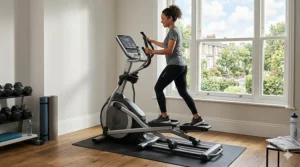
The MERACH Long Stride addresses a complaint that’s plagued elliptical training since its inception: stride lengths designed for average heights leave tall users feeling cramped and short users overextending. With a generous 47-48 cm (roughly 18.5-19″) stride, this machine caters specifically to users above 5’10” who’ve been shortchanged by standard 14-16″ models.
Key Specifications & Real-World Impact: The 8 kg flywheel sits in the sweet spot between budget models (4-6 kg) and premium options (10+ kg) — heavy enough for fluid motion, light enough to keep the price reasonable. You’ll find either 8 or 16 resistance level variants on Amazon.co.uk; opt for the 16-level version if budget permits, as eight levels leave frustratingly large gaps between settings once you’ve built cardiovascular fitness. The ultra-quiet magnetic resistance system lives up to its billing — crucial if you’re training early mornings in a terraced house where sound travels.
Who This Is For: Tall users (5’10″+) tired of feeling bunched up on standard machines, families where the primary user exceeds average UK height, and anyone who values natural stride motion over electronic bells and whistles. The 181 kg (400 lb) capacity is among the highest in this price range, speaking to solid construction.
Customer Feedback: The exclusive MERACH app receives mixed reviews — it’s functional for tracking workouts but lacks the immersive features of Kinomap or Zwift. Several UK buyers note the machine arrives 95% pre-assembled, which is rather brilliant when you’re unpacking it solo in a spare bedroom.
✅ Extended 47-48cm stride for tall users
✅ Exceptionally high weight capacity
✅ Minimal assembly required
❌ No adjustable stride length
❌ App integration basic compared to premium models
Price & Value: The £300-£450 range positions this as excellent mid-market value. It’s the machine I’d recommend for a 6’2″ runner transitioning from outdoor training during British winter when the pavements are icy and the daylight’s gone by 4pm.
3. JTX Strider-X7 Home Cross Trainer
The JTX Strider-X7 has quietly become one of the UK’s best-selling home ellipticals, and the reason isn’t flashy features — it’s reliable execution of the fundamentals. This machine does precisely what it promises: smooth, quiet elliptical motion at a price point that doesn’t require financing arrangements.
Key Specifications & Real-World Impact: The 12.5 kg flywheel is heavier than anything else in this price category, and you’ll feel the difference immediately in momentum consistency. Cheaper models with 6 kg flywheels require constant muscular input to maintain rhythm; this one glides. Sixteen resistance levels use electromagnetic adjustment rather than manual knob turning — press a button on the console, and the magnetic field shifts without mechanical parts grinding together. The 16″ stride length suits users between 5’4″ and 6’0″ comfortably, though those outside this range should look elsewhere.
Who This Is For: Budget-conscious buyers who refuse to sacrifice build quality, intermediate exercisers ready to graduate from basic equipment, and UK households where reliability trumps cutting-edge technology. The 120 kg user capacity covers the vast majority of adults.
Customer Feedback: UK reviewers emphasise longevity — multiple buyers report 3+ years of regular use without mechanical issues, which is rather impressive given the price point. The LCD monitor is basic (no tablet holder, no app connectivity) but displays the essentials: time, distance, calories, pulse.
✅ Heavyweight 12.5kg flywheel
✅ Proven UK reliability record
✅ Silent electromagnetic resistance
❌ Fixed 16″ stride (not adjustable)
❌ No smart connectivity
Price & Value: At £350-£450 on Amazon.co.uk, this offers the best pounds-per-kilogram-of-flywheel ratio in the market. It’s the machine I’d buy for someone who trains consistently but doesn’t need motivational apps — the sort who’ll put on a podcast and zone out for 45 minutes regardless of technology.
4. Dripex Elliptical Cross Trainer
The Dripex Elliptical occupies contested territory: the budget segment where manufacturers make compromises, and buyers must decide which compromises they’ll tolerate. Dripex has made thoughtful choices — sacrificing flywheel weight and premium materials whilst preserving smooth magnetic resistance and adjustable intensity.
Key Specifications & Real-World Impact: The 6 kg flywheel is light by elliptical standards, which translates to less momentum — you’ll need to maintain consistent pedalling effort rather than letting the wheel carry you through dead spots in your stroke. The 8 or 16 resistance levels (depending on model variant) use magnetic adjustment, avoiding the friction-based systems that plagued budget ellipticals a decade ago. The standard stride length suits users roughly 5’4″-5’10”; taller individuals will feel cramped after 20 minutes.
Who This Is For: First-time elliptical buyers testing the waters before committing to premium equipment, students in rented flats with limited budgets and space, and casual exercisers targeting 2-3 sessions weekly rather than daily training. The 120 kg capacity is adequate though not exceptional.
Customer Feedback: UK buyers note the machine is genuinely compact — it’ll squeeze into a small bedroom or conservatory without dominating the space. The LCD monitor tracks basics (time, distance, calories, pulse via hand sensors) but don’t expect app connectivity. Several reviewers mention the frame feels lighter than expected, though it remains stable during use.
✅ Genuinely affordable entry point
✅ Space-efficient footprint
✅ Magnetic resistance (not friction)
❌ Light 6kg flywheel limits smoothness
❌ Basic construction materials
Price & Value: At £180-£280, this is impulse-purchase territory for many UK households. It’s not the machine you’ll still be using in five years, but it might be the machine that convinces you to upgrade to something serious when you’ve proved to yourself you’ll actually use it three mornings a week.
5. Neezee Elliptical Cross Trainer
The Neezee represents the modern budget-plus category: equipment that costs slightly more than rock-bottom options but delivers noticeably better user experience. It’s the Primark-versus-Next of elliptical trainers — still affordable, but with quality where it counts.
Key Specifications & Real-World Impact: The 8 kg flywheel occupies middle ground between Dripex’s light 6 kg and premium 10+ kg options. You’ll notice improved momentum consistency compared to cheaper models, though still not the effortless glide of heavyweight machines. Sixteen levels of magnetic resistance provide finer progression increments than 8-level systems — useful when you’re plateauing at level 5 but level 6 feels impossibly hard. The ultra-quiet operation lives up to billing; several UK reviewers specifically mention using it whilst children sleep in adjacent rooms without disturbance.
Who This Is For: Urban dwellers in flats where noise complaints are a genuine concern, intermediate exercisers who’ve outgrown basic equipment but can’t justify £500+ expenditure, and anyone prioritising compact footprint over extended features. The 120 kg capacity is standard for this category.
Customer Feedback: The pulse sensors receive mixed reviews — they’re present on the static handlebars but sometimes struggle to maintain consistent readings, a common complaint across budget ellipticals. The LCD display is clear and readable without squinting, which matters more than you’d think when you’re six miles into a virtual distance challenge.
✅ Excellent noise insulation
✅ 16 resistance levels for progression
✅ Compact design for UK homes
❌ Pulse sensors occasionally temperamental
❌ No adjustable stride
Price & Value: The £200-£300 price range positions this as the minimum viable serious training tool. It’s what I’d recommend for someone who’s been using a gym elliptical regularly and wants home equivalency without premium investment.
6. Aeriflo M100 Elliptical Cross Trainer
The Aeriflo M100 enters the conversation through connectivity rather than mechanical superiority. At a time when Peloton has normalised £2,000 smart bikes, the Aeriflo delivers Bluetooth app integration at a fraction of the cost — specifically Kinomap and Zwift compatibility, which transforms solitary cardio into something resembling social exercise.
Key Specifications & Real-World Impact: The 8 kg flywheel and 42 cm stride length deliver respectable mechanical performance without breaking new ground. What distinguishes this machine is the Bluetooth connectivity that syncs your resistance and speed data with Kinomap’s 450,000+ km of video routes or Zwift’s virtual racing platform. For UK users stuck indoors during the six months of rain and early darkness, this connectivity addresses the psychological barrier of monotonous training more effectively than fancy resistance curves.
Who This Is For: Tech-oriented exercisers who need external motivation, former outdoor runners adjusting to British winter training indoors, and anyone who’s discovered that watching Netflix whilst exercising leads to half-hearted effort. The 150 kg capacity is generous for this price segment.
Customer Feedback: UK buyers emphasise the app compatibility as the decisive factor — several note they’d tried cheaper non-connected machines and lost motivation within weeks. The 80% pre-assembly is genuinely helpful; you’ll have this operational within 30 minutes of unboxing. Some users report initial Bluetooth pairing frustration, typically resolved through firmware updates.
✅ Kinomap/Zwift compatible
✅ 80% pre-assembled
✅ Strong 150kg capacity
❌ Requires subscription apps for full benefit
❌ Fixed 42cm stride
Price & Value: At £250-£350, you’re paying a £50-100 premium over non-connected equivalents, but that connectivity might be the difference between consistent training and equipment gathering dust. Worth noting: Kinomap subscriptions run roughly £8/month, Zwift approximately £13/month — factor this into long-term cost.
7. Bluefin Fitness CURV 2.0 Cross Trainer
The Bluefin CURV 2.0 makes a singular promise: effective elliptical training in the smallest possible footprint. For UK buyers in studio flats, bedsits, or terraced houses where every square metre counts, this compact machine addresses the “where would I even put that?” objection that kills most home fitness purchases.
Key Specifications & Real-World Impact: The 6 kg flywheel and 8 resistance levels mirror other budget options, but the dramatically reduced footprint sets this apart. The compact stride length sacrifices some biomechanical optimisation — taller users above 5’10” will feel confined — but for average-height individuals in space-constrained homes, it’s a reasonable compromise. Kinomap compatibility adds training variety without requiring a larger machine. The air walker-style design means your feet follow a slightly different path than traditional ellipticals, which some users find more natural, others less so.
Who This Is For: Flat dwellers with genuinely limited space, shorter users (under 5’8″) who benefit from compact stride, and UK buyers in the “I’d exercise if I had room” category. The weight capacity isn’t published prominently but appears adequate for average adults.
Customer Feedback: UK reviewers split into camps: those delighted to finally have elliptical access in small homes, and those who found the compact design too compromising. Several note it’s brilliant for recovery days and gentle cardio but struggles as primary training equipment for serious athletes. The Bluefin brand’s UK base means customer service operates on British time zones, which matters when you need support.
✅ Genuinely space-efficient
✅ UK-based company support
✅ Kinomap integration
❌ Compact stride limits tall users
❌ 6kg flywheel means less momentum
Price & Value: At £150-£250, this is the lowest price point for Kinomap-compatible equipment. It’s not the machine for someone training for a half-marathon, but it might be the machine that keeps an otherwise sedentary office worker moving through British winter.
How to Choose Your Ideal Variable Motion Elliptical Trainer
The elliptical market bombards you with specifications — resistance levels, flywheel weights, stride lengths, connectivity options — but most buyers make purchasing decisions based on the wrong priorities. Here’s how to actually match machine to need, starting with the factors that genuinely impact your training outcomes.
Stride Length: The Non-Negotiable Foundation
Your stride length dictates whether an elliptical feels natural or like hobbling through molasses. The relationship is height-dependent: users under 5’6″ typically need 14-16″ strides; 5’6″-5’11” users want 16-18″; above 6’0″ requires 18-20″+. The JTX Tri-Fit 2.0‘s adjustable 16-20″ range solves this for shared households, whilst the MERACH Long Stride‘s fixed 48 cm accommodates taller users specifically. What manufacturers rarely mention: a too-short stride forces hip flexor compensation that manifests as lower back discomfort after 2-3 weeks of consistent training. If you’re between sizes, always choose longer — you can shorten your stride through pedalling technique, but you cannot lengthen a mechanically short stride.
Flywheel Weight: Momentum Versus Muscle Engagement
Heavier flywheels (10+ kg) create momentum that carries you through your pedal stroke’s dead zones, mimicking outdoor running’s fluid motion. Lighter flywheels (4-6 kg) require constant muscular input, which burns more calories per minute but fatigues faster. The JTX Strider-X7‘s 12.5 kg flywheel represents the sweet spot for serious training without commercial-grade pricing. British buyers should note: heavier machines generally correlate with better vibration dampening, which matters enormously in terraced housing where structural sound transmission is unavoidable.
Resistance Mechanism: Magnetic Wins Every Time
All models reviewed here use magnetic resistance — a sealed electromagnetic field that adjusts intensity without physical contact between parts. Avoid friction-based systems still found on sub-£150 machines; they wear rapidly and sound like grinding gravel within six months. The practical difference between 8 and 16 resistance levels matters more than marketing suggests: eight levels create frustrating gaps once you’ve built base fitness, whilst sixteen levels allow micro-progressions that prevent plateaus. If choosing between models, prioritise more resistance levels over marginal improvements in other specifications.
UK-Specific Considerations: Space, Noise, and Climate
British homes average smaller square footage than American or Australian equivalents, making compact footprint a genuine concern. Measure your space before ordering — ellipticals typically require 170-190 cm length and 60-80 cm width, plus clearance for safe mounting. For noise, magnetic resistance helps, but check user reviews specifically mentioning “terraced house” or “flat” to gauge real-world sound levels. Climate-wise: British damp demands corrosion-resistant materials. Machines with sealed bearing assemblies (mentioned in higher-end models) prevent rust ingress from perspiration and ambient humidity, extending UK lifespan significantly.
Budget Allocation: Where to Spend, Where to Save
If funds are limited, prioritise flywheel weight and stride length over connectivity features. A £300 machine with an 8 kg flywheel and proper stride will deliver better training outcomes than a £300 machine with a 6 kg flywheel and app connectivity. Conversely, if budget permits £500+, connectivity features earn their keep through motivation maintenance — the psychological barrier of monotonous training kills more fitness goals than physical limitations. The Aeriflo M100 represents the minimum viable connected option; below that price point, app integration often feels bolted-on rather than integrated.
Common Mistakes When Buying Elliptical Trainers in the UK
British buyers consistently make five purchasing errors that transform promising equipment into expensive clothes hangers. Learning from others’ mistakes costs less than learning from your own.
Mistake 1: Assuming “Variable” Means Adjustable Mid-Workout
Marketing language deliberately blurs the line between machines offering adjustable stride settings (which you change between sessions by manual adjustment) and true variable motion that adapts mid-workout. Only the JTX Tri-Fit 2.0 among reviewed models offers genuine mid-workout electronic adjustment. Most others provide “variable” intensity through resistance changes, not stride modification. This matters if you’re expecting progressive stride adaptation as your fitness improves — you won’t get it from manually adjustable systems unless you’re willing to dismount, adjust, and remount mid-session.
Mistake 2: Underestimating British Weather Impact on Storage
UK buyers frequently place ellipticals in garages, sheds, or conservatories where temperature fluctuations and damp create havoc with cheaper machines. Unsealed bearings rust within months under British conditions; plastic consoles crack from temperature cycling; electrical components corrode from ambient moisture. If your planned location isn’t climate-controlled, you need machines explicitly designed for semi-outdoor use or must budget for dehumidifiers and protective covers. Several Amazon.co.uk reviewers learned this lesson expensively — “worked fine until the first winter” appears repeatedly in lower-rated reviews.
Mistake 3: Ignoring UKCA Certification and Electrical Standards
Post-Brexit, some equipment sold on Amazon.co.uk originates from non-UK suppliers and may carry CE marking only, not the required UKCA certification for the British market. Whilst enforcement remains patchy, the practical concern is voltage: UK mains operates at 230V/50Hz with Type G plugs. Machines imported from US stock (110V/60Hz) require transformers that add bulk, heat, and potential fire risk. Always verify UK-specific models with proper plugs and voltage ratings. Trading Standards can refuse to support CE-only products if issues arise, leaving you without consumer protection recourse.
Mistake 4: Buying for Who You Hope to Become, Not Who You Are
The most expensive purchasing error is buying a machine for your aspirational self — the person who’ll train 60 minutes daily — rather than your actual self who might manage 20 minutes three times weekly. A £900 elliptical gathering dust costs more than a £250 machine you actually use. Start with mid-tier equipment like the JTX Strider-X7 or Neezee; upgrade later if consistent training justifies it. The British fitness equipment resale market on eBay and Facebook Marketplace is flooded with barely-used premium machines from buyers who overestimated their commitment.
Mistake 5: Neglecting Assembly and Space Realities
Elliptical boxes arrive via courier weighing 40-70 kg, requiring two adults to manoeuvre up narrow UK staircases. Amazon.co.uk delivery typically means kerbside drop-off unless you’ve paid for premium handling. Assembly instructions assume American-sized rooms; you’ll need to partially assemble, angle through doorways, then complete assembly in situ. Several models reviewed arrive 80-95% pre-assembled (particularly MERACH), saving considerable frustration. If you’re in an upstairs flat or have a narrow Victorian staircase, verify dimensions against your access points before ordering — returning a 65 kg machine through Amazon.co.uk’s process is administratively nightmarish.
Real-World Performance: What to Expect in British Conditions
Specification sheets tell part of the story; the rest emerges during month six of February drizzle when your outdoor training routine has evaporated and this machine represents your sole cardio option. Here’s what manufacturers don’t advertise but UK owners discover.
Seasonal Performance Variations
British homes typically maintain 18-21°C in winter, dropping to ambient during summer heatwaves. Electronic consoles on budget models sometimes become sluggish in cold conservatories (below 15°C), whilst plastic components contract slightly, creating creaking sounds absent in warmer months. Magnetic resistance remains consistent across temperature ranges, but flywheel bearings need more initial momentum when cold. Practical tip: if training in an unheated space, perform a 2-minute low-resistance warm-up to get bearings and your body up to operating temperature simultaneously.
Noise Reality Check for Terraced Housing
“Ultra-quiet” means different things to manufacturers and neighbours sharing a wall. The JTX Strider-X7 and Neezee deliver on whisper-quiet billing — genuinely suitable for 6am sessions in terraced houses. Budget models like the Dripex produce mechanical noise levels tolerable in detached houses but potentially problematic in flats with thin floors. The sound isn’t the pedalling mechanism (magnetic systems are genuinely silent); it’s footfall vibration transmitting through flooring. An equipment mat underneath absorbs 60-70% of structural transmission, transforming a potential neighbour complaint into background noise.
Humidity and Corrosion Management
British air moisture averages 80%+ for six months yearly, creating corrosion challenges for ferrous metal components. Higher-end machines use stainless steel or corrosion-coated steel for exposed parts, whilst budget options rely on paint for protection. Perspiration accelerates corrosion dramatically — a single drop of sweat left on painted steel overnight initiates rust spots visible within weeks. Post-workout protocol matters: wipe down metal surfaces with a dry cloth, not antibacterial spray containing moisture. Several UK reviewers report surface rust appearing within 3-6 months on budget machines kept in garages; indoor storage in climate-controlled rooms extends lifespan substantially.
Actual Calorie Burn vs. Console Estimates
Console calorie displays consistently overestimate by 15-30% — they’re programmed to be encouraging rather than accurate. A 30-minute moderate-intensity session genuinely burns 180-280 calories for a 70 kg person (not the 350-450 many consoles display). This matters for weight management calculations: if you’re eating back exercise calories based on inflated console figures, you’ll plateau or gain rather than lose. For accurate tracking, use a heart rate monitor chest strap (hand sensors are notoriously unreliable) with a formula that accounts for your specific metrics. The Kinomap and Zwift apps connected to models like the Aeriflo M100 provide more realistic calorie estimates through integrated heart rate data.
Elliptical Training for Different UK Audiences
Your fitness background, living situation, and training goals should determine which variable motion elliptical trainer makes sense. Here’s how to match equipment to circumstance rather than buying based on price alone.
For London/Urban Commuters Replacing Transport Cardio
If you’ve abandoned cycle-to-work schemes because London’s roads feel increasingly hostile or urban congestion zones have made driving impractical, ellipticals can replace that lost incidental exercise. The challenge: commute cycling typically provided 20-40 minutes daily cardio plus functional strength from navigating traffic. You’ll need a machine that engages both upper and lower body simultaneously — models with active arm handles like the JTX Tri-Fit 2.0 or Aeriflo M100 better replicate the full-body engagement of urban cycling. Target 30-minute sessions 5-6 days weekly at moderate-high intensity to match your previous transport-based fitness maintenance.
For Post-Injury Runners Rebuilding Volume
British weather makes year-round running challenging even when healthy; combine that with recovering from runners’ knee, shin splints, or plantar fasciitis, and outdoor training becomes impossible. Ellipticals offer cardiovascular maintenance without impact loading that aggravates injury. The key specification: longer stride lengths (18″+) better approximate running gait, reducing the sensation of “shuffling” that shorter strides create. The MERACH Long Stride or JTX Tri-Fit 2.0 suit this purpose best. Start with 10-minute sessions at low resistance, incrementally building duration before increasing intensity. Reverse-pedalling engages hamstrings and glutes more than forward motion, addressing the posterior chain weakness that precipitates many running injuries.
For Families in Compact British Homes
Multi-user households face height variations that fixed-stride machines can’t accommodate effectively. A 5’2″ parent and 6’1″ teenager both using the same Dripex or Bluefin will compromise — one overextending, one cramped. The JTX Tri-Fit 2.0‘s adjustable stride solves this at premium cost; for budget-conscious families, consider buying two compact units (one optimised for shorter strides, one for longer) rather than a single mid-range machine that satisfies nobody. Alternatively, the MERACH suits families where the primary user is taller, with shorter members accepting slightly extended stride as acceptable compromise.
For Retirees Focused on Joint Health
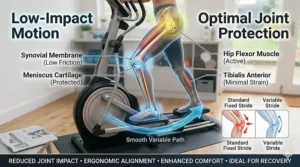
Elliptical training delivers cardiovascular benefits with minimal joint loading — particularly valuable as knee and hip cartilage deteriorates with age. What older UK users prioritise differs from younger buyers: lower step-on height for mounting ease, wide pedal bases for stability, visible large-format displays readable without glasses, and simple resistance adjustment without confusing digital menus. The JTX Strider-X7 excels here: straightforward controls, reliable build, modest learning curve. Avoid app-connected machines unless the user is already comfortable with smartphones — the Aeriflo M100 or Bluefin CURV 2.0 require digital literacy that proves frustrating for less tech-savvy buyers.
Long-Term Cost and Maintenance in the UK
The purchase price represents a fraction of total ownership cost over a machine’s 5-10 year lifespan. British buyers must factor replacement parts availability, maintenance requirements, and running costs that accumulate invisibly.
Parts Availability and Warranty Realities
UK consumer law provides automatic 6-month warranty protection regardless of manufacturer terms, but proving faults existed at purchase becomes your burden after those six months. Extended warranties matter: the JTX Tri-Fit 2.0‘s 2-year in-home warranty includes engineer call-outs, valuable when you’re untangling complex electronic issues. Budget brands often provide warranties but require you to ship defective machines to depots (at your expense for returns over 30 days), making a £200 machine repair cost £280 after courier fees. Replacement parts — particularly flywheel bearings, resistance magnets, and consoles — must ship from UK warehouses to be economical; imported parts from China or mainland Europe now incur post-Brexit customs delays and potential duties.
Annual Maintenance and Running Costs
Magnetic ellipticals require minimal maintenance compared to treadmills (no belt to lubricate or replace) or rowing machines (no chain or water tank issues). Annual tasks: cleaning dust accumulation from console ventilation slots (15 minutes), checking bolt tightness (30 minutes), testing resistance level functionality (5 minutes). Replacement parts you’ll eventually need: pedal foot straps (£15-30 per pair, every 2-3 years), console batteries if wireless (£5-10, every 1-2 years), floor protection mat if not purchased initially (£20-35). Total annual cost: roughly £10-30 depending on usage intensity.
Energy Consumption for Plug-In Models
Most ellipticals reviewed here generate their own power through pedalling momentum — no electrical outlet required. The JTX Tri-Fit 2.0 and app-connected models require mains power for electronic features. At UK electricity rates (roughly 34p per kWh as of 2026), a 50-watt console running 30 minutes daily costs approximately £3 annually — negligible compared to heated outdoor sports facilities or gym memberships. Factor this when comparing self-powered budget models to plug-in premium options; the electrical cost won’t influence your decision, but outlet proximity might.
Resale Value Considerations
British elliptical resale market (eBay, Facebook Marketplace, Gumtree) consistently shows equipment depreciates 40-60% immediately after purchase, then plateaus. A £600 machine sells for £250-350 used; a £250 machine fetches £80-120. Premium brands with strong reputations (JTX, Life Fitness, NordicTrack) maintain value better than budget brands (Dripex, generic imports). If you anticipate upgrading within 2-3 years, factor resale into total cost of ownership — sometimes buying £600 equipment that resells for £300 costs less net than buying £250 equipment that resells for £70. Collection-only listings dominate the market due to shipping costs; buyers within 20 miles of urban centres find far more options than rural dwellers.
Frequently Asked Questions
❓ Are variable motion elliptical trainers worth the extra cost compared to fixed-stride models?
❓ Can elliptical trainers genuinely replace running for cardiovascular fitness in the UK?
❓ Do I need Kinomap or app connectivity, or are basic models sufficient?
❓ How much space do I actually need for an elliptical in a typical UK home?
❓ Are Amazon.co.uk ellipticals genuine UK models or imports requiring voltage adapters?
Conclusion: Your Next Steps to Better Indoor Training
The British fitness landscape has shifted irreversibly. Gym memberships feel increasingly inconvenient when traffic congestion means 40 minutes commuting for a 30-minute workout. Outdoor running battles six months of rain, early darkness, and increasingly hostile road infrastructure. Variable motion elliptical trainers address both frustrations whilst preserving cardiovascular fitness and joint health in ways traditional exercise equipment cannot match.
Your ideal choice depends on circumstances: serious multi-user households justify the JTX Tri-Fit 2.0‘s £700-900 investment for genuinely adjustable stride and premium build. Tall individuals above 5’10” benefit specifically from the MERACH Long Stride‘s 47-48 cm stride at mid-market pricing. Budget-conscious buyers starting their fitness journey find excellent value in the JTX Strider-X7‘s heavyweight flywheel and proven reliability.
What matters more than specific model selection is matching equipment to your actual training habits rather than aspirational intentions. A £250 machine used three times weekly delivers superior fitness outcomes to a £900 machine used three times monthly. Start with mid-tier equipment, prove consistent training to yourself over 2-3 months, then upgrade if needed. The British elliptical resale market will absorb your initial purchase at reasonable depreciation rates.
Final consideration for UK buyers: check Amazon.co.uk’s current pricing and Prime eligibility before purchasing. Free next-day delivery often tips the value equation decisively compared to waiting weeks for non-Prime options or paying £50-100 courier fees. Spring typically sees higher availability and occasional promotional pricing as manufacturers clear inventory ahead of summer outdoor training season.
Recommended for You
- 7 Best 3D Motion Cross Trainers UK 2026
- 7 Best Horizontal Cross Trainers UK 2026
- 7 Best Lateral Trainer for Weight Loss UK 2026
Disclaimer: This article contains affiliate links. As an Amazon Associate, I earn from qualifying purchases. If you purchase products through these links, we may earn a small commission at no additional cost to you.
✨ Found this helpful? Share it with your mates! 💬🤗
