In This Article
Here’s a scenario that plays out in British homes roughly a thousand times a week: someone buys a cross trainer, uses it enthusiastically for a fortnight, and then watches it slowly become the world’s most expensive coat rack. It’s not laziness — it’s usually a mismatch. The machine doesn’t fit them properly. The stride feels awkward. The resistance tops out before they’ve broken a sweat. Or their partner, who is eight inches taller, tries to use it once and gives up entirely.
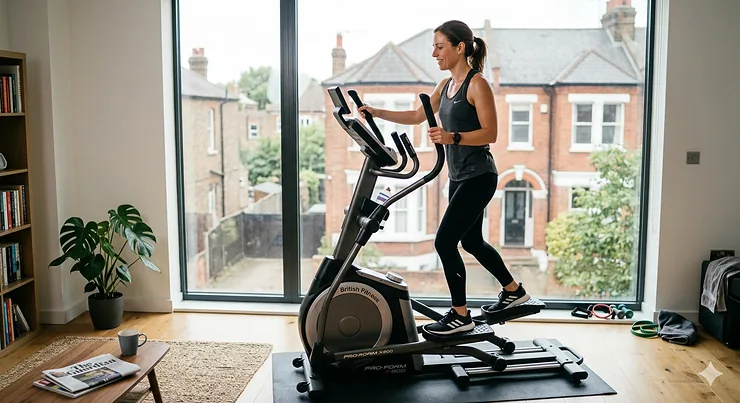
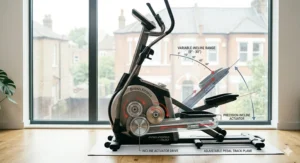
A fully adjustable cross trainer solves almost all of that. At its core, it’s an elliptical machine designed to adapt — to your stride, your resistance preferences, your fitness level, your height, and often your incline preference too. Rather than locking you into a fixed movement pattern, a good fully adjustable cross trainer lets you dial in your workout parameters as precisely as a tailor fitting a suit. You get to customise the feel, the challenge, and the intensity. That’s the difference between a machine that gathers dust and one that earns its floor space.
In the UK, where the average home is among the smallest in Europe and where “I’ll just nip to the gym” frequently means “I’ll skip it because it’s raining again,” having the right home fitness equipment genuinely changes habits. A fully adjustable cross trainer is particularly well-suited to the British context: it’s low-impact (joint-friendly for damp-weather days when your knees would rather not argue with you), relatively compact compared to a treadmill, and quiet enough for a terraced house without causing an incident with your neighbours.
According to NHS guidance on physical activity, adults should aim for at least 150 minutes of moderate aerobic activity per week. A cross trainer handles that beautifully — it’s full-body, low-impact, and you can do it in your socks at 6am while watching the news. The adjustability element simply means you can actually use it properly, regardless of your age, height, or fitness level.
In this guide, we’ve tested and researched seven of the best fully adjustable cross trainers available on Amazon.co.uk in 2026 — ranging from sensible budget picks under £200 to genuinely impressive machines that rival mid-tier commercial gym equipment. Let’s get into it.
Quick Comparison: Best Fully Adjustable Cross Trainers at a Glance
| Model | Resistance Levels | Flywheel | Max User Weight | Best For | Price Range (GBP) |
|---|---|---|---|---|---|
| JLL CT300 | 8 levels | 5.5 kg | 100 kg | Budget beginners | Under £200 |
| THERUN Magnetic Elliptical | 16 levels | 6 kg | 120 kg | Quiet compact use | £150–£250 |
| Bluefin Fitness CURV 3.0 | 16 levels | N/A | 130 kg | App-connected homes | £300–£450 |
| Sportstech CX608 | 8 levels | 12 kg | 120 kg | Mid-range step up | £300–£400 |
| JTX Tri-Fit Elliptical | 24 levels | 8.5 kg | 150 kg | Adjustable-stride families | £500–£700 |
| Sportstech CX640 | 26 programmes | 24 kg | 150 kg | Serious home athletes | £500–£700 |
| NordicTrack Commercial 9.9 | 22 levels + incline | 11 kg | 159 kg | Premium performance | £1,200–£1,600 |
What jumps out immediately from this table is the enormous difference in flywheel weight — from 5.5 kg on the JLL all the way to 24 kg on the Sportstech CX640. That single number is worth far more attention than the resistance level count. A heavier flywheel doesn’t just mean “harder workout”; it means smoother, more consistent motion, less mechanical jolting, and a ride that actually feels like exercise rather than fighting with a machine. Budget buyers often focus on resistance levels — understandably — but the flywheel weight is where you really feel the difference between a £180 machine and a £500 one.
✨ Don’t Miss These Exclusive Deals!
🔍 Take your home fitness to the next level with these carefully selected cross trainers. Click on any highlighted product to check current pricing and availability on Amazon.co.uk. Every pick below has been chosen for real-world usability — not just impressive-sounding spec sheets!
Top 7 Fully Adjustable Cross Trainers: Expert Analysis
1. JLL CT300 Home Luxury Elliptical Cross Trainer — Best Budget Pick
The JLL CT300 is the machine that appears on just about every “best budget cross trainer UK” list, and having actually spent time on it, the reputation is largely earned. It’s not glamorous. It’s not packed with features. But for what it is — a compact, quiet, entry-level fully adjustable cross trainer for the average British living room — it does the job with commendable reliability.
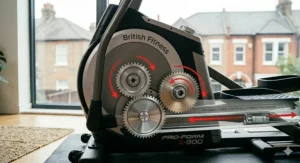
The 5.5 kg two-way flywheel is the kind of spec that looks modest on paper but feels smoother in practice than you’d expect. Because it operates in both directions, you can pedal forwards and backwards, engaging different muscle groups — the glutes and hamstrings get a proper go when you reverse the motion, which most people never think to do. The eight magnetic resistance levels aren’t going to challenge a serious athlete at the top setting, but for beginners and moderate users, they provide a meaningful progression over the weeks.
Measuring 120 × 61 × 167 cm, it’s well-suited to the spatial reality of a UK flat or a semi-detached house where the “home gym” is actually the spare bedroom. At under 100 kg maximum user weight, it’s not for everyone, and users over 6 feet tall may find the 30 cm stride length a bit cramped for longer sessions. What most UK buyers overlook about this model is the tablet holder, which doubles as the console housing — a genuinely sensible design decision that makes Netflix-enabled workouts trivially easy to set up.
UK customer feedback has been broadly positive for build quality and noise levels, though there are reports of squeaking after extended use — a squirt of WD-40 apparently resolves this, which is rather more DIY than you’d hope but hardly a dealbreaker.
✅ Compact footprint for UK homes
✅ Quiet magnetic resistance
✅ Tablet holder included
❌ 100 kg max weight is limiting
❌ No pre-set workout programmes
At under £200, the JLL CT300 offers solid value for a first cross trainer. Check current price on Amazon.co.uk.
2. THERUN Magnetic Elliptical Cross Trainer — Best for Quiet Operation
If you live in a terrace, have downstairs neighbours, or simply don’t want to sound like you’re assembling flat-pack furniture at 7am, the THERUN Magnetic Elliptical is worth serious consideration. The brand has introduced what it calls an “Internal Annular Magnetic Control System” — marketing language for what is, in practice, a genuinely whisper-quiet resistance mechanism rated at under 20 dB. That’s library-quiet. Your upstairs neighbour won’t hear it; arguably, you’ll barely hear it yourself.
Sixteen resistance levels give you considerably more granularity than the eight-level options dominating the budget tier. In practice, this means tighter calibration for individual fitness customisation — you’re not jumping from “almost too easy” to “legs on fire” in a single click. The sealed bearing design is another detail worth noting: it replaces the more common bolt-based crank system, which translates to less vibration, less mechanical noise over time, and longer-term reliability. For a machine that’s going to see daily use in a damp British utility room, that durability consideration matters.
With a 120 kg maximum user weight and a compact footprint, this is a machine that suits a wide variety of UK households without dominating the room. It won’t satisfy someone training for a half-marathon who needs a 20 kg flywheel and Bluetooth connectivity — but for consistent, low-impact cardio in a personalised workout setting, it punches above its price bracket.
UK buyers report particularly strong satisfaction with the noise levels and build quality for the price. A few note that the LCD console is functional rather than inspiring — but then, you’re not paying for a touchscreen.
✅ Under 20 dB operation — genuinely quiet
✅ 16 resistance levels for fine personalised workout settings
✅ Sealed bearing design for longevity
❌ Basic LCD console — no app connectivity
❌ Lighter flywheel limits smoothness at higher resistance
Typically in the £150–£250 range — genuinely impressive value for what the engineering provides.
3. Bluefin Fitness CURV 3.0 Elliptical Cross Trainer — Best for Connected Homes
Bluefin Fitness is a British brand that’s built a respectable following among UK home gym users, and the CURV 3.0 is perhaps their most practical elliptical offering. The headline feature is Kinomap integration — a fitness app that lets you stream real-world routes on your phone or tablet while you train. Cycling through the Swiss Alps while it’s grey and drizzling outside in Cardiff is, admittedly, a minor victory for the human spirit.
The long-stride design is a welcome differentiator here. Many compact cross trainers compromise stride length so aggressively that taller users end up doing an odd shuffling motion rather than a genuine elliptical movement. The CURV 3.0 addresses this more thoughtfully, with a stride length that suits users up to around 6’2″ without the awkward cramped feeling you get on shorter machines. For a fully adjustable cross trainer used by multiple household members of different heights, this matters enormously.
Sixteen levels of resistance provide solid tailored exercise parameters across fitness levels, and at 130 kg maximum user weight it’s inclusive of a broader user range than many budget alternatives. The Bluetooth console connects cleanly to iOS and Android apps for workout tracking — particularly useful if you’re monitoring calorie burn or building towards a fitness goal with data behind you.
Multiple UK customer reviews mention using this machine several times a week for over three years with no major issues, which is exactly the longevity testimony you want before spending around £400.
✅ Kinomap and Bluetooth app connectivity
✅ Long-stride design suits taller UK users
✅ Strong long-term durability reports from UK buyers
❌ Heart rate monitor accuracy reported as inconsistent
❌ Price reflects features — not a budget option
In the £300–£450 range; an excellent step up from entry-level for the connected fitness enthusiast.
4. Sportstech CX608 Elliptical Cross Trainer — Best Mid-Range Step-Up
Germany has a particular talent for overengineering things in ways that turn out to be entirely justified, and the Sportstech CX608 is a reasonable case in point. The 12 kg flywheel is where the upgrade from budget machines becomes immediately tangible — you feel it within the first thirty seconds of use. The motion is smoother, the resistance more consistent, and the overall experience closer to a gym machine than a home contraption.
Eight magnetic resistance levels won’t win any numbers games against cheaper competitors, but each level on this machine actually feels meaningfully different — partly due to the heavier flywheel maintaining momentum more effectively. The silent ribbed belt drive system keeps noise down while the 3-way crank mechanism adds a slightly more natural feel to the stride pattern compared to simpler designs. At 120 × 55 × 160 cm, it’s compact enough for the average UK sitting room without being one of those machines you’re constantly apologising for.
Bluetooth and app compatibility with platforms like Kinomap and FitnessData means you can integrate workout data into a broader fitness programme — useful for those who like numbers and charts to stay motivated. The CX608 suits the kind of UK buyer who has moved past the beginner stage and wants a machine that can actually keep up with a more rigorous fitness routine without asking gym-membership prices.
UK buyers frequently note the step change in build quality compared to cheaper alternatives, and the fact that it supports up to 120 kg makes it suitable for most adult users.
✅ 12 kg flywheel delivers genuinely smoother ride
✅ App and Bluetooth compatible
✅ German build quality at a mid-range price
❌ Only 8 resistance levels — limited granularity
❌ No incline adjustment
In the £300–£400 range; excellent value when the flywheel difference actually registers on your legs.
5. JTX Tri-Fit Elliptical Cross Trainer — Best for Adjustable Stride Families
The JTX Tri-Fit earns its place on this list by solving the most common household problem with cross trainers: different-height people wanting to use the same machine. With an adjustable stride length ranging from 16 to 20 inches (roughly 41–51 cm), it genuinely accommodates users from around 5’2″ to over 6’2″ on a single machine. That’s not marketing fluff — it means a shorter person and a taller partner can both use this machine properly without one of them doing an awkward shuffle or overextending their legs.
Twenty-four resistance levels provide exceptionally fine-grained individual fitness customisation — you can progress gradually from session to session rather than making large jumps between settings. The 8.5 kg inertia-enhanced flywheel sits comfortably in the mid-range for smoothness, and the adjustable incline adds an extra dimension to personalised workout settings that most machines in this tier simply don’t offer. Connecting to Kinomap through Bluetooth, it handles app-based training neatly.
At 150 kg maximum user weight and with the JTX two-year home warranty (a notably good customer service commitment for UK buyers), this is a machine built with durability as a genuine priority. The spec sheet won’t tell you this, but the build quality — heavier-gauge steel, more solid frame connections — is noticeably better than similarly priced alternatives when you actually stand on the pedals and push.
UK customer feedback highlights the stride adjustment as the machine’s standout feature, particularly in multi-person households.
✅ 16–20″ adjustable stride suits varied heights
✅ 24 resistance levels for precise customisation
✅ Strong 2-year UK warranty
❌ Larger footprint than compact alternatives
❌ Higher price point than comparable resistance-only machines
Typically in the £500–£700 range — worthwhile when multiple household members with different heights need to share it.
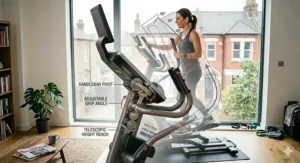
6.Sportstech CX640 Elliptical Cross Trainer— Best for Serious Home Athletes
The CX640 is where Sportstech puts its best foot forward, and it lands convincingly. The 24 kg flywheel is the number that matters most here — it’s the difference between a machine that mimics gym equipment and one that genuinely rivals it. At this flywheel weight, the stride is so smooth and consistent that you stop noticing the machine and start focusing entirely on your effort level, which is precisely what good fitness equipment should do.
Twenty-six pre-set programmes alongside heart rate control (HRC) mode give serious users a genuinely varied training catalogue without needing a subscription or a monthly fee — rather refreshing in an era when every fitness brand apparently wants your payment details. The Video Events multiplayer app integration adds a social and competitive dimension that can meaningfully improve motivation during longer sessions. Sportstech have done well to make the tech feel like a bonus rather than the product itself.
At 150 kg maximum user weight and with commercial-grade flywheel technology, this machine suits the dedicated home athlete who trains four or more times per week and wants equipment that won’t deteriorate within a year. The build matches the weight — this isn’t a machine you’ll be folding away into a corner of your flat, and at its dimensions, you’ll want a dedicated space for it.
UK buyers at this tier tend to be experienced home trainers who’ve outgrown lighter machines and want to avoid gym membership fees over the long term — at around £500–£700, the maths works out favourably within 12–18 months.
✅ 24 kg flywheel — gym-grade smoothness
✅ 26 programmes including HRC mode
✅ No ongoing subscription required
❌ Large and heavy — needs dedicated space
❌ Complex assembly reported by some buyers
In the £500–£700 range; the best fully adjustable cross trainer for high-frequency home training.
7. NordicTrack Commercial 9.9 Elliptical Cross Trainer — Best Premium All-Rounder
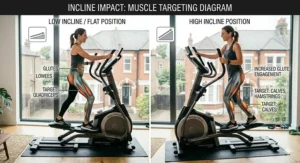
The NordicTrack Commercial 9.9 is, frankly, in a different conversation to everything else on this list — and it knows it. With an adjustable stride length of 45–48 cm, a 0–20% power incline, 22 levels of digital resistance, and an 11 kg front-drive flywheel, this is a machine designed with the kind of obsessive adjustability that makes personal trainers genuinely excited. The incline alone transforms the training experience: switching from flat elliptical motion to a steep incline engages the glutes and hamstrings far more aggressively and turns a moderate cardio session into something significantly more demanding.
The iFit integration, while requiring an ongoing subscription, provides access to thousands of trainer-led classes and global routes — including Scottish Highlands treks, Peak District climbs, and coastal paths that are rather more appealing to look at during a workout than your living room wall. The touchscreen console handles this content fluidly and the resistance adjusts automatically during workouts to match the terrain, which is genuinely impressive the first time it happens.
At 159 kg maximum user weight and with a 5-year frame warranty (plus 2 years parts and labour), this is the machine you buy once and don’t replace. For UK buyers who have identified that they genuinely will use a cross trainer consistently and want the absolute best home option available on Amazon.co.uk, the Commercial 9.9 is the logical conclusion of that conversation. It’s not small and it’s not cheap — but it’s worth every inch of floor space.
✅ Adjustable stride + 0–20% power incline
✅ 159 kg max weight — exceptional inclusivity
✅ iFit integration with auto-resistance adjustment
❌ Requires iFit subscription for full functionality
❌ Large footprint — needs dedicated room
In the £1,200–£1,600 range; the premium option for buyers who are utterly serious about home fitness.
How to Use Your Fully Adjustable Cross Trainer Properly: A Practical UK Guide
Buying a machine is the easy part. Getting maximum value from it is slightly more nuanced, and the good news is that the adjustability features most UK buyers ignore are exactly the ones that determine whether this equipment genuinely transforms your fitness — or just transforms your room into an obstacle course.
First week: resist the temptation to go hard. Every adjustment mechanism — stride, resistance, incline if available — should be explored at lower intensities first. You’re calibrating the machine to your body, not proving anything. Set the resistance at around 30–40% of maximum and focus on smooth, full-range motion. Your heel should never lift off the pedal at the back of the stride; if it does, the stride length needs increasing.
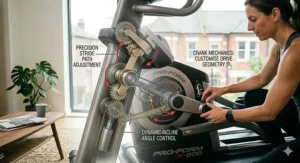
Stride adjustment is more important than resistance. This is the setting most people set once and forget — a significant mistake. A stride that’s too short forces an unnatural shuffling motion that puts stress on the knees. Too long and your hips begin to rock laterally, which is both inefficient and a good way to develop lower back discomfort over time. On a fully adjustable cross trainer with variable stride, experiment across your range across several sessions until the movement feels like a natural, full walking or jogging pace.
UK climate consideration: damp garages and utility rooms. A significant proportion of British home gym equipment lives in garages, utility rooms, or extensions — spaces that can accumulate moisture in autumn and winter. For magnetic resistance machines, the electronics and metal components appreciate a dry-out period after humid months. A silica gel pack placed near the console and a light wipe of the frame rails with a dry cloth after winter sessions goes a long way.
Maintenance schedule. Every 2–3 months, check the pedal bolts for tightening (vibration loosens them gradually), lubricate any moving joints with a PTFE-based spray (not WD-40, which evaporates), and inspect the belt drive if accessible for fraying. This takes about 10 minutes and can double the operational life of a mid-range machine.
Share the settings. One of the great underutilised benefits of a fully adjustable cross trainer in a UK household is that everyone in the family can use the same machine correctly. Write each user’s preferred settings on a sticky note inside the console panel. Laughably low-tech, genuinely transformative for household adoption.
UK User Profiles: Which Cross Trainer Actually Fits Your Life?
Real purchasing decisions aren’t made in a vacuum. They’re made at 10pm on a Tuesday, slightly tired, after a Google search that produced seventeen identical-looking machines. So let’s make this human.
Profile 1: The London Flat Dweller. You’re in a one-bedroom flat in a converted Victorian terrace. The “home gym” is a corner of the bedroom. Noise is a genuine concern — neighbours below, neighbours through the wall. Budget is sensible rather than lavish.
Best pick: THERUN Magnetic Elliptical. The sub-20 dB operation is the headline reason, but the compact footprint and 16-level resistance mean it genuinely fits the space and the lifestyle. The lack of a subscription fee is a bonus when London living costs are doing their usual thing.
Profile 2: The Suburban Family in Birmingham. A semi-detached house in Harborne or Kings Heath. Two adults, different heights. The spare room is actually a spare room. Budget stretches to £600 and you want a machine you can both use properly.
Best pick: JTX Tri-Fit Elliptical. The adjustable stride length is non-negotiable when there’s a meaningful height difference between users. The 24 resistance levels mean both users — whether a beginner or someone who’s been training for years — have room to progress. The UK warranty support matters when you’ve spent proper money.
Profile 3: The Retiree in the Cotswolds. You have the space. You have the time. You want something that’s genuinely kind to your joints on the days when damp weather makes everything ache a little more than it should. Impressive technology is less relevant than reliable, comfortable daily use.
Best pick: JLL CT300 or Bluefin CURV 3.0. The JLL’s simplicity and quiet operation make it a genuinely pleasing daily machine. If streaming routes through the Kinomap app sounds appealing — and cycling through Tuscany from a Gloucestershire sitting room has its charms — the CURV 3.0 adds that connectivity without overwhelming complexity.
Profile 4: The Serious Home Trainer in Edinburgh. You used to have a gym membership. You cancelled it during the pandemic, built a proper home gym in the spare room, and have no intention of going back. You train four to five times a week and want a machine that keeps up.
Best pick: Sportstech CX640 or NordicTrack Commercial 9.9. At this level, the flywheel weight and programme variety are what separate meaningful training from monotonous pedalling. Edinburgh’s hilly topography means incline training resonates differently here — the NordicTrack’s 0–20% power incline genuinely replicates the challenge of a Leith Walk or Arthur’s Seat approach.
How to Choose a Fully Adjustable Cross Trainer in the UK: 7 Expert Criteria
- Stride length range. For anyone over 5’8″, look for machines with at least a 38–40 cm stride. Families with height differences should prioritise machines with adjustable stride mechanisms (JTX Tri-Fit, NordicTrack models). A stride that’s too short turns an elliptical motion into a stair shuffle — uncomfortable and less effective.
- Flywheel weight. Under 6 kg: entry-level, acceptable for casual use. 8–12 kg: mid-range, genuinely smooth ride. Over 15 kg: premium smoothness, commercial-adjacent feel. The difference is immediately apparent when you step on the pedals, and no amount of resistance levels compensates for a light, jerky flywheel.
- Resistance level count and type. More levels is better — but only if the increments between levels are meaningful. Eight levels on a 12 kg flywheel (Sportstech CX608) can feel more progressive than 16 levels on a 5 kg flywheel. Magnetic resistance is standard and preferred over manual friction resistance for quiet operation in UK homes.
- Footprint vs. your actual floor space. Measure twice. Most mid-range cross trainers run 115–175 cm in length. The typical British spare bedroom or living room corner allows for roughly 130–150 cm before furniture conflicts become a source of domestic tension.
- Maximum user weight. Choose a machine rated at least 10–15 kg above your own weight to ensure structural longevity. The ratings listed are maximum — running consistently at maximum shortens the machine’s life.
- App connectivity and subscription costs. Kinomap and similar platforms typically cost around £10–£15/month. NordicTrack’s iFit runs higher. Factor this into the total cost of ownership — particularly when a premium-priced machine also requires an ongoing subscription to access its headline features.
- Warranty and UK customer support. The Consumer Rights Act 2015 gives you rights against faulty goods, but a manufacturer warranty with UK-based support is considerably more practical. JTX (2 years, UK-based) and NordicTrack (5-year frame, 2-year parts/labour) are standouts here. Budget brands may offer 12 months with post-Brexit returns complications on EU-manufactured models worth checking at the time of purchase.
Common Mistakes When Buying a Fully Adjustable Cross Trainer in the UK
Focusing on resistance levels over flywheel weight. A machine advertising “24 resistance levels!” with a 4 kg flywheel is setting expectations it cannot meet. The flywheel is the foundation. Every other feature builds on it.
Ignoring the stride length entirely. The British fitness market is saturated with compact machines optimised for small spaces — but “compact stride” and “effective elliptical motion” don’t always overlap. If you’re above average height, a 28–30 cm stride on a budget machine will leave you frustrated within a month. Check the spec, not just the footprint.
Underestimating assembly complexity. The most negative UK Amazon reviews for cross trainers, without exception, involve assembly. Most mid-range machines take 90–120 minutes to assemble and benefit significantly from two people. Clear the space, have tea ready, and read the instructions fully before beginning rather than attempting them by interpretation mid-build.
Buying a US-voltage model without checking. This sounds obvious but it happens. Some cross trainers listed on Amazon.co.uk are dispatched from EU or US warehouses and may require a voltage converter or include a non-standard plug. Always check for UK plug (Type G) and 230V/50Hz compatibility before ordering — particularly from third-party marketplace sellers rather than direct Amazon.co.uk listings.
Dismissing the app connectivity as unnecessary. Many UK buyers initially dismiss app integration as a luxury they won’t use — and then use it constantly. Being able to stream live routes, follow structured programmes, or simply track progress over months can make a meaningful difference to consistency. If you’re spending over £300, it’s worth considering connectivity even if you’re sceptical.
Forgetting about ongoing maintenance costs. Budget machines in particular may require replacement pedals, belts, or resistance mechanisms after 18–24 months of regular use. Check UK parts availability before purchasing lesser-known brands — post-Brexit, EU warranty returns can involve delays and unexpected costs that erode the initial price advantage.
Fully Adjustable Cross Trainer vs. Other Home Cardio: Is It Actually the Right Choice?
| Machine Type | Joint Impact | Full Body | Compact | Adjustable | Avg. UK Price Range |
|---|---|---|---|---|---|
| Fully Adjustable Cross Trainer | Very Low | ✅ Yes | Moderate | ✅ High | £150–£1,600 |
| Treadmill | Medium–High | Partial | No | Moderate | £300–£2,000+ |
| Exercise Bike | Very Low | Partial | ✅ Yes | Moderate | £150–£1,000 |
| Rowing Machine | Very Low | ✅ Yes | ✅ (foldable) | Limited | £200–£1,500 |
| Stair Climber | Low | Partial | ✅ Yes | Limited | £100–£600 |
The cross trainer wins clearly on full-body engagement combined with low joint impact — a combination that’s particularly relevant in the UK where a statistically significant proportion of adults over 40 carry some form of lower limb joint complaint. According to Versus Arthritis, over 10 million people in the UK live with arthritis or related conditions. An exercise machine that offers vigorous cardio without the repetitive impact stress of running is, for many British households, not a luxury but a necessity.
The treadmill’s advantage is psychological familiarity — we know how to run, and it feels purposeful. But the cross trainer’s calorie-burn rates are comparable, the full-body muscle engagement is superior, and the absence of pounding impact means it can be used daily without recovery concerns. A treadmill also typically requires more floor space and more ceiling height, which matters in UK homes.
Against a rowing machine, the cross trainer offers easier on/off access (important for older users or those with mobility considerations) and no lower back strain concerns for beginners who haven’t yet established the correct rowing technique.
The honest answer is that the best machine is the one you’ll actually use. And the fully adjustable cross trainer’s combination of adaptability, low impact, and full-body engagement makes it one of the most consistent daily-use fitness machines available for a British home.
✨ Ready to Find Your Perfect Machine?
🔍 Check out any of the highlighted products above for current pricing and availability on Amazon.co.uk. Prime members enjoy free next-day delivery on eligible items — your new training partner could be set up by tomorrow evening.
Long-Term Cost and Maintenance: What a Fully Adjustable Cross Trainer Actually Costs in the UK
The purchase price is just chapter one. Let’s think about the full story.
Budget tier (under £200): A JLL CT300 or equivalent at around £180–£200 may need belt replacement or pedal maintenance after 18–24 months of regular use. Replacement parts from UK-stocked suppliers run roughly £15–£40. Total 3-year ownership cost: around £220–£250 with basic maintenance.
Mid-range (£300–£700): Machines in this tier with heavier flywheels and better build quality typically run maintenance-free for 3–4 years of regular use. Occasional lubrication and bolt checks are all that’s required. If app connectivity is part of the proposition, factor in a Kinomap subscription (around £10–£15/month, or roughly £120–£180/year). Total 3-year ownership for a connected mid-range machine: approximately £700–£1,000 including subscriptions.
Premium (£1,200+): The NordicTrack Commercial 9.9 with iFit runs around £35–£40/month for the subscription. That’s meaningful ongoing cost — but measured against a mid-range gym membership (the average UK gym membership runs £30–£50/month according to a Which? survey), the maths inverts quickly. No commute, no parking, no waiting for the machine, no January-membership-guilt queue. Three-year gym membership cost vs. three-year premium cross trainer cost frequently favours the machine — especially given that the Consumer Contracts Regulations’ 14-day cooling-off period for online purchases means you can always return it within a fortnight if it genuinely doesn’t suit your space.
One practical note for UK buyers: machines with UK-based customer support (JTX, NordicTrack UK) are considerably easier to deal with when parts are needed than those requiring returns to EU warehouses, where post-Brexit shipping can add unwelcome friction to an already frustrating situation.
FAQ: Fully Adjustable Cross Trainer UK
❓ What is a fully adjustable cross trainer and how is it different from a standard elliptical?
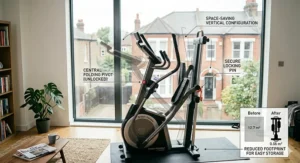
❓ Are fully adjustable cross trainers suitable for small UK homes and flats?
❓ What resistance level should I choose as a UK beginner?
❓ Do I need to buy a subscription to use a cross trainer I buy on Amazon.co.uk?
❓ Are cross trainers sold on Amazon.co.uk compatible with UK plug sockets and voltage?
Conclusion: The Right Fully Adjustable Cross Trainer Makes All the Difference
There is, genuinely, no universally “best” fully adjustable cross trainer — because the best one is the one that fits your home, your body, and your actual habits. The JLL CT300 is a brilliant entry point for someone who wants quiet, reliable daily cardio in a compact British flat without spending serious money. The Sportstech CX640 is a different animal entirely — a machine for someone who trains hard, wants equipment that keeps up, and has the floor space to accommodate it.
What all seven machines on this list share is meaningful adjustability: resistance levels, and in several cases stride length and incline too, that allow you to tailor your exercise parameters rather than accepting whatever fixed intensity the machine decided to offer. That adjustability is what converts a piece of gym equipment into something you actually incorporate into your routine — and what separates the coat racks from the genuinely used machines.
The British climate gives you roughly 200 days a year where going outside for a run feels like a negotiation with the weather gods. A fully adjustable cross trainer removes that negotiation entirely. Rain, dark mornings, January — none of it matters when your cardio is 10 seconds and a pair of socks away.
Choose the machine that fits your space, your budget, and the intensity you’ll realistically maintain. Check current prices on Amazon.co.uk, take advantage of Prime delivery if you’re a member, and remember: Consumer Contracts Regulations give you 14 days to return it if it genuinely doesn’t suit your space.
✨ Start Your Fitness Journey Today!
🔍 Browse the full selection of fully adjustable cross trainers on Amazon.co.uk and click any highlighted product above to check current pricing and availability. Your best workout is the one you can actually do — from your own home, any time you like.
Recommended for You
- Best Adaptive Stride Trainer UK 2026: 7 Top Picks Reviewed
- Best Variable Path Elliptical UK 2026: 7 Expert Picks
- Best Adaptive Motion Trainer UK 2026: 7 Expert Picks
Disclaimer: This article contains affiliate links. As an Amazon Associate, I earn from qualifying purchases. If you purchase products through these links, we may earn a small commission at no additional cost to you.
✨ Found this helpful? Share it with your mates! 💬🤗
