In This Article
Let’s be honest. The average British home is not built for a home gym. We live in terraced houses, purpose-built flats, and Victorian conversions where the “spare room” is optimistically named. The lounge doubles as the office. The bedroom floor is already doing important work housing shoes, books, and things you’ve been meaning to sort since 2019.
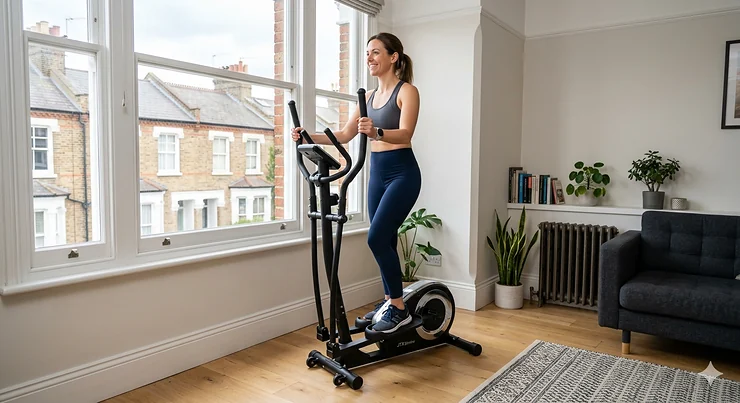
So when you start shopping for a cross trainer for small spaces, you quickly realise the fitness industry has a slight size problem. Many standard ellipticals measure upwards of 170 cm in length — roughly the same footprint as a dining table. That’s not a compact machine. That’s a housemate.
What you actually need is a space-saving fitness machine engineered with the British home in mind: something with a modest footprint, a sensible storage solution, and ideally the quietness not to annoy your neighbours through a Victorian party wall. According to NHS guidelines on physical activity, adults should aim for at least 150 minutes of moderate-intensity activity per week — and a good compact elliptical machine is one of the most joint-friendly, full-body ways to reach that target without leaving the house.
A cross trainer for small spaces typically describes any elliptical or glider-style machine with a footprint under roughly 100 cm × 60 cm, a compact stride length (usually 30–41 cm), and either a foldable frame or built-in transport wheels for storage. It’s the sweet spot between “actually usable” and “won’t take over your living room.” In this guide, you’ll find seven machines genuinely available on Amazon.co.uk — reviewed honestly, with real-world context for British buyers.
Quick Comparison: Best Cross Trainers for Small Spaces at a Glance
| Product | Approx. Footprint | Resistance Levels | Max User Weight | Best For | Price Range |
|---|---|---|---|---|---|
| MERACH Compact Elliptical Trainer | ~112 × 56 cm | 16 magnetic | 120 kg | App lovers, daily cardio | £150–£220 |
| Dripex Magnetic Cross Trainer | ~120 × 54 cm | 8 magnetic | 120 kg | Budget buyers, beginners | £120–£180 |
| Neezee Ultra-Quiet Cross Trainer | ~116 × 55 cm | 16 magnetic | 120 kg | Quiet flats, shared housing | £130–£190 |
| Neezee 2-in-1 Elliptical & Bike | ~115 × 54 cm | Adjustable | 120 kg | Versatility seekers | £160–£240 |
| Reebok ZR8 Elliptical Cross Trainer | ~148 × 63 cm | 32 electronic | 120 kg | Mid-range, programme variety | £280–£370 |
| Sunny Health & Fitness SF-E902SMART | ~100 × 52 cm | 5 levels | 100 kg | Ultra-compact, foldable storage | £130–£200 |
| JLL CT200 Home Elliptical | ~115 × 56 cm | 8 magnetic | 110 kg | Entry-level, brand reliability | £140–£200 |
The budget end (under £200) is genuinely competitive right now — the MERACH and Neezee models in particular punch well above their price tags. If you’re in a first-floor flat and noise is your primary concern, start with the Neezee or MERACH. If you’ve got slightly more space and want a proper workout programme progression, the Reebok ZR8 is worth the extra outlay. The Sunny SF-E902SMART is the one to pick if you’re working with a truly tiny corner and need full foldaway capability.
💬 Just one click — help others make better buying decisions too! 😊
✨ Don’t Miss These Exclusive Deals!
🔍 Take your home fitness to the next level with these carefully selected compact cross trainers. Click on any highlighted product to check current pricing and availability on Amazon.co.uk — and find the machine that fits your space and your goals.
Top 7 Cross Trainers for Small Spaces: Expert Analysis
1. MERACH Compact Elliptical Trainer for Home Use
The MERACH Compact Elliptical arrives with genuine ambitions. Sixteen levels of magnetic resistance, an LCD display, pulse sensors, a built-in tablet holder, and connectivity to the exclusive MERACH app — that’s an impressive feature sheet for a machine sitting comfortably in the under-£220 bracket.
In practical terms, the 16 resistance levels matter more than a spec sheet suggests. Budget machines with just 8 levels often feel either too easy or too hard, leaving a frustrating gap in the middle. With 16, you’ve got genuinely granular progression — handy whether you’re a returning-to-fitness type easing back in after a sluggish British winter, or someone building from scratch. The 120 kg weight capacity is solid, and the MERACH app (available on iOS and Android) adds live workout tracking and guided sessions that most competitors at this price don’t bother with.
What most UK buyers overlook about this model is the footprint. At approximately 112 × 56 cm — roughly the size of a large suitcase lying flat — it genuinely suits smaller British rooms. The built-in transport wheels mean you can slide it against a wall after use. It won’t fold flat, but the compact base helps enormously.
UK reviewers consistently praise the quiet operation, which is genuinely important in dense housing. Assembly runs about 45 minutes for most people working alone — manageable with the included instructions.
Pros:
- 16 resistance levels give real workout range
- App connectivity adds guided sessions and tracking
- Quiet magnetic drive suits shared walls and upstairs flats
Cons:
- Max 120 kg user weight isn’t the highest in class
- Stride length on the shorter side — taller users (over 185 cm) may feel restricted
Price range: £150–£220 | Check current price on Amazon.co.uk Verdict: Outstanding value for daily cardio in a compact flat. The app turns a budget machine into something that feels far more considered.
2. Dripex Magnetic Elliptical Cross Trainer
The Dripex Magnetic Cross Trainer has a bit of a cult following among UK budget fitness buyers, and it’s not hard to see why. The headline features — a 6 kg flywheel, 8 levels of magnetic resistance, pulse sensors, LCD monitor, and device holder — are all present and sensibly implemented for the price.
That 6 kg flywheel is what gives the Dripex its characteristic smooth feel. Cheaper machines use lighter flywheels that result in a jerky, uneven stride — the sort of motion that makes 20 minutes feel like swimming through treacle. The Dripex’s flywheel keeps the motion consistent, which matters if you’re doing low-impact sessions for joint recovery or rehabilitation. The magnetic resistance system (operating at around 20 dB, according to the manufacturer) is genuinely quiet — roughly the level of soft background music — making it one of the better apartment-friendly exercise machines in its category.
In my assessment, this is the right machine for a buyer who wants to establish a regular routine without spending a fortune and without filling their box room. The 8 resistance levels are limiting for anyone who progresses quickly, but for a beginner or returning exerciser using it three or four times per week, those 8 levels will sustain progress for six to twelve months easily.
UK users note that the steel frame feels robust for the price, and the rear transport wheels make moving it around a small flat genuinely painless. The device holder accommodates a phone or small tablet for entertainment — important for the long winter evenings when you’d rather be watching something than staring at a wall.
Pros:
- 6 kg flywheel delivers unexpectedly smooth stride
- Around 20 dB operation — genuinely quiet
- Solid steel frame, well-built for the price
Cons:
- Only 8 resistance levels — intermediate users will plateau
- No app connectivity
Price range: £120–£180 | Check current price on Amazon.co.uk Verdict: A no-fuss, dependable compact elliptical for beginners. What it lacks in features it more than makes up for in smooth, reliable operation.
3. Neezee Ultra-Quiet Compact Cross Trainer
The Neezee Ultra-Quiet Cross Trainer is a compelling proposition for anyone who lives in a flat above neighbours — which, in most British cities, is a significant portion of the population. Sixteen levels of magnetic resistance, pulse sensors, an LCD display, a device mount, and a 120 kg capacity in a compact footprint of roughly 116 × 55 cm. The headline selling point is noise reduction, and it delivers.
Here’s the thing about cross trainers in shared buildings: the issue usually isn’t the motor (there isn’t one) — it’s the vibration transmitted through the floor. The Neezee’s magnetic drive minimises mechanical vibration significantly, and with a rubber mat underneath (widely available on Amazon.co.uk for around £15–£25), you’ve got a genuinely considerate setup for urban living. Several UK reviewers specifically mention using it early morning without disturbing housemates — which, frankly, is the kind of real-world detail that matters more than any specification table.
The 16 levels of resistance match the MERACH for progression range, and at a similar price point, the choice between the two often comes down to whether you want app connectivity (MERACH) or a slightly more refined quiet operation (Neezee). For noise-sensitive situations, the Neezee edges ahead.
Assembly takes 30–45 minutes and is manageable for one person. The LCD display is basic but clear — it shows time, speed, distance, calories, and heart rate, which covers everything most users actually check mid-session.
Pros:
- Exceptionally quiet — thoughtful for flats and terraced houses
- 16 resistance levels for genuine workout progression
- Clean compact footprint suits small UK rooms
Cons:
- LCD display is functional rather than impressive
- No foldaway option for truly minimal spaces
Price range: £130–£190 | Check current price on Amazon.co.uk Verdict: The quiet achiever of the group. If you’re in a flat with thin floors and considerate instincts, this is your machine.
4. Neezee 2-in-1 Elliptical Cross Trainer and Exercise Bike
The Neezee 2-in-1 flips the script on the traditional compact elliptical by adding a full exercise bike function — which, in the context of British flat living, is actually quite smart. One machine, two distinct workouts, one footprint. It’s the kind of versatility that makes sense when you’re working with a bedroom corner rather than a dedicated studio.
The front-mounted flywheel on this model deserves a mention — it’s a deliberate design choice that improves stability compared to rear-flywheel competitors. Practically, this means less wobble during more intense intervals, and it also makes the machine slightly shorter front-to-back than a traditional elliptical design. The wide, padded seat converts the machine for bike-style seated sessions, which is particularly useful for anyone recovering from injury or for older users who find standing cross-trainer sessions taxing. The 120 kg capacity covers the majority of users comfortably.
What I’d caution against is expecting full gym-standard performance from either mode. The elliptical stride is slightly shorter than a dedicated trainer, and the bike seat is cushioned but not designed for extended cycling sessions. This is genuinely a jack-of-all-trades machine — ideal if you want variety and space efficiency, but less ideal if you’ve settled firmly on one type of training. For most UK home users doing 20–40 minute mixed sessions, that trade-off is entirely reasonable.
UK reviewers appreciate the ergonomic handles with sweat-proof foam and the non-slip pedals, noting that the build quality exceeds expectations at this price point.
Pros:
- Two workout modes in one compact footprint
- Front-mounted flywheel improves stability
- Comfortable seat for seated cycling sessions
Cons:
- Elliptical stride shorter than dedicated machines
- Not ideal for either mode at maximum intensity
Price range: £160–£240 | Check current price on Amazon.co.uk Verdict: The versatile option for flat-dwellers who want variety. Doesn’t excel at any single thing, but does two things adequately from one neat package.
5. Reebok ZR8 Elliptical Cross Trainer
Now we step up to the premium end of the compact category. The Reebok ZR8 is the machine you buy when you’ve stopped treating home fitness as an experiment and started taking it seriously. The 9 kg flywheel, 32 electronically controlled resistance levels, 20 pre-set workout programmes, a 38 cm stride length, and a 5.75″ backlit LCD display — this is a genuinely substantial machine at a mid-range price.
That 9 kg flywheel is the headline difference from budget alternatives. It produces a stride quality that genuinely resembles gym equipment — smooth, consistent, and satisfying under load. The 32 resistance levels mean you won’t plateau for years. The 20 built-in programmes include interval training and simulated incline climbs, which is the kind of structured progression most budget machines simply can’t offer.
The honest caveat here is footprint. At approximately 148 × 63 cm, the ZR8 is the largest machine on this list — borderline compact, depending on your room. That said, compared to full-size gym ellipticals (which often run to 200+ cm), it’s still meaningfully smaller. The transport wheels make moving it manageable, and the Reebok two-year warranty (covering parts and labour) is a meaningful reassurance at this price point. Reebok offers a dedicated UK helpline, which post-Brexit is worth noting — some European brands have patchy UK support.
UK users consistently rate the ZR8 highly for build quality and fluidity, with several long-term reviewers noting it’s still performing well after two or three years of regular use.
Pros:
- 9 kg flywheel delivers genuine gym-quality smoothness
- 32 resistance levels — won’t plateau for years
- Two-year UK warranty with local support
Cons:
- Largest footprint on the list — not for genuinely tight spaces
- No Bluetooth or app connectivity at this price point
Price range: £280–£370 | Check current price on Amazon.co.uk Verdict: The best machine on this list if you have the space and the budget. The step-up from budget options is immediately, noticeably real.
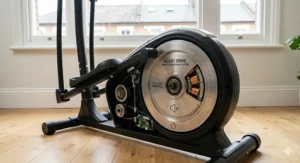
6. Sunny Health & Fitness SF-E902SMART Air Walk Cross Trainer
The Sunny Health & Fitness SF-E902SMART earns its place here for one very specific reason: it folds. Properly. In a category where most “compact” machines simply have a modest footprint, the SF-E902SMART has a foldable frame that reduces its storage profile meaningfully — essential for anyone in a one-bedroom flat where the machine needs to vanish after use.
The “Air Walk” motion is distinct from a standard elliptical — it mimics the natural arc of walking rather than a constrained oval path, which many users find easier on the knees and lower back. Five resistance levels and Bluetooth connectivity to the SunnyFit app round out a feature set that’s surprisingly coherent for the price. The app provides access to workout videos and virtual routes, which helps enormously with motivation during the dark British months when going outside feels actively hostile.
The trade-off is capacity and robustness. At 100 kg user weight, it’s the most restrictive on this list, and the frame — while sufficient — isn’t as solid as the heavier steel constructions of the Dripex or Reebok. This isn’t a machine for intense interval sessions; it’s a machine for consistent, moderate-intensity daily use by users who prioritise storage flexibility above all else. For a studio flat in Hackney, a flat in Glasgow’s West End, or a spare corner in a Cardiff terrace, it’s an honest and practical solution.
Pros:
- Genuine foldable design for ultra-small spaces
- Bluetooth and SunnyFit app connectivity
- Natural walking motion — easy on joints
Cons:
- 100 kg max capacity — the lowest on this list
- Only 5 resistance levels limits progression
Price range: £130–£200 | Check current price on Amazon.co.uk Verdict: The storage champion. If your primary constraint is “it needs to disappear when not in use,” this is your machine.
7. JLL CT200 Home Elliptical Cross Trainer
JLL is one of those UK fitness brands that tends to be undersold — reliable, well-supported domestically, and quietly popular with buyers who want a no-drama machine that simply works. The CT200 is their 2024 model, featuring 8 levels of magnetic resistance and an Advanced Momentum Mechanism engineered to simulate the feel of a 10 kg flywheel despite the machine’s compact dimensions.
That momentum mechanism is worth dwelling on. Lower-end ellipticals with lightweight flywheels produce a choppy, effortful stride that’s tiring in the wrong way — fighting the machine rather than working your muscles. JLL’s engineering approach smooths out the motion convincingly, delivering something that feels more premium than the price suggests. Combined with a heart rate sensor console and transport wheels, it’s a thoughtful package.
JLL’s UK customer service is genuinely rated highly by British buyers, which matters more than it might seem. Returns, warranty claims, and part replacements are meaningfully easier with a UK-based support team than with some of the direct-from-China brands on this list. For buyers who prioritise that sort of peace of mind — particularly first-time equipment purchasers — the JLL CT200’s domestic support network is a real differentiator.
The footprint is standard compact: approximately 115 × 56 cm, moveable on wheels, and liveable in most second bedrooms or dedicated corners.
Pros:
- Momentum mechanism produces smooth feel for its size
- UK-based customer support — easy returns and warranty
- Clean, reliable build quality
Cons:
- 8 resistance levels — adequate for beginners, limiting for intermediates
- No app connectivity
Price range: £140–£200 | Check current price on Amazon.co.uk Verdict: The sensible British buy. Less flashy than the MERACH, less premium than the Reebok, but supported domestically and unlikely to give you grief.
How to Set Up Your Cross Trainer in a Small Space: A Practical UK Guide
Buying the machine is only half the battle. Getting it to actually work in your home is where most people underestimate the planning required.
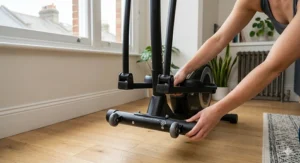
Measure twice, order once. Before you add anything to your basket, measure your available floor space with a tape measure — including ceiling height if you’re in a loft conversion or under a sloped roof. Most compact cross trainers are 160–175 cm tall in use. Add 50 cm of clearance on each side for comfortable arm movement, and 60 cm behind the machine for safe dismounting.
The floor matters more than you think. Most UK homes have either wooden floorboards (which amplify vibration) or carpet (which can snag transport wheels). A rubber equipment mat — roughly 120 × 60 cm, available on Amazon.co.uk for £15–£25 — solves both problems simultaneously. It protects your floor, dampens vibration (kind to downstairs neighbours), and gives the machine a stable, non-slip base. This is the single most impactful £20 accessory you can buy alongside any of the machines above.
Storage position is worth planning in advance. If your machine doesn’t fold (which most on this list don’t), identify the exact wall position where it will live and ensure there’s a clear path for the transport wheels. Machines left awkwardly in the middle of a room become obstacles, and obstacles become objects of resentment. Tuck it flush against a wall, ideally with a metre of clearance in front.
UK climate note: Avoid placing your machine in an unheated garage, conservatory, or shed over winter. The damp British cold can cause metal components to stiffen and, over time, corrode. If outdoor storage is unavoidable, a waterproof equipment cover (available on Amazon.co.uk in the £20–£35 range) is a worthwhile investment.
First 30 days: Resist the temptation to go hard immediately. Start with 15–20 minute sessions at moderate resistance, three times per week. Your joints — particularly ankles, knees, and hips — need time to adapt to the movement pattern. The NHS Couch to 5K principle of gradual progression applies equally well to cross training.
Who Should Buy Which Machine? UK User Profiles
Buying a cross trainer is surprisingly personal. The right machine depends on your space, your goals, your budget — and, frankly, your living situation. Here are three UK scenarios to help you self-identify.
Profile 1: The City Flat Dweller — London, Manchester, Edinburgh Emma rents a one-bedroom flat in Clapham. She works from home, her flat measures about 55 square metres, and her “gym space” is the 1.5 metre gap between her wardrobe and her window. Noise is a genuine concern — she’s directly above a light-sleeping retired couple. Budget: under £200.
Best fit: The Neezee Ultra-Quiet Cross Trainer or the Sunny SF-E902SMART. The Neezee’s near-silent operation is genuinely suited to this situation, and the MERACH is a close second. The Sunny wins if she genuinely needs to fold the machine away daily.
Profile 2: The Semi-Detached Suburbanite — Birmingham, Leeds, Bristol Mark and his partner have a three-bedroom semi in Solihull. There’s a spare bedroom that currently houses a treadmill nobody uses. He wants a cross trainer that feels premium enough to motivate consistent use, in a room about 3 metres × 3 metres. Budget: £300–£400.
Best fit: The Reebok ZR8 without question. The slightly larger footprint is no problem in this room, and the 32 resistance levels and 20 programmes provide the structure Mark needs to stay motivated long-term. The two-year UK warranty is a reassurance at this investment level.
Profile 3: The Recovering Runner — Anywhere in the UK Sarah has been advised by her GP to avoid high-impact exercise following a knee procedure. She wants a low-impact alternative for cardiovascular fitness, something she can do daily, ideally with seated options for bad days. Budget: flexible but practical.
Best fit: The Neezee 2-in-1 Elliptical & Bike. The seated cycling mode is a genuine asset for rehabilitation and low-intensity recovery sessions, while the elliptical mode provides higher-intensity options as she progresses. Exercise on an elliptical is classified as low-impact by NHS physiotherapy guidelines and widely recommended for joint rehabilitation.
How to Choose a Cross Trainer for Small Spaces: 7 Things That Actually Matter
Shopping for a compact elliptical machine online feels deceptively straightforward until you’re three hours deep in comparison tabs and still not sure. Here’s what to prioritise — and what the spec sheets won’t tell you.
1. Footprint vs. stride length — they’re in conflict. The shorter a machine’s footprint, the shorter its stride length tends to be. Most compact cross trainers offer 30–41 cm strides. For users under 175 cm, the lower end is fine. For taller users, a 38 cm+ stride becomes important for a natural, comfortable motion. Check both numbers before purchasing.
2. Flywheel weight matters more than resistance levels. A heavy flywheel (7 kg+) produces smooth, consistent motion regardless of resistance setting. A light flywheel with 16 resistance levels still feels choppy. The Dripex (6 kg) and Reebok ZR8 (9 kg) illustrate the difference across price brackets.
3. Magnetic resistance is non-negotiable for small spaces. Friction-based systems (common in the cheapest machines) are noisier and wear out faster. All seven machines in this guide use magnetic resistance — quieter, smoother, longer-lasting, and suitable for shared walls.
4. Transport wheels are essential, not optional. Even if you don’t plan to move your machine regularly, transport wheels make occasional repositioning (cleaning, rearranging furniture) vastly easier. Every machine on this list has them; if you find one that doesn’t, reconsider.
5. Weight capacity vs. your weight. A good rule: choose a machine rated at least 20 kg above your body weight. This isn’t about safety margins per se — it’s about longevity. Machines consistently used at or near their maximum capacity wear components faster.
6. Connectivity only matters if you’ll actually use it. The MERACH and Sunny SF-E902SMART both offer app connectivity. If you’re genuinely the kind of person who follows guided workouts, that’s valuable. If you’ll just put on a podcast and zone out (no judgement), you’re paying a premium for a feature you won’t use.
7. Warranty and UK support. Post-Brexit, returns and warranty claims on some European-stocked products have become slightly more involved. JLL and Reebok have established UK customer service operations. For other brands, check whether Amazon.co.uk itself is the seller (making returns straightforward under Consumer Contracts Regulations) or whether it’s a third-party seller with less clear returns processes.
Common Mistakes When Buying a Compact Cross Trainer (UK Edition)
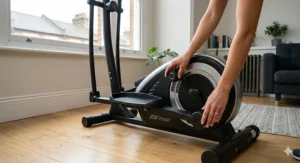
Buying on footprint alone. A machine with a 95 × 50 cm base sounds compact until you discover the moving handlebars extend 40 cm beyond the base in each direction during use. Always check the in-use dimensions, not just the static footprint.
Ignoring assembly requirements. Some cross trainers arrive in four large boxes and require two people and 90 minutes to assemble. If you’re in a first-floor flat with narrow stairs, verify the box dimensions before ordering. Amazon.co.uk’s product pages list package dimensions — check them.
Underestimating the noise of cheap alternatives. The very cheapest machines (under £80) often use friction resistance or inadequate flywheel bearings. The noise they generate can genuinely cause problems in shared buildings. Any of the machines in this guide operate quietly enough for urban flat use — go below the price ranges listed here, and you’re taking a risk.
Forgetting about VAT. All prices on Amazon.co.uk include 20% VAT, unlike US prices which typically exclude sales tax. When you see a UK price comparison with US equivalents, UK prices look higher — but the comparison isn’t like-for-like. The effective pre-VAT prices on this list are genuinely competitive.
Dismissing post-Brexit warranty considerations. Several compact ellipticals on the UK market are manufactured in China and sold via EU distributors. Post-Brexit, warranty claims on some of these can involve delays. Choosing a machine sold directly by the brand on Amazon.co.uk (rather than a third-party reseller) generally simplifies returns under the 14-day cooling-off period guaranteed by Consumer Contracts Regulations.
Cross Trainer vs. Exercise Bike for Small Spaces: The Honest Comparison
| Factor | Cross Trainer | Exercise Bike |
|---|---|---|
| Muscle groups | Full body (arms + legs + core) | Primarily lower body |
| Footprint | Slightly larger | Slightly smaller |
| Noise level | Low (magnetic) | Low (magnetic) |
| Joint impact | Very low | Very low |
| Calorie burn | Higher per session | Lower per session |
| Price (entry level, Amazon.co.uk) | From £120 | From £80 |
| Suitable for flat/shared housing | ✅ Yes | ✅ Yes |
| Foldable options available | Limited | More common |
The cross trainer wins on calorie burn and muscle engagement — because you’re moving both arms and legs simultaneously, you’re recruiting far more muscle mass per session than on a bike. A study published in the Journal of Strength and Conditioning Research found elliptical training produced comparable metabolic rates to treadmill running at equivalent effort levels — without the joint impact. For a small-space machine that does the most work per square metre occupied, a cross trainer is the more efficient choice.
The exercise bike wins on pure footprint (especially folding bikes) and seated comfort for longer sessions. If your primary concern is fitting something into a genuinely impossible corner or you have specific knee or back issues that make standing exercise difficult, a compact exercise bike may be preferable. But for most British home users wanting all-round cardio fitness from one compact investment, the cross trainer offers better value per use.
✨ Don’t Miss These Exclusive Deals!
🔍 Ready to find your ideal space-saving fitness machine? Click any highlighted product above to check current pricing and availability on Amazon.co.uk. Prime members enjoy free next-day delivery on most models — well worth checking if you’re eager to get started.
Long-Term Value: What It Actually Costs to Own a Compact Cross Trainer in the UK
People tend to think of exercise equipment as a one-off purchase. In reality, there’s a total cost of ownership worth understanding before you commit.
The machine itself: Ranging from around £120 for entry-level compact options to £370 for the Reebok ZR8. Consider this against a typical gym membership: the average UK gym membership runs approximately £30–£50 per month. At that rate, even a £300 cross trainer pays for itself within seven to ten months of regular use — and continues generating value indefinitely.
Accessories: A rubber floor mat (£15–£25) is essentially mandatory. A device holder if your machine doesn’t include one (£10–£15). Replacement foot pedal caps after a year or two (£5–£15). Total accessory spend over three years: approximately £50–£70.
Maintenance: Magnetic resistance machines have very few moving parts compared to motorised treadmills. There’s no motor to service, no belt to replace. Occasional lubrication of the central pivot points with light machine oil (available at any UK hardware store for a few pounds) is the primary maintenance requirement. Budget approximately £10–£20 per year for consumables.
Longevity: All seven machines in this guide use magnetic resistance, which is significantly more durable than friction systems. The weakest components are typically the pedal bearings and the console electronics. Machines used within their weight capacity and maintained properly routinely last five to seven years with home use. The Reebok ZR8’s two-year warranty is the strongest guarantee on this list; most budget machines offer 12 months.
Part availability: JLL and Reebok have UK parts and service networks. For newer brands like MERACH and Dripex, replacement parts are available via their Amazon.co.uk stores and direct websites — worth bookmarking when you buy.
FAQ: Cross Trainers for Small Spaces in the UK
❓ What is the smallest cross trainer available on Amazon.co.uk?
❓ Are compact cross trainers suitable for taller users?
❓ How noisy are compact ellipticals in a UK flat?
❓ Can I get free delivery on cross trainers from Amazon.co.uk?
❓ Do I need any certification or safety standard for a home cross trainer in the UK?
Conclusion: The Right Cross Trainer for Small Spaces Is Out There — And It Fits
The good news is this: the compact cross trainer market has genuinely improved. Two or three years ago, budget-friendly, space-saving fitness equipment often meant compromising on motion quality to the point of frustration. Today, magnetic resistance systems and improved flywheel engineering mean you can get a genuinely satisfying workout from a machine that lives against your bedroom wall.
The right choice depends on three things: your exact available space, your fitness goals, and your budget.
For most British flat-dwellers starting a fitness routine, the MERACH Compact Elliptical or Neezee Ultra-Quiet Cross Trainer in the £150–£190 range represents remarkable value. If you need guaranteed quiet above all else, the Neezee. If you want app guidance and 16 levels of progression, the MERACH. If storage space is the binding constraint, the Sunny SF-E902SMART folds in ways the others don’t.
For anyone willing to spend a bit more and wanting machine quality that will sustain serious training for years, the Reebok ZR8 is the clear answer — proper flywheel, proper progression, proper warranty. The JLL CT200 sits in an interesting middle ground: not as feature-rich as the Reebok, but backed by UK support infrastructure that genuinely simplifies ownership.
Whichever machine you choose: buy the floor mat. Check the assembly requirements before delivery day. And give your joints two weeks to adapt before judging whether the machine suits you. The NHS recommends 150 minutes of moderate activity per week — a 25-minute session on a compact cross trainer, six days a week, gets you there without leaving your house. In a British winter, that’s not a minor convenience. That’s transformative.
✨ Don’t Miss These Exclusive Deals!
🔍 Ready to claim your corner of the living room and start training? Click any highlighted product to check the current price and delivery options on Amazon.co.uk. Your future self — the one doing 30-minute morning sessions in February without stepping outside — will thank you for it.
Recommended for You
- Best Custom Workout Cross Trainer UK 2026: 7 Top Picks Reviewed
- Best Adjustable Incline Cross Trainer UK 2026: 7 Top Picks
- Best Fully Adjustable Cross Trainer UK 2026: Top 7 Picks
Disclaimer: This article contains affiliate links. As an Amazon Associate, I earn from qualifying purchases. If you purchase products through these links, we may earn a small commission at no additional cost to you.
✨ Found this helpful? Share it with your mates! 💬🤗
