In This Article
Here’s the situation. It’s February. You joined the gym in January with the energy of someone who genuinely believes this time will be different. By week three, however, the commute felt exhausting, the car park was grim, and a drizzly Tuesday night in Wolverhampton was enough to keep you firmly on the sofa. Sound familiar?
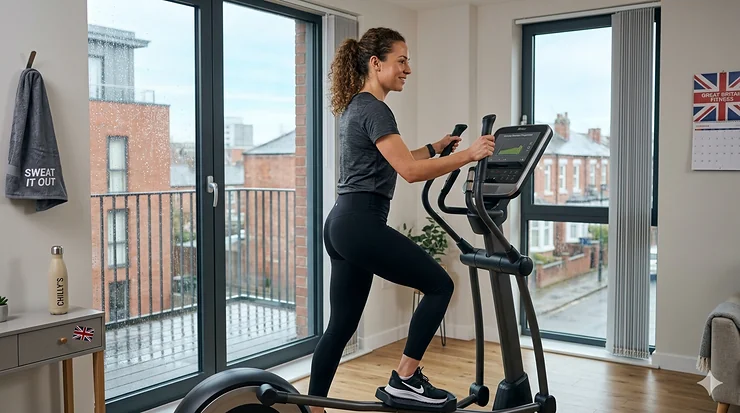
A cross trainer for weight loss positioned in your own front room changes that equation entirely. No commute. No waiting. No judgemental strangers watching you figure out the settings. Just you, your machine, and whatever Netflix series is currently eating your evenings — burning somewhere between 400 and 700 calories per hour in the process.
What makes the elliptical cross trainer particularly compelling for fat loss isn’t just the calorie burn — it’s the sustainability of it. Unlike running, which hammers your knees and sends most beginners limping back to the biscuit tin within a fortnight, the elliptical’s smooth, circular motion is genuinely joint-friendly. Research published in the Journal of Sports Medicine and Physical Fitness found that consistent elliptical training at 70–90% of maximum heart rate over 12 weeks significantly increased fat oxidation rates — in plain English, your body gets better at burning fat as fuel. The NHS recommends at least 150 minutes of moderate aerobic activity per week for healthy adults — and a cross trainer hits that target with considerably less joint carnage than the alternatives.
The question, of course, is which machine. The UK market in 2026 is heaving with options across every price point — from budget-friendly sub-£150 models to premium connected machines nudging £500. Getting this wrong is expensive and annoying. Getting it right means you have a piece of kit that earns its space, survives the British winter, and actually helps you shift those stubborn extra kilos.
We’ve done the research so you don’t have to. Seven real machines, all verified available on Amazon.co.uk, reviewed with the detail the product listings don’t give you.
Quick Comparison: The 7 Best Cross Trainers for Weight Loss at a Glance
| Machine | Flywheel | Resistance Levels | Max User Weight | Best For | Approx. Price Range |
|---|---|---|---|---|---|
| Dripex Elliptical Cross Trainer | 6kg | 16 | 100kg | Budget beginners | Under £150 |
| Klarfit Myon Cross Trainer | 12kg | Manual | 100kg | Value hunters | Around £200 |
| JLL CT300 Elliptical Cross Trainer | 5.5kg (bi-dir.) | 8 | 100kg | Compact flats | Under £200 |
| Neezee 2-in-1 Cross Trainer & Bike | 8kg | 16 | 120kg | Dual-function buyers | Around £150–£200 |
| Viavito Sina Magnetic Cross Trainer | 9kg | 32 | 120kg | Mid-range all-rounders | Around £250–£300 |
| Reebok FR30 Magnetic Cross Trainer | 9kg | 32 | 120kg | Tech-savvy trainers | Around £350–£450 |
| JTX Strider-X8 Smart Cross Trainer | 7kg (inertia-enhanced) | 16 | 120kg | Serious home athletes | Around £450–£500 |
The table tells part of the story, but the numbers alone don’t decide it. A higher flywheel weight generally means smoother, more consistent motion — but a well-engineered 7kg inertia-enhanced flywheel (like the JTX) can outperform a basic 10kg one in terms of real-world feel. Budget buyers should note that sub-£150 machines often sacrifice flywheel quality and frame rigidity — fine for two or three sessions a week, but they’ll feel the strain under daily hammering. For most UK buyers training four to five times per week with serious weight loss goals, the £250–£450 bracket offers the sweet spot between build quality and value.
💬 Just one click — help others make better buying decisions too! 😊
✨ Don’t Miss These Exclusive Deals!
🔍 Take your cross trainer for weight loss journey to the next level with these carefully selected machines. Click on any highlighted product to check current pricing and availability on Amazon.co.uk. Your best body doesn’t need a gym membership — just the right kit.
Top 7 Cross Trainers for Weight Loss: Expert Analysis
1. Dripex Elliptical Cross Trainer — Best Budget Pick for Beginners
The Dripex punches above its weight class — which is more than can be said for most sub-£150 fitness kit. Featuring 16 levels of magnetic resistance and a 6kg flywheel, this compact elliptical handles light-to-moderate training sessions with admirable steadiness. The stride length sits at around 38cm (15 inches), which suits most users up to roughly 5ft 10in comfortably enough. The built-in LCD monitor tracks time, speed, distance, and calories — the basic metrics you actually need, without the faff of a touchscreen that adds £100 to the price and breaks inside 18 months.
In practice, the 6kg flywheel means the motion is noticeably smoother than the very cheapest options on the market, but won’t quite replicate the gym-floor glide of a heavier machine. For someone doing 30-minute sessions three or four times a week, that’s entirely acceptable. For anyone planning daily hour-long HIIT sessions, you’ll outgrow it quickly.
UK buyers will appreciate the compact footprint — this fits tidily in a spare room, hallway corner, or bedroom without demanding a full-scale furniture rearrangement. Maximum user weight is 100kg, so taller or heavier users should look further up the list. UK customer reviews consistently highlight the surprisingly quiet operation, which matters enormously if you live in a terraced house or flat and your neighbours have opinions about 6am workouts.
✅ Whisper-quiet magnetic resistance
✅ 16 resistance levels — genuinely useful range for a beginner
✅ Compact footprint for smaller UK homes
❌ 6kg flywheel limits smoothness at higher intensities
❌ 100kg max user weight excludes some buyers
Under £150, and available on Amazon.co.uk with Prime delivery — it’s the most cost-effective entry point for anyone testing the cross trainer waters before committing to something pricier.
2. Klarfit Myon Cross Trainer — Best for Flywheel Performance at the Price
The Klarfit Myon is a German-engineered machine that arrives with a specification sheet that would embarrass machines costing nearly twice as much. The headline number is the 12kg flywheel — genuinely substantial for a machine in this price bracket and the reason the Myon’s motion feels notably more fluid than rivals at a similar cost. Pair that with the SilentBelt drive system (replacing the chain drives you find on cheaper models) and you have something that barely registers above a soft hum during a workout. Very welcome if your living room shares a wall with a light-sleeping baby or an irritable neighbour.
The integrated training computer is honest rather than flashy — time, speed, distance, calories, and heart rate via the handlebar sensors. It won’t sync to your phone, and there’s no Bluetooth. But for someone whose primary goal is fat-burning cardio rather than data analytics, that’s a reasonable trade-off. The non-slip treads hold firm even when you’re pushing hard, which is more than you can say for some budget models whose pedals develop an unsettling wobble after a few months.
What most buyers overlook is that the 12kg flywheel weight makes this an unusually satisfying machine for interval training — that heavier flywheel maintains momentum through the high-resistance intervals that do the most metabolic damage (in the best possible way). Maximum user weight is 100kg. Available on Amazon.co.uk, sold and dispatched by the UK branch of Electronic-Star.
✅ 12kg flywheel — best in class at this price point
✅ SilentBelt drive — genuinely quiet
✅ Solid build quality for the money
❌ No Bluetooth or app connectivity
❌ 100kg max user weight
Around £200, and remarkable value given the flywheel specification. A serious contender for anyone wanting quality without the premium price.
3. JLL CT300 Home Luxury Elliptical Cross Trainer — Best Compact Option for Smaller Spaces
“Luxury” is a bold claim for a machine under £200, but the JLL CT300 earns the description in one specific and rather clever way: its bi-directional flywheel. Most budget and mid-range cross trainers move in one direction only — forward. The CT300’s 5.5kg flywheel allows both forward and reverse pedalling, which research from the Journal of Strength and Conditioning Research suggests activates different muscle groups, specifically hitting the hamstrings and calves more aggressively in reverse mode. Over time, that variability in muscle recruitment means more balanced development and — crucially for weight loss — more total muscle mass, which raises your resting metabolic rate.
The 8-level magnetic resistance is modest compared to the 16 or 32 levels you get elsewhere, but in honest practice most people cycle through five or six settings at most. The console display tracks all the key metrics and includes a tablet holder — a feature that sounds trivial until you realise that the ability to watch a full episode of something is the single most reliable predictor of whether you’ll actually complete a 40-minute session. UK reviews frequently mention three or more years of trouble-free use, including one Manchester user who’d clocked daily use for three years without mechanical issues.
For anyone in a flat, a compact terraced house, or sharing space with housemates, the CT300’s footprint is one of the smallest on this list. Prime-eligible on Amazon.co.uk.
✅ Bi-directional flywheel — genuinely useful for balanced training
✅ Tablet holder — underrated feature for long sessions
✅ Outstanding long-term reliability reported by UK buyers
❌ Only 8 resistance levels limits progression for advanced users
❌ 5.5kg flywheel feels less smooth at maximum resistance
Under £200 on Amazon.co.uk. The bi-directional flywheel alone sets this apart from same-price rivals.
4. Neezee 2-in-1 Cross Trainer & Exercise Bike — Best for Dual-Function Versatility
Not everyone wants a machine that does one thing. The Neezee 2-in-1 provides both elliptical cross-training and upright cycling, switching between modes with the addition or removal of the adjustable seat. It’s an appealing proposition for households where different people have different preferences, or for solo users who want to vary their workout type without buying two separate machines.
The 8kg flywheel provides a noticeably smoother ride than the Dripex — forward and backward motion both work, and the front-mounted flywheel design improves stability over the rear-mounted equivalents you find on some budget options. Maximum user weight is 120kg, making this one of the more inclusive options at this price point. The LCD monitor covers the standard metrics, and the handlebar pulse sensors give a working (if not clinical-grade) estimate of your heart rate. For fat-burning workouts, staying in the right heart rate zone matters, so even an approximate reading helps.
The UK-specific caveat is storage. This isn’t the most compact machine on the list — with the seat fitted, it occupies meaningful floor space. For those in genuinely small London flats or compact terraced houses, measure twice before ordering. Assembly, according to UK reviewers, is manageable but benefits from two pairs of hands. Available on Amazon.co.uk with Prime delivery.
✅ Cross trainer and exercise bike in one — genuine versatility
✅ 120kg max user weight — more inclusive than budget rivals
✅ Front-mounted flywheel improves stability
❌ Larger footprint than single-function machines
❌ Seat adds storage complexity in small UK homes
In the £150–£200 range on Amazon.co.uk. Strong value for households wanting flexibility without buying two separate machines.
5. Viavito Sina Magnetic Elliptical Cross Trainer — Best Mid-Range All-Rounder
The Viavito Sina is where the cross trainer for weight loss conversation starts to get genuinely serious. The 9kg flywheel delivers the kind of smooth, consistent motion that feels closer to a commercial gym machine than anything under £250 has any right to — and crucially, 32 electronic resistance levels give you a progression ladder that’ll keep a dedicated trainer busy for the better part of a year before hitting the ceiling.
The 38cm (15-inch) stride length suits most users up to around 5ft 10in. The maximum user weight of 120kg is more generous than many mid-range competitors. The multicolour console supports up to four user profiles — genuinely useful in family homes where multiple people will be using the machine — and tracks the full range of training metrics including pulse via the handlebar sensors.
What sets the Sina apart in British conditions is the “hyper-quiet” designation, which isn’t mere marketing copy. The sealed magnetic resistance system operates at a genuinely low noise level — important when you’re exercising at 7am in a semi-detached and the walls aren’t quite as thick as you’d like. The built-in transport wheels mean repositioning it for hoovering (or to reclaim the room for guests) is a one-person job. UK customer feedback on Amazon.co.uk is consistently positive across hundreds of reviews, with particular praise for build quality and the breadth of resistance levels.
✅ 32 resistance levels — outstanding range for progressive training
✅ 9kg flywheel, smooth motion approaching gym quality
✅ 4 user profiles — ideal for family use
❌ Stride length may feel short for very tall users (6ft+)
❌ No Bluetooth connectivity
Around £250–£300 on Amazon.co.uk. The clear choice for anyone serious about structured, progressive weight-loss training at home.
6. Reebok FR30 Magnetic Elliptical Cross Trainer — Best for Tech-Connected Training
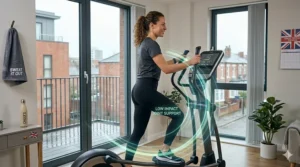
Reebok’s fitness equipment arm has spent years building genuinely credible home gym kit, and the FR30 is perhaps the strongest argument for the brand in 2026. It combines a solid 9kg flywheel with 32 electronic resistance levels, an LED touchscreen console, and Bluetooth connectivity — which opens up Kinomap integration, meaning you can follow virtual routes through the Lake District, the Thames Path, or virtually anywhere else you’d rather be on a dark November evening.
The dual-action handlebars deserve specific mention: you can choose between the moving arms (full-body workout, higher calorie burn) or fixed grips (isolation of the lower body, useful for focused leg work). For weight loss specifically, using the moving arms consistently increases the total muscle mass engaged and therefore the calorie expenditure — not a dramatic difference in any single session, but meaningful over months of training. The 18 pre-set programmes add enough variety to keep your metabolism guessing rather than adapting to a single routine.
The adjustable footplates and floor-levelling feet are more useful than they sound in practice — older British houses are rarely built on truly flat floors, and having a machine that doesn’t wobble is rather more motivating than one that rocks gently as you stride. Amazon.co.uk lists this as a Prime-eligible product with UK plug and 230V compatibility confirmed. Sustainability credentials include recycled materials certification (RCS Blended).
✅ Bluetooth + Kinomap compatible — virtual training routes
✅ Dual-action and fixed handlebar options
✅ 18 pre-set programmes for workout variety
❌ Premium price — significantly more than mid-range options
❌ Stride length may feel modest for very tall users
In the £350–£450 range on Amazon.co.uk. The FR30 is for the buyer who wants data, variety, and connectivity alongside their fat-burning workouts.
7. JTX Strider-X8 Smart Home Cross Trainer — Best Premium Pick for Serious Results
The JTX Strider-X8 is the machine for someone who means business. British brand JTX Fitness has been building home gym equipment long enough to understand what distinguishes a good machine from a great one, and the Strider-X8 demonstrates that understanding throughout. The 7kg flywheel might seem modest compared to the Klarfit’s 12kg, but the inertia-enhanced design delivers a motion quality that, in practice, exceeds heavier but less sophisticated systems — the stride feels natural, powerful, and remarkably gym-like.
Sixteen resistance levels controlled via electro-magnetic adjustment mean transitions between intensities are instantaneous and smooth. Eighteen training programmes cover everything from gentle recovery sessions to full-interval protocols, and Bluetooth connectivity allows syncing with popular training apps. The Kinomap compatibility means those virtual training routes are available here too. Maximum user weight is 120kg, and the compact design — notably narrower than many competitors — makes this viable for smaller UK rooms without sacrificing stride length.
The detail that separates the JTX from everything else on this list? A two-year in-home warranty with parts and labour included. For a machine at this price point, that’s the kind of commitment that transforms a purchase into an investment. JTX sends an engineer to you — no boxing up a 60kg machine and shipping it back. UK customers consistently rate the after-sales service as genuinely excellent. Available on Amazon.co.uk, and worth checking for Prime delivery eligibility.
✅ Two-year in-home warranty — outstanding after-sales support
✅ Inertia-enhanced flywheel — smooth, gym-quality motion
✅ Compact design despite premium specification
❌ Higher price point — the most expensive on this list
❌ Assembly requires two people and a committed hour
In the £450–£500 range on Amazon.co.uk. For buyers who want the best machine they can fit in a British home and won’t settle for less, the Strider-X8 is the answer.
How to Use a Cross Trainer for Weight Loss: A Practical Guide for UK Home Trainers
Owning a cross trainer is one thing. Using it in a way that actually shifts weight is another. Here’s what the product listing won’t tell you.
Start With Interval Training, Not Steady Plodding
The single biggest mistake people make on a cross trainer is treating it like a slow Sunday stroll — same resistance, same pace, same boredom, same zero results. Fat loss responds to variation. A basic protocol that works: warm up for five minutes at low resistance, then alternate 30 seconds of high resistance (level 10–15 depending on your machine) with 90 seconds of easy recovery. Repeat eight to ten times. Cool down for five minutes. That’s a 25-minute session that’ll elevate your metabolism for hours after you step off — what exercise scientists call excess post-exercise oxygen consumption, or EPOC. Far more efficient than 45 minutes of gentle gliding.
Use Both the Arms and the Legs — Every Session
This sounds obvious, but a surprising number of people treat the cross trainer as essentially a leg machine and barely engage the handlebars. For calorie burning and fat loss, that’s leaving money on the table. Actively driving the arm handles — pushing and pulling rather than letting them drag you along — meaningfully increases total calorie expenditure per session.
Practical UK Tips: Storage, Noise, and Damp
Most UK homes don’t have a dedicated gym room. A few things worth knowing: place a thick rubber mat underneath your machine — it protects the floor, reduces noise transmitted to the flat below, and prevents the machine from walking across laminate during high-intensity intervals. For garage storage during winter, check the machine documentation for minimum temperature storage requirements; lubricants in some machines can thicken in the cold, affecting the flywheel mechanism. Wipe down the machine after each session, particularly the metal frame — British homes in winter run damp, and even indoor equipment can develop surface rust if left moist over weeks.
Target three to five sessions per week for measurable weight-loss results. Pair your cross trainer sessions with a modest calorie deficit, and give it eight to twelve weeks before judging the outcome. Results on a cross trainer are real, but they’re not overnight.
Real UK Buyer Profiles: Which Cross Trainer Should You Choose?
Profile 1: Anya, 34, Leeds — Busy Parent, Limited Time and Space
Anya works full-time, has two children under seven, and a terraced house with a small box room that doubles as a home office. She wants to lose around 10kg, can commit to 30 minutes, four times a week, and has a budget of around £200. Noise is a concern — the kids go to bed at 8pm and she does most of her training in the evening.
Recommendation: JLL CT300 or Viavito Sina. The CT300’s compact footprint fits the box room without issue, the bi-directional flywheel adds valuable training variety for someone short on time, and UK reviewers confirm it’s genuinely quiet during evening sessions. If Anya can stretch to £250–£300, the Viavito Sina’s 32 resistance levels offer more progression without taking significantly more space. Either machine, placed on a rubber mat, will be inaudible through a closed door.
Profile 2: Marcus, 48, Bristol — Returning to Fitness After a Knee Injury
Marcus had a knee arthroscopy 18 months ago. His physiotherapist has cleared him for low-impact cardio, and he’s keen to lose the weight that accumulated during his recovery. He wants reliability and smooth action more than connectivity, and he’s willing to spend up to £400.
Recommendation: Reebok FR30. The adjustable footplates allow Marcus to find the exact pedal position that’s kind to his recovering knee — this is a feature the cheaper machines simply don’t offer. The floor-levelling feet matter too: older Bristol houses (and Bristol has plenty of them) rarely have perfectly level floors, and a wobbly machine transmits strain to the joints. The FR30’s 32 resistance levels also allow genuine progression from very gentle beginnings up to a challenging workout, all within one machine.
Profile 3: Sarah and Tom, both 40s, Surrey — Shared Family Machine
Two adults with different fitness levels sharing one machine, stored in a converted garage. Budget around £450–£500.
Recommendation: JTX Strider-X8. Multiple users at different intensity levels benefit from the smooth electro-magnetic resistance transitions. The two-year in-home warranty is particularly valuable for a shared machine that’ll see heavier use. The Bluetooth app connectivity means both Sarah and Tom can track individual progress separately. And for a converted garage — which is prone to temperature fluctuation — JTX’s robust build quality handles the environment better than budget alternatives.
How to Choose a Cross Trainer for Weight Loss in the UK: 7 Criteria That Actually Matter
Buying a cross trainer shouldn’t feel like a cryptic puzzle, but the sheer volume of specifications and marketing language can make it feel that way. Here’s a structured decision framework that cuts through the noise.
1. Set your weekly session frequency first. One to two sessions per week: budget machines under £200 are entirely sufficient. Three to five sessions: invest in the £250–£450 range for durability. Daily training: don’t compromise below the Reebok FR30 or JTX Strider-X8 level. Cheap machines fail under daily use faster than you’d expect.
2. Check your room dimensions before anything else. Standard cross trainers require roughly 160cm × 70cm of floor space plus clearance around the machine. In compact UK rooms, the difference between a machine that fits and one that doesn’t is simply the difference between using it and not using it.
3. Flywheel weight matters — but design matters more. A 7kg inertia-enhanced flywheel (JTX) outperforms a basic 10kg flywheel from a cheaper brand. Look for how the flywheel is described, not just the number.
4. Resistance levels affect long-term progression. If you’re starting a serious weight-loss programme, you’ll get fitter within months. A machine with only 8 resistance levels will feel too easy within six months if you’re training consistently. Aim for 16 minimum; 32 is better.
5. Maximum user weight — check before you assume. Several machines on this list cap at 100kg. If you’re above that figure — particularly if you’re carrying weight and using this machine specifically for fat loss — check the specification carefully.
6. Stride length and your height. The standard 38cm (15-inch) stride suits most people up to about 5ft 10in. Taller users should look for 40cm or more. An ill-fitting stride length creates awkward biomechanics that defeats the joint-friendliness argument entirely.
7. Noise level is a British home reality. In terraced houses, flats, or homes with early-rising neighbours, the difference between a SilentBelt or magnetic drive machine and a chain-drive budget model is the difference between training freely and tiptoeing around someone else’s schedule.
Common Mistakes When Buying a Cross Trainer for Weight Loss
Buying Based on Price Alone
The sub-£100 end of the UK market produces machines that — in polite terms — don’t last. Frame welds that loosen after six months. Pedals with disconcerting lateral play. Resistance mechanisms that slip at higher levels. None of these qualities are apparent in the product listing photos. The Dripex at around £120–£150 represents roughly the minimum investment for something that’ll survive six months of real use. Below that, you’re essentially purchasing an expensive promise.
Ignoring the Assembly Requirement
Every machine on this list requires assembly, and several (particularly the JTX Strider-X8) are genuinely challenging to build solo given the component weights. Budget 1–2 hours, recruit a helper, and read the full instructions before opening any packaging. Rushing assembly is the most reliable way to end up with a machine that rocks, squeaks, or — in the most unfortunate cases — develops structural issues that void the warranty.
Overlooking UK-Specific Warranty Terms
Several cross trainers sold on Amazon.co.uk are manufactured in China or Germany and may come with EU-focused warranty processes. Post-Brexit, this matters: check whether the warranty covers UK-based returns or repair, and whether the manufacturer has a UK customer service contact. The JTX Strider-X8’s in-home warranty is worth its weight in gold precisely because you don’t have to manage international returns logistics for a 60kg machine. For other machines, a quick search for the brand’s UK customer service contact before purchasing isn’t paranoid — it’s sensible.
Assuming the Machine Will Do the Work
This one stings, but it needs saying. A cross trainer for weight loss is a tool. Effective only when used consistently, in conjunction with a reasonable approach to diet. According to NHS guidance on healthy weight loss, sustainable fat loss typically occurs at 0.5–1kg per week — achievable with a combination of a modest calorie deficit and regular exercise. A cross trainer accelerates that process beautifully. But it won’t do it alone, and expecting dramatic results from two sessions a week without addressing diet leads to a very expensive coat rack.
Cross Trainer vs Treadmill for Weight Loss: An Honest Comparison
The treadmill vs cross trainer debate is one of the great enduring arguments of the home gym world, and the honest answer is more nuanced than most articles admit.
| Factor | Cross Trainer | Treadmill |
|---|---|---|
| Calorie burn per hour (moderate) | 400–600 kcal | 450–650 kcal |
| Joint impact | Very low | Moderate to high |
| Upper body engagement | Yes (with arm use) | Minimal |
| Noise level at home | Low–Medium | Medium–High |
| Suitable post-injury | Generally yes | Depends on injury |
| Motivation for long sessions | Higher (low discomfort) | Lower (higher effort) |
| UK home suitability | Excellent | Good |
Treadmills burn marginally more calories per hour at equivalent perceived effort — but the difference is smaller than most people expect, and the joint load is significantly higher. Research from the University of Mississippi found that perceived exertion on the elliptical is consistently lower than actual exertion, which in practice means people exercise longer and more comfortably before stopping. For a weight-loss programme built on sustainability, that’s a genuinely important finding. The cross trainer wins for longevity, joint health, and suitability in typical UK home environments. The treadmill wins for runners who want to train specifically for running. For general fat loss, the cross trainer is the pragmatic choice.
Long-Term Cost and Value: What Your Cross Trainer Really Costs Over 3 Years
One angle most buyers don’t consider: the total cost of ownership over time, compared to alternatives. Let’s run the numbers roughly, in GBP.
A monthly gym membership in the UK averages around £30–£50 per month (more in London). Over three years: £1,080–£1,800, with zero equity remaining at the end. A Reebok FR30 at approximately £400 has zero ongoing costs beyond electricity (negligible — cross trainers draw minimal power). Over the same three years, the FR30 costs roughly £11 per month. The JTX Strider-X8 at around £500 works out at approximately £14 per month over three years, plus two years of in-home warranty cover.
The maths is unambiguous. For anyone who would actually use a home machine consistently, buying is cheaper than membership within 10–15 months. Maintenance costs on magnetic resistance machines are minimal — no chains to oil, no belts to replace routinely, just the occasional tightening of frame bolts and a wipe-down after each session. For UK garage storage between seasons, a machine cover (available cheaply on Amazon.co.uk) prevents dust accumulation and protects electronics from condensation — worth every penny of the tenner it costs.
✨ Don’t Miss These Exclusive Deals!
🔍 Ready to start burning fat at home? Click on any product in this guide to check current pricing and availability on Amazon.co.uk. Fast delivery with Amazon Prime — and your cross trainer for weight loss journey starts as soon as it arrives.
Frequently Asked Questions About Cross Trainers for Weight Loss
❓ How many calories does a cross trainer burn for weight loss?
❓ How often should I use a cross trainer to lose weight in the UK?
❓ Are cross trainers suitable for people with bad knees?
❓ What's the minimum budget for a decent cross trainer for weight loss in the UK?
❓ Do I need a large space for a cross trainer in a UK home?
Conclusion: The Right Cross Trainer for Weight Loss Changes Everything
The best cross trainer for weight loss isn’t the one with the most features. It’s the one you’ll actually use, in the home you actually live in, at the budget you’re genuinely comfortable with. That’s why this guide spreads across the full price spectrum rather than simply pointing everyone at the most expensive option.
For tight budgets and curious beginners, the Dripex and JLL CT300 deliver real value under £200. For the serious mid-range buyer who wants to progress, the Viavito Sina is the standout choice. For connected, data-driven training, the Reebok FR30 earns its price. And for those who want the best home cross trainer money can sensibly buy in the UK right now, the JTX Strider-X8 — with its in-home warranty and inertia-enhanced motion — is hard to argue against.
Pick your machine, lay down your mat, and give it twelve weeks of genuine effort. The cross trainer for weight loss works. The science is solid, the machines are better than ever, and the gym commute has never been shorter.
✨ Don’t Miss These Exclusive Deals!
🔍 Check current prices and availability for all seven cross trainers on Amazon.co.uk. Prime-eligible options available for next-day delivery. Your weight-loss journey is one click away — start today.
Recommended for You
- Best Quiet Cross Trainer for Flat: 7 Top Picks UK (2026)
- Best Cross Trainer for Small Spaces: Top 7 UK Picks (2026)
- Best Custom Workout Cross Trainer UK 2026: 7 Top Picks Reviewed
Disclaimer: This article contains affiliate links. As an Amazon Associate, I earn from qualifying purchases. If you purchase products through these links, we may earn a small commission at no additional cost to you.
✨ Found this helpful? Share it with your mates! 💬🤗
