In This Article
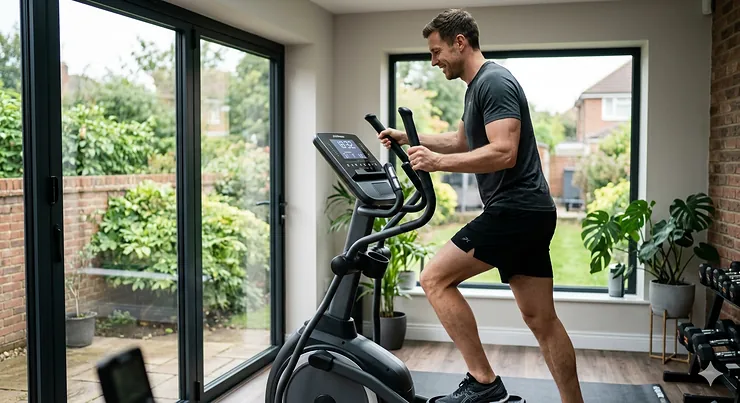
Here’s a scenario that will feel painfully familiar to anyone over 185 cm (6’1″) who has ever enthusiastically purchased a cross trainer online: the machine arrives, you assemble it over a long Saturday afternoon involving three mugs of tea and one mild profanity, you step on — and immediately feel like you’re pedalling a child’s toy. Your knees are up around your chin. Your back is hunched. The stride is somewhere between a shuffle and a penguin waddle. It is, in short, a disaster.
The problem isn’t you. The problem is stride length. A cross trainer for a tall person isn’t simply a bigger machine — it’s a machine specifically engineered to accommodate the biomechanics of a longer body, which means a stride length of at least 46 cm (18 inches) at the absolute minimum, and ideally 50–51 cm or more for anyone north of 190 cm. The NHS regularly recommends low-impact cardio such as elliptical training for cardiovascular health, and research published by institutions including Loughborough University’s School of Sport, Exercise and Health Sciences has demonstrated that biomechanically mismatched equipment significantly increases the risk of repetitive strain injuries in the knees and hips.
In 2026, the UK home fitness market has genuinely matured. There are more excellent options for taller users on Amazon.co.uk than ever before — from budget-friendly machines with honest long strides to mid-range adjustable beasts that accommodate everyone from 5’2″ to 6’5″ under the same roof. The question is which one earns a permanent spot in your front room (or tucked into the corner of your semi-detached garage in Manchester, which is frankly where half the UK’s fitness equipment ends up).
This guide has done the legwork. Seven real products, all available on Amazon.co.uk right now, reviewed with a specific focus on stride length, user height accommodation, build quality for heavier frames, and real-world performance in the sort of modest British home where “dedicated gym room” means moving the ironing board out of the way. Let’s get into it.
Quick Comparison: Best Cross Trainers for Tall Users in the UK
| Product | Stride Length | Max User Weight | Flywheel | Resistance Levels | Price Range | Best For |
|---|---|---|---|---|---|---|
| MERACH Long Stride Cross Trainer | 47–48 cm | 181 kg (400 lbs) | Self-generating | 8/16 levels | £400–£550 | Tall users wanting cable-free cardio |
| Maxxus CX 7.4 | 33–51 cm (adjustable) | 145 kg | N/A | 24 levels | £500–£700 | Multi-height households |
| JTX Tri-Fit 2.0 | 41–51 cm (adjustable) | 150 kg | 8.5 kg | 24 levels | £550–£750 | 6ft+ users sharing with shorter partners |
| Bluefin Fitness CURV 3.0 | 46–51 cm | 150 kg | 14 kg | 16 levels | £450–£650 | Mid-range buyers wanting quality build |
| Sole E20 Elliptical Cross Trainer | 46 cm (18″) | 136 kg | 6.5 kg | 20 levels | £350–£500 | Budget-conscious tall users |
| Dripex 3-in-1 Elliptical Cross Trainer | 42 cm | 150 kg | 8 kg | 16 levels | £200–£350 | Tight budgets, smaller homes |
| Neezee Elliptical Cross Trainer | 42 cm (16.5″) | 150 kg | 8 kg | 16 levels | £150–£280 | Beginners on a strict budget |
The table above makes one pattern immediately obvious: if you’re genuinely tall — say, 188 cm or above — the machines with adjustable or fixed stride lengths of 47 cm and upward are the ones worth your serious attention. The Maxxus CX 7.4 and JTX Tri-Fit 2.0 stand out for their flexibility across users, while the MERACH Long Stride and Bluefin CURV 3.0 offer the kind of fixed long-stride motion that taller users often actually prefer once they’ve found their correct length. Anything below 42 cm on this list will feel noticeably cramped if you’re 185 cm or taller, full stop.
✨ Don’t Miss These Exclusive Deals!
🔍 Take your home cardio to the next level with these carefully selected products. Click on any highlighted item to check current pricing and availability on Amazon.co.uk. These picks will help you find exactly what you need for a full-stride, joint-friendly workout!
💬 Just one click — help others make better buying decisions too! 😊
Top 7 Cross Trainers for Tall People: Expert Analysis
1. MERACH Long Stride Cross Trainer (E27B Series)
The MERACH Long Stride is the one that quietly became the bestseller nobody expected. It’s a self-generating cross trainer — meaning it runs entirely on pedal power with no mains lead — which makes it remarkably convenient in a British home where getting a cable to the right corner of the room is half the battle.
The 47–48 cm stride is the headline stat here, and it genuinely earns that description. Users up to around 196 cm (roughly 6’5″) report a natural, unhurried motion without the chopped, restricted feeling you get from machines claiming “long stride” at a rather optimistic 40 cm. The magnetic resistance operates at under 20 dB — quieter than a whispered conversation — which matters enormously if you live in a Victorian terrace and your neighbour’s wall is approximately 23 cm from your elbow. The 8/16 resistance system (the two modes let you choose between a streamlined eight-level experience or a finer sixteen-level gradient) provides enough range for both gentle morning sessions and sweating-through-your-shirt interval training.
The 181 kg (400 lbs) weight capacity is a genuine outlier at this price point; most competitors cap at 120–130 kg. UK customers particularly appreciate the 80% pre-assembled delivery — most report being on the machine within twenty minutes of the box arriving, which compared to some competitors’ IKEA-instruction-sheet assembly nightmares is rather appealing. The MERACH App integration adds workout tracking without forcing a subscription, which is refreshingly honest.
What most UK buyers overlook: the self-generating power system means the machine runs slightly heavier than equivalent plug-in models at lower resistance settings. You’ll feel a modest extra drag on the first stroke. After a warm-up, most people stop noticing entirely.
✅ Best-in-class weight capacity for tall, larger-framed users
✅ Near-silent operation — ideal for flats and semi-detached houses
✅ Self-generating: no mains cable, no awkward extension leads
❌ Slightly heavier initial pedal resistance than plug-in equivalents
❌ App features limited compared to premium competitors
Price range: £400–£550. For the capacity and stride length combination, this represents outstanding value.
2. Maxxus CX 7.4 Elliptical Cross Trainer
If your household contains people of dramatically different heights — say, a 6’3″ husband and a 5’4″ wife, or a teenage son who keeps growing — the Maxxus CX 7.4 is probably the most sensible purchase on this entire list. Its five-position adjustable stride (33, 40, 46, 48, and 51 cm) is the key selling point, and it’s a mechanical adjustment rather than an electronic one, which means no software to bug out and no subscription required.
The 51 cm maximum stride is among the longest available in this price bracket on Amazon.co.uk — that’s essentially matching what you’d find on commercial gym floor machines, which typically run at 50–51 cm. The steel frame construction supports up to 145 kg, and the overall dimensions of 167 × 69 × 175 cm mean it’s substantial but not absurd; it will fit in a standard British dining room if you’re willing to sacrifice the sideboard. The iConsole+ app compatibility adds a decent layer of digital engagement, including Bluetooth connectivity and workout programme variety, without locking you into a costly monthly fee.
The child safety lock is a thoughtful inclusion — useful not just for families but for anyone who’s ever had a cat or a curious toddler treat exercise equipment as an adventure playground. UK buyers on Amazon.co.uk consistently highlight the build quality as noticeably more substantial than the price might suggest, with several noting the machine feels closer to gym equipment than typical home-use alternatives.
What most buyers overlook: the stride adjustment requires a manual pin repositioning, which takes about thirty seconds. If you’re swapping between very different-height users multiple times a week, that’s a minor irritant. For most households, though, you set it once per person and forget about it.
✅ Widest stride-length adjustment range in this price tier (33–51 cm)
✅ 145 kg user weight capacity — solid for larger-framed users
✅ Child safety lock and app connectivity included as standard
❌ Stride adjustment is manual, not electronic
❌ At around 80.5 kg assembled weight, moving it between rooms isn’t casual
Price range: £500–£700. Worth every penny for multi-height households.
3. JTX Tri-Fit 2.0 Elliptical Cross Trainer
The JTX Tri-Fit 2.0 has arguably the most impressive real-world customer testimonial in its Amazon listing: a reviewer reports using it daily with one partner standing 6’4″ and another at 5’4″, both finding it perfectly comfortable. That’s not marketing copy — that’s exactly the scenario for which this machine was designed.
The adjustable stride of 41–51 cm (16–20 inches) shifts via a straightforward mechanism, and the manually adjustable incline adds a dimension of workout variety that fixed-stride machines cannot match. Incline training on a cross trainer is genuinely underrated — at higher angles, it shifts emphasis from quads to glutes and hamstrings, which is particularly useful for anyone training for hill walking in the Peak District, the Brecons, or the Highlands without wanting to go outside in November. The 8.5 kg inertia-enhanced flywheel delivers noticeably smoother motion than similarly priced competitors; the heavier the flywheel, generally speaking, the more the machine absorbs the natural inconsistencies in your stride rather than fighting back against them.
Kinomap compatibility is a genuine bonus here — it allows you to stream real-world route videos from cyclists and runners worldwide, overlaying your workout data in real time. For rainy British winters when motivation dissolves alongside your view out the window, having a virtual cycle through Tuscany while pedalling in your sitting room is rather more compelling than staring at a beige wall.
JTX is a British brand, which means UK customer service, UK warehouse stock, and a two-year home warranty that’s actually serviceable from this side of the Channel — a point worth noting in a post-Brexit market where European warranty claims can occasionally become postal adventures.
✅ Confirmed comfortable for users up to 6’4″ (real UK customer verified)
✅ Adjustable incline — adds workout variety without extra equipment
✅ British brand with UK customer service and two-year warranty
❌ Compact dimensions mean it’s not for users over 6’5″
❌ At 155 × 72 × 167 cm, slightly taller footprint than some alternatives
Price range: £550–£750. The adjustable incline justifies the step up in price.
4. Bluefin Fitness CURV 3.0 Elliptical Cross Trainer
Bluefin Fitness is a UK-based company, which explains why the CURV 3.0 feels unusually well-suited to British homes. It’s been designed with compact storage, aesthetic compatibility with real living spaces (not just rendered gym renders), and the practical reality of British electricity supply — self-powering, so no mains connection required.
The 14 kg flywheel is the standout specification. For context, most budget cross trainers in the UK run a 5–6 kg flywheel. The difference in real-world use is the difference between the smooth, slightly effortless glide you get on a gym machine and the slightly jerky, clanky experience of cheaper alternatives. Fourteen kilograms of rotating mass creates real inertia; your stride becomes fluid, consistent, and — crucially for taller users who typically move with more momentum — genuinely absorbing. The magnetic braking system means you can come to a stop smoothly rather than having the pedals jerk to an abrupt halt, which any physiotherapist will tell you is considerably kinder to your knees.
The 12 automatic programmes combined with 16 manual resistance levels provide solid workout variety. The Bluetooth connectivity links to the E-Health App for tracking, and there’s a tablet/smartphone holder for those who prefer Netflix to data screens — a decision approximately nobody judges.
UK customers note the machine arrives largely assembled and can be set up solo in under thirty minutes. The transport wheels at the base mean moving it around a tiled kitchen floor or between rooms is genuinely manageable rather than the two-person furniture-removal operation some competitors require.
✅ 14 kg flywheel — smoothest ride in its price bracket
✅ Self-powering: no mains cable required
✅ UK brand with genuine UK-focused customer support
❌ Stride length not explicitly adjustable — best for users 155–195 cm
❌ Heart rate monitor sensors less accurate than chest-strap alternatives
Price range: £450–£650. The flywheel quality alone justifies the mid-range pricing.
5. Sole E20 Elliptical Cross Trainer
Sole Fitness has built its reputation in the UK on one simple proposition: gym-quality engineering at a home-use price point. The E20 is the entry point to that promise, and for taller users on a tighter budget, it delivers admirably where it counts most — the 46 cm (18-inch) stride length.
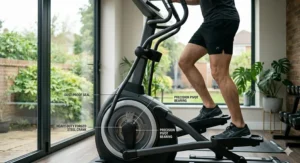
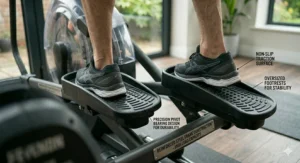
Eighteen inches is not the longest on this list, but it lands squarely in the comfortable zone for most users up to about 188 cm (6’2″). What lifts the E20 above comparably priced alternatives is the build: heavy 38 mm steel tubing, a powder-coated finish that resists the damp-garage treatment most British fitness equipment eventually receives, and oversized 15-inch foot pedals with a natural 2-degree inward slope. That inward slope sounds like a minor detail until you’ve spent forty minutes on flat pedals feeling a slow, grinding stress building in your ankles. Angled pedals follow the natural alignment of your feet; flat pedals don’t. After a month of daily use, the difference accumulates.
The 20-level resistance range is genuinely impressive for the price — most competitors offer 8 or 16 levels at this tier. The built-in cooling fan and audio speakers are modest touches, but on a forty-minute summer session, a fan is less a luxury and more a kindness. The 136 kg (300 lbs) weight capacity is adequate for most users, though larger-framed individuals may prefer the MERACH’s 181 kg ceiling.
The Sole E20 is currently available on Amazon.co.uk. Prime members can expect next-day delivery; non-Prime buyers typically receive within 3–5 working days.
✅ 20 resistance levels — more than almost any competitor in this range
✅ Angled pedals reduce ankle and knee stress during long sessions
✅ Robust 38 mm steel frame — built for longevity
❌ 136 kg weight capacity lower than top competitors
❌ Basic LCD display — no Bluetooth or app connectivity
Price range: £350–£500. Excellent value for users up to 188 cm wanting durability.
6. Dripex 3-in-1 Elliptical Cross Trainer
The Dripex 3-in-1 is for the tall person who lives in a flat, has approximately one square metre of available floor space, and cannot justify spending £500+ on a machine that might end up doubling as a very expensive coat rack. It’s honest about what it is: a compact, capable cross trainer that punches above its price bracket in build quality and punches at its price bracket in stride length.
The 16-level magnetic resistance system and 8 kg flywheel deliver a workout experience that’s smooth enough for genuine cardiovascular sessions rather than the token shuffle some ultra-compact machines produce. The “3-in-1” designation refers to its ability to function as an elliptical, stepper, and — with the optional seat — a recumbent exerciser, which gives it meaningful versatility beyond purely elliptical motion. For taller users this matters: mixing elliptical and stepper modes means varying which muscle groups are under load, which helps prevent the repetitive stress that comes from any single motion pattern.
At 42 cm, the stride is shorter than ideal for anyone approaching 190 cm, and that’s an honest limitation worth naming. But for tall users in the 178–188 cm range who are working within a genuine budget and space constraint, it represents a thoughtful, well-built option. UK customers on Amazon.co.uk frequently note the assembly is manageable solo in under an hour, and the noise level during operation is impressively low for the price — relevant if your downstairs neighbour has ever knocked to enquire about your vigorous morning activity.
✅ 3-in-1 versatility: elliptical, stepper, and optional recumbent modes
✅ Near-silent operation at under 20 dB — flat-friendly
✅ Compact footprint for smaller British homes
❌ 42 cm stride may feel restricted for users over 188 cm
❌ LCD display is functional but basic
Price range: £200–£350. The best value proposition for space-conscious tall users.
7. Neezee Elliptical Cross Trainer
The Neezee is the entry-level option on this list, and it wears that status without apology. For tall users who are new to home fitness equipment, unsure whether they’ll actually use a cross trainer regularly, or simply working within a strict budget, it offers a credible first step without committing hundreds of pounds to a machine that might end up in a charity shop by March.
The 42 cm (16.5-inch) stride accommodates users up to around 185 cm with reasonable comfort — you won’t mistake it for a commercial gym machine, but you won’t be fighting it either. The 16-level magnetic resistance and 8 kg flywheel mirror the Dripex in specification, and the 150 kg weight capacity is reassuring for larger-framed users at this budget tier. The inclusion of a pulse sensor, bottle holder, and LCD monitor covering the standard metrics (speed, time, distance, calories, heart rate) means you have everything needed for a genuine workout — nothing more, nothing less.
What separates the Neezee from the floor-scraping budget options that litter the market is the build quality. UK customers consistently note the frame feels solid, the pedals don’t flex under load, and the resistance knob operates with satisfying precision rather than the loose, imprecise feel of cheaper machines. For an entry-level purchase, that build confidence matters — nobody wants a machine that shakes and squeaks its way through every session.
Prime-eligible on Amazon.co.uk, with UK warehouse stock available for fast dispatch.
✅ Genuine entry point for tall beginners without excessive compromise
✅ 150 kg weight capacity — solid for budget tier
✅ Fast dispatch from UK Amazon warehouse
❌ 42 cm stride is limiting for users above 185 cm
❌ Basic feature set — no app, no Bluetooth
Price range: £150–£280. The smart starting point for uncommitted beginners.
How to Choose a Cross Trainer as a Tall Person in the UK: A Practical Framework
Buying fitness equipment is one of those decisions that seems straightforward until you’re staring at fourteen near-identical product descriptions at midnight and wondering whether a 47 cm stride is meaningfully different from a 46 cm stride. (It is. Barely. But it is.) Here’s a clear decision framework:
1. Start with your height, not your budget. If you’re 185 cm or taller, eliminate any machine with a fixed stride under 45 cm before you read another word about it. No amount of good reviews compensates for biomechanical mismatch.
2. Decide whether adjustability matters to you. If you’re the only person using the machine, a fixed long stride (48–51 cm) is generally smoother and more mechanically simple than an adjustable one. If you’re sharing with a shorter household member, adjustable stride (Maxxus CX 7.4, JTX Tri-Fit 2.0) becomes essential.
3. Match weight capacity to your frame honestly. Machine manufacturers typically rate maximum user weight at around 80% of actual structural limit. If the listed capacity is close to your own weight, choose a machine rated significantly higher. The MERACH’s 181 kg capacity, for instance, offers meaningful headroom for larger-framed users.
4. Consider your home layout before committing. British homes average significantly smaller than their American equivalents. Measure your available floor space, then add at least 60 cm around the machine for safe movement. Check assembled dimensions, not box dimensions.
5. Budget for the long term. A machine in the £400–£600 range typically lasts five to eight years with regular use and basic maintenance. A £150 machine might last two. The cost-per-session maths usually favours the mid-range purchase.
6. Check Amazon Prime eligibility. For larger fitness machines, Prime next-day delivery is a genuine benefit — most specialist retailers require advance booking for bulky item delivery, which adds friction to what should be a simple purchase.
Real-World Scenarios: Which Cross Trainer for Your Specific UK Life?
Every buyer’s situation is different. Here are three realistic British scenarios matched to the right machine:
The Tall London Commuter in a One-Bedroom Flat (Budget: Under £400) Tom is 6’2″, lives in a rented flat in Clapham, works long hours, and wants a machine he can use at 6:30am without waking the neighbours or the person in the flat below. Space is limited to roughly 100 × 60 cm when not in use. The Dripex 3-in-1 is the answer here. Its near-silent operation, compact footprint, and honest 42 cm stride work for Tom’s height with some compromise. The 3-in-1 versatility also means it pulls more workout weight per square metre than a single-mode machine.
The 6’4″ Dad in a Semi in Sheffield (Budget: £500–£750) Mark is 6’4″, his wife is 5’5″, and they have a teenage daughter who’s 5’8″ and growing. The machine will live in the conservatory and everyone in the house wants to use it. The Maxxus CX 7.4 or JTX Tri-Fit 2.0 are the clear choices. Both accommodate the full height range of this household with a few seconds of stride-length adjustment. Mark particularly benefits from the JTX’s incline feature, which mimics the Yorkshire hillsides he’d otherwise be climbing on foot during the summer months — if only it would stop raining.
The Recently-Retired Couple in the Cotswolds (Budget: £400–£600) David is 6’1″ and Margaret is 5’6″. Both have GP advice to maintain cardiovascular activity. They want something quiet, reliable, and unlikely to require complex maintenance. The Bluefin Fitness CURV 3.0 is the recommendation: the 14 kg flywheel delivers an unusually smooth, gentle ride that’s genuinely kinder on ageing joints, the Bluetooth and app connectivity provides optional variety for longer sessions, and the UK-based Bluefin customer service means any queries don’t disappear into a European returns void.
Common Mistakes When Buying a Cross Trainer for Tall People
Mistake 1: Trusting stride length claims without checking centimetre conversions. The UK market mixes imperial and metric stride claims with reckless abandon. “18-inch stride” sounds impressively long until you convert it: 18 inches is 45.7 cm. A machine advertised as “long stride” offering 40 cm is neither long nor suitable for anyone over 180 cm. Always check the actual measurement in centimetres before purchasing.
Mistake 2: Buying a machine with insufficient weight capacity. This is where tall users — who are often also heavier than the average — get caught out. A machine rated to 100 kg that you’re using at 95 kg will wear faster, feel less stable, and potentially fail earlier than its rated lifespan. As a general rule, choose a machine with a weight capacity at least 20–25% above your own body weight.
Mistake 3: Prioritising digital features over fundamental mechanics. A touchscreen and Bluetooth connectivity are genuinely useful. A smooth flywheel and a natural stride length are non-negotiable. Every pound spent on screen technology at the expense of flywheel weight or build quality is a poor trade-off for a tall user. The spec sheet won’t tell you this, but the first thirty seconds on a machine with a heavy flywheel tells you everything.
Mistake 4: Forgetting to measure the room before ordering. This sounds obvious until you’ve arranged for a 20 kg package to be delivered on a Tuesday and discovered the assembled machine is four centimetres wider than your only available doorway. Assembled dimensions matter. So does the height clearance if the machine is going under a sloped ceiling.
Mistake 5: Ignoring pedal spacing. For tall users, pedal spacing (the distance between the two foot platforms) affects natural gait significantly. Overly wide pedal spacing causes a hip-abduction wobble that becomes uncomfortable and biomechanically stressful after more than fifteen minutes. Look for a pedal spacing of 20–23 cm — described in some product listings as “Q-factor.” Sports England’s guidance on home exercise equipment notes that equipment matching natural movement patterns significantly increases long-term adherence, which is ultimately the only fitness metric that matters.
What to Expect: Real-World Performance of Cross Trainers in British Conditions
Here’s something the product listings won’t mention: British homes are not kind to fitness equipment. Damp is the enemy. Not dramatic, visible damp — the quiet, ambient moisture of a nation that averages 1,200 mm of rain annually and heats its homes inconsistently. Steel frames in garages or ground-floor rooms can develop surface rust within a year if not wiped down regularly.
The practical implication for tall users specifically is this: you tend to generate more perspiration during a session simply because you’re moving more mass through a larger arc of motion. That perspiration hits the machine. Combined with ambient UK moisture — particularly in Scotland, Wales, and the West Country — it creates ideal conditions for corrosion on unprotected metal parts.
What to do about it: Wipe down the flywheel housing, pedal arms, and handlebar connections after every session with a dry cloth. Once a month, run a very lightly oiled cloth along the flywheel rail if your machine has one. Store the machine away from external walls in garages and sheds, and if possible, use a fitted machine cover during extended non-use periods.
The other British-specific consideration is ceiling height. Many Victorian and Edwardian terrace houses in the UK — the dominant housing stock in cities like Leeds, Birmingham, and Liverpool — have ceilings of 240–255 cm on the ground floor. Cross trainers require overhead clearance during the stride: at the top of the ellipse, your head is raised by roughly 5–8 cm above standing height. For very tall users on machines with elevated rear-drive designs, this can become an unexpectedly close encounter with the light fitting. Check your ceiling height against the machine’s height specification with this in mind.
✨ Ready to Upgrade Your Home Workout?
🔍 These carefully selected cross trainers are all available to check on Amazon.co.uk right now. Click through to see current pricing, customer reviews, and delivery options. Your perfect fit is just a click away — long stride guaranteed.
Cross Trainer vs Treadmill vs Exercise Bike: The Tall Person’s Honest Guide
This comparison comes up constantly in UK fitness forums, and the answer genuinely depends on your specific situation. Let me be direct about the trade-offs:
| Feature | Cross Trainer | Treadmill | Exercise Bike |
|---|---|---|---|
| Joint impact | Very low | Medium-high | Very low |
| Full body engagement | ✅ Yes | ❌ Lower body only | ❌ Lower body only |
| Suitable for tall users | ✅ With correct stride | ⚠️ Usually fine | ⚠️ Need to check saddle height |
| Noise level | Low (magnetic) | Medium-high | Very low |
| Space requirement | Large | Large | Medium |
| Suitable for UK flats | ⚠️ If compact | ❌ Generally too noisy | ✅ Generally yes |
The cross trainer wins on one dimension that matters enormously for tall people: it works both upper and lower body simultaneously in a low-impact motion that places minimal stress on the spine and knees. NHS guidance on physical activity for adults recommends 150 minutes of moderate aerobic activity per week — the cross trainer is one of the most efficient routes to that target for taller individuals, because the upper-body engagement meaningfully increases caloric expenditure and cardiovascular demand without the joint loading of running.
For taller users specifically, treadmills present one underappreciated issue: the running belt is typically 50–55 cm wide, and taller runners with longer strides sometimes clip the side rails during sprints. A cross trainer eliminates this concern entirely — you’re locked into the pedal arc regardless of stride length.
Exercise bikes are quieter and more compact, but they simply don’t replicate full-body motion. For cardiovascular health and full muscle engagement, the cross trainer is the more complete tool.
Long-Term Cost and Maintenance of Cross Trainers in the UK
One thing the fitness industry doesn’t advertise: cross trainers require maintenance. Not much, but some. Understanding the running costs helps you make a more accurate lifetime-value assessment.
Routine maintenance costs:
- Machine mat (£20–£40 one-off): Essential for protecting floors and reducing vibration transfer in upper-storey rooms. More relevant in British homes with wooden floors and downstairs neighbours.
- Lubricant for drive belt/rail (£5–£15 per year): Prevents squeaking and extends belt lifespan. Takes about three minutes.
- Pedal replacement (£15–£40 per pedal): After 3–5 years of heavy use, pedal grip surfaces wear. Replacements are widely available for most brands.
- Annual wipe-down service: Zero cost, five minutes of your time.
Warranty context — important for UK buyers: Under the Consumer Rights Act 2015, online purchases must be fit for purpose and of satisfactory quality. If a machine develops a fault within 30 days, you’re entitled to a full refund. Between 30 days and six months, the retailer must prove the fault didn’t exist at sale. Beyond six months, the burden of proof shifts to you — but a manufacturer’s warranty (like the JTX Tri-Fit 2.0’s two-year home warranty) provides additional protection above the statutory minimum.
Post-Brexit, it’s worth noting that EU-manufactured products sold on Amazon.co.uk through UK fulfilment now carry full UK consumer law protections regardless of where they were made. Returns are handled under the Consumer Contracts Regulations, meaning a 14-day cooling-off period for online purchases — stronger than the US equivalent and particularly useful if your new cross trainer arrives and turns out to have a stride length that doesn’t suit you as well as the spec sheet suggested.
FAQ
❓ What stride length do I need on a cross trainer if I'm over 6 feet tall?
❓ Are there cross trainers on Amazon.co.uk with adjustable stride for different-height users?
❓ Will a cross trainer fit in a typical UK flat or terraced house?
❓ What's the difference between a self-generating and mains-powered cross trainer?
❓ Do I need a warranty for a cross trainer bought on Amazon.co.uk?
Conclusion: The Right Cross Trainer Changes Everything for Tall Users
There’s a version of this story that ends badly: you buy whatever comes up first on Amazon, spend a weekend assembling it, stride onto a machine with a 35 cm stride like a giraffe attempting a children’s scooter, and decide home fitness equipment is simply not for you. That version is needlessly expensive and entirely avoidable.
The best cross trainer for a tall person in the UK in 2026 is the one that matches your height to a proper stride length, fits your home without requiring structural modifications, and — crucially — feels good enough to use again tomorrow. The MERACH Long Stride is the pick for most tall users wanting reliable performance at a fair price. The Maxxus CX 7.4 wins if your household contains people of different heights. The JTX Tri-Fit 2.0 is the premium choice if adjustable incline and a British brand’s customer service matter to you.
Whichever machine you choose, do one thing before you commit: cross-reference your height against the stride length, check the assembled dimensions against your available space, and read the UK customer reviews, not the US ones. British homes, British ceilings, and British damp are their own distinct ecosystem. Pick the machine designed to work within it.
✨ Don’t Miss These Deals — Check Current Prices on Amazon.co.uk
🔍 Click any highlighted product in this guide to check current pricing, availability, and delivery options. Remember that Prime members benefit from free next-day delivery on most of these machines — often a significant saving on bulky items. Happy training. 🇬🇧
Recommended for You
- Best Cross Trainer for Knee Problems UK 2026
- Best Cross Trainer for Weight Loss 2026: Top 7 UK Picks
- Best Quiet Cross Trainer for Flat: 7 Top Picks UK (2026)
Disclaimer: This article contains affiliate links. As an Amazon Associate, I earn from qualifying purchases. If you purchase products through these links, we may earn a small commission at no additional cost to you.
✨ Found this helpful? Share it with your mates! 💬🤗
