In This Article
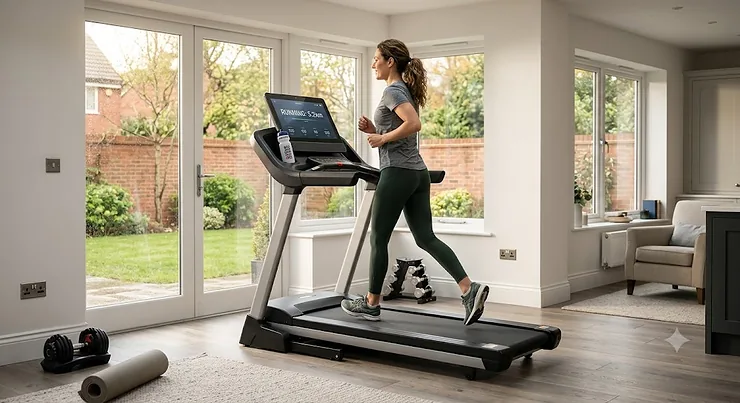
Let’s be honest about British weather for a moment. It’s October, it’s already dark by half four, and the pavement outside your front door resembles a particularly uninspiring river. Running outside isn’t just unpleasant — it actively conspires against you. This is, in large part, why the best motorised treadmill for home use has become the most searched piece of fitness equipment in the UK right now.
But here’s the thing most buying guides won’t tell you: the treadmill market in 2026 is both better and more confusing than it’s ever been. Budget models have genuinely improved. Premium machines have become proper training systems with interactive coaches and auto-adjusting inclines. And somewhere in the middle, there’s a surprisingly comfortable sweet spot where most UK buyers — those of us in terraced houses, semi-detacheds, or flats above neighbours who definitely notice every footfall — should be spending their money.
So what exactly makes the best motorised treadmill worth buying? At its core, it’s a motorised running belt driven by a continuous horsepower (CHP) motor, an adjustable speed range, and ideally a powered incline. Unlike manual treadmills, the belt moves under you rather than requiring you to push it. The difference in workout quality is significant. The difference in longevity is even more so.
The NHS recommends that adults aim for at least 150 minutes of moderate physical activity per week, and having a treadmill at home removes the two biggest barriers to hitting that target: British weather and sheer inconvenience. After testing seven machines across the full price range — from under £500 to well over £1,500 — here’s everything you need to know before spending a single pound.
Quick Comparison: Best Motorised Treadmills at a Glance
| Model | Motor | Max Speed | Max Incline | Best For | Price Range |
|---|---|---|---|---|---|
| NordicTrack T Series 5 | 2.25 CHP | 16 km/h | 10% powered | Best overall value | £500–£700 |
| JTX Sprint 7 | 2.5 CHP | 20 km/h | 12% powered | UK buyers, no subscription | £900–£1,100 |
| Reebok GT40z | 2.0 HP | 18 km/h | 12% powered | Budget-conscious runners | £500–£650 |
| Reebok i-Run 5.0 | 2.0 HP | 15 km/h | 12% powered | Small flats, first treadmill | Under £500 |
| Domyos Run 500 | 1.25 HP | 16 km/h | 10% powered | Compact storage, beginners | £450–£550 |
| JTX Sprint 9 Pro | 4.0 HP | 22 km/h | 15% powered | Serious runners, high use | £1,400–£1,700 |
| NordicTrack Commercial 1750 | 3.5 CHP | 20 km/h | 15% powered | iFIT enthusiasts, premium | £1,700–£2,200 |
What the table above reveals, if you look closely, is that powered incline is now standard even at mid-range prices — that’s a significant shift from just a few years ago. The gap between budget and premium is less about speed and more about motor durability, deck size, and what happens when something goes wrong at 6am on a Tuesday. Budget buyers should pay particular attention to warranty terms; a £400 saving looks less clever when the machine needs an engineer and the brand’s support line is located somewhere that isn’t Britain.
💬 Just one click — help others make better buying decisions too! 😊
✨ Don’t Miss These Exclusive Deals!
🔍 Take your home fitness to the next level with these carefully selected motorised treadmills. Click on any highlighted item to check current pricing and availability on Amazon.co.uk. These picks will help you find exactly what you need for your budget and space!
Top 7 Best Motorised Treadmills: Expert Analysis
1. NordicTrack T Series 5 — Best Overall Motorised Treadmill for Most UK Buyers
If you only read one entry on this page, make it this one. The NordicTrack T Series 5 is the treadmill that most people in Britain — running three or four times a week, living in a house without a dedicated gym room — should seriously consider. It’s not the cheapest, not the flashiest, and not the most powerful. But it lands in that rare territory where everything that matters is done properly.
The 2.25 CHP motor delivers smooth, consistent power from a walking pace right up to 16 km/h. For context, the average UK recreational runner sits somewhere between 9 and 11 km/h — so there’s genuine headroom. The 10% powered incline is what sets it apart from cheaper rivals at similar prices. A button press is all it takes to go from flat to a meaningful hill simulation. That matters enormously for calorie burn and for UK buyers doing the increasingly popular 12-3-30 workout (12% incline, 5 km/h, 30 minutes), and it’s something you simply cannot replicate with a manual two-position ramp.
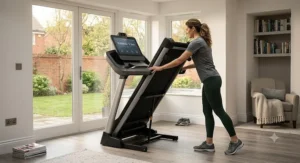
The SelectFlex cushioning lets you toggle between a softer surface for recovery runs and a firmer feel that mimics road running. The SpaceSaver hydraulic fold means it stands vertically against a wall when not in use — genuinely important for the average British home, where gym equipment competes for space with everything else. iFIT integration gives access to trainer-led sessions, but the machine works perfectly without a subscription in manual mode.
UK customers report consistently reliable delivery and solid build quality. The minor gripe — assembly takes longer than the manual suggests — is common across the category.
✅ Powered 10% incline at a mid-range price
✅ SelectFlex adjustable cushioning
✅ SpaceSaver hydraulic fold suits British homes
❌ iFIT subscription required for full content (£15/month)
❌ Assembly takes 45–60 minutes and is easier with two people
In the £500–£700 range, this is the one to beat.
2. JTX Sprint 7 — Best Motorised Treadmill for UK Buyers Who Want No Subscription
There’s something quietly satisfying about a British fitness brand that actually builds its machines around British needs. JTX Fitness, based in Brighton, designs and sells direct — no retailers, no middlemen, no passing the buck when something needs fixing. The Sprint 7 is their bestseller, and the reasons aren’t hard to understand.
The 2.5 CHP motor reaches 20 km/h — proper running speed, not just aspirational jogging territory. The 12% powered incline and a generously sized 145 × 51 cm running deck mean tall runners aren’t constantly worried about stepping off the back. Bluetooth connectivity works with Zwift and Kinomap from day one, with absolutely no subscription required. Nothing is locked behind a paywall. It just works, which in a market cluttered with iFIT and Peloton paywalls is genuinely refreshing.
What most UK buyers overlook about this model is the warranty. Three years of in-home parts and labour warranty, with actual British engineers. If the machine develops a fault, you’re not emailing support in Shenzhen and waiting three weeks for a canned response. You’re speaking to someone who can arrange a home visit. For a machine you might use 200 times a year, that peace of mind has real monetary value. UK customers on verified review sites frequently highlight the aftercare as the deciding factor in their purchase.
✅ Zwift and Kinomap compatible with no subscription
✅ 3-year in-home UK warranty — above average for the category
✅ 12% powered incline, proper running speeds
❌ Available direct from JTX rather than Amazon (worth noting for Prime buyers)
❌ Less brand recognition than NordicTrack for resale purposes
In the £900–£1,100 range, the Sprint 7 is what most serious home runners should buy.
3. Reebok GT40z — Best Motorised Treadmill for Value-Conscious Runners
Reebok’s treadmill range doesn’t get nearly as much attention as NordicTrack, and that’s largely a marketing story rather than a quality one. The GT40z is a case in point. It’s a light, compact folding treadmill — just 61 kg, which matters enormously if you’re moving it around a flat — with a 2.0 HP motor, 12% powered incline, and an 18 km/h top speed. ZigTech cushioning, borrowed directly from Reebok’s running shoe range, gives the deck a noticeably springy quality that’s easier on knees than many budget competitors.
But the headline here is the warranty. Ten years on both the motor and the frame. That’s exceptional in this price bracket, where most rivals offer two to three years before quietly retreating to fine print. The soft-drop fold and transport wheels mean moving it between rooms is manageable on your own. It connects with Zwift and Kinomap over Bluetooth, which means there are structured training options available without spending another penny.
For UK buyers in flats or terraced houses with limited storage — which, frankly, describes most of urban Britain — the GT40z offers a remarkably well-rounded package at a price that doesn’t require a difficult conversation with your bank. Available on Amazon.co.uk and eligible for Prime delivery.
✅ 10-year motor and frame warranty — outstanding at this price
✅ ZigTech cushioning from Reebok’s footwear range
✅ Compact and light at 61 kg
❌ 2.0 HP motor is adequate but shows strain above 18 km/h regularly
❌ Running deck on the smaller side for runners over 6 ft
Priced in the £500–£650 range — strong value for the warranty alone.
4. Reebok i-Run 5.0 — Best Budget Motorised Treadmill Under £500
Under £500 for a motorised treadmill with 12 levels of powered incline. That’s the pitch, and it’s a credible one. The i-Run 5.0 is the most affordable way to get genuine motorised incline adjustment into a British home, and for beginners, walkers, or anyone doing the NHS Couch to 5K programme on a treadmill, it covers almost everything you need.
The 2.0 HP motor reaches 15 km/h — honest jogging and running speeds for recreational use. The 12-level motorised incline is where the value really lands. Most machines under £500 either skip incline entirely or give you a manual ramp with two fixed positions that you adjust by crouching down and relocating a pin. The i-Run 5.0 adjusts at the touch of a button. That’s not just convenient; it’s the difference between actually using the incline feature and ignoring it entirely.
The machine folds to just 31 cm high, rolls away on transport wheels, and arrives fully assembled. In a first-floor flat above someone who works from home, or in a living room that doubles as everything else, these details are not trivial. Noise levels are modest for the price — quieter than many machines in this bracket, though not whisper-quiet under load.
✅ 12 levels of motorised incline under £500 — genuinely rare
✅ Arrives assembled, folds flat for storage
✅ Suitable for NHS Couch to 5K programme
❌ 15 km/h top speed limits options for faster runners
❌ Lighter build quality than machines at £700+
The best entry point into motorised incline treadmills for British buyers on a strict budget.
5. Domyos Run 500 — Best Compact Motorised Treadmill for Small British Homes
Decathlon’s Domyos range is rather unfashionable in the fitness world, which is a shame, because the Run 500 is one of the most practically designed treadmills for the realities of British living. It folds down to just 27 cm high — low enough to slide under a bed, which in a terraced house or flat is potentially the deciding factor in whether a treadmill exists at all or sits in a spare room gathering guilt.
The 1.25 HP motor and 16 km/h top speed cover brisk walking and steady jogging comfortably. It handles a 130 kg user weight — higher than most budget competitors — with a deck that’s been tested for 600 hours continuously in Decathlon’s lab. The 10% powered motorised incline is the standout feature at this price. Bluetooth and ANT+ heart rate connectivity works with compatible devices, and the machine carries over 1,600 verified customer reviews averaging 4.6 stars, which for a budget treadmill is genuinely unusual. Not available on Amazon.co.uk directly — purchased through Decathlon’s own site — but worth mentioning for buyers who prioritise in-store support at any of Decathlon’s UK locations.
✅ Folds to 27 cm — slides under most standard UK beds
✅ 130 kg user weight limit, higher than budget average
✅ 10% powered incline at a sub-£500 price point
❌ 1.25 HP motor is limited for sustained running above 12 km/h
❌ Not available on Amazon.co.uk — Decathlon direct only
A sensible choice for anyone whose main problem is space, not ambition.
6. JTX Sprint 9 Pro — Best High-Performance Motorised Treadmill for Serious UK Runners
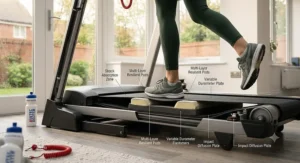
If you’re training seriously — 5K to 10K runs, marathon preparation, multiple sessions a week — you need a machine that’s been built to commercial specifications, not domestic ones. The Sprint 9 Pro is JTX’s answer to that requirement. At 4.0 HP continuous motor output and a 22 km/h top speed, this is where recreational enthusiasm meets genuine athletic capability.
The 153 × 52 cm running deck is one of the largest available in a home machine, which matters significantly for runners with a longer stride or those over 6 ft. Fifteen percent maximum powered incline gives access to proper hill training sessions — the kind that the Sport England exercise guidelines suggest can improve both cardiovascular capacity and lower body strength simultaneously. Bluetooth connectivity with Zwift and Kinomap works without subscription, and the 36 preset workouts provide variety without requiring an app. The 3-year in-home warranty with British engineers applies here too.
UK buyers who’ve used this machine for marathon training report excellent stability even at top speeds — no wobble, no lateral movement. The machine weighs around 110 kg assembled, so consider placement carefully; moving it after installation isn’t casual work.
✅ 4.0 HP motor for sustained high-speed and incline use
✅ 153 × 52 cm deck — large enough for serious stride
✅ 15% powered incline, 3-year UK in-home warranty
❌ Around 110 kg — requires permanent placement
❌ Premium price reflects commercial build quality
Priced in the £1,400–£1,700 range. Worth every penny for the runner who uses it properly.
7. NordicTrack Commercial 1750 — Best Premium Smart Motorised Treadmill
The Commercial 1750 occupies a category of its own. It’s not for everyone — the price, the size, and the iFIT ecosystem requirement all narrow the audience considerably. But for buyers who want the closest thing to a commercial gym experience in their own home, and who genuinely value interactive coaching, the 1750 is in a different league.
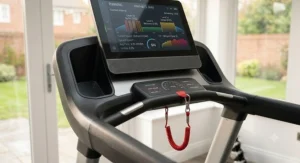
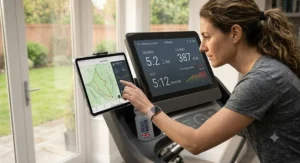
The 3.5 CHP motor with a 15% powered incline and -3% decline (yes, motorised downhill) gives training variety that no other home machine touches. The 14-inch HD touchscreen tilts and pivots, which means you can rotate it for off-treadmill strength and yoga sessions from the iFIT library. UK customers who’ve committed to the iFIT subscription (£15/month individual, £39/month family) report that the automatic terrain adjustment — where the treadmill incline changes to match a virtual outdoor route — transforms the training experience entirely.
The SpaceSaver fold means it doesn’t permanently dominate a room, but it’s a substantial machine regardless. Build quality is what you’d expect at this price: reassuringly heavy, absolutely solid under load. Assembly genuinely requires two adults and an afternoon.
✅ 3.5 CHP motor with motorised incline and decline
✅ 14-inch pivoting HD touchscreen for off-treadmill workouts
✅ iFIT auto-adjusts incline to match virtual terrain
❌ iFIT subscription required for most features (£15–£39/month ongoing cost)
❌ Large footprint even folded — needs dedicated space
Priced in the £1,700–£2,200 range. Extraordinary if you use iFIT seriously. Hard to justify if you don’t.
How to Set Up and Maintain Your Motorised Treadmill in a British Home
Getting the machine delivered is only half the battle. The way you install and care for a treadmill in the specific context of a British home — smaller rooms, suspended wooden floors, neighbours below or adjacent, damp autumn storage — determines how long it lasts and how pleasant it is to use.
Placement: Suspend flooring is common in British terraced and semi-detached houses, and a motorised treadmill on suspended timber creates noise that travels. Place the machine on a purpose-made treadmill mat (3–6 mm rubber is sufficient for most home use). This dampens vibration, protects the floor, and marginally quiets the motor noise for neighbours. The mat also catches lubricant drips and makes cleaning easier.
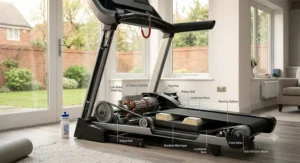
Lubrication: Most motorised treadmill belts require silicone lubricant every 40–50 hours of use, or every three to six months for average users. The spec sheet won’t tell you this in plain language, but it matters considerably. Under-lubricated belts create friction that wears the motor, stresses the belt seams, and produces that tell-tale burning smell. Use only the lubricant specified in the manual — applying the wrong type voids most warranties.
Belt tension: A loose belt slips and a tight belt strains the motor. The correct test: lift the belt at the centre point. It should rise approximately 5–7 cm. Too much or too little, and you’ll need to adjust the rear roller bolts with the hex key supplied — typically a quarter turn each side.
Damp and storage: British garages and sheds fluctuate significantly in temperature and humidity, particularly between October and March. If you’re storing a treadmill in an unheated garage, the electronics can be affected by condensation. A breathable cover (not a sealed plastic one) and a moisture absorber packet near the console will protect the electrics considerably.
First 30-day check: Run the machine for 10 minutes before your first proper workout. Listen for belt noise, check the incline motor moves smoothly through its full range, and ensure the emergency stop key works correctly. These checks take minutes and flag issues within the returns window rather than after it.
Real UK User Profiles: Which Treadmill Is Right for You?
Matching a machine to a real lifestyle matters more than matching it to a specification sheet. Here are three British buyer profiles, the problems they’re actually trying to solve, and which motorised treadmill makes the most sense for each.
Sarah, 34, renting a first-floor flat in Manchester: Sarah wants to do the NHS Couch to 5K programme without bothering the tenant below. Space is tight — the machine needs to fold and store out of the way. Budget is firmly under £500. The Reebok i-Run 5.0 is the answer: it folds flat, arrives assembled, runs quietly for its price bracket, and covers every speed the Couch to 5K plan requires.
Mark, 45, semi-detached in Leeds, 10K runner: Mark runs four times a week and wants to keep training through winter without losing fitness to dark evenings. He has space in a spare room, a realistic budget of £800–£1,100, and no interest in paying a monthly subscription. The JTX Sprint 7 is the obvious choice: proper running speeds, 12% incline, UK-based warranty support, and Zwift compatibility for structured sessions without a paywall.
Helen, 52, detached house in the Home Counties, returning to exercise: Helen is returning to running after a knee injury and wants something with good cushioning and long-term reliability. She’s willing to spend £1,500+ for the right machine. The NordicTrack Commercial 1750, with its Runners Flex cushioning and iFIT coached rehabilitation programmes, provides the guided, progressive return to running that would otherwise cost considerable money in personal training fees.
The right treadmill isn’t the most expensive one you can find. It’s the one that removes every excuse you have for not using it.
How to Choose the Best Motorised Treadmill in the UK: 6 Expert Criteria
Choosing a motorised treadmill without a framework is how people end up with a £300 machine that hums uncomfortably at anything above walking pace and breaks in March.
1. Continuous horsepower (CHP), not peak HP. This is the most abused specification in treadmill marketing. Peak HP figures are essentially meaningless — they represent a momentary burst, not sustained output. A 2.5 CHP motor runs at that power continuously. A machine listed as “3.5 HP motor” that only discloses peak figures is almost certainly weaker than those numbers imply. Look for CHP, and treat anything without that designation with appropriate scepticism.
2. Running deck dimensions. A standard recommendation for running (rather than walking) is a minimum 130 × 45 cm deck. Taller runners should look for 140 × 50 cm or larger. Squeezing your stride onto a short belt changes your gait, increases fall risk, and is deeply uncomfortable.
3. Powered vs manual incline. Manual incline — where you stop, crouch, and relocate a pin — is the friction-inducing solution that means you never actually adjust the incline during a workout. Powered incline, adjusted at the press of a button, transforms training variety. It’s worth paying extra for, particularly for the hill-interval and incline-walking workouts that research consistently shows are more effective for cardiovascular fitness.
4. Weight capacity with a safety margin. Every treadmill lists a maximum user weight. Always choose a machine rated at least 15–20 kg above your actual weight. The motor, frame, and belt all last significantly longer when not operating at the absolute top of their rated capacity.
5. Warranty and UK aftercare. This is arguably more important than any specification. A treadmill is a machine with moving parts, and it will need attention over a multi-year lifespan. A 10-year motor warranty from Reebok, or a 3-year in-home warranty from JTX with British engineers, is substantially more valuable than a 12-month parts warranty from a brand whose support address is listed somewhere vague.
6. Noise and vibration. If you live above neighbours or in a terrace, the decibel level of your treadmill affects your relationship with the people around you. Brushless motors are quieter. Heavier machines vibrate less. Budget treadmills running fast on suspended floors are the quickest way to become unpopular. Read UK-specific reviews — what’s quiet in a detached house may be unbearable above a downstairs neighbour.
Motorised Treadmills vs Manual Treadmills: What UK Buyers Need to Know
The question comes up often enough to deserve a proper answer. Manual treadmills — the kind you power with your own stride — are cheaper, lighter, and require no plug socket. They are also, for most purposes, inferior fitness tools for the majority of UK buyers.
The belt resistance on a manual treadmill forces you to lean forward and drive the belt with your legs, which changes your running mechanics in ways that can strain the lower back and hips. The inability to set a precise speed means interval training is guesswork. The maximum practical speed on most manual models sits well below what a motivated recreational runner actually wants.
| Feature | Motorised Treadmill | Manual Treadmill |
|---|---|---|
| Speed control | Precise, button-adjusted | Estimated, user-driven |
| Incline options | Powered (many models) | Fixed or none |
| Running mechanics | Natural gait | Forward lean required |
| Price range (UK) | £300–£2,500+ | £100–£500 |
| Motor noise | Present (varies by model) | None |
| Workout variety | High | Low |
| Best for | Running, intervals, incline training | Walking, very tight budgets |
The key takeaway: if you’re buying a motorised treadmill specifically for running, the slightly higher entry cost of a motorised machine pays back in better workouts, better results, and a machine that doesn’t fight you every time you want to pick up the pace. Manual treadmills suit walkers with a genuinely constrained budget. For anyone else, the motorised running belt is the correct choice.
Long-Term Cost and Maintenance: What UK Buyers Really Pay
The purchase price is only part of the cost of owning a motorised treadmill. The total cost of ownership over three to five years includes maintenance supplies, potential repairs, and — if you choose a connected machine — subscription fees.
Lubrication: A good silicone lubricant costs around £8–£15 per 500 ml bottle and should last 12–18 months for average use. Annual cost: approximately £8–£10.
Belt replacement: Most quality treadmill belts last 80,000–100,000 km before replacement is needed. For the average UK user running 3–4 times a week, that’s comfortably 10+ years. Replacement belts for mainstream brands cost £50–£150 fitted, and for machines with UK-based aftercare, the process is straightforward.
Subscription costs: This is where connected machines can quietly add up. NordicTrack’s iFIT runs £149/year for an individual subscription or £396/year for a family plan. Over five years, that’s £745–£1,980 on top of the purchase price. If you’re committed to the interactive coaching, it’s good value. If you only want to run, it’s an avoidable cost — models like the JTX Sprint 7 provide Zwift and Kinomap connectivity without any mandatory ongoing fee.
Electricity: A 2.5 CHP motor running at moderate load draws roughly 1.5–2 kWh per hour. At current UK electricity rates, a 45-minute session costs approximately 30–40 pence. Five sessions a week costs around £75–£100 per year in electricity. Significant compared to running outside; negligible compared to a gym membership.
VAT note: All prices on Amazon.co.uk already include 20% VAT, unlike US-listed prices, which typically exclude sales tax. When comparing UK and US pricing, the net figures are more comparable than they first appear.
✨ Don’t Miss These Exclusive Deals!
🔍 Ready to invest in your fitness? Click on any highlighted treadmill above to check current pricing and availability on Amazon.co.uk. Prime members enjoy fast delivery, and many models qualify for next-day dispatch.
Features That Actually Matter (And Marketing Fluff Worth Ignoring)
Marketing teams are creative. Here’s an honest filter.
Matters enormously: Continuous horsepower rating. Running deck length and width. Powered incline range. Weight capacity with headroom. Warranty terms and who actually services the machine. Noise levels for the specific environment.
Matters for some users: iFIT or Zwift connectivity. Touchscreen size. Bluetooth speakers. Built-in fans (actually more useful than they sound on longer runs). Heart rate monitoring via Polar chest strap (more accurate than grip sensors).
Matters very little: Peak horsepower claims. LED “workout light” displays. The number of preset programmes (you’ll use three at most). Claimed top speeds above 20 km/h for home use. Calorie counter accuracy (almost universally inaccurate across all brands — treat as a relative measure only).
Worth specific scepticism: Folding claims that don’t specify the actual folded height. Weight capacity figures without safety margin guidance. “Commercial grade” claims on machines under £600. Any treadmill listing only peak HP without CHP.
The most common mistake UK buyers make is over-specifying in some areas (buying a 20 km/h top speed machine that never gets above 14 km/h) while under-specifying in the area that actually matters to their daily life — usually the warranty, or the folded dimensions relative to their available storage space.
FAQ: Best Motorised Treadmill UK
❓ What is a good continuous horsepower (CHP) rating for a home treadmill?
❓ Are motorised treadmills safe to use on a first-floor flat in the UK?
❓ How often should I lubricate my motorised treadmill belt?
❓ Do I need a subscription to use a motorised treadmill in the UK?
❓ What motorised treadmill is best for a small British home with limited storage?
Conclusion: The Right Motorised Treadmill Exists for Every British Buyer
Here’s what years of testing home fitness equipment confirms: the best motorised treadmill isn’t the most expensive one, or the one with the biggest screen, or the most preset programmes. It’s the one that fits your home, matches your actual training needs, and comes with aftercare you can trust when something eventually needs attention.
For most UK buyers — realistic runners, people who want to walk more through winter, families with limited floor space — the NordicTrack T Series 5 represents the best balance of quality, features, and price. If you want no subscription and excellent UK support, the JTX Sprint 7 is arguably the stronger long-term bet. On a tighter budget, the Reebok i-Run 5.0 gets you into powered motorised incline territory for under £500, which a few years ago simply wasn’t possible at this quality level.
What all seven machines on this list share is the ability to deliver consistent, weather-independent cardiovascular training at home. In Britain. In February. When the pavements are wet and the motivation to leave the house hovers somewhere near zero. That, more than any specification or feature set, is the actual value of a good motorised treadmill.
✨ Don’t Miss These Exclusive Deals!
🔍 Check current pricing and availability on Amazon.co.uk for all seven models reviewed above. Click any highlighted product to see the latest deals — Prime members may qualify for next-day delivery on selected models!
Recommended for You
- Manual Treadmill vs Motorised: 7 Best UK Picks for 2026
- Best Treadmill Under £1000 UK 2026: 7 Powerful Picks
- 7 Quiet Treadmill for Flat in the UK (2026)
Disclaimer: This article contains affiliate links. As an Amazon Associate, I earn from qualifying purchases. If you purchase products through these links, we may earn a small commission at no additional cost to you.
✨ Found this helpful? Share it with your mates! 💬🤗
