
In This Article
You’ve made the decision. No more excuses about British weather. No more pretending a brisk walk to the corner shop counts as cardio. You’re getting a treadmill. And then, almost immediately, you hit the wall that stops everyone: manual treadmill vs motorised — what on earth is the difference, and which one do you actually need?
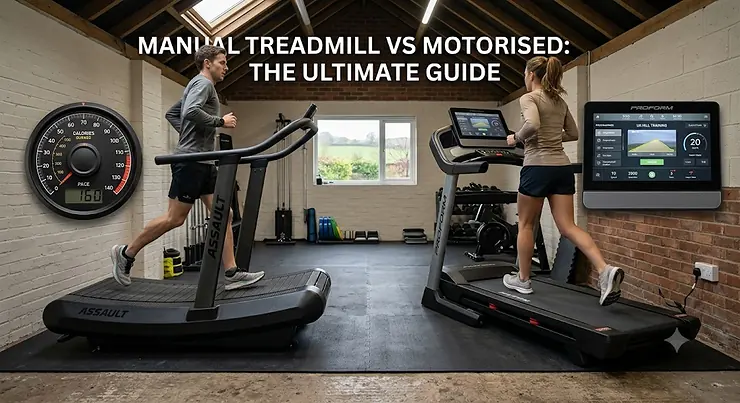
Here’s the short version. A manual treadmill is powered entirely by you — your legs move the belt, the machine does nothing except get out of the way. No plug socket required. No motor to maintain. Just you, physics, and however many biscuits you’re trying to work off. A motorised treadmill, by contrast, uses an electric motor to drive the belt at whatever speed you choose — you simply keep up. Structured, consistent, and rather convenient when you want to zone out to Netflix.
Both types have real merit. Both have genuine drawbacks. And choosing the wrong one is the kind of mistake that leads to an expensive clothes horse gathering dust in the corner of your spare room by February. According to NHS guidelines, adults should aim for at least 150 minutes of moderate-intensity activity per week — and a treadmill, whichever type you choose, is one of the most reliable ways to hit that target without leaving the house.
This guide cuts through the noise. We’ve researched real products available on Amazon.co.uk, dug into the science, and built a practical framework to help you decide. Whether you’re in a compact Leeds flat with no space for a plug socket near the garden, or a suburban semi in Guildford with a dedicated fitness room and grand ambitions, there’s an answer here for you.
Quick Comparison: 7 Best Treadmills at a Glance
| Product | Type | Price Range | Belt Size | Top Speed | Noise Level | Best For | |
|---|---|---|---|---|---|---|---|
| Sunny Health & Fitness SF-T1407M | Flat Manual | Under £150 | 107 × 33 cm | Self-paced | ⭐ Very Quiet | Budget walkers, small flats | |
| Curved Manual Air Runner (Entry) | Curved Manual | £150–£280 | ~120 × 40 cm | Unlimited (self-paced) | ⭐ Very Quiet | Home runners, HIIT beginners | |
| HXD-ERGO 2-in-1 Curved Manual | Curved Manual (Foldable) | £250–£400 | ~120 × 42 cm | Unlimited (self-paced) | ⭐ Very Quiet | Flat-dwellers, app users | |
| Half Human Curved Non-Motorised | Premium Curved Manual | £500–£900+ | ~160 × 45 cm | Unlimited (self-paced) | ⭐ Very Quiet | Serious athletes, home gyms | |
| HOMCOM Folding Motorised (1–10 km/h) | Motorised | £100–£180 | ~110 × 38 cm | 10 km/h | 🔉 Moderate | Beginners, casual walkers | |
| HOMCOM Electric (1–12 km/h, 500W) | Motorised | £150–£250 | ~120 × 40 cm | 12 km/h | 🔉 Moderate | Joggers wanting programmes | |
| Mobvoi Home Treadmill SE (2.5HP) | Smart Motorised | £300–£500 | ~120 × 40 cm | 12 km/h | 🔊 Low–Moderate | Tech users, structured runners |
What jumps out immediately is the calorie-burn gap. Research published in the Journal of Science and Medicine in Sport found that self-powered curved treadmills demand significantly higher heart rate and oxygen consumption at matched speeds compared to their motorised counterparts. That’s not marketing fluff — it’s physiology: your posterior chain (glutes, hamstrings, calves) works considerably harder when you’re the engine. The trade-off, however, is that motorised machines offer something manual ones simply cannot: repeatable, programmable intensity for steady-state endurance runs and structured training blocks.
For compact UK living — terraced houses, purpose-built flats, converted Victorian properties with thin walls and suspicious neighbours — the noise difference alone can be decisive. A motorised treadmill’s motor hum is a minor annoyance at best, a noise complaint at worst.
💬 Just one click — help others make better buying decisions too! 😊
✨ Don’t Miss These Exclusive Deals!
🔍 Take your home fitness to the next level with these carefully selected treadmills. Click on any highlighted product name to check current pricing and availability on Amazon.co.uk. These picks will help you find exactly what you need!
Top 7 Manual & Motorised Treadmills: Expert Analysis
1. Sunny Health & Fitness SF-T1407M Manual Walking Treadmill
The SF-T1407M is the gateway drug of manual treadmills — affordable, no-nonsense, and genuinely foldable enough to live under a bed in a one-bedroom flat. Its 107 x 33 cm running belt is on the narrower side, but for walking and light jogging it does the job without complaint. A fixed incline adds a consistent uphill challenge, which means even a 20-minute walk gets your heart rate up more than a flat-belt motorised equivalent.
What most UK buyers overlook is that the dual-flywheel resistance system means your speed is governed by how hard you push, not a dial — this is initially alarming if you’re used to electric machines, but you adapt within a few sessions. The LCD monitor tracks time, speed, distance, and calories burned, though the calorie readout is approximate at best. Maximum user weight is 15 stone (approximately 95 kg), so larger users will want to look elsewhere.
UK reviews are largely positive for the price bracket, with users particularly praising the fold-away convenience for small homes. It ships from Amazon with fast delivery options, and no complex assembly is required.
✅ Foldable and lightweight — ideal for small UK flats
✅ No electricity needed — use anywhere in the home
✅ Affordable entry point for manual training
❌ Narrow belt — uncomfortable for taller runners
❌ Fixed incline — no adjustment options
Price range: Under £150. Excellent value for casual walkers and beginners who want to test manual treadmill training before committing further.
2. Curved Manual Air Runner Treadmill (Entry-Level)
If the flat-belt manual treadmill is the starter flat, the curved manual is the house upgrade you didn’t know you needed. This entry-level curved model — available on Amazon.co.uk — gives you the distinctive concave running surface that encourages a natural forefoot strike pattern. The belt is made from multi-section rubber slats rather than a continuous PVC strip, which absorbs impact noticeably better. Your knees will notice the difference within a fortnight.
The curve means you lean slightly forward to accelerate and ease back to slow down — no buttons, no programmes, just pure biomechanical feedback. It’s genuinely closer to outdoor running than anything a flat belt offers, motorised or not. The self-paced nature also makes it safer: when you stop, the belt stops. There’s no being flung off the back if your mind wanders mid-sprint.
For home gyms in garages, garden offices, or living rooms where noise is a concern, the absence of a motor is a genuine selling point. The only sound is your footstrike — which, admittedly, can be considerable during sprints.
✅ Natural running gait — better biomechanics than flat belt
✅ Zero electricity — no running costs
✅ Highly durable — fewer electronics to fail
❌ Heavier than flat models — less easy to store
❌ No app connectivity on entry-level versions
Price range: £150–£280 range. A solid step up for runners who want more than basic walking.
3. HXD-ERGO 2-in-1 Curved Manual Treadmill
This is the one for the space-conscious runner who refuses to compromise on quality. The HXD-ERGO folds — a rarity among curved treadmills — which makes it genuinely practical for UK homes where a dedicated gym room is the stuff of fantasy. Its built-in app support connects via Bluetooth to track your sessions, log progress, and, frankly, give you something to look at while you’re trying not to collapse during a HIIT interval.
The running surface is slightly wider than entry-level models, making it more comfortable for taller users or those with a wider running stance. UK buyers with hardwood floors will appreciate the rubber-footed base, which reduces vibration transmission to downstairs neighbours — always a thoughtful consideration in terraced housing.
Customer feedback highlights the smooth belt feel and genuinely quiet operation as standouts. A few reviews note the folding mechanism requires a firm touch to lock securely, so check this on first assembly.
✅ Foldable curved design — rare and genuinely useful
✅ App connectivity for progress tracking
✅ Quieter operation than most flat-belt manuals
❌ Slightly higher price than basic curves
❌ Folding mechanism needs firm locking — check carefully
Price range: £250–£400 range. A genuinely smart buy for flat-dwellers who want serious training capability without sacrificing living space.
4. Half Human Curved Non-Motorised Treadmill
The Half Human is where this gets serious. Commercial-grade construction, a belt that feels like it could handle a CrossFit box, and a running surface designed for intensive daily use rather than the occasional Wednesday jog. If you’re an experienced runner, a PT, or simply someone who has decided that home fitness is no longer a casual hobby, this is the machine the others aspire to be.
The belt action is exceptionally smooth — the kind that makes you wonder how you ever tolerated anything lesser. Posterior chain engagement is notably higher than flat-belt alternatives, meaning you’re effectively doing more work per kilometre, which matters enormously if time efficiency is important to your training. It’s also built to a standard where UK climate issues (damp garages, condensation from cold mornings) don’t create maintenance headaches the way electronics-heavy motorised machines sometimes do.
The footprint is large and this machine does not fold. You need dedicated space and a reasonable budget. But for serious athletes or keen home gym enthusiasts, it genuinely delivers gym-level performance.
✅ Commercial-grade durability — built to last
✅ Outstanding belt action and posterior chain engagement
✅ Near-silent — footstrike only, no motor noise whatsoever
❌ Large footprint — not suited to small spaces
❌ Higher price bracket
Price range: £500–£900+ range. A long-term investment that pays dividends if you train seriously and consistently.
5. HOMCOM Folding Motorised Treadmill (1–10 km/h)
The HOMCOM is one of Amazon.co.uk’s consistently best-selling budget treadmills, and there’s a reason it keeps reappearing year after year: it does exactly what it promises without requiring a finance agreement. The 1–10 km/h speed range covers everything from gentle rehabilitation walking to a decent jog. At top speed with the incline engaged, you’ll get a respectable cardio session.
At 28 kg, it’s manageable to move around a flat, and the fold-away design stores it neatly against a wall. The LCD screen displays time, speed, distance, and calories — basic, but sufficient. The safety cut-off clip is present and correctly placed, which matters under UK consumer product safety requirements. Input voltage is 220–240V/50Hz, meaning a standard UK Type G plug socket is all you need.
Where it shows its budget origins is noise — the motor hum is noticeable, and users in flats should invest in a treadmill mat (available separately on Amazon.co.uk for around £20–£40) to reduce vibration transfer. Reviewers under 6 feet tall report consistent satisfaction; taller users find the belt slightly short for a full running stride.
✅ Excellent value — consistently well-reviewed for its price
✅ Folds flat — genuinely compact for UK homes
✅ Standard UK 230V plug — no adapters needed
❌ Audible motor — may disturb neighbours in shared properties
❌ Belt length limited — less comfortable for taller users above 183 cm
Price range: £100–£180 range. The sensible first motorised treadmill for beginners and walkers who want structure without spending significantly.
6. HOMCOM Electric Treadmill (1–12 km/h, 500W Motor)
The step-up sibling in the HOMCOM family adds meaningful improvements: a 500W motor pushing to 12 km/h, twelve pre-set workout programmes, and five speed modes that cover the gap between casual walk and solid running pace. The extra 2 km/h at the top end sounds modest, but it’s the difference between a brisk jog and something that actually makes you breathe hard.
The twelve pre-set programmes deserve credit — at this price, most competitors offer none. They vary intensity automatically, which is useful if you find yourself mindlessly maintaining one pace (we all do it). The LED display is clear and front-facing, which is better ergonomics than some models that mount it low and require a neck-craning glance downward.
UK reviewers highlight the relatively quick assembly and the emergency stop button as well-implemented safety features. At this price point it represents the sweet spot between functionality and affordability in the motorised category — particularly for users who want some structure to their sessions without managing a complex app ecosystem.
✅ 12 km/h top speed — covers walking through to running
✅ 12 pre-set programmes — rare at this price
✅ Foldable and compact — suitable for UK home use
❌ Motor noise — use a mat in flats or terraced homes
❌ No Bluetooth or app connectivity
Price range: £150–£250 range. A sensible motorised upgrade over entry-level walking pads, particularly if workout variety matters to you.
7. Mobvoi Home Treadmill SE (Smart AI, 2.5HP, 12 km/h)
The Mobvoi Home Treadmill SE is a different proposition entirely — this is a motorised treadmill that’s genuinely smart rather than just claiming to be. The 2.5HP motor handles sustained running sessions with minimal complaint. It connects to the TicSports app (compatible with Zwift and Kinomap, both popular with UK fitness enthusiasts), allowing virtual running routes, structured training plans, and proper data logging. The foldable 3-in-1 design means it transitions between flat pad mode (for under-desk walking), standard walking, and full running configuration without drama.
The LED display is clear and doubles as the primary controls, while the remote allows quick speed adjustments without breaking stride. A 120 kg weight capacity comfortably covers most users, and at 12 km/h the top speed is sufficient for runners who aren’t training for competitive events.
What sets it apart from the budget motorised options is the AI adaptive feature — the machine adjusts training suggestions based on your logged sessions over time. That’s not a gimmick; for users who find motivation difficult and respond well to data-driven nudges, it’s genuinely useful. Amazon Prime members can expect swift delivery; it ships from UK warehouse stock.
✅ Genuine smart features — Zwift and Kinomap compatible
✅ AI adaptive training suggestions — useful for self-motivated users
✅ Versatile 3-in-1 design — walking pad, walking, running modes
❌ More expensive than basic motorised options
❌ App dependent — some features require ongoing connectivity
Price range: £300–£500 range. The obvious choice for tech-oriented UK runners who want data, variety, and a treadmill that grows with their fitness level.
How to Choose the Right Treadmill for Your UK Home
There’s no universally correct answer in the manual treadmill vs motorised debate — there’s only the right answer for your specific situation. Here’s how to think through it in five steps.
1. Assess your space honestly. UK homes are considerably more compact than American ones. Before you buy anything, measure your available floor space and consider where you’ll store the machine when not in use. A standard foldable motorised treadmill typically folds to around 150 cm x 75 cm standing upright. Curved manual treadmills are generally shorter but often don’t fold at all. If you’re in a one-bedroom flat in Manchester or a studio in Bristol, a foldable flat-belt option (manual or motorised) is almost certainly your only realistic option.
2. Consider your noise environment. Living in a mid-terrace or a block of flats means noise matters. Manual treadmills win decisively here — the only sound is footstrike on belt, which you can partly mitigate with a rubber mat. Motorised machines produce a continuous motor hum that travels through floors. A 10mm treadmill mat (£20–£40 on Amazon.co.uk) helps significantly with motorised machines.
3. Be honest about your fitness goals. If you want HIIT training, sprint intervals, and athletic conditioning, a curved manual treadmill will serve you considerably better than any motorised equivalent at a similar price. If you want steady-state runs, structured programmes, or rehabilitation-paced walking with precise speed control, a motorised machine is the pragmatic choice. According to Sport England’s active people research, the most common reason UK adults abandon home fitness equipment is that it doesn’t match their actual usage pattern — so be specific with yourself.
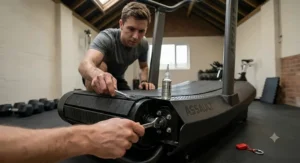
4. Factor in running costs. Manual treadmills have essentially zero running costs — no electricity, minimal maintenance. A motorised treadmill running 30 minutes daily at typical UK electricity rates (around 24p per kWh in 2026) costs roughly £8–£15 per year in electricity — not enormous, but worth noting if you’re budget-conscious. Motorised machines also require periodic belt lubrication (roughly every 3–6 months) and may need professional servicing over time.
5. Set a realistic budget in GBP. Entry-level manual treadmills start under £150. Curved manual machines begin around £200 and scale to over £800 for commercial-grade options. Motorised treadmills range from around £100 to well over £1,500. The mid-range of £250–£500 offers the best value in both categories for most UK buyers.
Real-World Scenarios: Who Should Buy What
Understanding the abstract pros and cons is one thing. Seeing your own situation reflected in a concrete example is another.
The Leeds flat-dweller working from home. Samira works remotely, has a 60 m² flat with thin walls and a downstairs neighbour who works night shifts. She wants to move more during the day without the noise of a motorised machine. The HXD-ERGO 2-in-1 Curved Manual Treadmill or the flat-belt Sunny Health & Fitness SF-T1407M both fit: silent, foldable, no power socket required. She can walk during video calls (handlebar folded down) and do intervals in the evening.
The Sheffield runner training for a half marathon. James already runs four times a week outdoors but dreads November through February. He has a garage he’s converting to a home gym and wants proper training capability. The Half Human Curved Non-Motorised Treadmill or the Mobvoi Home Treadmill SE are his two options — curved manual for biomechanically-focused high-intensity work, or motorised for structured pace training with app integration. Budget and preference for tech will decide it.
The retired couple in Cheltenham. Margaret and David want a gentle daily walk regardless of the weather, with heart rate monitoring and easy-to-use controls. Neither curved nor high-intensity is relevant to them. The HOMCOM Folding Motorised Treadmill at the budget end, or the Mobvoi SE for better features, give them exactly what they need: safe, controlled, simple.
Each of these users would be genuinely poorly served by the other’s recommendation. That’s the point.
Common Mistakes UK Buyers Make When Choosing a Treadmill
Buying based on top speed alone. A treadmill that reaches 16 km/h sounds impressive. But if you’re walking or jogging at 6–8 km/h for 90% of sessions, that headline figure is irrelevant. Focus instead on how smooth and quiet the machine is at your regular training speeds.
Ignoring belt dimensions. UK retailers don’t always make belt size prominent. A 107 x 33 cm belt (common in budget manuals and entry motorised options) is genuinely limiting for anyone over 180 cm or with a longer natural stride. Look for at least 120 x 40 cm if you plan to run rather than walk.
Overlooking the electrical situation. Manual treadmills need no power socket — which matters more than you’d think in older UK properties where outlets near clear floor space are uncommon. All motorised treadmills should be plugged into a grounded UK Type G socket; avoid extension cables unless they’re rated for the wattage load.
Underestimating the learning curve on curved manuals. First-time users often find curved treadmills disconcerting for the first one to three sessions. The belt responsiveness feels strange after electric machines. Give it a fortnight before concluding it’s not for you — the adaptation is worth persisting through.
Assuming cheap motorised equals cheap to run. Budget motorised machines sometimes have shorter maintenance intervals and less accessible replacement parts. Before buying, check whether replacement belts and lubricant are available on Amazon.co.uk for your specific model. This is the detail most buyers ignore and regret later.
✨ Don’t Miss These Exclusive Deals!
🔍 Ready to invest in your fitness? Click any highlighted product above to check current pricing, customer reviews, and delivery times on Amazon.co.uk. Prime members enjoy fast, free delivery on most treadmill orders.
Curved Treadmill: Is It Really Worth the Extra Cost?
A curved treadmill is a type of manual treadmill, not a category separate from it — worth clarifying because the terminology confuses a lot of buyers. The key difference from a flat manual belt is the concave running surface, which changes both biomechanics and workout intensity substantially.
The practical case for curved over flat manual is strong if you’re a runner. The curved surface naturally encourages a midfoot or forefoot strike, which most running coaches consider more biomechanically efficient than the heel-strike pattern many motorised treadmills inadvertently promote (the belt pulling your foot backward reinforces heel contact). This matters particularly for runners dealing with shin splints or knee discomfort — a common issue for British runners who spend significant time on pavement.
The calorie-burn advantage is real and consistent across studies. Research in Sports Medicine and wider exercise physiology literature regularly shows 20–30% higher energy expenditure on curved treadmills versus motorised machines at equivalent perceived effort levels. For time-pressed users — and most UK adults are — that efficiency matters. You can get an equivalent cardiovascular stimulus in a shorter session.
However, curved treadmills are emphatically not better for every use case. Long-distance training at steady pace is harder to programme on a curved belt than pressing a button to hold 9 km/h on a motorised machine. Rehabilitation programmes requiring precise speed control are better served by motorised options. And for beginners who find the learning curve of curved treadmills genuinely demoralising, a flat motorised machine that gets used consistently beats a curved one gathering dust in the spare room.
For a comprehensive resource on exercise standards and home equipment selection, the American College of Sports Medicine’s physical activity guidelines — widely referenced by UK fitness professionals — provide useful benchmarks for cardio training intensity and volume across different equipment types.
Long-Term Cost & Maintenance in the UK
This is the comparison most product review articles skip, and it’s one of the most practically useful things to understand before you spend several hundred pounds.
| Cost Factor | Manual Treadmill | Motorised Treadmill |
|---|---|---|
| Purchase price | £80–£1,500+ | £100–£2,000+ |
| Annual electricity cost | £0 | £8–£20 (typical home use) |
| Belt lubrication | Not required (dry system) | Every 3–6 months (~£5–£10 per application) |
| Major servicing | Rarely needed | Every 1–2 years for commercial; optional for home |
| Replacement belt | £30–£80 (varies widely) | £20–£60 (widely available) |
| Motor replacement | N/A | £80–£250+ (specialist part) |
| Estimated 5-year total cost | Purchase + £0–£50 maintenance | Purchase + £100–£400 in running/maintenance costs |
The maintenance gap narrows considerably for light domestic users on budget motorised machines — a HOMCOM run three times a week won’t rack up professional servicing bills. But for anyone using a treadmill daily or with high intensity, manual machines win on long-term cost with some margin.
One UK-specific consideration: replacement parts for some budget treadmill brands are shipped from overseas, meaning post-Brexit import complications occasionally affect availability and pricing. Before purchasing any treadmill, search Amazon.co.uk specifically for “[model name] replacement belt” — if no results appear, availability of parts may be a concern down the line.
The broader picture is that for most UK home users doing 30–45 minutes four to five times per week, the total cost of ownership difference between a decent manual and a decent motorised treadmill over five years is probably £100–£250. Meaningful, but not the deciding factor for most buyers. The deciding factors remain: space, noise, and how you actually want to train.
FAQ: Manual Treadmill vs Motorised — Your Questions Answered
❓ Is a manual treadmill any good for serious running?
❓ Can I use a motorised treadmill in a flat without annoying my neighbours?
❓ What is the difference between a self-propelled running surface and a normal motorised belt?
❓ Are manual treadmills available with free delivery on Amazon.co.uk?
❓ Is a curved treadmill better for bad knees than a motorised flat-belt machine?
Conclusion: Make the Right Call for Your Life, Your Space, Your Goals
The manual treadmill vs motorised question doesn’t have a universal right answer — it has your right answer. If you’re a serious runner after athletic conditioning, genuine calorie-burning efficiency, and freedom from both electricity bills and motor maintenance, a curved manual treadmill is the better machine. Full stop. If you want structured programmes, precise speed control, compatibility with fitness apps, and the comfort of a familiar gym-style experience, a good motorised machine will serve you loyally.
What matters most is that you buy the treadmill you’ll actually use. The best treadmill in the world is useless if it doesn’t fit your space, suit your training style, or match your daily reality. Start with the right questions — space, noise, training goals, budget — and the product selection becomes considerably simpler.
Check current prices and availability on Amazon.co.uk using the product links throughout this guide. All models listed are verified for UK delivery and use standard UK 230V/Type G plugs where power is required.
✨ Don’t Miss These Exclusive Deals!
🔍 Take your fitness to the next level. Click any highlighted product in this guide to check current pricing, delivery options, and genuine UK customer reviews on Amazon.co.uk. Your ideal treadmill is one click away!
Recommended for You
- Best Treadmill Under £1000 UK 2026: 7 Powerful Picks
- 7 Quiet Treadmill for Flat in the UK (2026)
- Best Treadmill for Walking UK 2026: 7 Expert Picks You’ll Actually Use
Disclaimer: This article contains affiliate links. As an Amazon Associate, I earn from qualifying purchases. If you purchase products through these links, we may earn a small commission at no additional cost to you.
✨ Found this helpful? Share it with your mates! 💬🤗
