
In This Article
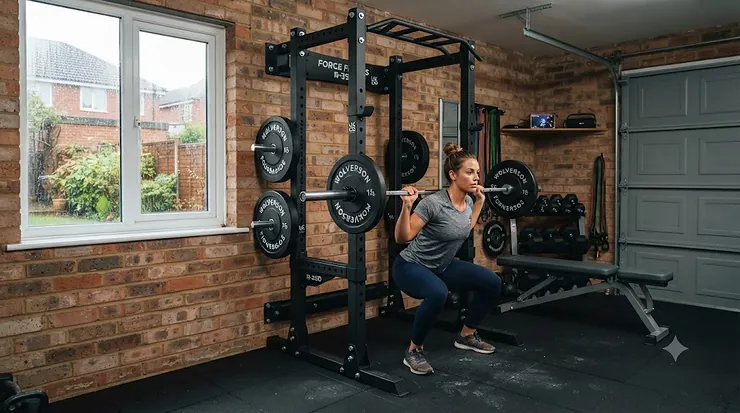
Picture a wet Tuesday evening in a British semi. The garage is 70% bikes and paint tins, the spare room doubles as an office, and the four-post cage you bought with big ambitions squats on your floor like a steel hippo. A wall-mounted power rack for small spaces is the graceful exit. It bolts to a solid wall, swings out for the length of a session, then folds back to roughly the depth of a bookcase.
Here’s the catch. Not every wall-mounted power rack for small spaces is built equally, and amazon.co.uk is a maze of near-identical black-and-red frames with wildly different track records. Skip the wall-fixing homework and you’re hanging several hundred kilos of dynamic load off a partition. Get it right and you have a proper barbell station that disappears between sessions.
This guide does the sifting. It compares seven real folding racks, translates each spec into what it means for your room, and reports what published buyer reviews say. To be transparent, this is analysis built on spec sheets, listings and aggregated reviews, not hands-on testing. UK availability on Amazon shifts constantly, so I flag where the evidence is thin. You also get a garage wall mounting walkthrough, a decision framework and a straight look at safety claims.
First, what exactly are we buying?
What Is a Wall-Mounted Power Rack for Small Spaces?
A wall-mounted power rack for small spaces is a barbell rack whose uprights hinge from brackets fixed to a wall. You unfold it for squats, presses and pull-ups, then fold it flat afterwards. Like a conventional power rack, it works as a mechanical spotter, but it stores in roughly 5-20 cm of depth.
Three designs dominate:
- Fold-out (side-folding): you pull hitch pins, swing the uprights out, and re-pin them. Most budget racks work this way.
- Fold-up: the whole frame slides up and down the wall. The PRx design uses gas shocks rather than removing four hitch pins.
- Freestanding folding: no wall fixing, but a larger stored footprint.
Note the naming. A folding wall-mounted squat rack usually has two uprights, so it behaves like a half rack, while a foldable power rack tends to imply a fuller cage. Marketing blurs the two constantly. What matters is whether it has safety arms and how far the frame opens from the wall.
Quick Comparison: 7 Folding Racks at a Glance
| Model | Folded depth / footprint | Claimed capacity | Frame | Indicative price | Best For |
|---|---|---|---|---|---|
| Mikolo 2×2 | ≈5 cm | ≈454 kg | 2×2 in, 13-gauge | £450-£650 | Best all-rounder |
| Garvee 2.36″ | Check listing | ≈454 kg | 2.36 in, 1.6 mm | £450-£650 | Awkward ceilings |
| VEVOR PK1922 | ≈0.25 m² | ≈454 kg | 2×2 in, 1.5 mm | Mid-£300s | Lowest entry price |
| RitFit PWM02 | ≈5 cm | ≈454 kg | 60 mm, 1.8 mm | £500-£700 | Warranty peace of mind |
| JELENS FS01 | ≈0.19 m² | ≈499 kg | 2×2 in | £500-£750 | Solo lifters wanting safeties |
| Goimu WM3-V4 | Check listing | ≈907 kg (claimed) | Not stated | £1,100-£1,400 | Rack plus cables |
| PRx Profile PRO | ≈10 cm (some tests) | Check spec | 3×3 in | £900-£1,200 landed | Daily folders |
Prices are indicative bands based on comparable listings at the time of research and may vary. Check current price.
Looking at the table, the four 2-inch-class racks (Mikolo, Garvee, VEVOR and RitFit) are near-twins on paper, so the real differences hide in steel thickness, warranty and review depth. Capacity figures are manufacturer claims, and the 907 kg on the Goimu matters far less than what your wall can carry. If you want the shortest route to a working rack, start with Mikolo. If you want a rack that folds in seconds and costs more, look at PRx Profile PRO.
💬 Just one click — help others make better buying decisions too!😊
Top 7 Wall-Mounted Power Racks for Small Spaces: Expert Analysis
I’ve ordered these by role rather than price alone: an all-rounder, three budget-minded frames, two feature-led options and one premium benchmark. Every entry translates specs into practical meaning and frames review evidence honestly.
1. Mikolo 2×2 Folding Wall Mounted Squat Rack — best all-rounder for tight rooms
The standout is a rare kind of restraint: this rack does the basics well without pretending to be a gym in a box. The listing gives roughly 119 cm wide by 218 cm tall, folding to about 5 cm deep and opening to around 50 cm, with a claimed 15-second switch between storage and use. The uprights are 2×2 inch (60 mm) 13-gauge steel, with UHMW-lined J-cups and a pull-up bar sitting about 226 cm off the floor.
On paper, 50 cm of open depth is enough to squat and bench but not to wander. That 226 cm bar height also deserves a tape measure. Under a 240 cm ceiling, a 180 cm lifter finishing a chin-up will likely graze it.
On reviews, one buying guide cites a 4.6-star average from 231 Amazon reviews on the US listing. The amazon.co.uk variant I found carried a single rating and showed as unavailable, so UK review depth is thin.
Pros:
- ✅ Slim folded depth of roughly 5 cm
- ✅ UHMW-lined J-cups protect barbell knurling
- ✅ Deepest review base among the budget frames
Cons:
- ❌ Only about 50 cm of open depth
- ❌ UK variants and stock are patchy
Price range: indicative £450-£650; check current price. It’s the best price-to-evidence ratio here, if you can find a variant in stock.
2. Garvee 2.36″ Folding Squat Rack — cheapest route with flexible mounting heights
Garvee’s party trick is adjustability at install time. It offers five wall-mount height positions and four pull-up bar positions, which helps when your ceiling isn’t the textbook 240 cm. The frame uses 2.36 inch (60 mm) uprights with a 1,000 lb (about 454 kg) claimed capacity, plus J-hooks, a pull-up bar and a landmine attachment.
The steel section matches Mikolo, so the differences live in weld quality and coating, which spec sheets never show. The landmine is a genuine bonus in a small room. It gives you rows, presses and rotational work from one barbell and one corner.
On reviews, one buyer’s guide calls it a promising budget option but flags a short track record. Read that as “fewer long-term reports”, not “bad”. amazon.co.uk carries Garvee and GarveeLife listings, and prices vary widely by seller.
Pros:
- ✅ Five mounting heights suit awkward ceilings
- ✅ Landmine attachment included
- ✅ Multiple listings on amazon.co.uk
Cons:
- ❌ Short track record, few long-term reports
- ❌ Prices swing sharply between sellers
Price range: Comparable unbranded 2.36-inch racks on amazon.co.uk ranged from about £540 to over £800 depending on seller and date. Compare offers carefully; patience pays here.
3. VEVOR Folding Power Cage (PK1922) — lowest entry price on the list
The standout is sheer affordability. It opens to about 10 sq ft (roughly 0.9 m²) and folds to about 2.7 sq ft (roughly 0.25 m²), on a 2×2 inch main frame with 1.5 mm walls and a 1,000 lb rating. The kit includes two J-hooks, a landmine holder and a pull-up bar, and it weighs about 30 kg.
That 1.5 mm wall is thinner than the 13-gauge steel (roughly 2.3 mm) on Mikolo. Thinner steel isn’t dangerous by default, but it leaves less margin for dynamic loads such as re-racking with a bounce. The 30 kg weight makes it easier to lift into place, though. If your capacity needs are modest, that’s a fair trade.
Reviews are thin: the Canadian listing shows 3.7 stars from 12 ratings, and the Australian one 3.7 from 9. That is mixed and low-volume, so I couldn’t verify meaningful UK sentiment. I also couldn’t confirm an amazon.co.uk listing, though VEVOR sells this model on its EU store.
Pros:
- ✅ Lowest entry price of the seven
- ✅ Light at around 30 kg, easier to hang
- ✅ Landmine and J-hooks included
Cons:
- ❌ 1.5 mm walls are the thinnest here
- ❌ Ratings are few and mixed
Price range: mid-£300s (converted from VEVOR’s EU pricing); check current price. It’s a fair gamble for light-to-moderate lifters, less so for someone chasing heavy singles.
4. RitFit PWM02 Folding Squat Rack — longest frame warranty of the budget bunch
What sets this apart is the paperwork. The listing describes 1.8 mm steel on 60 mm uprights, a 1,000 lb rating, a folded depth of about 2 inches (5 cm), and a 36-month warranty on the main steel frames. Attachments include J-hooks, a pin-on pull-up bar and a 360° landmine, and some variants add a safety arm.
At 1.8 mm, the wall sits between VEVOR and Mikolo. Warranty length says something about the manufacturer’s confidence, but a US-based claim process can be awkward from Britain, so ask the seller how UK claims work.
On reviews, the US listing ranks around #91 in power cages, and one representative buyer review praised the sturdiness, the collapsible design for a garage gym, and smooth assembly. RitFit’s own guide calls it a compact barbell station rather than a full cage replacement (a fair framing, though brand-authored). I couldn’t confirm the UK listing.
Pros:
- ✅ 36-month frame warranty on paper
- ✅ Safety-arm variant available
- ✅ 1.8 mm steel beats the thinnest budget frames
Cons:
- ❌ UK listing and support unverified
- ❌ Only about 50 cm of open depth
Price range: indicative £500-£700; check current price. Good value if UK availability and warranty support check out.
5. JELENS FS01 Folding Squat Rack — safety bars in the box
The standout is that catching hardware ships with the frame. It uses 2×2 inch steel with a claimed safe load of 1,100 lb (about 499 kg), safety bars that catch a falling barbell, and 23 front plus 12 side hole positions. Open dimensions of about 60 cm deep, 129 cm wide and 219 cm tall give you a little more room than Mikolo, and one guide notes a folded footprint near 2.08 sq ft.
The extra 100 lb of claimed capacity is marketing. The safety bars are the real story, because squatting alone without catches is the classic home-gym accident. Twelve side holes also mean you can fine-tune safety height rather than guess.
Several roundups list it (including a 2026 folding-rack list), but I couldn’t find a sizeable, verified UK review pool, so treat its sentiment as unproven.
Pros:
- ✅ Safety bars included for solo lifting
- ✅ About 60 cm of open depth
- ✅ Fine-grained hole spacing
Cons:
- ❌ Thin verified review evidence
- ❌ UK Amazon listing unconfirmed
Price range: indicative £500-£750; check current price. It suits solo lifters who prize safety hardware over review volume.
6. Goimu WM3-V4 Folding Squat Rack — rack and cable trainer in one
Here the hook is versatility. It combines a squat rack, cable crossover and lat pulldown, with dual independent pulleys and 15 adjustable heights. One guide credits it with the highest listed capacity (2,000 lb) and over 80 exercises.
The 2,000 lb figure is a headline, not a reason to buy. What matters more is wall loading. Cables pull sideways and outwards on the frame, so the structure behind it must be properly masonry-solid. That’s a real consideration for garage wall mounting.
On reviews, the amazon.co.uk listing shows 4.4 stars from 80 ratings, the deepest verified UK evidence of the seven. Reviewers note that assembly and wall mounting take effort, and the cable range of motion has limitations.
Pros:
- ✅ Replaces a rack plus a cable machine
- ✅ 15 pulley heights, dual cables
- ✅ Best UK review evidence of the seven
Cons:
- ❌ Cable travel is limited
- ❌ Pricey, with a heavier install
Price range: the listing I saw sat above £1,000, so call it £1,100-£1,400; check current price. It’s worth it only if you’d otherwise buy a functional trainer as well.
7. PRx Performance Profile PRO — folds up in seconds on gas shocks
The standout is the mechanism. PRx folds up rather than in, and it’s effortless compared with pin-based racks. One expert roundup crowns it best overall, notes about 4 inches folded depth and USA manufacture, and offers sizes to suit different ceilings and heights.
If you’ll fold daily, a 10-second routine beats a 60-second pin dance every time. Fold-up designs likely need headroom above the frame, so confirm the required ceiling clearance for your model. The 3×3 uprights also give it a heavier build than the 2×2 budget frames.
On reviews, reviewers consistently describe installation as straightforward and the unit as very sturdy. The catch is UK logistics: one UK buying guide puts the landed cost, including shipping and import duty, around £900-£1,200, and I couldn’t confirm an amazon.co.uk listing.
Pros:
- ✅ Fast fold-up mechanism
- ✅ Heavier 3×3 build
- ✅ Consistent expert praise
Cons:
- ❌ Highest cost once duty is added
- ❌ Overseas warranty and shipping
Price range: roughly £900-£1,200 landed; check current price. It’s pricey, but you’re paying for daily convenience.
Evidence Check: What We Can and Can’t Verify
| Model | amazon.co.uk listing seen? | Review evidence found | Confidence | Best For |
|---|---|---|---|---|
| Mikolo 2×2 | Yes (some variants unavailable) | 4.6 stars from 231 US reviews; 1 UK rating | Medium | Value seekers |
| Garvee 2.36″ | Yes (several listings) | Short track record noted | Low-medium | Budget buyers |
| VEVOR PK1922 | Not confirmed | 3.7 stars from 9-12 ratings (AU/CA) | Low | Lowest cost |
| RitFit PWM02 | Not confirmed | Strong US sales rank; brand-authored guide | Medium | Warranty fans |
| JELENS FS01 | Not confirmed | Listed in guides; few verified reviews | Low | Solo lifters |
| Goimu WM3-V4 | Yes | 4.4 stars from 80 UK ratings | Medium | Cable fans |
| PRx Profile PRO | Not confirmed | Top pick in expert roundups | Medium-high | Daily folders |
Read this table as a warning label. Only two racks had confirmed amazon.co.uk listings, and none had a large UK review pool, so buy from a seller with a clear returns policy. Where evidence is thin, lean on fundamentals such as steel thickness, safety hardware and your wall, not on star ratings alone.
✨ Don’t Miss These Exclusive Deals!
🔍 Take your home gym to the next level with these carefully selected racks. Click on any highlighted item to check current pricing and availability. These picks will help you create a training corner your whole household can live with!
How to Choose a Wall-Mounted Power Rack for Small Spaces
Here’s a quick decision path for picking the right wall-mounted power rack for small spaces:
- Check the wall first. A rack is only as good as what holds it. Solid masonry or structural timber is the goal, so know your wall type before you shop.
- Match open depth to your room. Around 50-60 cm is typical. Measure from wall to the spot where the barbell ends will clear.
- Measure ceiling clearance. Subtract light fittings and add your height for pull-ups. A 226 cm bar leaves little headroom under 240 cm.
- Prioritise safety hardware. Safety bars or spotter arms matter more than extra rated capacity if you train alone.
- Judge the steel. Compare wall thickness, roughly 1.5 mm (thin) to 2.3 mm (13-gauge), and upright size, 2×2 versus 3×3.
- Pick a fold mechanism you’ll actually use. Pin-based racks are cheaper, but daily folders benefit from faster designs.
- Weigh warranty and UK support. A long warranty means little if claims route overseas.
Folding Gym Equipment Features That Actually Matter (And Those That Don’t)
Marketing loves big numbers, but folding gym equipment lives or dies on a handful of details. Here’s the filter.
Features that matter
- Wall bracket design. Full-height stringers spread load better than a few bolts.
- Safety catches. Sturdy, adjustable, and preferably included.
- Numbered holes. They make height changes fast and repeatable.
- Lined J-cups. UHMW protects the bar and cuts noise.
Features that don’t
- Headline capacity. 1,000 lb versus 2,000 lb rarely changes anything for home lifters, because dynamic loads and wall strength cap you first.
- Accessory count. Extra pulleys and pegs look great in photos but often go unused.
- Colour options. Pretty, but irrelevant.
For most people, the sensible folding wall-mounted squat rack is one with safety bars, decent steel and a mounting height you can adjust. Everything else is garnish. If a listing shouts about pulleys but whispers about the wall bracket, be suspicious.
Wall Mounted Squat Rack vs Foldable Power Rack vs Freestanding Options
A wall mounted squat rack (two uprights, wall-fixed) gives the best space saving but leans entirely on your wall. A foldable power rack that stands on the floor trades a larger stored footprint for wall-free installation. The Bodypower Deluxe Folding Power Rack, for example, stands flat when not in use and unfolds in three movements, and it includes a lat machine, low row station and 32 holes per upright. It suits renters, though the amazon.co.uk listing sat near £1,000.
UK-made wall options exist too. Bulldog Gear’s wall-mounted folding rack lists 80×80 mm steel, with a short variant sitting 67.5 cm out and a long variant 126 cm. It showed as unavailable when I checked, so it’s a benchmark rather than a pick.
| Type | Floor space when stored | Stability | Needs wall fixing? | Best For |
|---|---|---|---|---|
| Wall mounted squat rack (fold-out) | Almost none | Depends on wall | Yes | Mikolo, Garvee buyers |
| Foldable power rack (freestanding) | Moderate | High | No | Renters |
| Fold-up wall rack | Almost none | Depends on wall | Yes | PRx Profile PRO buyers |
| Traditional four-post cage | Large, permanent | Highest | Optional | Dedicated rooms |
The table shows why the wall is the deciding factor. If you own a solid brick or block garage wall, a wall-fixed frame wins on space. If you rent, or your walls are questionable, a freestanding foldable power rack is the safer path even at a larger footprint.
Garage Wall Mounting: A Practical Guide
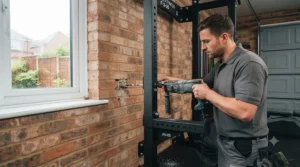
Good garage wall mounting is 80% inspection and 20% drilling. Follow this sequence.
- Identify the wall. Solid brick or dense block is ideal. Stud walls need fixing into structural timber, and cavity walls need fixings that engage the solid inner leaf. If unsure, ask a builder.
- Scan for services. Use a cable and pipe detector before you drill anything.
- Use rated fixings. Check the manual for the wall types the manufacturer’s hardware suits. If you’re substituting fixings, get professional advice.
- Mark, level, repeat. Assemble the frame on the floor, offer it up with a helper, and mark holes with a spirit level. A rack that’s 3 mm out of plumb will annoy you forever.
- Load gradually. Start with the empty bar, then add weight in stages, watching for movement.
- Re-check after week one. Fixings can settle, so re-torque and inspect.
Common first-month mistakes include hanging from plasterboard, skipping the level, and folding the rack before the pins are fully seated. If any step feels beyond you, paying an installer is cheap insurance against the rack you love coming off the wall.
Real-World Scenarios: Which Rack Fits Which Home?
These are hypothetical profiles, not testimonials. The NHS guidelines recommend strengthening work on at least two days a week, and that pace is what we’re planning for.
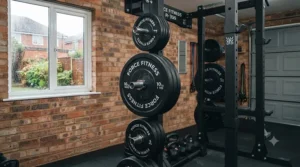
Profile A: the single-garage family. The car needs the garage overnight, so everything must fold. A wall-fixed folding wall-mounted squat rack like Mikolo or Garvee fits, with the folded depth measured against the car door swing. Budget: £450-£650 plus fixings.
Profile B: the spare-room lifter with a 2.4 m ceiling. Pull-up clearance is the constraint. Choose a frame with adjustable bar positions like Garvee, or plan pull-ups elsewhere. Add safeties, since it’s solo training in a quiet room.
Profile C: the cable enthusiast. You’d otherwise buy a functional trainer and a rack. Goimu WM3-V4 consolidates both, provided you have a masonry wall. Budget £1,100+.
Profile D: the daily folder with budget. You train five mornings before work and fold every time. PRx Profile PRO earns its price in seconds saved.
Buyer’s Decision Framework
Use this priority checklist to cut the options quickly:
- If you rent or can’t drill, choose a freestanding foldable power rack, because it needs no wall.
- If your budget is tight and your wall is solid, choose VEVOR or Garvee, because they cost least while keeping the core rack functions.
- If you want the best evidence-to-price ratio, choose Mikolo, because it has the strongest review base among budget frames.
- If you train alone, choose JELENS FS01 or a RitFit PWM02 safety-arm variant, because catching hardware matters more than extra capacity.
- If you want cables too, choose Goimu WM3-V4, because it replaces two machines.
- If you fold daily and can afford it, choose PRx Profile PRO, because the fast mechanism removes friction.
Still torn? Rank your priorities: wall type, budget, safety, folding speed. The first three usually settle it.
Common Mistakes When Buying a Wall-Mounted Power Rack for Small Spaces
Trusting capacity numbers. A 1,000 lb sticker isn’t independent testing. ISO 20957-1 sets general safety requirements and test methods for stationary training equipment, so ask sellers whether their rack has been tested against it, and don’t assume.
Ignoring the wall. The best rack on a weak wall is a hazard. Solve garage wall mounting before you order.
Skipping safeties. Solo squatting without catches is risky. Budget for spotter arms if they’re not included.
Forgetting bar length. A 2.2 m Olympic bar in a 120 cm rack leaves plenty of sleeve poking out, and plates need clearance.
Buying attachments you won’t use. Pulleys and pegs are tempting, but most people end up doing squats, presses and pull-ups.
Overlooking stock and returns. Marketplace sellers vary, so confirm delivery, returns and who handles warranty claims.
Ignoring ceiling clearance. Measure pull-up headroom, as the 226 cm bar example shows.
Long-Term Cost & Maintenance
Total cost is the rack plus fixings, safeties, a bench and a barbell. Add £30-£80 for quality fixings and possibly £150-£300 for an installer if walls are tricky. Plates and bars are separate.
Spread across time, the numbers soften. Over five years at three sessions a week, that’s about 780 sessions, so a £400-£600 rack works out at roughly 51-77p per session before extras.
| Model | Indicative price | Value verdict |
|---|---|---|
| VEVOR PK1922 | Mid-£300s | Cheapest; thinner steel |
| Garvee 2.36″ | £450-£650 | Flexible heights; short record |
| Mikolo 2×2 | £450-£650 | Best evidence-to-price |
| RitFit PWM02 | £500-£700 | Warranty appeal |
| JELENS FS01 | £500-£750 | Safety-first |
| PRx Profile PRO | £900-£1,200 landed | Premium convenience |
| Goimu WM3-V4 | £1,100-£1,400 | Two machines in one |
The table shows a clear step at each tier: budget frames cluster, PRx buys speed, and Goimu buys cables. Compare the total with your own gym membership, transport and time. For maintenance, inspect bolts and welds every few months, wipe down rust spots in damp garages, and check J-cup liners for wear.
Safety, UK Regulations and What “Rated Capacity” Really Means
Safety comes down to three questions: is the rack tested, is the wall sound, and are the catches set correctly?
On testing, general stationary training equipment standards exist, but I couldn’t establish that every wall-mounted rack here has been tested against one. Ask sellers directly. On marking, the government’s guidance on UKCA marking explains which product categories require it. Whether a folding rack falls inside a specific requirement can depend on the product, so check the seller’s declaration. General product safety law applies regardless.
On capacity, remember that dynamic loads, such as re-racking hard or bailing a failed lift onto the safeties, exceed static bar weight. Choose racks with margin over your working weights. Set safety bars an inch or two below your lowest squat position and test with an empty bar first.
Finally, check your home insurance if you install heavy fixings, and get landlord consent before drilling if you rent. If you’re unsure about your wall, get an expert to inspect it before you lift.
FAQ
❓ How much does a folding wall-mounted squat rack cost in the UK?
❓ Can I fit a wall mounted squat rack to a stud wall?
❓ Is a foldable power rack safe for heavy squats?
❓ How much floor space does a wall-mounted power rack for small spaces actually save?
❓ Do I need landlord consent for garage wall mounting?
Conclusion: Small Room, Big Barbell
A wall-mounted power rack for small spaces is one of the smartest ways to reclaim a room without giving up barbell training. The trick is choosing on fundamentals, not on glossy claims. For most people, Mikolo 2×2 offers the best balance of evidence and price, Garvee wins when ceilings are awkward, and VEVOR undercuts both if you accept thinner steel. RitFit PWM02 and JELENS FS01 add warranty and safety hardware, Goimu WM3-V4 adds cables, and PRx Profile PRO buys daily convenience at a premium.
Whatever you choose, do the unglamorous things well: verify your wall, budget for safeties, measure your ceiling and buy from a seller with clear returns. A folding wall-mounted squat rack or foldable power rack is only as good as its installation. Treat folding gym equipment as a system, not a gadget, and it will serve you for years.
✨ Ready to reclaim your floor?
🔍 Compare the seven racks above, check current pricing and availability, and pick the one that fits your wall, your ceiling and your training. Your future self, and your car, will thank you! 🏋️♂️💪
Recommended for You
- Power Rack For Home Gym: 7 Proven Picks For UK Lifters (2026)
- Power Rack for Garage Gym: 7 Best UK Picks for 2026
- Squat Rack for Beginners: 7 Best Picks for UK Home Gyms (2026)
Disclaimer: This article contains affiliate links. As an Amazon Associate, I earn from qualifying purchases. If you purchase products through these links, we may earn a small commission at no additional cost to you.
✨ Found this helpful? Share it with your friends! 💬🤗
