
In This Article
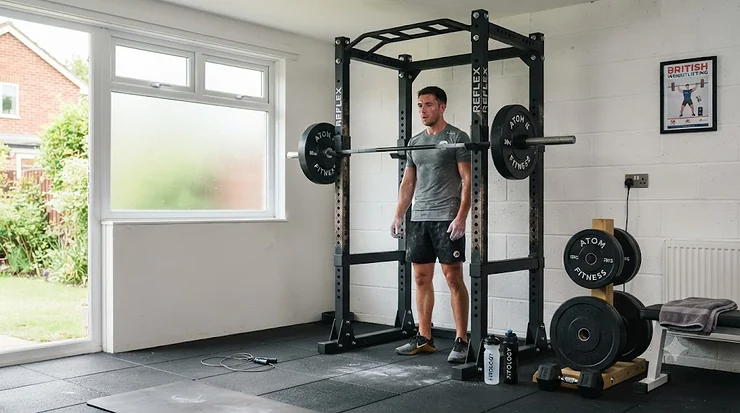
A power rack for home gym training is a four-post steel frame that holds your barbell at any height and catches it on adjustable safety bars if a rep fails. It lets you squat, press and bench alone without a spotter, and most models add a pull-up bar and attachment options for extra exercises.
Here’s the honest pitch. Lifting heavy alone in a garage is brilliant right up until the moment it isn’t. A power rack works as a mechanical spotter: set the catches just below the bottom of your squat and a failed rep becomes an annoying clang instead of an A&E visit. That single feature is why a power rack for home gym use beats almost any other big purchase you can make for strength training.
The catch is choice. The squat rack vs power cage debate confuses newcomers, a full size power rack can swallow a single garage, and every brand claims industrial-grade steel. Some models add a power rack with weight storage built in; others expect you to sort your plates out yourself. Then there’s the squat and bench setup itself, which decides whether your rack feels safe or merely looks impressive.
This guide cuts through the noise. Every pick comes from published specs and the consistent findings of reviewers (I haven’t assembled all seven in my own garage, and I won’t pretend otherwise). Expect real-world interpretation of every number, plus practical setup advice. Prices are indicative ranges from the time of research, so check current price before you buy.
Quick Comparison: The Best Power Rack for Home Gym at a Glance
| Rack | Price range | Frame and steel | Stated capacity | Weight storage | Best For |
|---|---|---|---|---|---|
| JX FITNESS Power Cage | Under £300 | Compact four-post, thinner steel | Lower than heavy-duty rivals | Barbell holder pegs | Small budgets and small rooms |
| GYM MASTER Adjustable Power Cage | £180–£400 (varies by model) | Four-post, 28 J-cup heights | J-cups and spotters 200 kg | Corner plate poles | Value-minded home lifters |
| Mirafit M200 Power Rack | £300–£450 | 60 mm frame, 2–6 mm steel | 350 kg max load | Optional storage poles | UK-brand all-rounder |
| Force USA MyRack | £450–£600 (base unit) | 60 mm uprights, 12-gauge | 900 kg static | Built-in bar sleeves | Modular, expandable builds |
| Signature Fitness SF-3 Power Cage | £350–£550 | 3 x 3 inch, 11-gauge | About 680 kg | Not stated in sources | Heavy lifters |
| YODOLLA Power Rack with Cable Crossover | £450–£700 | Full cage plus cable system | 907 kg frame rating | Plates load onto cables | Rack and cables in one |
| Goimu C1-V4 Power Cage | £600–£900 | 2 x 2 inch alloy steel | 907 kg | Four Olympic plate posts | Cable work and tidy storage |
Two patterns matter here. First, prices track steel thickness and included extras, so the cheapest cages are fine for moderate loads but will feel less planted under a heavy squat. Second, only some racks combine a proper power rack with weight storage; if plates end up on the floor, the rack has failed the tidiness test.
💬 Just one click — help others make better buying decisions too!😊
Top 7 Power Racks for Home Gym Training: Expert Analysis
Ordered roughly from budget to premium. Each entry weighs the specs against real-world use and the recurring themes in published reviews, not marketing copy.
1. JX FITNESS Power Cage — cheapest way into caged lifting
The JX FITNESS Power Cage is the “I’d like to lift heavy without dying” starter pack: a compact four-post frame that costs less than anything else here.
It has an elevated pull-up bar that takes wide and close grips, adjustable J-hooks and safety bars, and barbell holder pegs, and it fits standard and Olympic bars. In practice, being the smallest cage in this round-up means it slips into a spare-room corner or tight garage where a full size power rack simply won’t go. You keep the safety-catch benefit, which is the whole point of a cage, without sacrificing half your floor.
Here’s what to weigh: it suits beginners and lighter-to-moderate lifters, but it uses thinner steel and a lower rating than the heavy-duty options, and there’s no cable stack. What the spec sheet won’t tell you is that a lower rating matters most when a loaded bar lands on the safeties, so set them carefully and don’t treat the frame as unbreakable.
One UK round-up notes that thousands of owner reviews back it up as a solid starter rack. I couldn’t verify individual review text, so treat that as broad sentiment rather than a guarantee.
Pros:
- ✅ Lowest outlay for proper caged safety
- ✅ Compact frame suits small rooms
- ✅ Elevated pull-up bar takes wide and close grips
Cons:
- ❌ Thinner steel and lower capacity
- ❌ No cable stack or heavy-duty upgrade path
Price range and verdict: budget-tier, typically under £300 at the time of research — great value if expectations stay realistic; check current price.
2. GYM MASTER Adjustable Power Cage — sensible value with corner plate storage
The GYM MASTER Adjustable Power Cage is the middle-ground pick for home lifters who want a proper cage without commercial-gym prices.
It’s a four-post cage with 28 height settings on the J-cups, a pull-up bar across the top, and plate storage poles on each corner that double as ballast to keep the frame planted. That makes it a genuine power rack with weight storage: the plates you park on the corners add stability while clearing your floor. The J-cups and spotter bars are rated to 200 kg, which is ample for the squats, bench and overhead press most people do at home, and the pull-up bar holds up to 120 kg.
On paper it suits a lifter working with realistic home weights rather than chasing huge numbers. The honest limits: the 200 kg J-cup rating is lower than premium rivals, the steel is thinner-gauge, and very strong lifters will eventually want something beefier.
Owners regularly praise the finish and the build quality for the money. Listings for some GYM MASTER racks note that assembly tools aren’t included, so have spanners ready.
Pros:
- ✅ 28 J-cup height settings
- ✅ Corner plate poles add stability and storage
- ✅ Pull-up bar rated to 120 kg
Cons:
- ❌ 200 kg J-cup rating is modest
- ❌ Thinner steel than premium racks
Price range and verdict: roughly £180–£400 depending on the exact model, at the time of research — strong value; verify the variant before ordering.
3. Mirafit M200 Power Rack — the UK brand default with a proper 60 mm frame
The Mirafit M200 Power Rack is the one many British home lifters shortlist first, and the specs explain why.
It uses a 60 mm x 60 mm steel frame with thickness ranging from 2 mm to 6 mm, 6 mm brace plates on the uprights, 16 adjustment levels, and UHMW-lined J-cups and full-length spotters that protect your bar. Total size is about 220 cm tall, 147 cm wide and 141 cm deep, with a 350 kg maximum load. Bolt-down feet let you anchor it, and the rear base bar position gives a bench more room inside the cage. Translation: a squat and bench setup fits comfortably, and the liners spare your knurling.
Based on the spec comparison, this is a strong all-rounder for a full size power rack in a garage. The catch: it’s too wide for a standard 6 ft barbell, so you’ll need a 7 ft or international 6 ft bar, and storage poles are optional extras rather than included.
Reviewers describe assembly as straightforward, with legs slotting into the frame and uprights bolting on. I couldn’t verify a broad recent body of independent reviews for this exact model, so this entry leans on specs.
Pros:
- ✅ Sturdy 60 mm frame with 6 mm brace plates
- ✅ UHMW-lined J-cups and spotters protect the bar
- ✅ Bench-friendly rear base position
Cons:
- ❌ Storage poles cost extra
- ❌ Too wide for a standard 6 ft bar
Price range and verdict: around £300–£450 at the time of research depending on colour and bundle — the safe UK choice; check current price.
4. Force USA MyRack — modular rack that grows with you
The Force USA MyRack is a blank canvas: a solid cage base that you customise with over twenty attachments as your training evolves.
It uses 60 mm (2.4 inch) 12-gauge uprights with 10-gauge support brackets, Westside hole spacing, 54 adjustment points front and back, and built-in Olympic bar storage sleeves. Force USA’s UK store quotes a 900 kg static rating and a lifetime structural warranty. Westside spacing puts holes about an inch apart near the bench zone, which makes dialling in bench catches easier than on coarser designs. It’s also heavy enough to stand freestanding, though bolt-in options exist.
Analytically, it suits lifters who value expansion over immediate extras. Reviewers praise the steel, spacing and price for what you get, while noting the uprights are 12-gauge rather than 11, attachment quality can feel less premium, and the powder coat and printed numbers draw mild criticism. Remember the rating is static: dropping a loaded bar is a different test.
It’s mainly sold through Force USA’s own UK store, so check availability on Amazon UK.
Pros:
- ✅ Westside hole spacing for precise bench and rack heights
- ✅ 900 kg static rating with lifetime structural warranty
- ✅ Huge attachment ecosystem
Cons:
- ❌ 12-gauge uprights rather than 11-gauge
- ❌ Attachments cost extra and vary in finish
Price range and verdict: around £450–£600 for the base unit at the time of research; check current price, as attachments add up.
5. Signature Fitness SF-3 Power Cage — heavy-duty steel you won’t outgrow
The Signature Fitness SF-3 Power Cage is what you buy when you plan to squat serious weight and never think about flex.
The frame uses 3 inch by 3 inch, 11-gauge steel, a visible step up from the 14-gauge tubing most budget cages use, with a rating of about 680 kg. It comes with UHMW-coated J-hooks that protect knurling, safety straps, and a multi-grip pull-up bar. Numbered uprights make it quick to set hooks and safeties at matching heights. Translation: less wobble on heavy rack pulls, fewer nervous glances at bolts, and safety straps that catch the bar more quietly than steel pins.
This is the pick for lifters heading towards big squats, and it’s arguably the closest thing to a commercial full size power rack in this line-up. The trade-offs are size and effort: a large footprint, heavy assembly, and most owners bolt it down for the steadiest feel.
One UK round-up ranks it best for heavy-duty use. Weight storage isn’t mentioned in the sources I found, so plan separate plate storage.
Pros:
- ✅ Thick 3 x 3 inch, 11-gauge steel
- ✅ UHMW-coated J-hooks and safety straps
- ✅ Numbered uprights speed up setup
Cons:
- ❌ Large footprint and heavy assembly
- ❌ Costs more than budget cages
Price range and verdict: roughly £350–£550 at the time of research — outstanding steel for serious lifters; check current price.
6. YODOLLA Power Rack with Cable Crossover — rack and cable trainer in one
The YODOLLA Power Rack with Cable Crossover does the work of two machines, which is why one UK round-up names it best overall.
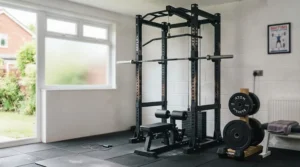
It’s a full cage with a pull-up bar, movable J-hooks, adjustable safety bars and dip bars, plus a cable crossover, lat pulldown and landmine attachment. The frame is rated to 907 kg and the footprint is about 161 cm deep by 142 cm wide by 212 cm tall. Cables take both 25 mm standard and 50 mm Olympic plates, so you can use plates you already own. In practice, you squat inside, then move to pulldowns, rows and pushdowns without leaving the frame.
Here’s the reality check: it’s plate-loaded rather than pin-selected, so changing cable weight means handling discs, and cable action at this price won’t be as glass-smooth as a commercial machine. Assembly is a long job that’s easier with two people.
For lifters wanting variety in a single footprint, it’s the most capable all-rounder here.
Pros:
- ✅ Cage plus cable crossover, pulldown and landmine
- ✅ Takes standard and Olympic plates
- ✅ Accessories included in the box
Cons:
- ❌ Plate-loaded cables rather than a weight stack
- ❌ Long assembly best done with two people
Price range and verdict: roughly £450–£700 at the time of research — superb versatility; check current price.
7. Goimu C1-V4 Power Cage — cable station with tidy plate posts
The Goimu C1-V4 Power Cage is the option for lifters who want cables and organised storage in the same frame.
It’s a full four-post cage built from 2 inch by 2 inch alloy steel, rated to 907 kg, with a high and low pulley system on a 1:1 ratio. Extras include a tricep rope, T-bar, pulldown bar, J-hooks, six counterweight racks with clamps and a 360-degree landmine. The cage is 43 inches deep, so a squat and bench setup has real room, and four Olympic plate storage posts plus six hooks make it a genuine power rack with weight storage. The whole thing occupies about 17.9 square feet.
Here’s what to weigh: the 1:1 ratio means less cable travel than a 2:1 machine, it’s plate-loaded rather than pin-selected, and it’s a big build. Goimu includes a two-year warranty. As a do-it-all station it packs a lot in, but only suits a garage with real space.
Pros:
- ✅ High and low 1:1 pulley system
- ✅ Four Olympic plate posts and six hooks
- ✅ Two-year warranty
Cons:
- ❌ Large footprint of about 17.9 sq ft
- ❌ Plate-loaded cables with shorter travel
Price range and verdict: around £600–£900 at the time of research — feature-packed for cable fans; check current price.
Top 7 Compared: What Reviewers Praise and Criticise
| Rack | Standout strength (per reviewers) | Recurring criticism | Best For |
|---|---|---|---|
| JX FITNESS Power Cage | Lowest cost, compact | Thinner steel | First-time lifters in small rooms |
| GYM MASTER Adjustable Power Cage | Value, finish, corner plate poles | Lower J-cup rating | Home lifters on a budget |
| Mirafit M200 Power Rack | Frame strength, UHMW liners | Optional storage, wide for 6 ft bars | UK garage all-rounders |
| Force USA MyRack | Steel, spacing, attachments | 12-gauge uprights, attachment finish | Modular expandable builds |
| Signature Fitness SF-3 Power Cage | 11-gauge steel, straps | Size, assembly effort | Heavy squatters |
| YODOLLA Power Rack with Cable Crossover | Rack plus cables | Plate-loaded cable feel | Variety seekers |
| Goimu C1-V4 Power Cage | Cables, storage posts | 1:1 ratio, big build | Cable fans with space |
Read across the rows and the compromises are predictable: cheaper racks lose steel and capacity, cable racks lose floor space, and modular racks lose money to attachments. That’s fine, because it means you can choose the compromise you’ll actually accept. If you’re torn, the Mirafit M200 and Signature Fitness SF-3 are the safest heavy-lifting picks, while the YODOLLA rewards anyone who’ll really use cables.
✨ Ready to Pick Your Rack?
🔍 Take your home gym to the next level with these carefully selected racks. Click any product name to check current pricing and availability, then measure your space one more time.
How to Choose a Power Rack for Home Gym Training
Choosing a power rack for home gym use comes down to six decisions, in this order:
- Measure your space first. Height, width and depth all matter; add clearance above the pull-up bar for your hands.
- Decide between a cage and stands. The squat rack vs power cage choice hinges on whether you train alone; a cage catches you from inside.
- Check steel and capacity. Thicker steel (lower gauge number) flexes less, but check J-cup and safety ratings, not just the frame rating.
- Plan storage. A power rack with weight storage keeps plates tidy and adds ballast; a full size power rack without it needs extra shelving.
- Check bench compatibility. Confirm the width between uprights and internal depth suit your bench.
- Think about expansion. Attachments, hole spacing, UHMW liners and warranty separate a rack you’ll keep from one you’ll replace.
Independent guidance such as Garage Gym Reviews’ squat rack safety guide is worth reading before you buy, particularly on capacity and build. As a rule, the best power rack for home gym use is the one that fits your room, matches your loads and leaves a little headroom.
Squat Rack vs Power Cage: Which One Fits Your Space?
The squat rack vs power cage question is really a question about risk and space. A power cage is a four-post enclosure: you lift inside, with safeties catching a failed rep. A squat rack or squat stand is usually two posts that you lift in front of, so it costs less and takes up less room, but it offers less protection if a lift goes wrong.
| Type | Typical footprint | Solo safety | Versatility | Best For |
|---|---|---|---|---|
| Full power cage (e.g. Mirafit M200, about 147 cm wide by 141 cm deep) | Large | Catches inside the frame | Pull-ups, dips, attachments | Solo lifters with space |
| Short cage (e.g. Mirafit M200S, about 183 cm tall) | Large but lower | Same cage protection | Same, with lower pull-up bar | Low-ceiling garages and rooms |
| Two-post squat stand | Small | Limited without spotter arms | Basic squats and presses | Small rooms with a spotter |
The verdict on squat rack vs power cage: if you train alone and can fit one, the cage wins on safety and versatility. A squat stand only makes sense when space or budget is genuinely tight. The Mirafit M200S is a neat compromise, offering cage protection at just over six feet tall.
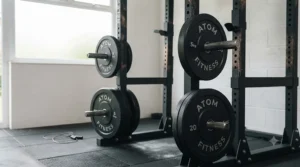
Full Size Power Rack: Dimensions, Ceiling Height and Floor Space
A full size power rack is bigger than most people imagine. The Mirafit M200 stands about 220 cm tall, 147 cm wide and 141 cm deep. The YODOLLA Power Rack with Cable Crossover measures about 161 cm deep by 142 cm wide by 212 cm tall, and the Force USA MyRack is roughly 87 inches tall, 47 inches wide and 55 inches deep. The Goimu C1-V4 occupies about 17.9 square feet.
Now compare that with your room. A standard UK ceiling is around 240 cm, which suits most cages, but allow roughly 30 cm above the pull-up bar for hands and head, and check garage door tracks or low joists. If clearance is tight, the short Mirafit M200S or a shorter variant is worth a look.
Then think about the barbell. The Mirafit M200 is too wide for a standard 6 ft barbell, so plan on a 7 ft or international 6 ft bar. Add bench length, plate loading space and walking room: a full size power rack demands a working area, not just a footprint.
Finally, remember delivery: these racks arrive in several heavy boxes, and you’ll want a route that gets them to the room without drama.
Power Rack With Weight Storage: Does It Actually Help?
A power rack with weight storage does two jobs. It keeps your plates tidy, and it adds ballast that stops the frame rocking when you rack or unrack a barbell.
The GYM MASTER Adjustable Power Cage has plate storage poles on each corner that double as ballast. The Goimu C1-V4 Power Cage adds four Olympic plate storage posts and six hooks. The Mirafit M200 has spare holes for optional weight storage poles, while the Force USA MyRack builds in Olympic bar storage sleeves. Notice the pattern: storage is either included, optional or absent, so check before you assume.
Here’s the honest analysis. Loaded storage pegs improve stability, but they don’t replace bolting down if you do dynamic pulls or lift near the rack’s limits. Also, load plates evenly: a lopsided stack can bias the frame. Finally, keep heavy plates low to the ground, where they’re easier to grab and safer to drop.
If storage is a priority, a power rack with weight storage is worth a small premium. If you’d rather buy a separate plate tree, a plain frame is fine, but budget for it.
Squat and Bench Setup: A Step-by-Step Guide Inside the Cage
A good squat and bench setup is what turns a rack into a safe training station. Here’s a repeatable routine.
Set the J-hooks
For squats, set the hooks just below shoulder height so you can unrack without tiptoeing. For bench, set them so you can unrack with slightly bent arms.
Set the safeties
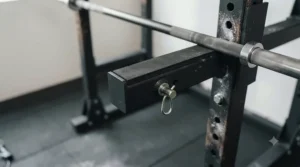
For squats, position safety bars just below the lowest point of your squat, so the bar clears them on a correct rep but lands on them if you bail. For bench, put them just above your chest. This is the same principle a power rack uses as a mechanical spotter. Safety straps are a popular alternative because they absorb impact more quietly and are kinder to the bar.
Centre the bench
Place the bench centred between the uprights with the bar above your eyes. Check that the bench fits the width between the uprights; some GYM MASTER models list around 110 cm between uprights, for instance.
Test before you trust it
With a light load, gently lower the bar onto the safeties and confirm everything is level and secure. Only then add weight.
Rehearse bailing
Practise dumping the bar on safeties at a light load so it becomes automatic. Squat and bench setup is a habit, not a one-off.
Steel Gauge, Capacity and What the Numbers Mean
Steel gauge runs backwards: a lower number means thicker steel. A listing for a GYM MASTER cage equates 11-gauge with 3.0 mm, while Force USA’s UK store equates 12-gauge with 2.3 mm. The Signature Fitness SF-3 Power Cage uses 11-gauge 3 x 3 inch tubing; the Force USA MyRack uses 12-gauge 60 mm uprights with 10-gauge support brackets; the GYM MASTER Adjustable Power Cage is a lighter build.
Capacity figures need interpretation. Ratings like the Force USA MyRack‘s 900 kg are static, meaning the load resting on the hooks, not a dropped bar. Reviewers point out a dropped loaded bar is a different, tougher test. Meanwhile, component ratings often sit well below the frame rating: the GYM MASTER J-cups and spotters are rated to 200 kg, and Mirafit’s single-prong safety catches have been described as 200 kg rated.
The practical rule: choose a frame rating far above your heaviest lift, then check that J-cups and safeties comfortably exceed your working loads. For most home lifters, 11- or 12-gauge steel with sensible ratings is plenty.
Real-World Scenarios: Matching the Rack to the Lifter
The garage lifter. Three sessions a week, a 240 cm ceiling and room to spare. The Mirafit M200 or Signature Fitness SF-3 Power Cage delivers stable steel for a squat and bench setup that will last. Add a good adjustable bench and a 7 ft bar.
The spare-room beginner. A low ceiling, limited space and a modest budget. The JX FITNESS Power Cage or the shorter Mirafit M200S keeps caged safety without dominating the room. In the squat rack vs power cage debate, this lifter still benefits from a cage.
The shared home gym. Two people, mixed goals and a garage with a decent footprint. The YODOLLA Power Rack with Cable Crossover or Goimu C1-V4 Power Cage combine barbell work and cable training, and each offers a power rack with weight storage or plate-loading options that keep plates off the floor.
Match budget, environment and frequency to the rack, not the other way round.
Assembly, Anchoring and Your First 30 Days
Even the best power rack for home gym training only helps once it’s built properly.
Build it right. Follow the assembly diagrams and use the correct set of holes, because misaligned holes cause alignment problems. Allow time: the YODOLLA is described as a long job that’s easier with two people, and some GYM MASTER listings note that tools aren’t included.
Anchor it. The Mirafit M200 has bolt-down feet, and most makers recommend bolting down. If you can’t drill into your floor, load the storage pegs and keep movements controlled.
Check the bolts. Re-tighten everything after the first week and periodically after that.
Start light. Use the first weeks to learn your hook and safety heights, practise bailing, and build volume gradually. Aim to train all major muscle groups on at least two days a week, in line with the NHS physical activity guidelines.
Protect the floor. A rubber mat under the rack helps spread load and protect the surface.
Common Mistakes When Buying a Power Rack for Home Gym Training
- Buying on capacity alone. A big frame rating means little if the J-cups and safeties are rated far lower.
- Ignoring ceiling height. Measure with the pull-up bar included, then measure again.
- Forgetting bench width and depth. A rack that can’t fit your bench makes your squat and bench setup impossible.
- Skipping safeties. Setting them wrongly defeats the entire point of a cage.
- Assuming storage replaces bolting. A power rack with weight storage improves stability but doesn’t remove the need to anchor for dynamic lifts.
- Deciding squat rack vs power cage on price alone. Cheaper stands save money and space but give up solo safety.
Long-Term Cost and Value: What a Power Rack for Home Gym Really Costs
The rack is only the opening bid. A full setup also needs a barbell (7 ft if your cage is wide), plates, a bench, flooring and possibly attachments such as dip bars, cables or a landmine.
Value, however, is easy to see. A rack costing around £400 used three times a week for a year is roughly 150 sessions, which works out at about £2.70 a session, well below most gym passes. Strength training is also recommended by the NHS for improving strength.
Warranty matters too: Force USA MyRack carries a lifetime structural warranty, and Goimu C1-V4 Power Cage includes two years. For a power rack for home gym use, the sweet spot is usually mid-range steel with room to expand, rather than the cheapest frame or the most elaborate station.
FAQ
❓ Can a power rack for home gym use fit under a low garage ceiling?
❓ What barbell length fits a full size power rack?
❓ Do I need to bolt down a power rack with weight storage?
❓ How much weight can a power rack for home gym training hold?
❓ Is a solo bench press safe in a cage?
Conclusion
The best power rack for home gym training is the one that fits your room, matches your loads and leaves space to grow. If money and space are tight, the JX FITNESS Power Cage gets you into caged lifting, while the GYM MASTER Adjustable Power Cage adds corner storage and value. The Mirafit M200 is the dependable UK all-rounder, the Force USA MyRack is the modular option, and the Signature Fitness SF-3 Power Cage is the heavy-duty choice. For cable work, the YODOLLA Power Rack with Cable Crossover and Goimu C1-V4 Power Cage pack two machines into one footprint.
Remember what matters: settle squat rack vs power cage honestly, measure for a full size power rack before you commit, consider a power rack with weight storage to keep the room tidy, and rehearse your squat and bench setup until it’s second nature. Prices change constantly, so check current price and availability before you decide.
✨ Ready to Build Your Home Gym?
🏋️ Pick the rack that matches your space and your goals, click through to check current pricing and availability, and get that first set in. The bar is waiting!
Recommended for You
- Power Rack for Garage Gym: 7 Best UK Picks for 2026
- Squat Rack for Beginners: 7 Best Picks for UK Home Gyms (2026)
- Multi Gym vs Power Rack: 7 Best Picks for UK Home Gyms (2026)
Disclaimer: This article contains affiliate links. As an Amazon Associate, I earn from qualifying purchases. If you purchase products through these links, we may earn a small commission at no additional cost to you.
✨ Found this helpful? Share it with your friends! 💬🤗
