
In This Article
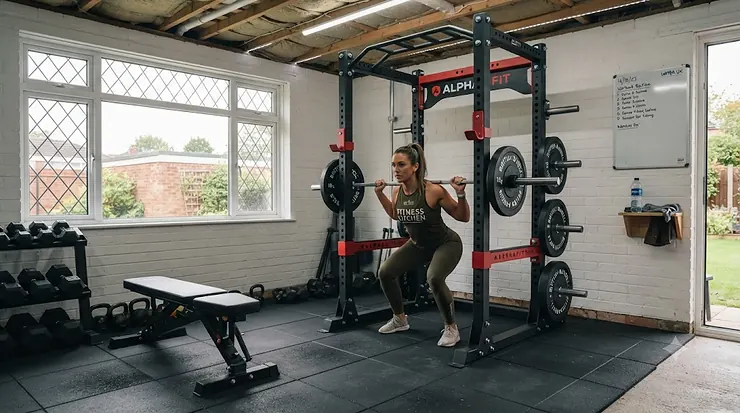
Somewhere between “I’ll just use resistance bands” and “I’ve remortgaged the house for a full commercial cage” sits the sensible answer: a half rack for home gym training. It’s the piece of kit that lets you squat, bench, and pull heavy without needing a spare bedroom the size of a squash court. A half rack for home gym setup essentially takes the safety and loading capacity of a proper power cage and strips away the redundant back half of the frame, so you get J-hooks, safety arms, and often a pull-up bar, in a footprint that fits against a garage wall or in the corner of a spare room.
What is a half rack for home gym use? In short, it’s a two-to-three-upright steel frame with adjustable barbell catches and safety spotter arms, designed to support squats, bench press, and overhead work without the full four-post enclosure of a power cage — trading a little rear stability for a much smaller footprint and lower price. Public health guidance backs up why this matters: the NHS recommends strengthening activities that work all the major muscle groups on at least two days a week, and a rack sat in your hallway removes every excuse about traffic, membership fees, or gym opening hours.
We’ve dug through UK-available models from Mirafit, GYM MASTER, Strongway, RIP X, and Yaheetech to find seven real half racks that suit different budgets, ceiling heights, and ambitions — from a £100 squat stand for beginners to a light-commercial-grade cage that’ll outlive your mortgage.
Quick Comparison Table: Half Racks at a Glance
| Model | Price Range | Max Load | Footprint (H x W x D) | Best For |
|---|---|---|---|---|
| GYM MASTER Heavy Duty Half Power Cage | £150-£200 | 200kg | 210 x 119 x 136cm | Budget buyers wanting dip bars included |
| Yaheetech Adjustable Squat Rack | £90-£120 | 400kg (claimed) | 90-155cm adj. height | Absolute beginners, tightest budgets |
| Mirafit M130 Squat & Bench Rack | £120-£160 | Bar-rated, no stated max | 78-123cm width adj. | Narrow rooms, dual squat/bench use |
| RIP X Heavy Duty Power Rack | £180-£230 | 260kg bar / 210kg pull-up | 209 x 112.5 x 110cm | Compact power rack fans, small rooms |
| Mirafit M210 Half Power Rack | £230-£270 | 250kg bar / 150kg pull-up | 220 x 132 x 141cm | Half rack with pull up bar, UK-built |
| Strongway Multi-Gym Power Cage | £250-£300 | 400kg | 209 x 110 x 140cm | Free weight training plus cable work |
| Mirafit M4 Half Power Rack | £850-£950 | Commercial-rated | 3x3in 11-gauge steel | Serious lifters, light-commercial use |
Looking at the spread above, there’s a clear line between the sub-£200 entry racks that prioritise footprint over rated capacity, and the £250-plus models that add genuine training versatility through pull-up bars and pulley systems. The jump to the Mirafit M4 Half Power Rack at the top isn’t about raw strength most home lifters will ever need — it’s about the frame tolerances, hole spacing precision, and long-term durability that only heavier-gauge steel provides. If you’re only ever going to squat and bench in the 60-120kg range, the mid-table options comfortably cover you.
💬 Just one click — help others make better buying decisions too!😊
Top 7 Half Rack for Home Gym: Expert Analysis
1. GYM MASTER Heavy Duty Half Power Cage — best budget dip-station combo
The GYM MASTER Heavy Duty Half Power Cage pairs squat and press capability with a built-in dip station, which is the standout feature that separates it from cheaper bare-bones stands. Its 50mm reinforced steel tube frame is rated to 200kg for both the barbell catches and the pull-up bar — a figure that comfortably covers the vast majority of home lifters, though anyone chasing a 250kg-plus squat should look further down this list. The 210 x 119 x 136cm footprint means it needs a proper 2.1m ceiling clearance, so measure twice before ordering.
Based on the spec comparison, this is a rack built for people who want squats, presses, dips, and pull-ups from a single unit without paying for a cable pulley system they might not use. Reviewers consistently note that the gunmetal powder-coated finish holds up well against the condensation that’s common in unheated UK garages, and that assembly, while requiring your own spanners, is a manageable solo job in under two hours.
Pros:
- ✅ Dip bars and pull-up bar included at no extra cost
- ✅ Gunmetal finish resists garage condensation and rust
- ✅ Suits both 6ft and 7ft International barbells
Cons:
- ❌ 200kg max load will limit advanced lifters eventually
- ❌ Assembly tools not included, so budget for a socket set
Price sits in the £150-£200 range at the time of research, and for that money the included dip station arguably makes this the best value combo unit on this list — check current price for the latest figure.
2. Yaheetech Adjustable Squat Rack — lightest, most adjustable entry point
The Yaheetech Adjustable Squat Rack is the squat stand purists will recognise: two adjustable uprights with no rear frame, no pull-up bar, and nothing to distract from the core job of racking a bar safely. Its standout feature is the adjustability — height runs from 90cm to 155cm and width from 70cm to 115cm, so it genuinely does fold down small when you’re not training, then expand out for taller lifters or wider bench setups.
What most buyers overlook about this style of rack is that the lack of a rear frame is a feature, not just a cost-cutting measure — you can walk straight through the working area rather than stepping over a base rail, and it tucks into a corner far more easily than any half rack with pull up bar attached. The manufacturer states a 400kg max load, though as with most budget squat stands, that figure describes static frame strength rather than a realistic dynamic training limit; treat it as a ceiling, not a target.
Pros:
- ✅ Genuinely compact when folded down for storage
- ✅ Width and height both independently adjustable
- ✅ Lowest price point of any rack on this list
Cons:
- ❌ No pull-up bar or rear stability frame
- ❌ Stated 400kg capacity is a manufacturer maximum, not a working guide
At around £90-£120, this is the sensible starting point if you’re not yet sure home training will stick, or if your ceiling height rules out taller half racks. Check current price before buying, as budget squat stands see frequent promotional movement.
3. Mirafit M130 Adjustable Squat & Bench Press Rack — best narrow-footprint all-rounder
The Mirafit M130 Adjustable Squat & Bench Press Rack stands out for its narrow-position setting, which shrinks the footprint down when you’re not actively lifting — a genuinely useful feature for anyone sharing a garage with a car or a spare room with, well, actual spare room needs. With 13 barbell rack levels at 2-inch intervals and 11 spotter levels at 1-inch intervals, the adjustment granularity here beats most sub-£200 competitors.
Here’s what to weigh: the spotter height range of 62-87cm makes this equally happy as a squat rack and as a bench press station, which matters because plenty of half racks are optimised for one movement at the expense of the other. Reviewers consistently note the sturdiness given the price point, with several long-term owners reporting years of use without wobble, and one buyer specifically praised the rack for taking a dropped 200kg lift without incident.
Pros:
- ✅ Narrow storage position saves space between sessions
- ✅ 10 width settings suit both standard and Olympic bars
- ✅ Widely praised by UK reviewers for stability at the price
Cons:
- ❌ No pull-up bar included on this base model
- ❌ Assembly needs two 17mm spanners, not supplied
Priced around £120-£160, and often available bundled with a Mirafit bench and barbell set for those starting completely from scratch.
4. RIP X Heavy Duty Power Rack — best compact power rack for small rooms
The RIP X Heavy Duty Power Rack earns its standout tag through footprint discipline: at 112.5cm wide and 110cm deep, it’s noticeably narrower front-to-back than most half racks on this list, which reviewers repeatedly flag as the reason they chose it over bulkier alternatives. Its 21 height increments and 260kg barbell rating with a 210kg pull-up capacity put it ahead of the GYM MASTER unit on raw numbers, while staying in a similar price bracket.
The spec sheet won’t tell you this, but user reports suggest the narrower frame is specifically compatible with 6ft standard barbells as well as 7ft Olympic bars, which is a genuine plus for anyone training in a box room where a full-length bar simply won’t swing round. One verified buyer highlighted needing a proper 17mm socket set rather than an adjustable wrench, after scuffing the base trying to force it with the wrong tool.
Pros:
- ✅ Narrower 110cm depth suits tight rooms and box bedrooms
- ✅ 260kg barbell and 210kg pull-up rating beats similarly priced rivals
- ✅ Compatible with both 6ft standard and 7ft Olympic bars
Cons:
- ❌ Base finish is sprayed rather than powder-coated, so it marks easily
- ❌ Textured pull-up bar grip runs slightly narrow for bigger hands
At roughly £180-£230, the RIP X Heavy Duty Power Rack represents strong value for the compact power rack category specifically — check current price, as this model has moved in and out of stock periodically.
5. Mirafit M210 Half Power Rack — best half rack with pull up bar
If you’re specifically shopping for a half rack with pull up bar as standard, the Mirafit M210 Half Power Rack is the benchmark UK option. Its 32mm diameter straight pull-up bar sits atop a proper 60mm x 60mm steel frame — noticeably heavier-gauge tubing than the RIP X or GYM MASTER models — with 16 adjustment levels at 8cm hole spacing across a 220cm total height.
Based on the spec comparison, the M210’s 250kg barbell and 150kg pull-up rating sits mid-pack, but what actually differentiates it is expandability: Mirafit sells a bolt-on cable pulley system, dip bars, weight storage poles, and a landmine attachment specifically for this model, so it can grow with your training rather than being replaced. Reviewers consistently note the pull-up bar’s thickness feels closer to commercial-gym equipment than the thinner bars found on budget imports, and one long-term owner specifically compared it favourably against a previous full cage they’d owned and sold.
Pros:
- ✅ Proper 32mm pull-up bar rated to 150kg
- ✅ Genuine attachment ecosystem for future upgrades
- ✅ UK-based customer service and 30-day returns
Cons:
- ❌ At 220cm tall, it needs a genuinely high ceiling
- ❌ Some owners note fewer third-party attachment options than US brands
Priced around £230-£270 direct from Mirafit, occasionally undercut on Amazon — check current price across both before committing.
6. Strongway Multi-Gym Power Cage with Dual Pulley — best for free weight training plus cables
The Strongway Multi-Gym Power Cage with Dual Pulley stands apart from the rest of this list by folding a genuine dual cable pulley system into the half rack format, without ballooning into full multi-gym territory. Its standout feature is versatility: a 400kg rated capacity, pull-up bar, landmine attachment, dip handles, and a two-anchor-point pulley system suitable for both 25mm and 50mm Olympic plates, all inside a 209 x 110 x 140cm footprint.
What most buyers overlook about this model is that the pulley system effectively replaces a separate cable machine, which is normally a four-figure purchase on its own — meaning this rack does double duty for anyone who wants both heavy free weight training and accessory cable work like lat pulldowns or tricep pushdowns in the same session. Reviewers consistently praise the steel safety spotters and their locking mechanism, describing the rack as feeling noticeably more solid under load than its price point suggests.
Pros:
- ✅ Genuine dual cable pulley system included as standard
- ✅ 400kg rated capacity, among the highest on this list
- ✅ Compatible with both 25mm and 50mm Olympic plates
Cons:
- ❌ Assembly is more involved given the added pulley hardware
- ❌ At 140cm deep, it needs more floor space than the RIP X or GYM MASTER
Expect to pay in the £250-£300 range, making it arguably the best value-per-feature rack here if cable work matters to you — check current price for live figures.
7. Mirafit M4 Half Power Rack — premium pick for serious, long-term training
The Mirafit M4 Half Power Rack is the light-commercial step-up on this list, built from 3-inch by 3-inch 11-gauge steel — a meaningfully heavier gauge than the 60mm frames used on the mid-range Mirafit models. Its standout feature is Westside hole spacing with laser-cut numbering, giving spotter and J-cup positioning the kind of precision usually reserved for proper gym-floor equipment.
On paper this means the M4 is over-specified for the vast majority of home lifters, and that’s rather the point: reviewers consistently describe it as a “buy once, cry once” purchase, with one owner specifically praising how well the rack accommodated a 6ft1 frame with long arms across both the pull-up bar and bench spotter positions. This is also the only rack on our list rated for light-commercial use, meaning it’s built to handle a small home gym business, a garden studio, or genuinely heavy, frequent training without the fatigue concerns that come with lighter-gauge steel.
Pros:
- ✅ Heavy-duty 11-gauge 3x3in steel, light-commercial rated
- ✅ Laser-cut Westside hole spacing for precise adjustments
- ✅ Wide attachment ecosystem including a functional trainer add-on
Cons:
- ❌ Price puts it well beyond casual home-gym budgets
- ❌ Overkill for lifters not chasing serious long-term strength goals
At roughly £850-£950, the Mirafit M4 Half Power Rack is a genuine investment piece rather than an impulse buy — but for anyone planning to lift heavy for years, not months, it’s worth comparing against a gym membership’s total cost of ownership.
Half Rack vs Full Rack: Which Actually Suits Your Home Gym
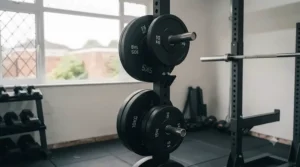
The honest answer to half rack vs full rack is that most home lifters overestimate how much they need the enclosed, four-post design of a full power cage. A full power rack surrounds the lifting space with four uprights and internal safeties, which genuinely does add rear stability and allows for in-rack accessories like a lat pulldown seat, but it also demands considerably more floor space — often 150cm or more front-to-back once you account for safe walk-around clearance.
A half rack for home gym use trades that rear enclosure for open access, which in practice means you can walk straight up to the bar rather than stepping through a cage door, and you can push the whole unit against a wall since nothing needs clearance behind it. What most buyers overlook is that a well-built half rack, like the Mirafit M210 Half Power Rack or RIP X Heavy Duty Power Rack, loses very little practical capability for squats, bench, overhead press, and pull-ups — the exercises that make up 90% of a typical strength programme. Where full racks genuinely win is if you’re planning band-resisted work, in-rack rows, or heavy rack pulls from multiple pin heights, since the rear uprights give you more anchor points.
If your floor space is under roughly 2.5 square metres, a half rack is very likely the smarter buy; above that, and if you’ve got the ceiling height to match, a full cage like the Mirafit M4 Half Power Rack‘s bigger siblings starts to make more sense.
How to Choose a Half Rack for Home Gym
- Measure your ceiling height first. Most half racks run 205-220cm tall; you’ll want at least 15-20cm of clearance above that for safe pull-up bar use and to avoid catching your head on overhead beams.
- Check the floor footprint against your actual space. Don’t just measure the rack’s footprint — add 60-90cm of clearance on the open side for safe barbell loading and unloading.
- Match the rated capacity to your realistic lifting goals, not your ambitions. A 200kg-rated GYM MASTER Heavy Duty Half Power Cage comfortably covers most intermediate lifters; only go higher if you’re already squatting in that territory.
- Decide whether you need a pull-up bar now or can add one later. Models like the Mirafit M210 Half Power Rack build it in from the start; others require a separate attachment.
- Factor in floor protection and bolt-down options. Concrete garage floors handle unbolted racks fine; wooden floors or upstairs rooms benefit from rubber matting and, ideally, bolting down.
- Consider whether cable or pulley functionality matters to you. If you want lat pulldowns or cable rows without buying a separate machine, the Strongway Multi-Gym Power Cage earns its higher price back quickly.
- Budget for the barbell and plates separately. Almost none of these racks include a bar or weights, and a decent 20kg Olympic barbell alone typically adds £80-£150 to your total spend.
Compact Power Rack vs Squat Stand: Picking by Footprint
Compact Power Rack
A compact power rack — like the RIP X Heavy Duty Power Rack at 110cm deep — keeps the enclosed, multi-upright design but shrinks the overall dimensions, usually by narrowing the depth rather than the height. Reviewers consistently note this is the better choice if you want a permanent, fixed training station with a pull-up bar and safety spotters built in, and you’re not fussed about moving it around.
Squat Stand
A squat stand, exemplified here by the Yaheetech Adjustable Squat Rack, strips things back further still — no rear frame, no pull-up bar, just two adjustable uprights. What the spec sheet won’t tell you is that this makes a genuine difference to how a space feels day to day: a squat stand can be pushed flush against a wall or even wheeled aside in some cases, whereas a compact power rack, however small, still reads as a permanent fixture in the room. If your space needs to double as a spare bedroom or home office outside of training hours, the squat stand format wins; if the room is dedicated purely to training, a compact power rack’s extra stability is worth the fixed footprint.
Half Rack With Pull-Up Bar: Is It Worth the Upgrade?
Adding a pull-up bar to a half rack for home gym use sounds like a minor spec difference, but it changes the exercise range meaningfully. Without one, as with the base Yaheetech Adjustable Squat Rack or Mirafit M130, you’re limited to barbell and bodyweight floor work; with one, as on the Mirafit M210 Half Power Rack or Strongway Multi-Gym Power Cage, you unlock pull-ups, chin-ups, hanging leg raises, and — with the right rack — a place to loop resistance bands for accessory work.
Based on the spec comparison, the practical trade-off is height: pull-up bar racks tend to sit 205-220cm tall versus 155-185cm for pure squat stands, so this decision often comes down to your ceiling clearance rather than preference alone. Reviewers consistently note that once they had a rack-mounted pull-up bar, it became one of the most-used features of the whole setup — more so than some buyers expected going in — simply because it’s always right there rather than requiring a separate doorway bar to be fitted and removed.
Home Gym Layout: Planning Your Space Around a Half Rack
Getting the layout right before your rack arrives saves you from rebuilding your whole setup a month in. Start by chalking or taping out the rack’s actual footprint on the floor, then add clearance: roughly 90cm in front for the barbell loading zone, and at least 60cm on any open side for safe entry and exit during squats.
Think about flooring next — rubber gym tiles at 15-20mm thickness protect both a concrete garage floor and your equipment from dropped plates, and they meaningfully reduce noise transfer if you’re training below a bedroom or above a neighbour. Position the rack against the sturdiest available wall if you plan to bolt it down, and leave a dedicated zone nearby for a bench, since most half racks — including the Mirafit M130 Adjustable Squat & Bench Press Rack — are designed to double as bench press stations. Finally, don’t forget lighting and ventilation: garages in particular get cold and poorly lit in winter, and a cheap LED batten light plus a small dehumidifier will do more for your motivation than any piece of equipment on this list.
Setting Up Your Half Rack: The First 30 Days
Getting a new half rack for home gym use assembled correctly, and used safely from day one, matters more than most first-time buyers expect. In the first week, focus purely on assembly and calibration: use a spirit level to check the frame sits flush, torque every bolt to the manufacturer’s spec rather than “tight enough,” and test the safety spotter arms empty before ever loading a bar onto them.
Weeks two and three are for finding your numbers — record which hole height suits your squat unrack position and bench spotter height, since most racks like the RIP X Heavy Duty Power Rack use laser-cut or printed numbering specifically so you can return to the same setting every session without re-measuring. A common first-month mistake is setting safety arms too low, which defeats their purpose, or too high, which restricts your range of motion; aim for arms that would catch the bar roughly 2-3cm below your lowest working position.
By week four, revisit the bolts and floor fixings — vibration from repeated loading and unloading can work fasteners loose, and a five-minute monthly check becomes a genuinely important maintenance habit rather than an optional extra.
Real-World Scenarios: Matching a Half Rack to Your Training
If you’re a first-time lifter working from a box bedroom with a 2.1m ceiling and roughly 1.5 square metres of floor space, the Yaheetech Adjustable Squat Rack or Mirafit M130 Adjustable Squat & Bench Press Rack make the most sense — both prioritise a small, adjustable footprint over maximum load capacity, which suits someone still building base strength.
If you’re an intermediate lifter converting a single garage and want to combine heavy barbell work with accessory cable exercises without buying a separate machine, the Strongway Multi-Gym Power Cage with Dual Pulley is the clear fit — its 400kg rating and pulley system cover squats, bench, rows, and pulldowns from one footprint. And if you’re a committed, long-term lifter — someone who’s already outgrown a commercial gym’s queueing culture and plans to train seriously for years — the Mirafit M4 Half Power Rack‘s heavier-gauge steel and light-commercial rating justify the higher upfront cost through sheer longevity, spreading that price over a decade of use rather than a single season.
Free Weight Training vs Machines: Why a Half Rack Wins for Home Gyms
Free weight training on a half rack develops stabiliser muscles and functional strength that fixed-path machines simply can’t replicate, because barbell squats, presses, and pulls all demand balance and coordination across multiple joints simultaneously. Research from Loughborough University’s exercise physiology group has specifically explored how structured resistance training, including barbell and band-based loading, contributes to measurable improvements in bone density and strength — benefits that machine-only training tends to deliver less effectively, since fixed paths reduce the stabilisation demand on the body.
Here’s what to weigh: machines are undeniably safer for complete beginners with zero supervision, since the path is fixed and the failure mode is simply setting the pin down. But a half rack for home gym use, fitted with proper safety spotter arms — as every model on this list includes — closes most of that safety gap while delivering the far broader exercise selection and long-term strength carryover that free weights provide. For anyone training beyond the first few months, the case for a rack over a multi-station machine becomes increasingly one-sided.
Common Mistakes When Buying a Half Rack for Home Gym
The single most common error is buying based on rated capacity alone without checking real-world footprint and ceiling clearance — a 400kg-rated rack is useless if it doesn’t physically fit your room. A close second is skipping floor protection entirely; dropped plates on bare concrete chip both the floor and the plates, and on wooden joists can genuinely cause structural noise or, in extreme repeated cases, damage.
Buyers also frequently underestimate assembly tool requirements — most racks, including the GYM MASTER Heavy Duty Half Power Cage and RIP X Heavy Duty Power Rack, need a proper 17mm socket set rather than the adjustable spanner many people reach for first, and using the wrong tool risks rounding bolt heads or scuffing the powder coating. Finally, a surprising number of first-time buyers forget that a rack alone does nothing — budget separately for a barbell, weight plates, and ideally a bench, since none of the seven racks reviewed here include them as standard.
Long-Term Cost & Maintenance
Total cost of ownership for a half rack for home gym setup extends well beyond the sticker price. Add a barbell (£80-£180), a starter plate set (£100-£250 depending on whether you choose iron or bumper plates), and ideally an adjustable bench (£100-£200), and even the budget Yaheetech Adjustable Squat Rack becomes a £400-£600 total investment once you’re training-ready.
Set against that, compare it to a typical UK gym membership at roughly £30-£50 per month — a mid-range setup like the Mirafit M210 Half Power Rack with a full weight set pays for itself against gym fees within 12-18 months, and every session after that is effectively free. Maintenance costs are minimal but not zero: budget for occasional replacement of J-cup liners (£10-£20) as they wear, touch-up powder-coat pens for scratched frames (£5-£10), and a yearly bolt-tightening pass that costs nothing but half an hour.
Safety, Flooring & Ceiling Requirements
Every rack on this list is designed for home use, and none are rated for unsupervised commercial or high-traffic environments except the Mirafit M4 Half Power Rack, which explicitly carries a light-commercial rating. Before installing any half rack, confirm your ceiling height leaves at least 15-20cm above the tallest point — typically the pull-up bar — and check that your floor can bear the combined static and dynamic load, particularly on suspended timber floors in upstairs rooms or converted lofts.
The UK’s own physical activity sector has flagged strength training as a genuine public health gap: sector body ukactive reports that around a third of UK adults currently do no muscle-strengthening activity at all, despite official guidance recommending it twice weekly. A safely installed half rack removes several of the common barriers cited in that gap — cost, time, and gym access — provided the basics are covered: bolt down where possible, always use safety spotter arms set correctly, and never train seriously heavy without at least informing someone else in the house.
Frequently Asked Questions
❓ What is the difference between a half rack and a squat stand?
❓ Can a half rack fit in a standard UK box bedroom?
❓ Do I need to bolt a half rack to the floor?
❓ How much weight can a half rack for home gym hold?
❓ Is a half rack better than a full power cage for beginners?
Conclusion
A half rack for home gym training strikes the balance that a full commercial cage and a pair of resistance bands both miss: genuine heavy-lifting capability without needing to sacrifice a whole room to it. Whichever end of this list you land on — the budget-friendly Yaheetech Adjustable Squat Rack or the long-term investment of the Mirafit M4 Half Power Rack — the real driver of long-term success isn’t the spec sheet, it’s whether the rack fits your actual space and gets used consistently.
Measure your room properly, be honest about your ceiling height, and match the rated capacity to where your training realistically sits today rather than some hypothetical future PB. Do that, and any of the seven racks above will quietly become the best-used piece of furniture in the house.
✨ Don’t Miss These Exclusive Deals!
🏋️ Take your home gym to the next level with these carefully selected half racks. Click on any highlighted product to check current pricing and availability. These picks will help you build the strong, consistent training habit your future self will thank you for!
Recommended for You
- Wall-Mounted Power Rack For Small Spaces: 7 Best Picks (2026)
- Power Rack For Home Gym: 7 Proven Picks For UK Lifters (2026)
- Power Rack for Garage Gym: 7 Best UK Picks for 2026
Disclaimer: This article contains affiliate links. As an Amazon Associate, I earn from qualifying purchases. If you purchase products through these links, we may earn a small commission at no additional cost to you.
✨ Found this helpful? Share it with your friends! 💬🤗
