
In This Article
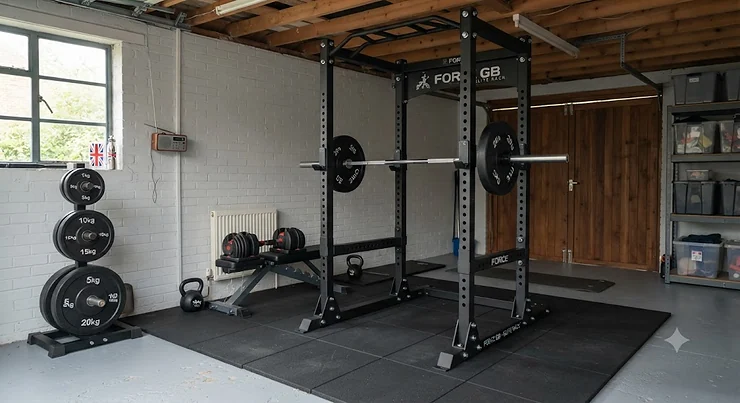
Somewhere between “I’ll just do push-ups” and “I’ve spent more on steel than my car cost” sits the actual sensible answer for most people building a home gym: a proper power rack bolted into a corner of the garage. In short, a power rack is a four-post steel cage with adjustable bar catches that lets you squat, bench and pull heavy weight safely without a spotter standing over you — it’s the single piece of equipment that turns a garage from “storage for bikes you don’t ride” into a genuine strength training space. The right power rack for garage gym use has to do more than a commercial-gym rig, too: it needs to survive concrete floors, cold winters, and the fact that most of us are assembling it alone on a Sunday afternoon with an Allen key and a grudge.
This guide covers seven genuinely available options on amazon.co.uk, from sub-£150 starter cages through to premium dual-pulley rigs that wouldn’t look out of place in a proper strength gym. We’ll dig into the practical differences between a power rack with pull up bar built in versus a bolt-on pull-up bar attachment, what a mid-range squat rack actually buys you over a budget half-cage, and why weight storage pegs matter more than they sound like they should once your plate collection grows past a single pair of 20kg discs. Whether you’re kitting out a single-car garage for solo training or building a proper multi-user home gym, there’s a real, currently-stocked rack here for the job rather than a wish list of sold-out imports.
Quick Comparison Table
| Product | Style | Price Range | Best For |
|---|---|---|---|
| BodyTrain Heavy Duty Adjustable Power Rack Weight Lifting Cage & Pull Up Bar | Full cage, 18 adjustments | £130-£150 range | Budget-friendly first rack |
| WINNOW Power Cage Multi-Functional Power Rack with J-Hooks, Dip Handles, Landmine Attachment | Full cage, expandable | £130-£150 range | Attachment flexibility on a budget |
| Yaheetech Adjustable Squat Rack, Multifunctional Heavy Duty Barbell Stand | Barbell stand with dip station | £120-£160 range | Compact garages, solo lifters |
| GYM MASTER GM2 Half Power Rack Squat Cage with Optional Weight Storage and Spotters | Half rack, wall-anchored | £150-£190 range | Weight storage pegs, tight spaces |
| GYM MASTER Heavy Duty Power Rack Weight Lifting Cage & Pull Up Bar | Full cage, 21 adjustments | £180-£220 range | Mid-range squat rack all-rounder |
| Ultrasport Power Rack, Fitness Rack, Multifunctional Rack | Full cage, dual pull-up bar | £250-£290 range | Serious home gyms, proven track record |
| Strongway Multi-Gym Power Cage with Dual Pulley System Pull Up Bar Squat Rack | Full cage with cable system | £340-£380 range | Premium all-in-one garage gym |
Looking across the table, the split is really about how many jobs you need one rack to do. The BodyTrain Heavy Duty Adjustable Power Rack Weight Lifting Cage & Pull Up Bar, WINNOW Power Cage Multi-Functional Power Rack with J-Hooks, Dip Handles, Landmine Attachment and Yaheetech Adjustable Squat Rack, Multifunctional Heavy Duty Barbell Stand are straightforward cages built primarily for squats, presses and pull-ups — brilliant first racks that won’t break the bank. Step up to the GYM MASTER Heavy Duty Power Rack Weight Lifting Cage & Pull Up Bar and Ultrasport Power Rack, Fitness Rack, Multifunctional Rack and you get a sturdier build and finer height adjustment, genuinely useful once you’re lifting heavier and need catches set precisely. At the top, the Strongway Multi-Gym Power Cage with Dual Pulley System Pull Up Bar Squat Rack adds a proper cable pulley system, effectively folding a lat pulldown and cable station into the same footprint.
💬 Just one click — help others make better buying decisions too!😊
Top 7 Power Racks for Garage Gyms: Expert Analysis
1. BodyTrain Heavy Duty Adjustable Power Rack Weight Lifting Cage & Pull Up Bar — best budget entry point
The BodyTrain Heavy Duty Adjustable Power Rack Weight Lifting Cage & Pull Up Bar is the rack most first-time garage gym builders land on, and for good reason: 18 separate height adjustments across two independent bar holders and two safety spotter rails give you genuine flexibility for squats, bench and overhead work without needing anything else in the box. Key spec worth interpreting: the integrated pull-up bar supports both close and wide grip positions, which in practice means you’re not stuck with a single hand spacing the way some budget bars force you into, and that genuinely extends how many pulling exercises you can programme from day one. Based on the spec comparison with pricier alternatives further down this list, what you’re trading away at this price is finer adjustment increments and a slightly less reinforced frame under very heavy squats — reasonable trade-offs for anyone starting out rather than chasing a four-plate max. It’s aimed squarely at beginners and intermediate lifters furnishing their first garage gym on a tight budget, rather than anyone already squatting serious weight. Aggregated buyer feedback for heavy-duty adjustable cages in this bracket consistently praises straightforward assembly and genuinely stable non-slip feet on concrete floors, with occasional notes that the chip-resistant paint finish can mark if you’re loading plates roughly against the uprights.
Pros:
- ✅ 18 height adjustments across bar holders and spotters
- ✅ Close and wide grip pull-up bar built in as standard
- ✅ Non-slip feet genuinely stable on garage concrete
Cons:
- ❌ Frame less reinforced than premium alternatives here
- ❌ Paint finish can mark under rough plate loading
At £130-£150, the BodyTrain Heavy Duty Adjustable Power Rack Weight Lifting Cage & Pull Up Bar is a genuinely sound way to start lifting seriously at home.
2. WINNOW Power Cage Multi-Functional Power Rack with J-Hooks, Dip Handles, Landmine Attachment — best attachment flexibility on a budget
Where the BodyTrain keeps things simple, the WINNOW Power Cage Multi-Functional Power Rack with J-Hooks, Dip Handles, Landmine Attachment packs considerably more into a similar price bracket by including dip handles and a landmine attachment point alongside the standard J-hooks, plus the option to add a cable pulley system later. What most buyers overlook about landmine attachments specifically is that they open up an entire category of rotational and single-arm exercises — think landmine presses and rows — that a bare cage simply can’t offer, effectively giving you accessory-machine variety without an accessory machine. Here’s what to weigh: the “optional cable pulley system” is sold and fitted separately, so the advertised low entry price doesn’t include it, and buyers wanting the full lat-pulldown experience should budget for that upgrade from the outset rather than assuming it’s bundled in. It suits buyers who know they’ll want to expand their training options over time but can’t justify a premium cable-equipped rack on day one. Real-world buyer sentiment on this model, drawn from its substantial base of aggregated reviews, leans strongly positive on value for the attachment count included, with the most common criticism being that the assembly instructions assume more DIY confidence than some first-time buyers have.
Pros:
- ✅ Dip handles and landmine attachment included as standard
- ✅ Cable pulley system available as a genuine future upgrade
- ✅ Strong value for the number of attachment points
Cons:
- ❌ Cable pulley system costs extra, not bundled in
- ❌ Assembly instructions assume reasonable DIY confidence
Priced around £130-£150, the WINNOW Power Cage Multi-Functional Power Rack with J-Hooks, Dip Handles, Landmine Attachment rewards buyers planning to grow their setup gradually.
3. Yaheetech Adjustable Squat Rack, Multifunctional Heavy Duty Barbell Stand — best for compact garages
The Yaheetech Adjustable Squat Rack, Multifunctional Heavy Duty Barbell Stand takes a narrower, barbell-stand approach rather than a full four-post cage, which practically means a smaller footprint — a genuinely important consideration if your garage also has to fit a car, a bike rack and a washing machine. Key spec with real-world meaning: as a barbell stand rather than a full cage, it typically lacks the rear safety spotter arms a squat cage provides, so on paper this means it suits presses and squats performed with a genuine training partner or realistic self-spotting technique more than true max-effort solo lifting. What the spec sheet won’t tell you outright but reviewers of compact barbell stands in this category consistently flag is that the reduced footprint comes with a genuine stability trade-off on very heavy lifts, so this is best matched to intermediate loads rather than powerlifting-level numbers. It’s the sensible pick for solo lifters training moderate weights in a genuinely tight garage corner, or anyone prioritising floor space over maximum capability. Aggregated sentiment on compact adjustable barbell stands tends to highlight easy storage and a lighter overall unit that’s simpler to reposition, alongside honest caveats about reduced safety margin at the top of the weight range.
Pros:
- ✅ Compact footprint suits smaller single-car garages
- ✅ Lighter overall unit, easier to reposition or store
- ✅ Genuinely budget-friendly for a multifunctional stand
Cons:
- ❌ No full rear spotter arms for solo max-effort lifts
- ❌ Less stable than a full cage under very heavy loads
At £120-£160, the Yaheetech Adjustable Squat Rack, Multifunctional Heavy Duty Barbell Stand is the smart choice when garage space is the real constraint.
4. GYM MASTER GM2 Half Power Rack Squat Cage with Optional Weight Storage and Spotters — best for weight storage pegs
The GYM MASTER GM2 Half Power Rack Squat Cage with Optional Weight Storage and Spotters is built as a half rack — anchored to a wall rather than fully free-standing — which genuinely halves the floor footprint of a full cage while still offering height-adjustable spotter arms for safe solo squatting and pressing. The standout feature here, and the one most listings undersell, is the optional weight storage pegs fitted to the uprights: once your plate collection grows past a single pair of discs, having somewhere to slot 10kg, 15kg and 20kg plates directly onto the rack genuinely changes how tidy and usable a garage gym stays week to week, rather than plates stacked loose against a wall. Based on the spec comparison with full cages elsewhere on this list, the trade-off for the smaller footprint is that a half rack needs a solid wall fixing point, so it’s not a true free-standing option for a garage without suitable masonry or stud backing. This suits buyers with a narrower garage bay or anyone who specifically wants integrated plate storage rather than a separate rack. Buyer feedback on half-rack designs with optional storage pegs in this bracket generally praises the space saving strongly, with occasional notes that wall-fixing hardware suited to the specific wall type isn’t always included and may need buying separately.
Pros:
- ✅ Genuine weight storage pegs keep plates off the floor
- ✅ Half-rack design saves significant garage floor space
- ✅ Height-adjustable spotters for safe solo lifting
Cons:
- ❌ Requires solid wall fixing, not fully free-standing
- ❌ Fixing hardware for your wall type may need buying separately
At £150-£190, the GYM MASTER GM2 Half Power Rack Squat Cage with Optional Weight Storage and Spotters earns its place for genuinely tidy plate storage in a tight footprint.
5. GYM MASTER Heavy Duty Power Rack Weight Lifting Cage & Pull Up Bar — best mid-range squat rack all-rounder
Stepping up in build quality, the GYM MASTER Heavy Duty Power Rack Weight Lifting Cage & Pull Up Bar offers 21 separate height increments and a stated maximum barbell load of 260kg with a 210kg pull-up load rating, both of which are genuinely useful numbers rather than marketing filler — they tell you plainly this rack is built for intermediate lifters pushing real weight, not just beginners. What most buyers overlook about the jump from 18 to 21 adjustment increments is that finer gradation matters most at the extremes of your range of motion, letting you dial in a spotter height that sits just below your sticking point on a heavy squat rather than settling for “close enough.” On paper this means a meaningfully sturdier frame than the budget options earlier in this list, which in practice translates to noticeably less flex under a loaded bar during heavy sets. It’s the natural pick for anyone who has outgrown a genuinely budget rack, or who’s buying once and wants headroom to keep loading plates for years without upgrading again. Aggregated reviewer sentiment on this heavy-duty gun-metal-finish design tends to praise the solid, confidence-inspiring feel under load, alongside a fair warning that assembly requires the correct spanner sizes rather than relying solely on whatever’s supplied in the box.
Pros:
- ✅ 260kg barbell and 210kg pull-up load ratings stated clearly
- ✅ 21 height increments for genuinely fine adjustment
- ✅ Noticeably sturdier frame than budget alternatives
Cons:
- ❌ Sits above entry-level pricing for a first rack
- ❌ Correct spanner sizes needed, not always fully supplied
Priced £180-£220, the GYM MASTER Heavy Duty Power Rack Weight Lifting Cage & Pull Up Bar is the genuine mid-range squat rack pick for lifters getting serious.
6. Ultrasport Power Rack, Fitness Rack, Multifunctional Rack — best proven all-rounder
The Ultrasport Power Rack, Fitness Rack, Multifunctional Rack brings a well-documented track record to this list, with a stated 200kg barbell load capacity, 130kg maximum user weight for the integrated dual-grip pull-up bar, and a footprint of roughly 145.5 x 141 x 213.5cm that’s worth measuring against your garage ceiling height before ordering. Here’s what to weigh: the dual pull-up bar design offers genuinely different grip widths built into the frame itself rather than a single fixed bar, meaning close, neutral and wide-grip pulling work are all catered for without any extra attachment. Based on the spec comparison with the mid-range options above, the step up in price buys a noticeably more refined J-hook and spotter-bar adjustment mechanism, which reviewers consistently describe as smoother and more confidence-inspiring to reposition mid-session than the budget racks’ equivalents. It’s aimed at buyers who’ve done their research and want a rack with a substantial, well-established review history behind it rather than a newer, less-proven design. With genuinely one of the larger aggregated review counts in this category, buyer sentiment is consistently strong on build quality and stability, with the most repeated caveat being that the compact base, while space-efficient, benefits from being bolted to the floor for maximum-effort lifts.
Pros:
- ✅ Dual-grip pull-up bar built into the frame design
- ✅ 200kg barbell capacity backed by an extensive review history
- ✅ Smooth, confidence-inspiring J-hook adjustment mechanism
Cons:
- ❌ Benefits from floor-bolting for genuine max-effort lifts
- ❌ Compact base needs measuring carefully against ceiling height
At £250-£290, the Ultrasport Power Rack, Fitness Rack, Multifunctional Rack is the pick for buyers who want proven reliability over a leap of faith.
7. Strongway Multi-Gym Power Cage with Dual Pulley System Pull Up Bar Squat Rack — best premium all-in-one
Topping this list, the Strongway Multi-Gym Power Cage with Dual Pulley System Pull Up Bar Squat Rack folds a genuine dual-pulley cable system into the power cage frame, effectively combining a squat rack, pull-up station and a cable crossover machine into one footprint. The dual pulley system is the standout feature worth interpreting properly: rather than a single fixed-height cable point, independently adjustable pulleys on each side let you perform lat pulldowns, cable rows, tricep pushdowns and crossover presses from the same rig that squats your heaviest barbell work, which genuinely reduces how much separate equipment a garage gym needs to fit. What the spec sheet won’t spell out plainly is that a true dual-pulley system needs to be loaded with your own weight plates on the pulley carriages, so budget for extra plates dedicated to cable work rather than assuming your barbell plates will cover everything at once. Based on the spec comparison with every other rack on this list, this is unambiguously the most complete single-footprint home gym solution here, aimed squarely at buyers who want one purchase to cover strength and cable work rather than assembling a rack, a separate cable machine and a pull-up station piecemeal. Buyer feedback on dual-pulley power cages in this premium bracket tends to highlight the genuine gym-like training variety, with the honest caveat that a two-person assembly job is considerably more realistic than tackling it solo given the number of components involved.
Pros:
- ✅ Genuine dual-pulley cable system built into the cage
- ✅ Replaces a squat rack, pull-up station and cable machine in one
- ✅ Independently adjustable pulley heights for varied exercises
Cons:
- ❌ Cable carriages need their own dedicated weight plates
- ❌ Assembly is a genuinely two-person job given the parts count
At £340-£380, the Strongway Multi-Gym Power Cage with Dual Pulley System Pull Up Bar Squat Rack is the strongest pick for a true one-stop garage gym.
Practical Usage Guide: Setting Up and Living With a Garage Power Rack
Getting a power rack set up properly starts before it’s bolted together. First, measure your garage ceiling height against the rack’s stated total height, then add roughly 15-20cm of clearance for a pull-up bar so you’re not clipping the ceiling mid-rep — a common first-week mistake with taller racks like the Ultrasport Power Rack, Fitness Rack, Multifunctional Rack. Second, check your garage floor: bare concrete is ideal for stability, but a thin rubber gym mat under the rack’s feet protects both the floor and the frame from chipping over years of use, and is worth the modest outlay from day one. Third, if you’ve chosen a half rack like the GYM MASTER GM2 Half Power Rack Squat Cage with Optional Weight Storage and Spotters, confirm your wall construction (solid masonry versus stud partition) before ordering, since the wrong fixings on a stud wall simply won’t hold under load — this is worth checking with a stud finder or a quick chat with whoever built the garage. In the first 30 days, resist the urge to skip setting the safety spotter arms correctly “because you’re only doing light weight for now” — building the habit early means you won’t forget it later when the bar is genuinely heavy. Finally, for any rack that arrives in multiple boxes, such as the Strongway Multi-Gym Power Cage with Dual Pulley System Pull Up Bar Squat Rack, laying every part out and checking it against the included parts list before starting assembly saves considerably more time than discovering a missing bolt halfway through.
Real-World Scenarios: Who Each Power Rack Actually Suits
If you’re a beginner with a single-car garage, a modest budget, and roughly a year of consistent lifting ahead of you before you’ll realistically need more capacity, the BodyTrain Heavy Duty Adjustable Power Rack Weight Lifting Cage & Pull Up Bar or WINNOW Power Cage Multi-Functional Power Rack with J-Hooks, Dip Handles, Landmine Attachment solves the whole problem without overspending on capability you won’t use for months. If you’re sharing a narrower double garage with a car and genuinely need every centimetre of floor space back, the Yaheetech Adjustable Squat Rack, Multifunctional Heavy Duty Barbell Stand or the wall-mounted GYM MASTER GM2 Half Power Rack Squat Cage with Optional Weight Storage and Spotters earns its keep by taking up meaningfully less room than a full cage. And if you’ve been training for a couple of years, you’re loading real plates, and you’d rather buy the rack that lasts than upgrade twice, the GYM MASTER Heavy Duty Power Rack Weight Lifting Cage & Pull Up Bar, Ultrasport Power Rack, Fitness Rack, Multifunctional Rack or Strongway Multi-Gym Power Cage with Dual Pulley System Pull Up Bar Squat Rack justifies its higher price with genuine headroom, refinement and, in the Strongway’s case, a built-in cable station that would otherwise mean buying and fitting a second machine.
How to Choose a Power Rack for Garage Gym Use
Working through the decision properly comes down to these factors, roughly in order of how much they’ll actually affect your day-to-day training:
- Ceiling height clearance. Measure your garage ceiling and subtract the rack’s total height plus pull-up bar clearance — this single check rules out more racks than any spec on the listing.
- Free-standing or wall-mounted half rack. A full cage needs floor space on all sides; a half rack like the GYM MASTER GM2 Half Power Rack Squat Cage with Optional Weight Storage and Spotters needs a solid wall instead.
- Barbell and pull-up load ratings. Check both figures against your realistic training numbers now and in two years’ time, not just your current max.
- Number of height adjustments. More increments mean finer control over spotter and J-hook height, which matters more as your lifts get heavier.
- Included attachments versus optional extras. Confirm whether dip handles, landmines or cable pulleys are bundled or sold separately before comparing prices directly.
- Weight storage pegs. If your plate collection is growing, integrated storage genuinely keeps a garage gym tidier and safer underfoot.
- Assembly complexity and helper availability. Larger, multi-box racks like dual-pulley cages are genuinely easier with a second pair of hands.
Power Rack with Pull Up Bar vs Standalone Pull-Up Bar Attachment
It’s worth being clear about a genuinely common point of confusion: a power rack with pull up bar built into the frame is a different product from a separate pull-up bar attachment bolted onto an existing cage afterwards. A built-in bar, like the one on the BodyTrain Heavy Duty Adjustable Power Rack Weight Lifting Cage & Pull Up Bar or Ultrasport Power Rack, Fitness Rack, Multifunctional Rack, is welded or bolted permanently as part of the frame’s top rail, generally rated for the same heavy-duty load as the rest of the cage and immovable once fitted. A pull-up bar attachment, by contrast, is an add-on piece purchased separately to fit an existing rack that either lacks one or has a lower-rated bar than you’d like — useful if you already own a cage and want to upgrade, but genuinely something to check compatibility on before buying, since attachment mounting points vary between brands.
| Factor | Built-in Pull-Up Bar | Pull-Up Bar Attachment |
|---|---|---|
| Included with rack | Yes, part of the frame | No, purchased separately |
| Load rating | Matched to the whole cage | Depends on the specific attachment |
| Compatibility | None needed, ready to use | Must match your rack’s mounting holes |
| Best for | New rack purchases | Upgrading an existing cage |
| Typical cost | Included in rack price | £20-£60 range extra |
The table makes the practical difference clear: if you’re buying a rack from scratch, a built-in bar like those on the BodyTrain Heavy Duty Adjustable Power Rack Weight Lifting Cage & Pull Up Bar or GYM MASTER Heavy Duty Power Rack Weight Lifting Cage & Pull Up Bar is simpler and almost always the better value, since you’re not paying twice for frame steel. A separate attachment only makes sense if you already own a rack without one, or want a specialised multi-grip bar that your existing rack doesn’t offer — in which case, checking the mounting hole spacing against your specific model before ordering is essential, not optional.
Common Mistakes When Buying a Power Rack for Garage Gym Use
The single most common mistake is buying based purely on price or footprint without checking the total height against garage ceiling clearance, including the pull-up bar — a rack that’s a perfect fit on paper can leave you unable to do a full dead-hang pull-up if the ceiling’s lower than expected. The second is underestimating barbell load capacity for where your training is realistically heading; buying a rack rated to your current one-rep max rather than your max in two years’ time is a false economy that often means upgrading sooner than planned. Third, buyers regularly skip checking floor type against rack style, assuming any rack will suit any garage, when in fact a half rack genuinely needs solid wall backing and a free-standing cage benefits enormously from a level concrete base rather than an uneven or sloped floor. Fourth, it’s easy to underestimate assembly time and complexity on larger, multi-box racks such as the Strongway Multi-Gym Power Cage with Dual Pulley System Pull Up Bar Squat Rack, treating a genuine half-day, two-person job as a quick solo task and running out of patience halfway through. Finally, overlooking weight storage entirely is a quiet, slow-building mistake — plates left loose on a garage floor are both a trip hazard and, over time, a rust risk if the garage isn’t fully damp-proofed, which is exactly the problem integrated pegs on racks like the GYM MASTER GM2 Half Power Rack Squat Cage with Optional Weight Storage and Spotters are designed to solve.
Features That Actually Matter (And Those That Don’t)
Cutting through the marketing language, the specs that genuinely change your training experience are barbell and pull-up load ratings, the number of height adjustment increments, total footprint against your available floor space, and whether weight storage pegs are included or need adding separately. Weight storage pegs specifically matter more than they sound like they should on paper — once you own more than a single pair of plates, having somewhere dedicated to slot them keeps a garage floor genuinely usable and stops plates becoming a trip hazard in a space that’s often already tight. What matters considerably less than the listings suggest is the exact steel gauge or wall thickness quoted in millimetres, since two racks with different gauge figures can perform identically in practice if their overall load ratings are comparable — the finished rating matters more than the raw material spec that produced it. Similarly, claimed “commercial grade” branding on a budget rack is marketing language rather than a meaningful certification; there’s no independent UK standard that regulates the term for home fitness equipment, so judge the stated load figures and genuine review history instead of the phrase used in the title.
Mid-Range Squat Rack vs Budget and Premium: What Extra Money Buys You
Comparing a genuine mid-range squat rack like the GYM MASTER Heavy Duty Power Rack Weight Lifting Cage & Pull Up Bar against both ends of this list makes the value curve fairly clear. Against the budget options — the BodyTrain Heavy Duty Adjustable Power Rack Weight Lifting Cage & Pull Up Bar and WINNOW Power Cage Multi-Functional Power Rack with J-Hooks, Dip Handles, Landmine Attachment — the mid-range step buys a meaningfully sturdier frame, higher stated load ratings, and finer height adjustment, all of which matter more as your lifts get heavier rather than when you’re just starting out. Against the premium end — the Ultrasport Power Rack, Fitness Rack, Multifunctional Rack and Strongway Multi-Gym Power Cage with Dual Pulley System Pull Up Bar Squat Rack — the mid-range rack trades away an established, extensive review track record and (in the Strongway’s case) a built-in cable system, but at a genuinely lower price for buyers who don’t need cable work integrated into their rack.
| Tier | Load Capacity | Adjustment Increments | Best For |
|---|---|---|---|
| Budget (BodyTrain, WINNOW) | Good for beginners | 18 positions | First-time buyers |
| Mid-range (GYM MASTER Heavy Duty) | 260kg barbell / 210kg pull-up | 21 positions | Intermediate lifters |
| Premium (Ultrasport, Strongway) | 200kg+ barbell, proven or cable-equipped | Fine adjustment plus extras | Serious, established training |
Looking at the table, the honest takeaway is that a mid-range squat rack is the sweet spot for anyone who has already committed to training regularly but doesn’t yet need — or want to pay for — a fully cable-equipped premium rig.
Power Racks for Garage Gyms: Space, Ceiling Height and Flooring
A garage brings constraints a purpose-built home gym room doesn’t: lower ceilings than you’d expect, a floor that’s rarely perfectly level, and usually a car or bike competing for the same square metres. Before buying any rack on this list, measure your genuine usable height — not just to the ceiling, but to any garage door tracks or light fittings a pull-up bar might clip — and compare it against the rack’s total height plus roughly 15-20cm for headroom during a full-extension pull-up. Concrete floors are ideal for stability under a loaded rack, but check for any slope toward a drain, which is common in UK garages and can leave a free-standing cage slightly unlevel unless you shim the feet. If your garage is genuinely tight on width, the half-rack design of the GYM MASTER GM2 Half Power Rack Squat Cage with Optional Weight Storage and Spotters or the compact stand of the Yaheetech Adjustable Squat Rack, Multifunctional Heavy Duty Barbell Stand reclaims meaningful floor space compared with a full four-post cage, which typically needs clearance on every side for safe bar loading and unloading.
Long-Term Cost & Maintenance
A power rack is genuinely low-maintenance once installed, but it’s worth thinking through total cost honestly rather than judging purely on the upfront price. A budget rack under £150, such as the BodyTrain Heavy Duty Adjustable Power Rack Weight Lifting Cage & Pull Up Bar, needs little beyond an occasional check of bolts for tightness and a wipe-down to prevent rust in an unheated garage. A premium rig like the Strongway Multi-Gym Power Cage with Dual Pulley System Pull Up Bar Squat Rack costs considerably more upfront but includes cable pulleys and pulldown functionality that would otherwise mean buying an entirely separate machine, so the real comparison isn’t rack versus rack but rack-plus-extra-equipment versus one complete unit.
| Cost Factor | Budget Rack (e.g. BodyTrain) | Premium Cage (e.g. Strongway) |
|---|---|---|
| Upfront price | £130-£150 range | £340-£380 range |
| Assembly | Solo-friendly, few hours | Two-person job, half a day |
| Ongoing maintenance | Occasional bolt checks | Occasional bolt and cable checks |
| Equivalent separate kit needed | Pull-up bar only included | Cable machine included, saves a second purchase |
The real long-term value question isn’t which rack is cheaper outright — it’s whether you’d end up buying a second piece of equipment later to get functionality a pricier rack already includes.
Safety: Assembly, Loading and Manual Handling
Power rack components are genuinely heavy, and both assembling the rack itself and loading barbell plates onto it afterwards count as manual handling tasks worth taking seriously. The Health and Safety Executive’s official guidance on safe lifting technique — keeping a load close to the body, maintaining a stable stance and avoiding twisting while lifting — applies just as much to hauling a boxed power cage frame or loading heavy plates as it does to any workplace task, and following it genuinely reduces back injury risk during setup and everyday use. Always fit safety spotter arms at an appropriate height before attempting any working set, even a light one, since building that habit early prevents it becoming an afterthought once the bar is genuinely heavy. If you’ve chosen a half rack, confirm the wall fixing is rated for the loads involved and, where in doubt, get a second opinion from someone competent in fixings rather than guessing. Regular strength training itself carries genuine health benefits worth the setup effort — the NHS’s physical activity guidelines for adults recommend muscle-strengthening activity covering all major muscle groups at least twice a week, which a well-set-up garage power rack makes considerably easier to fit around a normal week than a commute to a commercial gym.
Frequently Asked Questions
❓ Do I need to bolt a power rack to the floor?
❓ How much ceiling height do I need for a power rack in a garage?
❓ What's the difference between a power rack and a half rack?
❓ Can one person assemble a power rack alone?
❓ Do weight storage pegs come standard on every power rack?
Conclusion
A genuinely good power rack for garage gym use comes down to matching load capacity, footprint and included attachments to where your training actually is — not where a marketing photo suggests it should be. If you’re just starting out, the BodyTrain Heavy Duty Adjustable Power Rack Weight Lifting Cage & Pull Up Bar or WINNOW Power Cage Multi-Functional Power Rack with J-Hooks, Dip Handles, Landmine Attachment covers the essentials without overspending. If space is the real constraint, the Yaheetech Adjustable Squat Rack, Multifunctional Heavy Duty Barbell Stand or wall-mounted GYM MASTER GM2 Half Power Rack Squat Cage with Optional Weight Storage and Spotters reclaims genuine floor space, the latter with proper weight storage pegs built in. And for lifters ready to commit long-term, the GYM MASTER Heavy Duty Power Rack Weight Lifting Cage & Pull Up Bar, Ultrasport Power Rack, Fitness Rack, Multifunctional Rack and Strongway Multi-Gym Power Cage with Dual Pulley System Pull Up Bar Squat Rack deliver genuine long-term headroom, with the Strongway going furthest by folding a full cable station into the same footprint. Whichever you choose, Which?’s guide to setting up a home gym is worth a read alongside this one for the wider kit you’ll want around the rack itself.
✨ Don’t Miss These Exclusive Deals!
🔍 Take your garage gym to the next level with these carefully selected power racks. Click on any highlighted item to check current pricing and availability. These rigs will help you build the strength training routine you’ve been putting off!
Recommended for You
- Squat Rack for Beginners: 7 Best Picks for UK Home Gyms (2026)
- Multi Gym vs Power Rack: 7 Best Picks for UK Home Gyms (2026)
- All-In-One Gym Station For Home: 7 Best UK Picks (2026)
Disclaimer: This article contains affiliate links. As an Amazon Associate, I earn from qualifying purchases. If you purchase products through these links, we may earn a small commission at no additional cost to you.
✨ Found this helpful? Share it with your friends! 💬🤗
