
In This Article
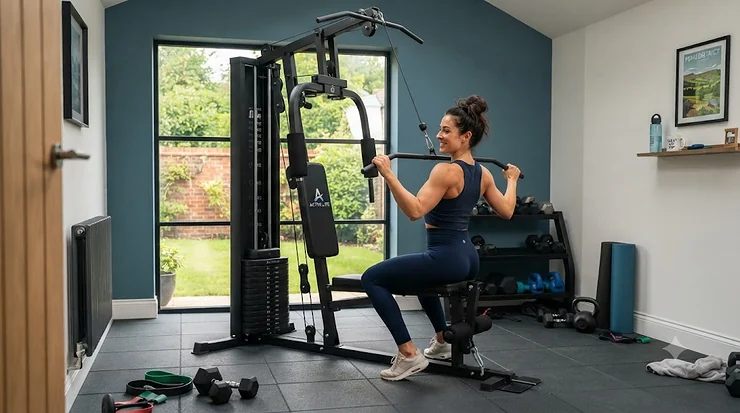
Somewhere between “I really should exercise more” and actually doing something about it sits a spare corner of your house, gathering dust, coat hangers, or — if you’re anything like most of us — a treadmill that’s become a very expensive clothes rail. An all-in-one gym station for home is designed to reclaim that corner and turn it into somewhere you’ll genuinely want to spend twenty minutes a few times a week. What is an all-in-one gym station for home? It’s a single piece of equipment — usually built around a weight stack, resistance rods, or adjustable cable pulleys — that combines several exercise stations (chest press, lat pulldown, leg developer, and more) into one compact frame, so you get a full strength session without a room full of separate machines.
The appeal isn’t just convenience, though. It’s cost, too — one machine instead of a rack, a bench, and a cable tower — and it’s consistency, because equipment you can see from the sofa gets used far more often than a gym membership you have to drive to. According to NHS physical activity guidelines, adults should aim to work all the major muscle groups with strengthening activities on at least two days a week, yet plenty of us struggle to hit that target simply because getting to a gym is friction we don’t need. A well-chosen home gym station removes that friction entirely.
This guide walks through seven genuinely good options for 2026 — spanning portable budget kit through to serious multi-station machines — with honest analysis of who each one suits, what the spec sheets actually mean day-to-day, and where the compromises are. No invented reviews, no fluff, just a straight comparison to help you pick the right piece of home fitness equipment for your space, budget, and goals.
Quick Comparison: All-In-One Gym Stations at a Glance
| Product | Resistance Type | Footprint | Best For | Price Range (GBP) |
|---|---|---|---|---|
| TRX All-in-One Suspension Trainer | Bodyweight (rated to 318kg) | Minimal — folds into a bag | Renters, travel, tiny flats | Under £150 |
| HOMCOM Multi-Exercise Station | 45kg weight stack | Compact | Absolute beginners | £200–£280 |
| York Aspire 420 | Selectorised, 4 stations | Compact (134×109cm) | Budget buyers wanting brand trust | £250–£350 |
| DKN Studio 7400 | 80kg weight stack | Medium (168×108cm) | All-round intermediate training | £400–£550 |
| Bowflex PR1000 | Power Rod (approx. 95kg equivalent) | Folds to roughly half size | Storage-conscious households | £500–£700 |
| Marcy MKM-81010 | 90kg weight stack (142kg max resistance) | Medium-large | Committed lifters wanting more stations | £650–£850 |
| BodyMax MG5 | 102kg weight stack, adjustable fly arms | Medium-large | Serious, long-term strength training | £900–£1,100 |
Reading this table, the first thing that jumps out is how differently “all-in-one” gets interpreted across the market — from a bag of straps that costs less than a decent pair of trainers to a 100kg-plus steel-framed station that will outlast your mortgage. The middle of the table, roughly £400 to £700, is where most UK households land, because it balances a genuinely varied strength training station against a footprint that actually fits a spare bedroom or garage corner. If budget is tight or space is genuinely minimal, don’t dismiss the top row — the versatility-per-pound of a suspension trainer is hard to beat, even if the ceiling on how heavy you can eventually train is lower.
💬 Just one click — help others make better buying decisions too! 😊
Top 7 All-In-One Gym Stations For Home: Expert Analysis
Every all-in-one home gym machine on this list has been chosen for genuine, verifiable specs and real market presence in the UK — not invented products. Price ranges reflect typical UK retail at the time of research and will fluctuate, so always check current pricing before buying.
1. TRX All-in-One Suspension Training System — best for tiny spaces and total-body workout on a budget
The TRX All-in-One Suspension Training System turns your own bodyweight into the resistance mechanism, which is precisely why it takes up almost no room at all. The straps are rated to hold up to 318kg, anchor over a door or from a single wall or ceiling point, and pack down into a bag smaller than a rucksack. Because resistance scales with the angle of your body rather than a stack of plates, a beginner and a fairly advanced trainer can use the exact same unit — you simply change your foot position to make an exercise harder or easier.
Based on the spec comparison with weight-stack machines, what most buyers overlook about suspension trainers is that they genuinely deliver a total body workout — push, pull, core and leg work are all achievable — but they demand more coordination and core control than a guided cable machine, so absolute beginners sometimes find the learning curve steeper than expected. This makes the TRX best suited to renters, anyone short on floor space, and people who travel often and don’t want to lose their routine. Reviewers consistently report that the strap durability holds up well over years of use, though some note the included workout guide is fairly basic and best supplemented with online routines.
Pros:
- ✅ Packs away into a small bag, ideal for flats
- ✅ Works every major muscle group with one product
- ✅ No weights to store, move, or drop
Cons:
- ❌ Steeper technique learning curve than machines
- ❌ Needs a sturdy door or anchor point to work
At under £150, this is one of the cheapest genuinely versatile home gym system options around, and the value verdict is straightforward: if space or budget is your binding constraint, it’s very hard to beat.
2. HOMCOM Multi-Exercise Station — best entry-level weight-stack machine
The HOMCOM Multi-Exercise Station is where a lot of first-time buyers land, and for good reason: it’s a genuine weight-stack multi-station gym equipment setup at a price that barely clears three figures. The 45kg stack is modest by the standards of this list, but it’s more than enough resistance for a true beginner working through their first six to twelve months of structured training, and the stations typically cover a lat pulldown, chest press and leg developer in one compact frame.
What the spec sheet won’t tell you, but reviewers note, is that 45kg is a ceiling you can realistically outgrow within a year or so of consistent training, particularly on pulling movements like the lat pulldown where people tend to get strong quickly. That’s not a criticism so much as context: this machine is designed as an entry point, not a forever-machine, and it succeeds well at that specific job. Aggregated customer feedback tends to praise the compact footprint and straightforward assembly, while a recurring gripe is that the padding on the seat and backrest is thinner than on pricier machines, so expect to feel it during longer sessions.
Pros:
- ✅ Genuinely low entry price for a weight-stack machine
- ✅ Compact enough for a spare room corner
- ✅ Straightforward setup for total beginners
Cons:
- ❌ 45kg stack limits long-term progression
- ❌ Thinner padding than mid-range alternatives
In the £200–£280 range, it represents solid value as a first machine, but strong beginners who progress quickly should budget mentally for an upgrade within a year or two.
3. York Aspire 420 Home Multi Gym — best British-brand value pick
York is one of the more trusted names in UK home fitness equipment, and the York Aspire 420 Home Multi Gym brings that reputation to a genuinely affordable price point. It packs four stations — chest press, chest fly, lat pulldown and leg extension — onto ball-bearing pulleys with TPU-coated steel cables, inside a compact 134×109cm footprint that fits into most spare rooms without dominating the space.
In practice, the ball-bearing pulley system is the standout detail here: cheaper machines often use plastic bushings that wear and start squeaking within months, while ball bearings keep the cable action smooth for years, which matters enormously for how enjoyable the machine actually is to use long-term. Based on the spec comparison against similarly priced rivals, the four-station spread is a genuine strength training station rather than a single-exercise gadget, making it well suited to anyone wanting proper variety without stepping up to a 400kg-plus price bracket. The four-foam padded leg developer is a small but appreciated touch that budget competitors frequently skip.
Pros:
- ✅ Trusted British brand with long track record
- ✅ Smooth ball-bearing pulley action
- ✅ Compact 134×109cm footprint
Cons:
- ❌ No adjustable seat height on some builds
- ❌ Four stations is fewer than pricier rivals
At around £250–£350, this is arguably the smartest all-in-one home gym machine purchase for buyers who want brand confidence without paying a premium price tag.
4. DKN Studio 7400 Compact Home Multi Gym — best all-rounder for intermediate training
The DKN Studio 7400 Compact Home Multi Gym is the machine that keeps coming up as the sensible middle-ground pick across UK fitness comparison sites, and the spec sheet explains why. An 80kg selectorised weight stack, a dual-action chest press, high and low pulleys, an adjustable preacher curl pad and a dedicated leg curl station all sit inside a 168×108cm frame — genuinely comprehensive multi-station gym equipment without needing a garage.
Here’s what to weigh: 80kg of stack resistance, combined with pulley ratios on certain stations, gives most intermediate trainers years of usable progression before they’d need to consider a heavier machine, which is precisely the gap this model fills between entry-level 45kg units and premium 100kg-plus machines. The pin-select weight change mechanism means switching between exercises takes seconds rather than the faff of swapping plates, which genuinely affects how consistently people stick with a routine. Reviewers frequently highlight the two-year warranty as reassurance of build quality, while some note that assembly, while manageable solo, is easier with a second pair of hands.
Pros:
- ✅ 80kg stack suits years of intermediate training
- ✅ Quick pin-select exercise changes
- ✅ Backed by a two-year warranty
Cons:
- ❌ Assembly is easier with two people
- ❌ 168cm length needs a dedicated space
In the £400–£550 range, this is the pick most reviewers point beginners-to-intermediates toward first, and the spec sheet backs that consensus up.
5. Bowflex PR1000 — best for storage-conscious households
Where most machines on this list rely on a stack of steel plates, the Bowflex PR1000 uses Power Rod resistance — flexible composite rods that bend to provide resistance rather than being lifted vertically. The practical upshot is a machine that folds down to roughly half its operating footprint for storage, which matters enormously if your “home gym” also needs to double as a guest room or garage workspace on non-training days.
On paper, Power Rod resistance tops out at a level roughly equivalent to 95kg of free weight, which covers the vast majority of home trainers comfortably, though very advanced lifters chasing maximal strength on compound-style pressing movements may eventually find a ceiling. What most buyers overlook about rod-based resistance is that the feel differs slightly from a weight stack — resistance increases progressively through the rep rather than staying constant — which some people prefer for joint comfort and others find takes a session or two to adjust to. Aggregated review sentiment consistently praises the fold-flat design and the relatively quick assembly, with an occasional complaint about the rods creaking after a couple of years of heavy use, a known characteristic of rod-resistance systems generally rather than a defect specific to this model.
Pros:
- ✅ Folds to roughly half size for easy storage
- ✅ Smooth, joint-friendly progressive resistance
- ✅ Faster assembly than most stack machines
Cons:
- ❌ Resistance ceiling lower than top-end stack machines
- ❌ Rods can creak with years of heavy use
At £500–£700, this versatile home gym system earns its keep in households where floor space is shared with other uses, not just permanently dedicated to training.
6. Marcy MKM-81010 — best for committed lifters wanting more stations
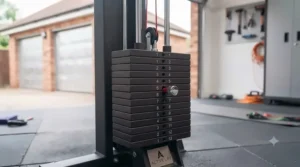
Step up again and you reach the Marcy MKM-81010, a genuinely serious piece of multi-station gym equipment built around a 90kg weight stack that, through pulley ratios on certain movements, delivers up to 142kg of effective resistance on specific exercises. Pec dec, arm curl and reverse row stations sit alongside the more familiar lat pulldown and chest press, giving a genuinely comprehensive spread across pushing, pulling and isolation work.
Based on the spec comparison with the DKN and York models earlier in this list, the extra stations here are the real differentiator — the reverse row and dedicated arm curl station in particular fill gaps that simpler four-station machines leave open, meaning fewer accessory dumbbells are needed to round out a full session. The trade-off is footprint: at roughly 99cm depth and a noticeably heavier overall frame, this needs a properly dedicated space rather than a corner that also does other jobs. Reviewers who’ve put this through sustained use tend to flag the cable durability and the multi-position bench as strong points, with the recurring critique being that the exercise chart supplied is fairly basic and best supplemented with proper programming advice.
Pros:
- ✅ Wide station spread including arm curl and row
- ✅ Up to 142kg effective resistance on some lifts
- ✅ Durable cables reported across long-term use
Cons:
- ❌ Larger footprint needs a dedicated room
- ❌ Included exercise chart is fairly basic
In the £650–£850 bracket, this suits someone who has already outgrown an entry-level station and wants meaningfully more capability without jumping to premium pricing.
7. BodyMax MG5 — best premium pick for serious long-term training
At the top of this list sits the BodyMax MG5, a machine built for people who see their home gym station as a long-term investment rather than a starter purchase. A 102kg weight stack — among the heaviest available at this size — pairs with adjustable fly arms that let you fine-tune the angle of chest and shoulder work in a way fixed-arm machines simply can’t replicate.
The adjustable fly arms are the standout feature here, and here’s what to weigh: being able to change the arm angle means you can target the upper, middle and lower chest with genuinely different movement paths on a single station, which is a level of exercise variation you’d otherwise need several separate machines to achieve. Combined with the 102kg stack, this gives serious home trainers years — plausibly a decade or more — of progressive overload before the resistance ceiling becomes limiting, which matters if you’re the kind of person who trains consistently rather than sporadically. Aggregated customer sentiment consistently highlights the build quality and smoothness of the cable action as justifying the higher price, with the main honest caveat being that a heavier, larger frame like this needs genuine floor space and isn’t something you casually fold away.
Pros:
- ✅ 102kg stack rivals small commercial gyms
- ✅ Adjustable fly arms add genuine exercise variety
- ✅ Built for years of serious progressive training
Cons:
- ❌ Highest price point on this list
- ❌ Large, heavy frame needs dedicated space
At £900–£1,100, this is a considered investment rather than an impulse buy, but for anyone treating strength training as a long-term habit, the value case genuinely stacks up.
Practical Usage Guide: Getting the Most From Your Home Gym Station
Buying the machine is the easy part; setting it up properly and using it correctly for the first month is where most home fitness equipment either becomes a genuine habit or a coat rack. Start by giving the assembly the time it needs — most weight-stack machines take 60–120 minutes to build properly, and rushing the frame bolts is the single most common cause of squeaking or wobble down the line. Once assembled, spend your first session simply learning the pin positions and cable routing rather than training hard; you’ll waste less time hunting for the right pin weeks later.
A quick maintenance schedule pays for itself many times over: wipe cables and guide rods down monthly to stop dust building into a grinding paste, check every visible bolt for tightness every few weeks during the first two months (frames do settle slightly), and apply a light silicone spray to pulley wheels every couple of months to keep the action smooth. The most common mistake in the first 30 days isn’t overtraining — it’s under-programming. New owners frequently do the same two or three exercises repeatedly simply because they’re the ones they remember, then get bored within a fortnight. Write a simple four-to-six exercise rotation covering push, pull and legs before your first session, and stick it somewhere visible near the machine.
Finally, resist the urge to max out the weight stack in week one to “test” the machine. Progressive loading — adding resistance only once your current weight feels genuinely comfortable for the full rep range — protects both your joints and the machine’s cables from unnecessary strain.
Real-World Scenarios: Who Actually Benefits From Which Station
The busy parent with 20 minutes and a spare landing. If you’re realistically training in short, interrupted bursts around childcare, a compact strength training station like the York Aspire 420 or HOMCOM Multi-Exercise Station makes more sense than a sprawling premium machine — quick pin changes and a small footprint matter more here than an extra 20kg of stack you’ll rarely reach.
The renter who moves flats every year or two. Anyone without permanent floor space genuinely available should lean toward the TRX suspension system. It delivers a full total body workout, costs less than a month of some commercial gym memberships, and moves house in a single bag rather than requiring a van.
The intermediate lifter who’s outgrown resistance bands. Someone who trains three to four times a week and has been doing bodyweight or band work for six months-plus will likely find the DKN Studio 7400 or Marcy MKM-81010 the natural next step — enough resistance and station variety to keep progressing for years without immediately needing a premium machine.
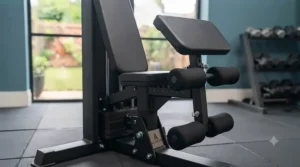
How to Choose an All-In-One Gym Station for Home
- Measure your actual space first, not your ideal space. Most multi-station gym equipment needs 1.5–2 metres of clearance around it for full range of motion, not just the footprint quoted in the spec sheet.
- Be honest about your training frequency. If you genuinely expect to train twice a week, prioritise a machine that’s quick and inviting to use over one with marginally more stack weight.
- Check the resistance ceiling against your realistic progression. A 45kg stack suits a genuine beginner; anyone with prior training experience should look toward 80kg-plus from the outset to avoid outgrowing it within a year.
- Consider resistance type, not just weight. Rod-based systems like the Bowflex PR1000 fold away but feel different under load than a traditional weight stack — try to understand which you’ll actually enjoy using.
- Factor in assembly and long-term maintenance. Heavier premium machines generally reward you with smoother, more durable cable systems, but also demand more floor space you can’t reclaim.
- Read aggregated review themes, not star ratings alone. A 4-star average tells you little; recurring specific complaints (padding, cable durability, wobble) tell you much more about what ownership actually feels like. Independent testers such as Which?’s home gym equipment reviews are a useful sense-check against manufacturer marketing.
- Budget for accessories separately. Ankle straps, extra grip attachments and a floor mat aren’t always included and can add £30–£60 to your total spend.
Common Mistakes When Buying Multi-Station Gym Equipment
The single most common mistake is buying based on the number of stations advertised rather than the quality of the cable and pulley system behind them — a machine with four smooth, ball-bearing stations will get used far more than one with seven stations on cheap plastic bushings that seize up within a year. A close second is underestimating footprint: buyers frequently measure the machine’s resting dimensions but forget the extra clearance needed for full range of motion during a lat pulldown or leg extension, resulting in a machine that’s technically in the room but awkward to actually use properly.
Buyers also commonly skip checking the maximum user weight rating, which matters not just for the person training but for anything loaded onto the bench during use. Finally, a subtler mistake: choosing the heaviest weight stack you can afford “to be safe,” when in reality a station you’ll actually enjoy using regularly beats a heavier one gathering dust because it feels intimidating or oversized for the room.
All-In-One Gym Station vs Traditional Gym Membership
| Factor | Home Gym Station | Traditional Gym Membership |
|---|---|---|
| Ongoing cost | One-off purchase, no monthly fee | £25–£50+/month indefinitely |
| Travel time | None | 10–30 minutes each way typically |
| Equipment variety | Limited to one machine’s stations | Extensive, multiple machines |
| Consistency | Higher — zero friction to start | Lower — commute is a barrier |
| Privacy | Complete | Shared space |
The financial case resolves itself within roughly a year for most buyers: a £400–£550 machine like the DKN Studio 7400 pays for itself against an average UK gym membership within twelve to eighteen months, after which every session is effectively free. Where a traditional gym still wins is variety — no home gym station replicates a full commercial floor of specialised machines — and social accountability, which some people genuinely need to stay consistent. For most people training two to four times a week on a fairly standard programme, though, a well-chosen all-in-one home gym machine removes far more friction than it costs.
What to Expect: Real-World Performance
Spec sheets rarely translate directly into how a machine actually feels under load, so it’s worth setting honest expectations. On an 80kg-plus weight stack machine like the DKN Studio 7400 or Marcy MKM-81010, expect the pin-select mechanism to feel satisfyingly quick within the first few sessions — swapping between a lat pulldown and a chest press genuinely takes under thirty seconds once you know the layout. Cable smoothness varies more than most buyers expect; ball-bearing pulley systems (as found on the York Aspire 420) noticeably outperform basic bushings within the first six months of regular use, even though both feel similar fresh out of the box.
On rod-resistance machines like the Bowflex PR1000, expect the resistance curve to feel different from what you’re used to if you’ve trained with free weights or a stack machine before — progressively firmer through the range rather than a constant load. Most users report adjusting within two to three sessions. And on the TRX suspension system, expect your core and stabiliser muscles to fatigue noticeably faster than on a guided machine during your first few weeks, simply because you’re doing more of the stabilising work yourself — this is a feature, not a flaw, but it’s worth knowing going in so you don’t mistake it for the equipment being “too hard.”
Long-Term Cost & Maintenance
Total cost of ownership on home fitness equipment extends well beyond the sticker price. Budget roughly £15–£30 a year for consumables — cable lubricant, replacement grip pads, and the occasional foam roller replacement on heavily used seats. Weight-stack machines in the £400–£850 range typically need their cables checked for fraying every one to two years of regular use; catching wear early is a five-minute job, while ignoring it risks a more expensive cable replacement, generally £20–£50 including the part.
Cost-per-use tells the real story. A £499 DKN Studio 7400 used three times a week works out to roughly £3.20 per session in year one alone, falling well under £1 per session by year three — figures that comfortably beat most UK gym memberships once travel time and missed sessions from bad weather or a busy week are factored in. Premium machines like the BodyMax MG5, despite the higher upfront cost, often work out cheapest per session over a five-year horizon simply because the build quality means fewer replacement parts and a longer usable lifespan.
Features That Actually Matter (And Those That Don’t)
Genuinely important: cable and pulley quality (ball-bearing beats plastic bushing every time), weight stack increments (2.5kg jumps allow finer progression than clunky 5kg steps), and seat/backrest adjustability, which affects whether a machine fits users of different heights in the same household. Also worth prioritising: a documented warranty length, which tends to correlate reliably with a manufacturer’s actual confidence in their build quality.
Less important than the marketing suggests: the total number of “exercises possible,” a figure often padded by counting minor grip variations as separate movements, and flashy digital consoles on basic multi-station machines, which add cost without meaningfully improving a strength training station’s core function. A high maximum stack weight also matters less than most buyers assume if you’re new to training — the practical ceiling you’ll actually reach in year one is far lower than the number printed on the box.
All-In-One Gym Stations for Small Homes and Flats
Space is the single biggest constraint for UK buyers specifically, given the average British home is considerably smaller than equivalents in the US or much of Europe. For a genuinely small room or flat, prioritise footprint over stack weight: the TRX system needs essentially no dedicated floor space at all, while compact frames like the HOMCOM Multi-Exercise Station or York Aspire 420 fit into corners that would swallow a full-size power rack. If you’re working with a box room or a section of a living room, measure the clearance needed for a seated lat pulldown specifically — it’s usually the movement requiring the most vertical space — before committing to any weight-stack machine. Folding options like the Bowflex PR1000 are worth a serious look if the room needs to serve double duty as a guest space, since halving the footprint on non-training days makes a genuine practical difference.
Safety, Regulations & Compliance Guide
UK home fitness equipment sold today generally carries either a CE or UKCA conformity mark, confirming it meets recognised safety standards for mechanical and structural safety. Helpfully for buyers, the UK government has confirmed that businesses can continue to use the CE mark for products sold in Great Britain alongside the newer UKCA marking, so you don’t need to worry about one marking being “less valid” than the other when comparing products — full detail is available via GOV.UK’s guidance on using the UKCA marking.
Beyond the marking itself, a few practical safety habits matter more day-to-day: check the maximum user weight rating against everyone in the household who might use the machine, inspect cables for fraying every few months rather than waiting for a visible problem, and always ensure the machine is on a level, stable floor before first use — an uneven surface is a common and easily avoidable cause of premature frame wear. If you’re mounting any wall-anchored component, such as a suspension trainer door anchor, always test it under light load before committing your full bodyweight.
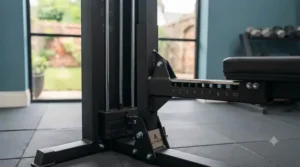
Frequently Asked Questions
❓ Is an all-in-one gym station for home actually worth it?
❓ How much space does a home multi gym actually need?
❓ Can beginners use a multi-station gym machine safely?
❓ Do I need extra equipment alongside an all-in-one gym station?
❓ How long do home gym stations typically last?
Conclusion
There’s no single “best” all-in-one gym station for home — only the right one for your space, your budget, and how honestly you can predict your own training habits. If floor space is your real constraint, the TRX suspension system removes that excuse entirely. If you want the safest, most sensible first purchase for genuine long-term progression, the DKN Studio 7400 keeps coming up across independent reviews for good reason — it hits the sweet spot between stack weight, station variety and price. And if you’re committed for the long haul and have the room to match, the BodyMax MG5’s 102kg stack and adjustable fly arms will keep challenging you for years rather than months.
Whichever you choose, the honest truth backed by NHS guidance on strength and flexibility is straightforward: a strength exercise is simply any activity that makes your muscles work harder than usual, and doing it on at least two days a week delivers real health benefits — the specific machine matters far less than actually using it consistently. Pick the one that fits your space and your realistic routine, not the one with the biggest number on the box, and you’ll get far more value out of it.
✨ Don’t Miss These Exclusive Deals!
🔍 Take your home strength training to the next level with one of the seven picks above. Click through on any highlighted product to check current pricing and availability before you commit — the right versatile home gym system is one click away!
Recommended for You
- Compact Multi Gym for Small Spaces: 7 Best UK Picks (2026)
- Multi Gym for Small Garage Gym: 7 Best UK Picks (2026)
- Multi Gym for Full Body Workout: 7 Best UK Picks (2026)
Disclaimer: This article contains affiliate links. As an Amazon Associate, I earn from qualifying purchases. If you purchase products through these links, we may earn a small commission at no additional cost to you.
✨ Found this helpful? Share it with your friends! 💬🤗
