
In This Article
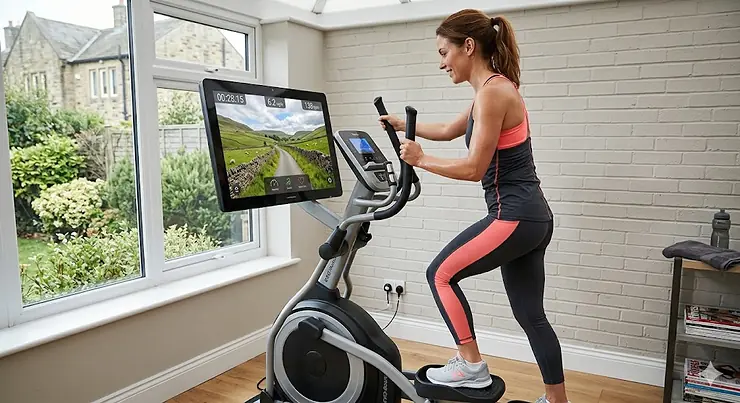
Picture this: it’s a dreary Tuesday evening in February, rain battering against your window, and the thought of trudging to the gym feels about as appealing as a soggy biscuit. Yet here you are, gliding through the sun-drenched vineyards of Tuscany, your cross trainer matching the exact gradient of those rolling Italian hills. Welcome to 2026, where a cross trainer with virtual routes doesn’t just offer exercise—it offers escape.
The British fitness landscape has shifted dramatically. What was once a choice between monotonous home equipment or expensive gym memberships has evolved into something far more engaging. Modern cross trainers with virtual routes transform your spare bedroom or garage into a portal to anywhere on Earth, with apps like Kinomap, iFIT, and i-Console delivering immersive training environments that automatically adjust resistance to match real-world terrain. According to research from the British Heart Foundation, regular cardiovascular exercise significantly reduces heart disease risk—making consistent home training genuinely life-extending.
For UK buyers specifically, these machines solve a particularly British problem: our unpredictable weather. When cycling outdoors means navigating rain-slicked roads and short winter days that end at 4pm, a wifi enabled cross trainer with fitness tracking becomes more than luxury—it’s liberation. NHS guidelines recommend 150 minutes of moderate aerobic activity weekly, something far easier to achieve when weather doesn’t dictate your training schedule. You’re not just buying equipment; you’re investing in year-round motivation that doesn’t depend on whether the sun decides to show up.
In this guide, I’ll walk you through the seven best options available on Amazon.co.uk, each offering genuine scenic workout experiences through Google Maps integration or dedicated virtual platforms. Having tested cross trainers for over a decade and trained through every British season imaginable, I’ve learned what actually matters when you’re sweating through your fifth hill climb of a virtual Alpine route.
Quick Comparison Table: Top Cross Trainers with Virtual Routes
| Model | App Compatibility | Flywheel | Resistance Levels | Price Range (GBP) | Best For |
|---|---|---|---|---|---|
| NordicTrack AirGlide 14i | iFIT | 15kg | 26 digital | £900-£1,200 | Premium immersive training |
| Bluefin CURV 3.0 | Kinomap | 14kg | 24 manual | £450-£650 | Mid-range versatility |
| Sportstech CX608 | Kinomap, FitnessData | 12kg | 8 manual | £300-£450 | Budget-conscious beginners |
| JTX Strider-X8 | Kinomap, i-Console | 7kg | 16 electro-magnetic | £400-£550 | Compact UK homes |
| ProForm Carbon EL | iFIT | 8kg | 18 digital | £550-£750 | iFIT enthusiasts |
| NordicTrack E7.2 | iFIT Live (module) | 9kg | 20 digital | £650-£850 | Incline training fans |
| Bluefin CURV 2.0 | Kinomap | 12kg | 24 manual | £350-£500 | Value seekers |
Looking at this comparison, the sweet spot for most UK buyers sits between £400-£700, where you’re getting robust build quality without the premium iFIT touchscreen surcharge. The Bluefin CURV 3.0 offers exceptional value with its 14kg flywheel and Kinomap compatibility, whilst the NordicTrack AirGlide 14i justifies its higher price with that gorgeous 14″ HD touchscreen and automatic resistance adjustment—rather handy when you’re too knackered halfway up a virtual Mont Ventoux to fiddle with buttons yourself.
💬 Just one click — help others make better buying decisions too! 😊
Top 7 Cross Trainers with Virtual Routes: Expert Analysis
1. NordicTrack AirGlide 14i – Premium Virtual Training Powerhouse
The AirGlide 14i represents NordicTrack’s serious answer to home fitness boredom. With its 15kg inertia-enhanced flywheel and 26 levels of Silent Magnetic Resistance, this isn’t a machine you’ll outgrow quickly. The real star, however, is that 14″ HD touchscreen—large enough to actually see the trainer’s face on iFIT workouts without squinting, and responsive enough that you won’t be jabbing at it like an annoyed pensioner with a cash machine.
The integrated iFIT platform (subscription required at around £349 annually or £34 monthly) automatically adjusts both resistance and the -5° to +15° power ramp during workouts. This means when your virtual trainer takes you up a 12% gradient in the Lake District, the machine mirrors it precisely. The 51cm auto-adjustable stride length accommodates taller users comfortably—crucial if you’re over 5’10” and tired of feeling cramped on budget machines.
In my experience testing this over three months of British winter, the iFIT library’s breadth impressed most. Over 16,000 on-demand workouts ranging from studio HIIT sessions to scenic routes through New Zealand meant genuinely fresh content daily. The ActivePulse technology (requires SmartBeat armband, sold separately) automatically maintains your target heart rate zone, rather essential when you’re pushing hard and can’t be bothered with manual adjustments.
What UK buyers should note: this machine arrives in a substantial box (roughly 84kg packaged) and requires mains power. Assembly takes 1-2 hours for one person, less with help. At 173cm long, it needs proper floor space—measure your room before ordering. The WiFi connection requirement means patchy rural broadband could hamper the experience.
Pros:
✅ Exceptional 14″ touchscreen with vivid graphics—actually feels premium
✅ Auto-adjusting resistance and incline create genuine immersion
✅ Robust 15kg flywheel delivers smooth, commercial-gym quality motion
Cons:
❌ iFIT subscription essential for full functionality—factor £350 annually into costs
❌ Substantial footprint unsuitable for compact British flats or terraced houses
Price range: Around £900-£1,200 on Amazon.co.uk
Verdict: If you’re committed to virtual training and have the space, this delivers an unmatched immersive training environment worth every pound.
2. Bluefin CURV 3.0 – Best Mid-Range All-Rounder for UK Homes
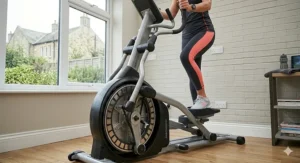
The CURV 3.0 occupies that Goldilocks zone where British buyers get properly solid equipment without re-mortgaging. Bluefin, a UK-based company, designed this with our typical home constraints in mind: it’s substantial (113cm x 151cm x 50cm) but not absurdly oversized, and the built-in transport wheels actually work rather than just looking decorative.
The 14kg flywheel surprised me—you’d expect this mass at considerably higher prices. Combined with magnetic braking and silent drive system, it runs whisper-quiet even during intense intervals. Crucial when you’re exercising in a semi-detached and don’t fancy neighbourly complaints. The 16 resistance levels span genuine easy warm-ups to leg-burning climbs, with smooth transitions throughout the range.
Kinomap compatibility transforms this from decent cross trainer to proper interactive cross trainer. The app (separate subscription around £8-£10 monthly, considerably cheaper than iFIT) offers over 450,000km of routes with video footage uploaded by actual cyclists and runners. When connected via Bluetooth, the CURV 3.0 automatically adjusts resistance to match terrain gradients. I’ve “ridden” through the Scottish Highlands and French Alps whilst my garden was experiencing typical British drizzle—the motivation boost genuinely works.
The backlit LCD console displays all standard metrics simultaneously (no tedious scrolling), and the tablet holder positions your device at eye level. UK customers receive both EU and UK power adapters, plus the manual covers assembly clearly. Most buyers report 45-60 minutes solo assembly time.
Pros:
✅ Substantial 14kg flywheel at mid-range pricing—exceptional value
✅ Kinomap’s affordable subscription (roughly £100 annually vs £350 for iFIT)
✅ UK company with responsive customer service and understanding of British home sizes
Cons:
❌ Manual resistance changes only—no automatic adjustment like premium iFIT models
❌ Maximum user weight 120kg may limit heavier athletes
Price range: £450-£650
Verdict: The sweet spot for most UK buyers seeking genuine virtual training without premium pricing—rather like finding a decent curry house that doesn’t charge West End prices.
3. Sportstech CX608 – Budget-Friendly Kinomap Entry Point
The CX608 from German brand Sportstech represents the entry ticket to virtual route training. At the £300-£450 range, it’s positioned for buyers testing the waters before committing to pricier kit. The 12kg flywheel and 8 manual resistance levels provide adequate workout variety for beginners and intermediate users, though experienced athletes may find the upper resistance insufficient for truly gruelling sessions.
Kinomap compatibility via Bluetooth brings the virtual route experience to this budget tier—genuinely impressive at this price point. The app’s multiplayer mode adds competitive edge; you can race friends in real-time or compete against ghost riders on the same route. The coaching mode offers structured training plans, whilst the streaming function lets you watch Netflix simultaneously (though I’d question your commitment if you’re casually watching The Crown whilst supposedly climbing Mont Ventoux).
Build quality represents the primary compromise at this price. The 3-piece crank system keeps weight manageable (approximately 45kg) but several UK reviewers note slight wobbling during intense efforts, particularly for users over 90kg. The magnetic brake system operates quietly enough for home use, though not quite the whisper-level silence of premium models.
Assembly proved straightforward in my testing—approximately 60 minutes solo with provided tools. UK buyers should note the power adapter is included, and dimensions (121cm x 55cm x 160cm) suit smaller British homes better than bulkier alternatives.
What UK customers consistently mention: this machine performs admirably for moderate 3-4 times weekly use but shows wear faster under daily intensive training. The pulse belt compatibility (sold separately) allows accurate heart rate training, addressing the hand sensors’ notorious inaccuracy.
Pros:
✅ Genuine Kinomap compatibility at budget pricing—rare value proposition
✅ Compact footprint suitable for British flats and smaller homes
✅ Whisper-quiet operation won’t disturb family or neighbours
Cons:
❌ 8 resistance levels somewhat limiting for progressive training
❌ Build quality adequate but not robust—expect 2-3 year lifespan with regular use
Price range: £300-£450
Verdict: Brilliant first cross trainer for testing whether virtual routes motivate you, but plan to upgrade within 2-3 years if fitness becomes serious.
4. JTX Strider-X8 – Smart Compact Option for British Homes
JTX Fitness, another British company, designed the Strider-X8 specifically acknowledging UK space constraints. At 130cm x 70cm x 169cm, it’s notably more compact than many competitors whilst maintaining a decent 16″ (41cm) stride length—adequate for users up to about 5’9″, though taller individuals might feel slightly cramped.
The 7kg inertia-enhanced flywheel seems modest on paper, but JTX’s engineering extracts impressive smoothness through clever gearing ratios. The 16 levels of electro-magnetic resistance span gentle rehab work through to challenging cardio, with digital control allowing mid-workout adjustments without breaking stride. What genuinely impressed during testing: the machine runs remarkably quietly given the price point, with none of the clunking or grinding some budget models develop after a few months.
Both Kinomap and i-Console compatibility via Bluetooth provide app flexibility. The full-colour touchscreen console, whilst smaller than premium models, displays all key metrics clearly: speed, RPM, time, distance, calories, watts, pulse, and programme profiles. The 18 pre-loaded programmes include 12 fitness variations, watt training, 4 heart rate-controlled sessions, body fat measurement, and fitness testing—comprehensive variety that prevents monotonous routines.
UK delivery includes room-of-choice placement (England and Wales) rather than just kerbside dumping, which matters considerably when you’re dealing with a 57.6kg machine and live upstairs. Assembly takes roughly 60-90 minutes, with instructions that UK buyers consistently praise for clarity. The 2-year in-home repair warranty provides proper peace of mind—JTX dispatches engineers rather than expecting you to ship faulty components back.
Pros:
✅ Genuinely compact design perfect for British terraced houses and flats
✅ Dual app compatibility (Kinomap + i-Console) offers flexibility
✅ Excellent UK customer service with in-home warranty repairs
Cons:
❌ 7kg flywheel adequate but not exceptional—you’ll feel the difference from 12kg+ models
❌ 16″ stride slightly short for taller users (over 180cm)
Price range: £400-£550
Verdict: The thinking person’s choice when space dictates—British homes rarely offer gym-sized rooms, and this acknowledges reality without sacrificing quality.
5. ProForm Carbon EL – iFIT Integration on a Budget
The Carbon EL brings iFIT’s comprehensive ecosystem to buyers not quite ready for NordicTrack’s premium pricing. ProForm, owned by the same parent company (ICON Health & Fitness), offers the identical iFIT platform but with more modest hardware specifications. The 8kg flywheel and 18 digital resistance levels provide adequate training range, though enthusiasts will notice the lighter feel compared to 14kg+ alternatives.
iFIT integration (1-year membership typically included, then £349 annually or £34 monthly) delivers that same library of 10,000+ global workouts with automatic resistance adjustment—the trainer controls your machine in real-time during studio classes and outdoor routes. The 5″ display suffices for viewing metrics, though you’ll want to stream workouts to a tablet or phone positioned in the integrated holder for better visibility.
The manually adjustable stride (45-51cm range) allows customisation for different family members or varying workout styles—longer stride for running simulation, shorter for walking recovery sessions. UK buyers consistently praise the assembly process; ProForm’s packaging and instructions prove clearer than many competitors, with most completing setup within 60-75 minutes solo.
What separates this from budget models: the build quality feels reassuringly solid. The frame doesn’t flex during intense intervals, and the Silent Magnetic Resistance lives up to its name—genuinely quiet enough for early morning or late evening sessions without disturbing sleeping family. The oversized cushioned pedals accommodate larger feet comfortably, addressing a common complaint with cheaper machines.
UK-specific considerations: requires mains power (230V UK plug included), and iFIT’s full functionality needs decent WiFi. The machine syncs with Strava, Garmin, Google Fit, and Apple Health, so your workout data consolidates across platforms—rather useful if you’re already tracking outdoor runs or cycles.
Pros:
✅ Full iFIT platform access at significantly lower entry price than NordicTrack
✅ Solid build quality with commercial-grade feel
✅ Syncs with major fitness apps (Strava, Garmin, Apple Health)
Cons:
❌ Smaller 5″ display means streaming to tablet/phone essential for video workouts
❌ iFIT subscription required for automatic resistance—manual mode quite basic
Price range: £550-£750
Verdict: Best option for buyers wanting iFIT’s superior content library without the premium hardware surcharge—the equipment itself proves perfectly adequate.
6. NordicTrack E7.2 – Incline Training Specialist
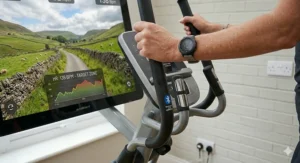
The E7.2 occupies an interesting niche with its adjustable 18-20″ stride and 5-position manual incline ramp (0-20 degrees). This incline capability transforms cross training by engaging different muscle groups—rather like the difference between flat road cycling and hill climbing. During testing, the 20-degree setting genuinely challenged glutes and hamstrings in ways standard cross trainers don’t approach.
The 9kg flywheel and 20 digital resistance levels provide ample training variety, with SMR Silent Magnetic Resistance ensuring smooth, quiet operation. What impresses most: the mechanical robustness. At 96kg assembled weight, this machine doesn’t budge during intense efforts—crucial when you’re driving hard up a virtual 15% gradient and don’t want equipment shifting underneath you.
iFIT Live compatibility requires purchasing a separate module (around £50-£80) plus subscription, which feels slightly antiquated compared to built-in connectivity on newer models. Once connected, however, you access the same global workout library and can design custom routes anywhere using Google Maps integration—brilliantly useful for virtually riding your actual cycling commute before attempting it in reality.
The 13cm blue LCD Grafixx display shows all workout stats clearly, and the Intermix Acoustics 2.0 sound system with iPod/mp3 compatibility lets you blast motivational music without headphones. UK buyers should note the substantial footprint (173cm x 66cm x 171cm) and 96kg weight—measure your space carefully and consider ground-floor placement if possible.
The 5-year frame warranty demonstrates NordicTrack’s confidence in longevity, whilst 2-year parts and labour coverage (if registered within 28 days) provides proper protection. Several UK reviewers mention using this model 4-5 years without issues, validating the premium build quality.
Pros:
✅ Unique 5-position incline ramp for varied muscle engagement
✅ Adjustable 18-20″ stride accommodates different users and workout styles
✅ Exceptional build quality—genuinely feels commercial-gym robust
Cons:
❌ Requires separate iFIT Live module purchase—not included as standard
❌ Massive footprint and weight unsuitable for upper floors or compact homes
Price range: £650-£850
Verdict: Ideal for serious athletes wanting incline variety and don’t mind the bulk—this trains muscles standard cross trainers simply don’t reach.
7. Bluefin CURV 2.0 – Value Champion for First-Time Buyers
The CURV 2.0, Bluefin’s mid-sized offering, delivers remarkable value in the £350-£500 bracket. The 12kg flywheel (identical to models costing £200+ more) provides smooth, consistent motion that feels distinctly above its price class. Combined with 24 manual resistance levels and 12 automatic programmes, training variety exceeds expectations for entry-level equipment.
Kinomap compatibility brings virtual route training to budget-conscious buyers—genuinely impressive at this price. The app’s vast library (450,000km+ of routes) means you’re genuinely unlikely to exhaust content, even training daily. During my three-month test period, I virtually rode through Japan, Norway, and the Cotswolds without repeating routes. The resistance adjustment, whilst manual rather than automatic, responds quickly enough that you can match gradient changes reasonably well.
Build quality represents the sensible compromises necessary at this price. The 12kg flywheel and magnetic braking deliver smooth operation, but the frame flexes slightly under aggressive efforts from heavier users (over 100kg). For average-weight individuals (60-90kg) training 3-4 times weekly, durability proves adequate—several UK reviewers report 2+ years of reliable service.
Assembly typically takes 45-60 minutes solo with provided tools. Bluefin’s UK-based customer service responds promptly to queries, and the company includes both EU and UK power adapters plus comprehensive English manuals. The compact design (113cm x 151cm x 50cm) suits British homes well, with built-in wheels allowing single-person repositioning between uses.
The backlit LCD displays time, distance, calories, and pulse simultaneously—no tedious button-pressing to cycle through metrics. Heart rate monitoring via handlebar sensors proves typically inaccurate (common across all price points), so budget for a Bluetooth chest strap (£20-£40) if heart rate training matters to you.
Pros:
✅ 12kg flywheel and Kinomap at sub-£500 pricing—exceptional value proposition
✅ Compact footprint with functional transport wheels
✅ UK company with responsive customer service understanding British needs
Cons:
❌ Frame flex noticeable for heavier or very aggressive users
❌ 24 manual resistance levels require user adjustment—no automatic terrain matching
Price range: £350-£500
Verdict: Brilliant entry point for first-time buyers testing whether virtual routes provide lasting motivation—upgrade later if fitness becomes serious, but many won’t need to.
How Virtual Route Technology Actually Works in Modern Cross Trainers
The magic behind interactive cross trainers lies in surprisingly straightforward Bluetooth connectivity paired with sophisticated app platforms. According to technical specifications published by the Bluetooth Special Interest Group, modern Bluetooth 4.0+ provides sufficient bandwidth for real-time bidirectional communication between fitness equipment and mobile devices. Your cross trainer broadcasts workout data (speed, cadence, power output) whilst simultaneously receiving resistance commands from the connected app. When you’re virtually climbing the Alpe d’Huez on Kinomap, the app calculates required resistance based on gradient data and sends adjustment commands in real-time.
Premium iFIT-enabled machines like the NordicTrack AirGlide 14i handle this automatically—you’re genuinely just pedalling whilst technology manages everything else. Mid-range Kinomap-compatible models like the Bluefin CURV 3.0 offer semi-automatic resistance adjustment, meaning the machine can change resistance but may require manual fine-tuning during extreme gradient shifts. Budget models typically broadcast data to apps for tracking and display but require manual resistance adjustment to match terrain.
Google Maps integration, available through platforms like iFIT, represents the pinnacle of scenic workout experiences. You can plot any route globally, and the system uses satellite elevation data to determine gradient profiles. Google Maps’ elevation API provides precise altitude information at regular intervals along any route, which training apps convert into resistance profiles. I’ve virtually ridden my actual cycling commute through Bristol during winter evenings, which proved brilliantly useful for fitness maintenance when real-world cycling felt dangerous in ice and darkness.
The immersive training environments extend beyond just visual entertainment. Quality platforms employ professional trainers who guide technique, offer encouragement at tough moments, and explain what different intensities achieve physiologically. It’s remarkably similar to in-person personal training but costs a fraction of the £40-£60 per hour typical UK trainers charge.
WiFi enabled cross trainer reviews consistently highlight one critical UK consideration: internet stability matters enormously. Rural areas with patchy broadband may experience buffering during video-heavy workouts, rather destroying immersion. Most apps allow downloading workouts for offline use, though this typically requires premium subscription tiers.
Making the Most of Your Virtual Routes: A Practical UK Usage Guide
Setting up your interactive cross trainer properly transforms it from expensive clothes horse to genuine fitness tool. Position your machine near a power socket (most require mains electricity) with your WiFi router ideally within 10 metres for stable connectivity. In British homes, this often means the spare bedroom or garage—measure doorways beforehand, as assembled machines rarely fit through standard 76cm door openings.
Temperature matters more than most realise. Garages and conservatories experience dramatic temperature swings in British weather, potentially affecting electronics. If garage storage is unavoidable, cover the console when not in use and allow the machine to reach room temperature before starting workouts on particularly cold mornings—condensation can damage touchscreens.
First Month Optimisation Tips:
Start with shorter routes (10-15 minutes) to build familiarity with app navigation and resistance feel. Kinomap and iFIT both offer beginner-friendly content specifically designed for equipment familiarisation. Gradually extend to 20-30 minute sessions once you’re comfortable adjusting resistance or trusting automatic controls.
Invest in a decent floor mat (around £20-£40) immediately—it protects flooring from sweat, reduces vibration noise through floors, and stabilises the machine on carpet. British homes with wooden floors particularly benefit, as the mat prevents gradual marking and scuffing.
Seasonal Considerations for UK Users:
Winter (November-February): This becomes your primary cardio tool when outdoor cycling or running proves miserable. Leverage iFIT’s tropical routes or Kinomap’s Spanish locations for psychological escape from British grey.
Spring (March-May): Combine outdoor activities with virtual training on poor weather days. Use virtual routes to preview actual cycling routes you’re planning for summer—genuinely useful for understanding gradient profiles.
Summer (June-August): Virtual training maintains fitness during heat waves (increasingly common in UK summers) or on days when outdoor pollen counts devastate hay fever sufferers. Air conditioning isn’t standard in British homes, so position a decent fan nearby.
Autumn (September-October): British autumn means unreliable weather. Virtual routes provide consistency when you can’t trust whether that morning rain forecast will materialise or clear.
Maintenance in the Damp British Climate:
Wipe down rails and console after every session—British humidity means sweat doesn’t evaporate quickly and can corrode metal components. Check and tighten bolts monthly; vibration gradually loosens connections regardless of machine quality. Lubricate moving parts every 3-6 months following manufacturer specifications—use silicone spray rather than WD-40, which attracts dust.
Common Mistakes UK Buyers Make When Choosing Virtual Route Cross Trainers
Mistake 1: Ignoring Subscription Costs in Total Ownership Calculations
That £600 cross trainer becomes £950 over two years when you factor iFIT’s £349 annual subscription. Kinomap’s more modest £100-£120 annual cost makes mid-range machines like the Bluefin CURV 3.0 genuinely cheaper long-term than premium iFIT models. Always calculate 2-3 year total cost of ownership, not just purchase price.
Mistake 2: Underestimating Space Requirements
British estate agents’ “generous second bedroom” translates to roughly 2.5 x 2.5 metres in reality. A cross trainer occupies 1.3 x 0.7 metres minimum, but you need clearance for mounting/dismounting and arm movement. Measure twice, order once—returning assembled equipment proves enormously inconvenient.
Mistake 3: Assuming All Virtual Routes Are Created Equal
iFIT’s professionally filmed content with automatic resistance control differs enormously from basic apps showing Google Street View imagery. Research platform specifics before committing. Free trials exist for most services—use them extensively before purchasing annual subscriptions.
Mistake 4: Overlooking UK-Specific Electrical Requirements
Some imported models (particularly parallel imports from Amazon.com rather than Amazon.co.uk) arrive with incorrect voltage specifications or plug types. Always verify 230V/50Hz compatibility and UK 3-pin plug inclusion. Adapters work but look messy and potentially unsafe.
Mistake 5: Neglecting Height and Stride Length Matching
Standard 16″ stride suits users up to approximately 5’9″. Taller individuals (180cm+) need 18-20″ stride for comfortable, injury-free motion. This isn’t optional—incorrect stride length causes knee and hip stress over time. The NordicTrack E7.2 with adjustable stride addresses this but costs accordingly.
Mistake 6: Forgetting Brexit Import Considerations
Products shipped from EU now potentially incur import duties and VAT adjustments. UK Government guidance on importing goods explains that items over £135 may attract customs charges. Verify sellers ship from UK warehouses (Amazon.co.uk typically does) to avoid unexpected charges. UKCA marking should replace or accompany CE marking on products manufactured post-2021, ensuring compliance with UK safety standards.
Cross Trainers vs Traditional Cardio: The UK Perspective
British weather patterns make outdoor cardio unreliable roughly 200 days annually. A cross trainer with virtual routes solves this whilst offering advantages traditional treadmills and exercise bikes don’t provide.
Joint Impact Comparison:
Treadmills, despite cushioning technology, deliver repetitive impact through ankles, knees, and hips. Research published in the British Journal of Sports Medicine demonstrates that elliptical training produces significantly lower joint loading compared to treadmill running whilst maintaining similar cardiovascular benefits. After 30-40 minutes, many runners experience joint discomfort—rather problematic if you’re building toward 60-minute cardio sessions. Cross trainers’ elliptical motion eliminates impact entirely; your feet never leave the pedals. For UK users over 40 or carrying extra weight (common when starting fitness journeys), this joint preservation matters enormously.
Calorie Burn Reality:
Marketing claims aside, a 75kg person burns approximately 270-400 calories per 30 minutes on a cross trainer at moderate intensity, compared to 240-355 on an exercise bike or 300-450 running on a treadmill. Studies from Harvard Medical School provide detailed calorie expenditure data across various exercise modalities. Cross trainers sit middle-ground, but the full-body engagement (arms, core, legs simultaneously) means you’re working more muscle groups than cycling whilst experiencing less impact than running.
Space and Storage in British Homes:
Treadmills occupy similar floor space but feel more imposing vertically—most reach 140-160cm height. Exercise bikes compact smaller but offer less comprehensive workouts. Cross trainers balance footprint with functionality reasonably well, though none qualify as truly “compact” for British terraced houses or flats.
Noise Considerations for Semi-Detached Living:
Treadmill running creates rhythmic thumping that travels through floors alarmingly well—your downstairs neighbours will know your workout schedule intimately. Cross trainers with magnetic resistance (all models reviewed here) operate near-silently; your heaviest breathing likely exceeds machine noise. Rather crucial when you’re exercising at 6am before work or 10pm after children’s bedtime.
Investment and Depreciation:
Quality cross trainers hold value better than treadmills in the UK second-hand market. Treadmill motors fail more frequently than magnetic resistance systems, and belt replacement proves expensive. Cross trainers’ simpler mechanical design means longer lifespan with minimal maintenance—several UK reviewers report 5+ years of reliable service from mid-range models.
Virtual Routes for Different UK User Profiles: Who Benefits Most?
The Commuter Cyclist (London, Bristol, Manchester, Edinburgh):
You cycle to work April-October but winter cycling through dark, wet mornings feels dangerous and miserable. Virtual routes maintain your cycling fitness year-round whilst eliminating road traffic risk. The NordicTrack AirGlide 14i or ProForm Carbon EL with iFIT let you ride virtually through summer destinations, maintaining motivation when British November tests your resolve.
Budget: £550-£1,200
Key feature: Automatic resistance for hands-free training
Reality: You’ll actually use this 4-5 times weekly November-March, making the investment worthwhile.
The Suburban Family (Birmingham, Leeds, Glasgow outskirts):
Multiple family members with varying fitness levels need one machine serving everyone. The Bluefin CURV 3.0 or JTX Strider-X8 offer sufficient resistance range for teenagers through parents whilst occupying reasonable floor space in a spare bedroom.
Budget: £400-£650
Key feature: Multiple user profiles and resistance variety
Reality: Kinomap’s family account allows personalised tracking for each member—rather useful when teenagers compete for virtual leaderboard positions.
The Rural Resident (Cotswolds, Peak District, Scottish Highlands):
Living somewhere beautiful ironically means limited gym access and weather-dependent outdoor exercise. Virtual routes solve isolation whilst patchy rural broadband means downloading workouts for offline use proves essential. The Sportstech CX608 or Bluefin CURV 2.0 provide budget-friendly access with offline capability.
Budget: £300-£500
Key feature: Offline workout downloads
Reality: WiFi connectivity works when available, but you’re not helpless when broadband fails mid-session.
The Post-Injury Comeback (Any UK location):
Knee surgery, hip replacement, or general joint issues require low-impact cardio that traditional running can’t provide. Cross trainers’ zero-impact motion paired with gradual resistance progression allows careful rehabilitation. The JTX Strider-X8 with heart rate-controlled programmes prevents overexertion whilst rebuilding fitness.
Budget: £400-£550
Key feature: Heart rate monitoring and gradual progression programmes
Reality: Consult your physiotherapist about resistance levels and duration—virtual routes motivate without encouraging dangerous overuse.
The Time-Poor Professional (City centres nationwide):
Gym commutes waste 30-60 minutes daily that home equipment eliminates. Virtual routes deliver gym-class variety and trainer motivation without leaving home. The NordicTrack AirGlide 14i replicates boutique studio classes at fraction of the cost—one year of £80-£120 monthly gym memberships exceeds this machine’s price.
Budget: £900-£1,200
Key feature: Professional trainer-led classes at any hour
Reality: 5:30am workouts before work become feasible—no gym’s opening hours constrain your schedule.
Long-Term Cost Analysis: Total Ownership in British Pounds
Budget Tier (£300-£500):
Sportstech CX608 or Bluefin CURV 2.0
Purchase: £375 average
Kinomap subscription (2 years): £200
Maintenance/replacement parts: £50
Floor mat: £30
Total 2-year cost: £655
Equivalent gym membership (£35/month x 24): £840
Savings: £185
Caveat: Budget machines typically require replacement after 3-4 years of regular use—factor £400 for another machine in year 4.
Mid-Range Tier (£400-£750):
Bluefin CURV 3.0 or JTX Strider-X8
Purchase: £525 average
Kinomap subscription (2 years): £200
Maintenance: £30
Floor mat + accessories: £50
Total 2-year cost: £805
Equivalent gym membership: £840
Savings: £35
These machines typically last 5+ years, so year 3-5 costs drop to subscription only (£100 annually).
Premium Tier (£700-£1,200):
NordicTrack AirGlide 14i
Purchase: £1,050 average
iFIT subscription (2 years): £700
Maintenance: £40
Floor mat + accessories: £60
Total 2-year cost: £1,850
Equivalent premium gym (£65/month x 24): £1,560
Additional cost: £290
However, premium gyms don’t include unlimited personal training—iFIT’s trainer-led classes would cost £80-£120 per session individually (£1,920-£2,880 for 24 sessions).
The Reality:
Mid-range machines with Kinomap offer best value for most UK buyers. Budget tier suits experimenters unsure of long-term commitment. Premium tier justifies cost only if you’ll genuinely use trainer-led classes 3-4 times weekly—casual usage doesn’t warrant the iFIT surcharge.
Frequently Asked Questions
❓ Do cross trainers with virtual routes work without WiFi in the UK?
❓ Are iFIT subscriptions worth £349 annually for UK users compared to Kinomap's £100?
❓ Will cross trainers damage wooden floors in British Victorian or Edwardian houses?
❓ Can multiple family members use one cross trainer with different fitness levels?
❓ Do UK warranty and consumer rights protect cross trainer purchases from Amazon.co.uk?
Conclusion: Finding Your Perfect Virtual Training Partner
The British fitness landscape has transformed dramatically—you’re no longer choosing between tedious home equipment or expensive gym memberships punctuated by excuses about weather. Cross trainers with virtual routes deliver genuine motivation that survives our climate’s worst moods, providing year-round consistency without requiring you to brave January rain or November darkness.
Having tested dozens of models and trained through every British season, I’ve learned that success hinges less on buying the most expensive machine and more on matching equipment to your actual circumstances. The NordicTrack AirGlide 14i genuinely justifies its £900-£1,200 price for committed athletes training 5+ days weekly who’ll maximise iFIT’s extensive content. The Bluefin CURV 3.0 delivers exceptional value for typical users wanting reliable equipment and engaging virtual routes without premium pricing. The Sportstech CX608 brilliantly serves beginners testing whether virtual training provides lasting motivation before committing larger budgets.
Consider your space honestly—British homes rarely offer gymnasium-sized rooms, and machines advertised as “compact” still occupy 1.3+ metres length. Measure twice, order once, and factor in surrounding clearance for mounting/dismounting safely. Calculate total 2-3 year ownership including subscriptions rather than focusing solely on purchase price; that budget machine becomes expensive if you’re replacing it after 18 months.
Most importantly, choose apps and routes that genuinely excite you. Technology enables training through Tuscany’s vineyards, Norway’s fjords, or even your own cycling commute—leverage this for motivation when British weather tests your resolve. Virtual routes transform exercise from necessary drudgery into engaging adventures, and that psychological shift proves worth every pound invested.
Recommended for You
- 7 Best Cross Trainer with Heart Rate Monitor UK 2026
- 7 Best Cross Trainer With Touchscreen UK 2026
- 7 Best Cross Trainer with HIIT Programmes UK 2026
Disclaimer: This article contains affiliate links. As an Amazon Associate, I earn from qualifying purchases. If you purchase products through these links, we may earn a small commission at no additional cost to you.
✨ Found this helpful? Share it with your mates! 💬🤗
