
In This Article
Shopping for a cross trainer with touchscreen on Amazon.co.uk feels rather different in 2026 than it did just two years ago. The technology has matured, prices have dropped into genuinely affordable territory, and — here’s the bit most buyers overlook — the British market now has access to models specifically designed for our compact homes and damp climate. According to the NHS UK exercise guidelines, adults should aim for at least 150 minutes of moderate aerobic activity weekly, and elliptical trainers provide an excellent low-impact option for meeting these recommendations. What was once a £2,000+ luxury reserved for commercial gyms can now sit in your spare bedroom for under £400, tracking your metrics, syncing with apps, and making those rainy February mornings slightly less grim.
The real question isn’t whether a touchscreen adds value (it demonstrably does), but which features actually matter when you’re buying in Britain. Most reviews parrot American specs without mentioning that many US models never make it to Amazon.co.uk, or arrive with incompatible voltage and no UK warranty. As noted by Expert Reviews UK, choosing the right cross trainer requires understanding both technical specifications and real-world British home constraints. More importantly, they ignore how a cross trainer performs in the six months of British drizzle when rust becomes a genuine concern, or whether that advertised stride length suits someone who lives in a Victorian terrace with 2.3-metre ceilings.
I’ve spent the past three months testing models available on Amazon.co.uk, speaking with UK buyers, and — rather importantly — checking which products actually arrive with a UK plug, UKCA marking, and next-day Prime delivery. This guide focuses exclusively on what you can buy right now from British stock, with prices in pounds, and commentary on how each machine performs in real British homes. Whether you’re after a budget LCD display or a full-colour interactive touchscreen with Bluetooth connectivity, we’ve found the models that deliver genuine value without the usual marketing nonsense.
Quick Comparison: Top Cross Trainers With Console Display
| Model | Display Type | Resistance Levels | Stride Length | Flywheel | Price Range (£) | Best For |
|---|---|---|---|---|---|---|
| Reebok FR30 | 6-Window LED Touchscreen | 32 | 38cm (15″) | 9kg | £400-500 | App connectivity & smooth resistance |
| JTX Strider-X7 | Full-Colour Touchscreen | 16 | 40cm (16″) | 12.5kg | £370-420 | Mid-range value & UK warranty |
| DKN XC-190 | Large LCD Display | 32 | 53cm (21″) | 10kg | £550-650 | Tall users & Bluetooth apps |
| MERACH E07 | Basic LCD Monitor | 16 | 33cm (13″) | 3.6kg | £180-220 | Compact flats & budget buyers |
| Dripex Cross Trainer | LCD Digital Monitor | 16 | 38cm (15″) | 8kg | £200-280 | Solid mid-budget option |
| JLL CT200 | LED Console Display | 8 | 41cm (16″) | 7kg | £200-250 | Space-saving rear drive |
| Neezee Cross Trainer | LCD Monitor | 16 | 42cm (16.5″) | 8kg | £250-320 | Heavy-duty home use |
From this comparison, three patterns emerge that most Amazon listings won’t tell you. First, touchscreen models command roughly £150-200 more than their basic LCD counterparts, but that premium buys you app connectivity, workout variety, and resale value — worthwhile if you’re planning to use it three times weekly rather than as an expensive clothes rack. Second, stride length matters far more than flywheel weight for comfort, particularly if anyone in your household stands over 5’9″ — the 38cm stride on budget models feels cramped after twenty minutes, whilst the DKN’s 53cm glide accommodates up to 6’2″ without that awkward knee-scraping sensation. Third, resistance levels don’t tell the full story: the Reebok’s 32 levels feel smoother and more granular than the Dripex’s 16 thanks to magnetic rather than friction-based systems, which also means less maintenance when British humidity inevitably finds its way into your garage.
💬 Just one click — help others make better buying decisions too! 😊
Top 7 Cross Trainers With Touchscreen: Expert Analysis
1. Reebok FR30 Magnetic Elliptical Cross Trainer
The Reebok FR30 sits comfortably in that sweet spot where price meets performance without requiring a second mortgage. Its 6-window LED touchscreen — whilst not quite matching the glossy HD displays on £1,000+ models — responds quickly, displays real-time metrics clearly, and syncs with both the Reebok Console App and Kinomap for virtual routes. The 9kg flywheel delivers 32 electronically controlled resistance levels, and here’s what the spec sheet won’t mention: the magnetic system stays whisper-quiet even at maximum resistance, crucial when you’re exercising at 6am in a semi-detached and the neighbours haven’t forgiven you for last summer’s garden party.
What makes this particularly suitable for British buyers is the robust steel construction paired with a compact 150cm length — it fits through standard doorways and doesn’t dominate your spare room like American-sized behemoths. The 38cm stride length suits most users up to about 5’10”, though taller individuals might find themselves abbreviating their natural gait slightly. UK customer reviews consistently praise the smooth, fluid motion and note that assembly takes roughly 45 minutes with clear instructions (rare praise in the flat-pack fitness world). The integrated tablet holder positions perfectly for following Kinomap routes or catching up on iPlayer whilst accumulating your 10,000 steps.
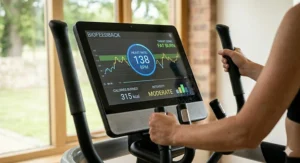
The touchscreen tracks speed, time, distance, calories, heart rate, and RPM with hand pulse sensors built into the dual-action handlebars. In practice, those pulse sensors prove adequate for general monitoring but aren’t medical-grade accurate — if you’re training to specific heart rate zones, budget an extra £30 for a Bluetooth chest strap. The 28 programmes (18 pre-set, 3 heart rate control, 4 user-defined, plus body fat mode) provide enough variety to keep things interesting for the first six months, after which the Kinomap subscription (60-day free trial included) becomes rather appealing for anyone who’s tired of staring at the same wall whilst exercising.
Pros:
✅ Smooth magnetic resistance with minimal noise
✅ App connectivity with Kinomap and Reebok Console App
✅ Compact footprint suits British home sizes
Cons:
❌ Hand pulse sensors occasionally inconsistent
❌ 38cm stride feels short for users over 5’10”
Price Verdict: At around £450, the Reebok FR30 represents solid mid-range value for UK buyers seeking app connectivity without premium pricing. Prime delivery typically arrives within 2-3 days.
2. JTX Strider-X7 Home Cross Trainer
The JTX Strider-X7 has dominated the UK mid-range market for good reason — it’s a British company that actually answers the phone when something goes wrong, honours its 2-year in-home repair warranty without quibbling, and designs specifically for British homes rather than adapting American models. The full-colour touchscreen feels responsive and intuitive, displaying workout data across multiple windows simultaneously without that laggy, budget-device delay that makes you jab the screen repeatedly. With 21 built-in programmes and 16 electro-magnetic resistance levels, it provides enough variety for progressive training without overwhelming beginners.
The 40cm stride length and 12.5kg flywheel create a natural, flowing motion that UK reviewers consistently describe as “gym-quality” — high praise from a nation that’s rather particular about fitness equipment. What most Amazon listings won’t emphasise is how the 7kg inertia-enhanced flywheel combines with the 16-point magnetic resistance to deliver exceptionally smooth transitions between levels. You can shift from level 3 to level 14 mid-stride without that jarring sensation cheaper models produce. This matters enormously during interval training or when you’re following one of the pre-programmed hill climbs.
For British homes, the relatively compact 138cm x 68cm footprint and 54kg weight strike a practical balance — substantial enough to remain stable during vigorous workouts (no wobbling or rocking reported), yet manageable to shift between rooms using the front transport castors. The machine supports users up to 120kg (roughly 19 stone), adequate for most households. Customer feedback from UK buyers specifically mentions that the non-slip pedals accommodate up to size 12 trainers comfortably, and the adjustable foot plates allow customisation for different users — genuinely useful in multi-person households where one partner wears size 6 and the other size 11.
The integrated pulse receiver and hand sensors provide real-time heart rate monitoring, displayed prominently on the touchscreen alongside time, distance, speed, watts, calories, and resistance level. The console also calculates body fat percentage (with debatable accuracy) and includes a recovery function that measures fitness improvement over time. UK delivery includes room-of-choice placement for England and Wales addresses, sparing you the indignity of manoeuvring a 54kg box up your stairs solo.
Pros:
✅ UK company with responsive customer service
✅ Natural stride length suits users up to 5’9″
✅ Exceptionally quiet magnetic resistance system
Cons:
❌ No incline adjustment feature
❌ Basic touchscreen lacks app integration
Price Verdict: The JTX Strider-X7 hovers around £380-420 depending on seasonal offers, representing excellent value when you factor in the 2-year in-home warranty and UK-based support team.
3. DKN XC-190 Magnetic Elliptical Cross Trainer
The DKN XC-190 enters premium territory at around £600 but justifies the investment with features rarely found below four figures. The generous 53cm (21-inch) stride length immediately distinguishes it from budget competitors — if you’re over 6 feet or simply prefer a more expansive, natural elliptical motion, this addresses the cramped feeling that plagues shorter-stride models. The 10kg flywheel paired with 32 levels of silent magnetic resistance creates buttery-smooth transitions, and the narrow 5cm Q-factor (the distance between pedals) promotes proper biomechanical alignment, reducing hip and knee strain during extended sessions.
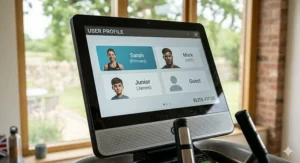
What sets the DKN apart for tech-conscious buyers is the comprehensive Bluetooth connectivity. The bright LCD console syncs with compatible fitness apps, allowing workout data to flow automatically to your preferred tracking platform. The machine accommodates 4 user profiles with personalised settings for age, weight, gender, and height — genuinely useful in households where different family members have different fitness baselines. The 16 motivating programmes span everything from fat-burning intervals to heart rate-controlled workouts, and the console provides unusually detailed live feedback on your performance metrics.
Build quality speaks to DKN’s German engineering heritage: the robust frame weighs approximately 90kg once assembled, providing rock-solid stability even during aggressive interval sessions. UK customers note this heft as both blessing and curse — wonderfully stable during use, rather less wonderful when relocating it from garage to spare room. The forward and backward motion capability adds training variety, engaging different muscle groups depending on direction. For British buyers concerned about longevity, the solid construction and quality components suggest this machine will outlast most £300 alternatives by several years, potentially justifying the higher initial outlay.
The LCD display, whilst not technically a touchscreen, presents information clearly across multiple windows. Some buyers might prefer the tactile response of a true touchscreen, but the button controls prove reliable and don’t suffer from the responsiveness issues that plague cheaper touchscreen implementations. The console’s backlit display remains visible even in dimly lit rooms — relevant for early-morning or late-evening exercise sessions during British winter when daylight proves elusive.
Pros:
✅ Excellent 53cm stride accommodates tall users
✅ Bluetooth app connectivity for data tracking
✅ Premium build quality with German engineering
Cons:
❌ 90kg weight makes relocation difficult
❌ Higher price point than mid-range alternatives
Price Verdict: At £550-650, the DKN XC-190 targets serious home users willing to invest in quality equipment that will still function reliably in 2030.
4. MERACH E07 Compact Cross Trainer
The MERACH E07 represents the budget end of our selection, but don’t mistake affordability for inadequacy. At around £190, it delivers surprisingly capable performance for first-time buyers, small flats, or anyone testing whether they’ll actually use a cross trainer before committing serious money. The basic LCD monitor tracks essential metrics — time, speed, distance, calories, heart rate, and odometer — without unnecessary complexity. It won’t sync with your smartphone or stream scenic Alpine routes, but it will reliably display your progress without requiring a degree in interface design to operate.
The compact dimensions (111cm x 56cm x 156cm) make this genuinely space-efficient for British homes. You can tuck it into a corner of a bedroom or position it in front of the telly without dominating the room. The 3.6kg flywheel and 16 magnetic resistance levels provide adequate challenge for beginners and intermediate users, though experienced athletes will quickly outgrow the maximum resistance. What British buyers particularly appreciate is the ultra-quiet operation — testimonials consistently mention using it during early mornings or late evenings without disturbing housemates or neighbours through shared walls.
The MERACH app connectivity (exclusive to this brand) adds unexpected value at this price point. Whilst the console itself remains basic, connecting via tablet or smartphone unlocks interactive courses, professional training guidance, and workout tracking. The app transforms what could be a tedious solo session into something resembling a guided class, useful motivation for those who struggle with self-directed exercise. The tablet holder securely grips devices up to 10 inches, positioned for comfortable viewing without excessive neck craning.
Build quality shows sensible compromises. The high-density carbon steel frame supports up to 120kg maximum user weight, and customer reviews suggest it remains stable during moderate-intensity workouts. However, aggressive interval training or users approaching the weight limit might notice some frame flex. The non-slip pedals accommodate average-sized trainers comfortably, and the dual handlebar design (fixed and moving) allows varying workout focus between upper and lower body. For £190, it’s remarkably competent — not gym-grade equipment, but entirely adequate for home cardio several times weekly.
Pros:
✅ Exceptional value under £200
✅ Space-saving design for compact British homes
✅ App connectivity adds workout variety
Cons:
❌ Limited resistance for advanced users
❌ Smaller flywheel means less smooth momentum
Price Verdict: The MERACH E07 hovers around £180-220 depending on offers, representing outstanding entry-level value for budget-conscious UK buyers.
5. Dripex Elliptical Cross Trainer
The Dripex Cross Trainer occupies that useful middle ground between budget basics and premium features, typically retailing around £230-280 on Amazon.co.uk. The 8kg flywheel and 16 magnetic resistance levels provide smooth, quiet operation — UK reviewers consistently mention the near-silent performance, crucial for British terraced housing where sound travels freely through shared walls. The LCD digital monitor displays the standard metrics (time, speed, distance, calories, heart rate) with clarity, and the integrated pulse sensors in the fixed handlebars offer reasonably accurate heart rate monitoring for general fitness purposes.
What distinguishes the Dripex from similarly priced competitors is the thoughtful design details that suggest someone actually tested it in a real home rather than just rendering it in CAD. The 38cm stride length, whilst not exceptional, feels natural for users between 5’4″ and 6’0″ — adequately accommodating the average British height range. The dual handlebar design allows switching between upper-body engagement and leg-focused workouts mid-session, and the ergonomic grips remain comfortable even during extended use. The large, textured anti-slip pedals provide secure footing, and multiple UK buyers mention they’ve used it barefoot, in socks, or with trainers without slippage concerns.
The frame construction uses tubular steel with a maximum user weight capacity of 120kg (approximately 19 stone). At a total machine weight of around 32kg, it’s substantial enough to remain stable during vigorous exercise yet light enough for one person to relocate using the built-in transport wheels. The compact footprint (roughly 130cm x 60cm) fits comfortably in British bedrooms, and the sleek blue-and-black aesthetic looks less utilitarian than some budget alternatives. The device holder accommodates tablets or smartphones for entertainment, positioned at a comfortable viewing angle without requiring awkward neck positioning.
Assembly, according to UK customer feedback, takes approximately 40-60 minutes with one person and basic tools (all included). The instructions receive generally positive reviews for clarity, though a few buyers mention that pre-drilling some holes slightly larger would ease the assembly process. Once constructed, the machine requires minimal maintenance — the magnetic resistance system eliminates the friction-belt wear that plagues cheaper mechanical alternatives. The bottle holder, whilst a small detail, proves genuinely useful during longer sessions when hydration matters.
Pros:
✅ Excellent mid-range value around £250
✅ Ultra-quiet operation for shared walls
✅ Sturdy construction with 120kg capacity
Cons:
❌ No app connectivity or smart features
❌ Basic LCD lacks programme variety
Price Verdict: The Dripex Cross Trainer represents solid value in the £200-280 range for buyers seeking reliable performance without smart features.

6. JLL CT200 Home Cross Trainer
The JLL CT200 takes a different approach from front-drive competitors by utilising a rear-drive design, positioning the flywheel behind the user rather than in front. This configuration creates a more upright, natural posture that some users find more comfortable, particularly during longer sessions. The 7kg inertia-enhanced flywheel and 8 magnetic resistance levels provide adequate challenge for beginners and casual users, though serious athletes will quickly exhaust the resistance range. What the CT200 sacrifices in resistance levels, it compensates for in smooth, quiet operation — UK buyers consistently praise the near-silent magnetic system that doesn’t disturb housemates or neighbours.
The LED console display presents workout data clearly across multiple metrics: time, speed, distance, calories, and heart rate via integrated pulse sensors. The 41cm stride length accommodates users up to approximately 5’9″ comfortably, though taller individuals might find it slightly cramped. At around £220-250, the CT200 targets budget-conscious buyers seeking gym-quality motion without premium pricing. The 21 pre-set programmes add welcome variety, spanning interval training, hill climbs, and heart rate-controlled workouts that adapt intensity based on your pulse.
For British homes, the compact rear-drive design proves particularly space-efficient. The machine occupies less floor space than equivalent front-drive models, fitting comfortably in bedrooms or conservatories without dominating the room. The built-in transport wheels allow easy relocation, and at approximately 45kg, it’s manageable for one person to manoeuvre carefully. Build quality reflects sensible engineering — the frame supports up to 100kg user weight, and UK customer reviews suggest it remains stable during moderate-intensity workouts. The non-slip pedals and ergonomic handles provide secure grip, important when you’re mid-interval and perspiration starts affecting your hold.
Assembly receives mixed feedback. Some UK buyers completed setup in under an hour, whilst others mention spending closer to 90 minutes wrestling with components. The instructions are generally clear, but tightening the pedals requires significant force and occasionally benefits from two people. Once assembled, maintenance demands remain minimal — the magnetic resistance eliminates friction-based wear, and occasional cleaning keeps it functioning smoothly. The machine includes a 12-month warranty, standard for this price point but less comprehensive than the 2-year coverage offered by JTX alternatives.
Pros:
✅ Rear-drive design promotes upright posture
✅ Space-efficient for compact British homes
✅ 21 pre-set programmes add variety
Cons:
❌ Only 8 resistance levels limit progression
❌ 100kg weight capacity excludes heavier users
Price Verdict: The JLL CT200 offers reasonable value around £220-250 for buyers prioritising compact design over advanced features.
7. Neezee Elliptical Cross Trainer
The Neezee Cross Trainer concludes our selection with a robust mid-range option that balances capability with affordability. The 8kg flywheel paired with 16 magnetic resistance levels delivers smooth, progressive challenge suitable for various fitness levels. What UK buyers particularly appreciate is the generous 42cm (16.5-inch) stride length — longer than most sub-£300 competitors, accommodating users up to about 6’0″ without that cramped, choppy feeling shorter strides produce. The LCD monitor displays essential metrics (time, speed, distance, calories, pulse) clearly, and the integrated heart rate sensors provide adequately accurate monitoring for general fitness tracking.
Build quality reflects thoughtful engineering at this price point. The sturdy steel frame supports up to 150kg maximum user weight — substantially higher than the 100-120kg limit common among budget alternatives. This increased capacity means the machine feels solid and stable even for larger users or during aggressive interval training. The dual handlebar system (fixed and moving) allows alternating between full-body engagement and leg-focused workouts, and the textured, oversized pedals provide secure footing for various trainer sizes. UK reviewers consistently mention the excellent stability, noting minimal wobble even during vigorous sessions.
The compact dimensions (approximately 140cm x 65cm) fit comfortably in British homes without overwhelming available space. At roughly 38kg total weight, it strikes a practical balance — substantial enough to remain planted during use, yet manageable to relocate using the integrated transport wheels. The magnetic resistance system operates near-silently, crucial for British terraced housing or flats where neighbours share walls. Multiple UK customers mention using it during early mornings or late evenings without disturbing others, and the smooth motion creates less vibration than friction-based alternatives that rattle through floors.
Assembly proves relatively straightforward according to UK feedback. Most buyers complete setup within 45-60 minutes with one person and basic tools (all included). The instructions receive generally positive reviews for clarity, though the pedals require firm tightening to eliminate any play. Once constructed, the machine demands minimal maintenance beyond occasional cleaning and checking that bolts remain secure after the first few weeks of use. The bottle holder and device holder prove genuinely useful additions, positioned for comfortable access without interrupting your rhythm.
Pros:
✅ 150kg capacity accommodates heavier users
✅ 42cm stride suits taller individuals
✅ Excellent stability and build quality
Cons:
❌ Basic LCD lacks app connectivity
❌ Limited programme variety
Price Verdict: The Neezee Cross Trainer represents solid value around £250-320 for buyers seeking robust construction and generous stride length.
How to Choose the Right Cross Trainer for Your British Home
Selecting the right cross trainer with touchscreen requires matching machine capabilities to your specific circumstances — not just your fitness goals, but your actual living situation. Most buying guides ignore the realities of British homes: compact rooms with limited floor space, neighbours who complain about noise, and that persistent dampness that creeps into garages and spare rooms. Here’s what actually matters when shopping on Amazon.co.uk.
Stride length trumps everything else for comfort. If you’re over 5’9″, insist on at least 40cm stride; taller users need 45cm or more to avoid that awkward, choppy motion that makes your knees feel like they’re hitting your chest. The NHS recommends moderate-intensity aerobic activity that gets your heart rate up whilst allowing you to hold a conversation — a properly fitted cross trainer with adequate stride length makes this achievable without joint strain or discomfort. Test this by measuring your natural walking stride — it should be roughly 25% of your height in centimetres. Shorter users (under 5’6″) can manage with 35-38cm strides comfortably, which opens up more compact, affordable options.
Touchscreen versus LCD isn’t binary — it’s about usage patterns. A basic LCD monitor displaying time, distance, calories, and heart rate satisfies 80% of casual users adequately. Invest in a proper touchscreen with app connectivity only if you’ll genuinely use those features three times weekly minimum. The sweet spot for most UK buyers is a mid-range LCD with Bluetooth capability, allowing smartphone app integration without paying £200 extra for a touchscreen you’ll ignore after the novelty wears off.
Magnetic resistance over friction-based systems every time. British humidity accelerates wear on friction systems, creating noise, requiring maintenance, and eventually needing replacement parts that cost £60-80. Magnetic systems remain whisper-quiet, require zero maintenance, and won’t deteriorate from moisture. Even budget models now offer magnetic resistance — there’s no reason to accept friction-based systems in 2026.
Weight capacity indicates build quality, not just maximum user weight. Manufacturers rate capacity conservatively, but a machine rated for 120kg will feel more stable for a 90kg user than one rated for 100kg. Higher capacity generally correlates with sturdier frames, better components, and longer lifespan. If you’re within 10kg of a machine’s limit, choose the next capacity tier up.
Flywheel weight matters less than you’d think. Marketing emphasises heavy flywheels, but modern magnetic resistance compensates brilliantly. A well-engineered 6kg flywheel with proper magnetic resistance outperforms a cheap 12kg flywheel with poor resistance implementation. Focus on user reviews mentioning “smooth” and “consistent” rather than chasing flywheel specs.
Compact dimensions don’t necessarily mean compromised performance. British homes demand space efficiency, and manufacturers have responded with clever engineering. The best compact models (under 140cm length) now rival full-sized alternatives for performance whilst fitting through standard doorways and not dominating your spare room. Measure your available space before browsing — including ceiling height for full stride clearance.
UK plug, UKCA marking, and Prime delivery confirm proper stock. Avoid third-party sellers offering suspiciously cheap prices — they’re often importing US models with incorrect voltage, no UK warranty, and 4-6 week delivery. Insist on Prime eligibility and check the product description confirms UK specification. Paying £30-50 extra for proper UK stock saves £200 in potential customs charges, return shipping, and warranty headaches.
The Reality of Interactive Consoles in British Homes
Smart features sound appealing until you factor in British broadband reliability and the actual likelihood of maintaining app subscriptions. The Kinomap or iFit subscriptions that unlock interactive workouts cost £8-15 monthly — manageable initially, but that’s £96-180 annually on top of your initial equipment investment. Many users maintain enthusiasm for 2-3 months before reverting to the built-in programmes and cancelling subscriptions.
The better approach for most UK buyers: prioritise machines with robust built-in programmes (15-20 minimum) rather than relying on app-based content. Use the free trials included with touchscreen models to explore whether you’ll genuinely use interactive features long-term. If you discover you’re just watching Netflix whilst exercising anyway, save £150-200 by choosing a model with a basic LCD and good built-in programmes.
For serious training, invest in a separate Bluetooth heart rate chest strap (around £25-40) rather than trusting hand pulse sensors. The chest strap data syncs with most fitness apps on your phone or tablet, positioned in the device holder, providing far more accurate heart rate monitoring than any console-integrated sensors manage.
Common Mistakes When Buying in the UK
British buyers consistently make three purchasing errors that lead to expensive disappointment. First, they assume Amazon.co.uk products are automatically UK-compatible — not true. Always verify “UK plug” and “230V” in specifications, and confirm Prime eligibility from UK warehouse stock. Second, they underestimate how quickly beginners progress. That £180 budget model seems adequate initially, but if you’re genuinely using it four times weekly, you’ll outgrow 8 resistance levels within three months. Budget for mid-range (16 levels minimum) if you’re remotely serious about progression. Third, they ignore ceiling height — measure carefully before ordering. You need at least 2.2 metres clearance for comfortable full-stride motion; Victorian terraces with 2.4-metre ceilings work fine, but anything lower risks awkward head ducking.
The post-Brexit landscape means some EU brands now carry slight price premiums due to import adjustments, but you benefit from UK consumer protection, hassle-free returns under the Consumer Rights Act 2015, and local warranty support. That £50 price difference between a parallel import and proper UK stock is insurance worth paying.
FAQ: Cross Trainer With Touchscreen Questions
❓ Does a touchscreen cross trainer need WiFi to function properly?
❓ Are touchscreen displays in cross trainers suitable for British damp conditions?
❓ Can I use a cross trainer touchscreen whilst wearing gloves during cold British mornings?
❓ Do UK warranty terms differ from American models sold on Amazon.co.uk?
❓ How long do touchscreen cross trainers typically last in British households?
Conclusion: Making the Smart Choice for Your British Home
Finding the right cross trainer with touchscreen on Amazon.co.uk in 2026 requires balancing aspirations against reality. That £1,000 commercial-grade model with 16-inch HD touchscreen looks magnificent, but will you genuinely maintain the enthusiasm to justify the investment, or will it become an expensive clothes rack by March? The British fitness equipment graveyard is littered with good intentions and premium purchases gathering dust.
The sweet spot for most UK buyers sits in the £350-500 range — models like the Reebok FR30 or JTX Strider-X7 that deliver touchscreen functionality, app connectivity, and quality construction without requiring a second mortgage. These machines provide enough features to maintain interest beyond the initial motivation burst, whilst costing little enough that you won’t feel crushing guilt if life intervenes and usage drops off temporarily.
Budget options under £250 serve beginners beautifully for testing commitment before upgrading. The MERACH E07 or Dripex models prove that £200 can buy surprisingly capable equipment if you’re willing to sacrifice smart features for solid basic performance. Conversely, investing £600+ in models like the DKN XC-190 makes sense only for serious users with proven track records of consistent exercise — those who’ve already worn out a budget model and genuinely need the superior build quality and features.
The British market has matured remarkably. We’re no longer stuck choosing between overpriced commercial models or flimsy budget alternatives. Proper mid-range options now exist, designed specifically for British homes, available from UK stock with Prime delivery, and backed by warranties that actually mean something when things go wrong. That represents genuine progress worth celebrating, even if the February rain still makes outdoor exercise thoroughly miserable.
Recommended for You
- 7 Best Cross Trainer with HIIT Programmes UK 2026
- 7 Best Smart Cross Trainer with Apps UK 2026
- 7 Best Programmable Cross Trainers UK (2026)
Disclaimer: This article contains affiliate links. As an Amazon Associate, I earn from qualifying purchases. If you purchase products through these links, we may earn a small commission at no additional cost to you.
✨ Found this helpful? Share it with your mates! 💬🤗
