In This Article
Somewhere between the third missed gym session and the fourth “I’ll start Monday,” most of us start eyeing up an exercise bike for weight loss instead. It makes sense. No commute, no queue for the squat rack, no judgment from anyone except the cat. An exercise bike for weight loss is simply a stationary cycling machine — upright, recumbent, or studio-style — used to raise your heart rate and burn calories through pedalling resistance you control yourself, in 40-60 words: it’s cardio equipment that turns pedalling into a repeatable, weather-proof habit. But here’s the bit nobody tells you at the point of purchase: the bike itself is only half the story. The other half is picking a model whose resistance, noise level and comfort actually match how — and where — you’ll use it. Buy the wrong one and it becomes an expensive clothes horse by February.
We’ve dug into real UK-available models, from budget folding frames under the £150 mark to studio-grade spin bikes north of £500, cross-referencing verified specs against genuine aggregated review sentiment rather than marketing copy. Cycling indoors raises your heart rate, gets you breathing faster and warms you up — the hallmark of what health professionals class as moderate intensity activity, the kind NHS guidance on the benefits of exercise recommends building into most days — so the goal here isn’t just “which bike is cheapest,” it’s which bike you’ll actually still be riding in six months. Below you’ll find seven genuinely different machines — quiet ones, foldable ones, joint-friendly recumbents, and serious HIIT-ready studio cycles — each broken down honestly, pros and cons included, so you can match the bike to your body, your budget and your goals rather than a glossy product photo.
Quick Comparison Table
| Bike | Flywheel | Resistance | Best For | Price Range |
|---|---|---|---|---|
| JLL IC300 Pro | 20kg | Magnetic (infinite) | Best all-rounder for calorie burning | £300-£400 range |
| Bluefin Fitness Tour 5.0 | 12kg | Magnetic, 24 levels | Quiet, app-connected budget pick | £180-£250 range |
| YOSUDA YB001R | 16kg | Magnetic | Quietest bike for flats/shared homes | £180-£250 range |
| Ultrasport F-Bike | Small | Magnetic, 8 levels | Best exercise bike for beginners | Under £140 |
| YOSUDA RC-PRO Recumbent | N/A | Magnetic, 16 levels | Low impact fat burn, joints & seniors | £180-£280 range |
| JTX Cyclo 6 | 22kg | Friction (infinite) | HIIT bike workout & hill climbs | £400-£550 range |
| Schwinn IC4 (800IC) | 18-20kg | Magnetic, 100 levels | Premium interval training | £500-£700 range |
Looking at the spread above, the pattern is fairly simple: heavier flywheels and magnetic resistance systems generally cost more but reward you with a smoother, quieter pedal stroke that holds up to daily use. The Ultrasport F-Bike and YOSUDA RC-PRO Recumbent sit at the accessible end for anyone easing in gently, while the JTX Cyclo 6 and Schwinn IC4 are built for riders who want to push into proper interval territory without the bike wobbling underneath them.
💬 Just one click — help others make better buying decisions too!😊
Top 7 Exercise Bikes for Weight Loss: Expert Analysis
Picking the “best” bike genuinely depends on your starting point, your flat’s floor plan, and whether your downstairs neighbour has ever banged on the ceiling. So rather than crowning one overall winner, here’s an honest, spec-by-spec look at seven real options spanning budget to premium.
1. JLL IC300 Pro — the mid-range calorie-burning workhorse
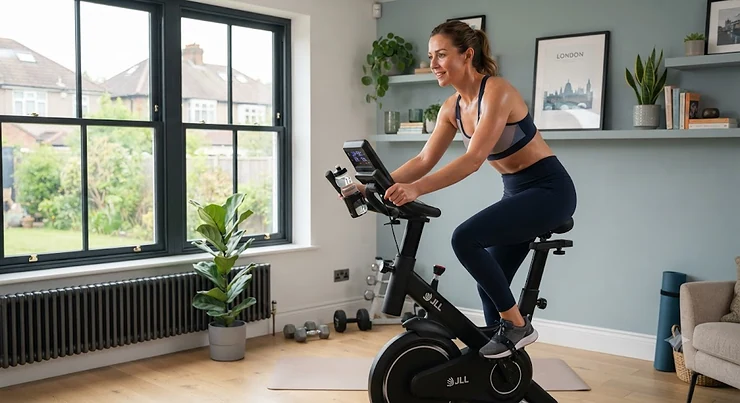
The JLL IC300 Pro opens with a statement of intent: a 20kg bi-directional flywheel, which is hefty for this price bracket and translates into a noticeably smoother pedal stroke than lighter budget bikes. Key specs worth knowing: magnetic resistance controlled by a single knob rather than numbered click-stops, a 3-piece crank for durability, and an LCD monitor tracking speed, distance, time, RPM, calories and heart rate via handlebar sensors. Based on the spec comparison, that heavier flywheel matters more than most buyers realise — it’s what stops the ride feeling jerky when you stand up for a hill-climb effort, which is exactly the kind of movement that spikes calorie burn. This bike suits anyone who wants gym-quality resistance without a gym-quality price tag, particularly beginners who’ll grow into the tougher settings rather than maxing them out on week one. Reviewers consistently report that the ride feels smooth and stable even during 45-minute sessions, though a minority of buyers have flagged wobble developing in the handlebar mount after several months of heavy use, and the stock seat draws frequent complaints for firmness. Manufactured by a UK-based company with a Birmingham showroom, JLL’s after-sales reputation is well regarded across independent reviews.
Pros:
- ✅ Heavy 20kg flywheel gives a genuinely smooth, gym-like pedal feel
- ✅ Tracks heart rate, calories, RPM and distance on one display
- ✅ UK-based brand known for responsive customer service
Cons:
- ❌ No numbered resistance levels, just an adjustable knob
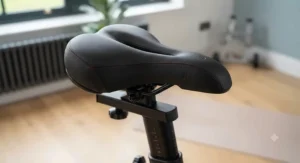
- ❌ Stock seat is firm and often needs a padded cover
At around £300-£400, the JLL IC300 Pro lands solidly in “serious hobbyist” territory without tipping into studio-bike pricing, and for riders who want one bike that handles both steady cardio and harder efforts, it’s a genuinely defensible pick.
2. Bluefin Fitness Tour 5.0 — whisper-quiet and app-connected on a budget
The Bluefin Fitness Tour 5.0 trades flywheel weight for smart features, and it’s a trade that makes sense for a specific kind of rider. Its 12kg flywheel is lighter than most on this list, but it’s paired with a silent magnetic drive system, 24 resistance levels and 12 pre-set programmes that simulate varied terrain without you touching a dial. What most buyers overlook about this model is the Kinomap app compatibility, which streams real cycling routes and coached sessions — genuinely useful for anyone who finds a blank wall demotivating after ten minutes. The backlit LCD console tracks time, distance, calories and pulse, and the whole unit weighs a manageable 29-30kg, meaning it’s one of the easier bikes here to shift between rooms. This is the bike for a beginner in a flat who wants variety and structure without investing in a premium studio cycle. Aggregated reviewer sentiment repeatedly praises how genuinely quiet the drive system is, alongside comfort complaints about the stock saddle, which several buyers describe as needing a cushion within the first few sessions.
Pros:
- ✅ Genuinely silent magnetic drive, ideal for shared walls
- ✅ Kinomap app unlocks virtual routes and guided coaching
- ✅ 24 resistance levels give real progression room for beginners
Cons:
- ❌ Stock seat is commonly reported as uncomfortable
- ❌ Full app features need an ongoing Kinomap subscription
Sitting around £180-£250, the Bluefin Fitness Tour 5.0 is a smart middle ground for anyone who wants smart-bike engagement without smart-bike pricing.
3. YOSUDA YB001R Magnetic — the quietest ride for flats and early mornings
If noise is your single deciding factor, the YOSUDA YB001R Magnetic consistently tops aggregated review sentiment for how little sound it makes. Its 16kg flywheel runs on magnetic resistance via a belt-drive system, which testers have described as being quiet enough to use before anyone else in the house is awake. Here’s what the spec sheet won’t tell you, but reviewer reports confirm: the ergonomic, spring-cushioned seat is unusually comfortable for a budget bike, softening the ride in a way that pricier studio cycles — with their narrow race seats — deliberately don’t. The bike supports a maximum user weight of roughly 122kg (270lb) and includes an integrated device shelf plus a bottle cage, small conveniences that matter over a 40-minute session. This is a strong option for anyone whose top priority is disturbing nobody, whether that’s sleeping housemates, a baby in the next room, or downstairs neighbours with thin ceilings. Reviewers consistently note that assembly takes around 40 minutes and that a spare felt brake pad is included for when the resistance pad eventually wears.
Pros:
- ✅ Genuinely whisper-quiet belt-driven magnetic resistance
- ✅ Unusually comfortable, spring-cushioned seat for the price
- ✅ Includes a spare resistance pad for long-term upkeep
Cons:
- ❌ No preset resistance numbers, just an adjustable knob
- ❌ Basic plastic device holder feels flimsy compared with the frame
At roughly £180-£250, the YOSUDA YB001R Magnetic earns its reputation as one of the best exercise bike for burning calories picks for anyone prioritising a quiet, comfortable, no-frills ride.
4. Ultrasport F-Bike — the cheapest way to start without commitment
For anyone who isn’t yet sure indoor cycling will stick, the Ultrasport F-Bike removes almost every barrier to entry. It folds flat for storage, weighs around 18kg, and runs on 8 levels of magnetic resistance controlled by a simple turn knob. The LCD console covers the basics — speed, time, distance, calories and pulse — and crucially, it doesn’t need mains power, so it can live anywhere in the house without trailing a cable across the carpet. Reviewers consistently note the ride is quiet enough to use while watching television, and the padded seat is more generous than you’d expect at this price point. Honest analytical take: this bike isn’t designed for vigorous standing sprints or serious hill-climb resistance, and it shouldn’t be judged against studio bikes costing four times as much — its job is to make that first 20-minute pedal genuinely achievable, which for a nervous beginner is often the harder problem to solve than raw wattage.
Pros:
- ✅ Folds flat and needs no mains power, ideal for small spaces
- ✅ Padded seat is more comfortable than the price suggests
- ✅ Quiet enough to use during television or phone calls
Cons:
- ❌ Resistance ceiling is too low for serious interval training
- ❌ Some owners report pedals working loose over time
Priced under £140, the Ultrasport F-Bike is arguably the lowest-risk entry point on this list, and its huge base of verified Amazon reviews backs up its reputation as a dependable exercise bike for beginners.
5. YOSUDA RC-PRO Recumbent — kindest on the joints, built for consistency
The YOSUDA RC-PRO Recumbent takes a different shape entirely: a reclined seat with full back support, legs extended forward rather than beneath you. This isn’t a lesser workout, it’s a different one, and reviewers consistently note how much easier it is to sustain a longer session without lower-back or wrist strain. Key specs: 16 levels of magnetic resistance, a padded backrest and seat, noise rated as low as 15dB — genuinely quieter than a soft whisper — and a maximum user weight of around 159kg (350lb), among the highest weight ratings on this list. Based on the spec comparison, the quick-adjust seat mechanism (no tools, no getting off the bike) is a small but meaningful feature for older riders or anyone managing an injury who doesn’t want to fight with a seat post clamp mid-session. This is the bike for anyone whose knees, hips or lower back have ruled out upright cycling, or for beginners who want to build a consistent habit before graduating to higher-intensity equipment. Aggregated feedback highlights comfortable extended sessions and easy assembly, with the main recurring criticism being a smaller, basic display compared with app-connected rivals.
Pros:
- ✅ Reclined, back-supported seat removes strain from long sessions
- ✅ Extremely quiet — rated as low as 15dB
- ✅ High 159kg weight capacity, among the best on this list
Cons:
- ❌ Basic LCD display with no app or programme integration
- ❌ At 26kg it’s heavier to move than a folding bike
Around £180-£280, the YOSUDA RC-PRO Recumbent is the clearest low impact fat burn choice here, and honestly, the best pick for anyone who’s been putting off exercise because previous cardio machines simply hurt to use.
6. JTX Cyclo 6 — studio-grade resistance for serious hill climbs
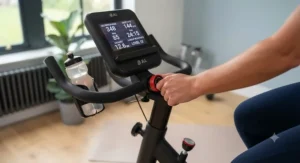
Step up to the JTX Cyclo 6 and the difference is immediately physical: a 63kg frame anchoring a 22kg flywheel, running friction resistance that increases the harder and faster you pedal, much like an air-resistance rowing machine. The spec sheet won’t tell you this, but user reports suggest the “infinity resistance” system is what makes this bike feel closest to an actual studio spin class — there’s no ceiling to hit, so intermediate and advanced riders won’t outgrow it the way they might a magnetic bike capped at 20-something levels. The Quadri-Set adjustment system moves both seat and handlebars vertically and horizontally, a level of fit customisation rarely seen below the £600 mark, and the bike ships with dual-sided pedals combining SPD clips with standard toe cages. This is squarely a bike for riders planning genuine HIIT bike workout sessions — think 30-second sprints against real resistance rather than gentle steady-state pedalling. JTX’s Trustpilot rating sits above 9 out of 10, and aggregated Amazon review sentiment lands around 4.5 stars, with buyers repeatedly praising the smoothness of standing efforts and the sturdiness of the frame under hard use.
Pros:
- ✅ 22kg flywheel with true infinity resistance for hard intervals
- ✅ Quadri-Set seat and handlebar adjustment fits a wide range of bodies
- ✅ Two-year in-home warranty plus a lifetime frame warranty
Cons:
- ❌ At 63kg, it’s genuinely difficult to move without the transport wheels
- ❌ SPD-specific cleats need buying separately from standard shoes
Typically priced in the £400-£550 range depending on promotions, the JTX Cyclo 6 earns its place as the calorie burning stationary bike pick for anyone who has outgrown gentler machines and wants studio intensity at home.
7. Schwinn IC4 (800IC) — premium interval training with app coaching
Sitting at the top of this list, the Schwinn IC4 — sold in the UK under the 800IC name — pairs a heavyweight flywheel with 100 levels of magnetic resistance and genuine Bluetooth connectivity to apps like Zwift and Peloton’s app. On paper this means near-infinite fine-tuning between effort levels, but what matters in practice is how quiet the flywheel is: independent testers describe it as “almost silent,” a genuinely unusual claim for a bike built to withstand serious HIIT sessions. Dual-sided pedals accommodate both SPD cycling shoes and ordinary trainers via toe cages, the seat and handlebars adjust across a wide range to fit riders roughly 4’6″ to 6’6″, and the bike arrives with a Bluetooth heart-rate armband plus small dumbbells that clip into holders behind the seat. Here’s what most buyers overlook: the display itself is deliberately basic, because Schwinn expects you to pair a tablet and run the workout through an app rather than the console — a design choice that suits tech-comfortable riders but frustrates anyone wanting simple, screen-free stats. This is the bike for someone committed to structured interval training long-term, not someone testing the waters.
Pros:
- ✅ Near-silent flywheel even under hard sprint efforts
- ✅ 100 resistance levels connect to Zwift, Peloton and JRNY apps
- ✅ Ten-year frame warranty, among the longest on this list
Cons:
- ❌ Narrow, race-style seat is uncomfortable for casual riders
- ❌ Full app workout library requires a JRNY subscription
Expect to pay in the £500-£700 range for the Schwinn IC4, making it the premium pick here — justified for committed interval trainers, overkill for someone who just wants to pedal gently while watching a boxset.
Practical Usage Guide: Your First 30 Days on an Exercise Bike
Getting the bike through the door is the easy part. The habit-forming happens in the first month, and this is where most home cycling setups quietly fail. On day one, spend ten minutes purely on fit: seat height should leave a slight bend in your knee at the pedal’s lowest point, not a locked-out leg, and handlebars should sit within easy reach without you hunching forward. Skipping this step is the single biggest cause of early knee or wrist discomfort, and it’s completely avoidable.
For your first week, resist the urge to smash the resistance dial to maximum. Ride at a conversational pace for 15-20 minutes, three or four times, purely to build the habit before you build the intensity — this mirrors general activity guidance around consistency over intensity in the early stages. From week two, start layering in short bursts of harder pedalling within otherwise steady rides. A common mistake in the first 30 days is treating every session as an all-out effort; this burns you out fast and increases the chance you’ll quietly stop using the bike by week three. Maintenance-wise, wipe down the flywheel and frame monthly to stop sweat corroding metal components, and check pedal and seat-post bolts every couple of weeks, since vibration during use gradually loosens them — a recurring complaint across budget folding bikes in particular.
Real-World Scenarios: Matching the Bike to Your Life
Scenario one: the shift worker in a shared flat. If you’re cycling at 6am before neighbours wake, the YOSUDA YB001R Magnetic or Bluefin Fitness Tour 5.0 make more sense than a heavier studio bike — both prioritise near-silent resistance systems, and their lighter frames mean you can tuck them into a corner rather than commit floor space permanently.
Scenario two: the returning exerciser with knee concerns. Someone rebuilding fitness after time off, or managing a joint issue, is better served by the YOSUDA RC-PRO Recumbent. Its reclined position and quick-adjust seat remove the strain that upright cycling can place on the lower back and knees, letting consistency build before intensity does.
Scenario three: the budget-limited student or first-timer. Space and money are both tight, and commitment is untested. The Ultrasport F-Bike solves both problems at once — it folds away between sessions and costs a fraction of studio-style alternatives, making it a low-stakes way to find out whether indoor cycling actually suits you.
Scenario four: the intermediate rider chasing real HIIT results. If you’ve already built a base level of fitness and want genuine interval training, the JTX Cyclo 6 or Schwinn IC4 deliver the resistance ceiling and stability that gentler bikes simply can’t match once you’re standing and sprinting.
Problem → Solution: Fixing Common Weight-Loss Plateaus
Problem: calorie burn has plateaued despite consistent riding. Your body adapts to repeated steady-state effort within a few weeks. Solution: introduce structured HIIT bike workout intervals — even two sessions a week alternating 30 seconds hard with 90 seconds easy can reignite calorie burn without adding total ride time.
Problem: sessions feel boring and motivation is dropping. Solution: an app-connected bike like the Bluefin Fitness Tour 5.0 or Schwinn IC4 brings in virtual routes or streamed classes, which aggregated reviewer feedback repeatedly credits with keeping riders consistent past the notoriously difficult six-week mark.
Problem: knee or lower-back discomfort after riding. This is very often a fit issue rather than a fitness issue. Solution: recheck seat height and handlebar reach first; if discomfort persists, a recumbent model like the YOSUDA RC-PRO removes the postural strain entirely.
Problem: the bike is too noisy to use around family schedules. Solution: swap to a magnetic-resistance model — the YOSUDA YB001R and Bluefin Fitness Tour 5.0 are both built around genuinely quiet drive systems rather than friction pads that squeak as they wear.
Problem: weight loss has stalled even though the bike sessions haven’t changed. Solution: remember that exercise is only one lever in weight loss — diet plays an equally large role, and no amount of pedalling fully cancels out a persistent calorie surplus elsewhere — so pair your riding with a modest, sustainable calorie deficit rather than expecting the bike to do all the work alone.
✨ Don’t Miss These Exclusive Deals!
🔍 Take your home cardio setup to the next level with these carefully selected exercise bikes. Click on any highlighted model to check current pricing and availability, and start building genuine, sustainable fat-loss results from your living room.
Best Exercise Bike for Burning Calories: What the Numbers Really Mean
Calorie burn depends on far more than the bike’s spec sheet — your body weight, effort level and session length all matter enormously. Independent UK testing has estimated that a moderate 30-minute stationary bike session burns somewhere in the region of 200-300 calories depending on bodyweight, with vigorous, harder-effort sessions climbing toward 300-450 calories over the same half hour — figures you can explore in more depth via Which?’s independently tested exercise bike guide. What this tells us practically is that a heavier flywheel bike like the JTX Cyclo 6 or Schwinn IC4 doesn’t inherently burn more calories than a budget model — what drives the number is how hard you’re working against the resistance, not the badge on the frame. Where the heavier, higher-resistance bikes genuinely earn their price tag is in letting you push harder before you hit a ceiling, which matters once your fitness improves and a lighter flywheel model starts feeling too easy even maxed out. For pure calorie-burning stationary bike efficiency early on, consistency at a moderate-to-vigorous effort on any of the seven bikes above will outperform sporadic maximum-effort sessions on the priciest machine in the range.
Exercise Bike Workout for Fat Loss: Structuring Sessions That Work
A genuinely effective exercise bike workout for fat loss isn’t complicated, but it does need structure rather than random pedalling. A simple weekly framework: two steady-state sessions of 30-40 minutes at a conversational-but-effortful pace, one structured interval session (see the HIIT section below), and one shorter recovery ride at an easy pace. What most buyers overlook is that total weekly volume matters more than any single “perfect” session — three imperfect 25-minute rides beat one exhausting hour that leaves you too sore to ride again for days. Track progress through the console’s calorie and distance readouts where available, but treat those numbers as a rough guide rather than gospel, since most consumer bike consoles overestimate calorie burn compared with a dedicated heart-rate monitor. On bikes like the JLL IC300 Pro or YOSUDA YB001R, where resistance is knob-adjusted rather than numbered, keep a simple note of roughly how many turns constitute your “moderate” and “hard” settings so sessions stay consistent week to week.
HIIT Bike Workout: Interval Training for Maximum Afterburn
High-intensity interval training on an exercise bike is where a heavier flywheel genuinely earns its keep. A beginner-friendly structure: five-minute warm-up, then eight rounds of 20 seconds at maximum effort followed by 100 seconds easy pedalling, finishing with a five-minute cool-down — roughly 20 minutes total. The JTX Cyclo 6 and Schwinn IC4 are particularly well suited here because their higher resistance ceilings mean you’re still working against real load during the hard bursts rather than spinning your legs uselessly fast on an under-resisted flywheel. What the spec sheet won’t tell you is that HIIT’s real calorie advantage comes partly from elevated post-exercise oxygen consumption — your metabolism stays raised for a period after you finish, on top of calories burned during the session itself. That said, interval training is demanding on joints and cardiovascular capacity alike, so it’s worth building a base of steady-state fitness first rather than starting a completely sedentary routine with maximum-effort sprints.
Quiet Exercise Bike: Why Noise Levels Matter More Than Marketing Suggests
Noise sounds like a minor spec until it’s the reason a bike gathers dust in the corner. Magnetic resistance systems, used in the YOSUDA YB001R, Bluefin Fitness Tour 5.0, Ultrasport F-Bike and YOSUDA RC-PRO Recumbent, generate resistance through magnets positioned near the flywheel without physical contact, which is why they run dramatically quieter than friction-based systems like the one in the JTX Cyclo 6. Reviewers consistently note that friction pads also wear down over time and can develop an audible squeak as they age, whereas magnetic systems stay consistently quiet for years with minimal maintenance. For anyone in a flat, a house with a nursery next door, or simply someone who wants to ride before 6am without starting a family argument, prioritising a magnetic-resistance model over raw flywheel weight is often the smarter trade-off — the “best” bike on paper isn’t much use if you can only ride it when everyone else is out of the house.
Exercise Bike for Beginners: Getting Past the Common Fears
The two fears that stop most beginners from starting are looking foolish and getting hurt, and a well-chosen exercise bike for beginners addresses both directly. Look for a model with a wide, padded seat, a low resistance floor that lets you build up gradually, and simple, jargon-free console readouts — the Ultrasport F-Bike and YOSUDA RC-PRO Recumbent both fit this brief well, prioritising comfort and accessibility over maximum resistance ceilings. Reviewers consistently note that the biggest early hurdle isn’t fitness, it’s simply forming the daily or near-daily habit, so choosing a bike that’s genuinely pleasant to sit on for 15-20 minutes matters more at this stage than chasing advanced features you won’t use for months. A sensible beginner approach: start with three short sessions a week at an easy, sustainable effort, and only introduce structured intervals once riding itself feels routine rather than like a chore you’re gritting your teeth through.
Low Impact Fat Burn: Protecting Your Joints While You Lose Weight
Cycling is inherently gentler on joints than running or high-impact cardio, because your body weight is supported by the seat rather than absorbed through your knees and ankles with every stride. This makes it a genuinely sensible option within the roughly 150 minutes of moderate aerobic activity most UK adults are advised to aim for each week — full detail is available via the official NHS physical activity guidelines for adults. Recumbent models like the YOSUDA RC-PRO take this further still, distributing weight across a wider seat and backrest so there’s minimal load through the lower back or wrists — a meaningful difference for anyone managing an existing injury, carrying extra weight, or simply returning to exercise after a long gap. Low impact doesn’t mean low effectiveness for weight loss; it means you can sustain the activity for longer and more consistently without the joint wear that eventually sidelines high-impact routines, and consistency is what actually drives results over months rather than weeks.
Exercise Bike vs Walking and Running: Which Burns More Fat?
Walking is essentially free and requires no equipment, but it burns calories at a comparatively modest rate and is harder to make genuinely intense without running. Running burns calories fast but carries real injury risk for beginners, particularly around knees and shins, and it’s weather-dependent unless you own a treadmill. An exercise bike sits in a useful middle ground: you can dial resistance up to running-level intensity on a bike like the Schwinn IC4 or JTX Cyclo 6, or dial it right down to walking-level gentleness on a recumbent model, all without leaving the house or worrying about pavement conditions.
| Activity | Typical Calorie Burn (30 min) | Joint Impact | Weather Dependent |
|---|---|---|---|
| Brisk walking | Moderate | Very low | Yes (outdoors) |
| Running | High | High | Yes (outdoors) |
| Exercise bike (moderate) | Moderate-High | Very low | No |
| Exercise bike (HIIT) | High | Low | No |
The table above makes the trade-off fairly clear: an exercise bike can match or beat running’s calorie burn at the higher end of intensity while keeping the joint impact closer to walking, which is precisely why it’s such a popular weight-loss tool for people returning to exercise after injury or a long break. The catch is that a bike, unlike walking, requires upfront investment and indoor space, so the “better” choice really depends on whether convenience or capital cost matters more to your situation.
Common Mistakes When Buying an Exercise Bike for Weight Loss
The most frequent mistake is buying based on flywheel weight alone without checking resistance type — a heavy friction flywheel on a cheap bike can still feel rough and noisy compared with a lighter, well-engineered magnetic system. Second, many buyers skip checking maximum user weight and seat dimensions, assuming “one size fits all” applies to exercise bikes the way it rarely does to actual bikes. Third, it’s easy to underestimate footprint: a studio-style bike like the JTX Cyclo 6 needs meaningfully more floor space than a folding model like the Ultrasport F-Bike, and cramming it into a tight corner makes standing efforts genuinely awkward. Finally, plenty of buyers chase app connectivity and smart features without checking the ongoing subscription cost, only to discover the bike’s “premium” experience is gated behind a monthly fee they hadn’t budgeted for.
Long-Term Cost & Maintenance: The True Price of Home Cycling
The purchase price is only the starting point. Budget bikes with friction resistance, like older folding models, typically need a replacement brake pad every year or two of regular use — a low-cost part, but one worth factoring in. Magnetic resistance bikes largely avoid this cost entirely, since there’s no physical contact to wear down, which is a genuine long-term saving even if the upfront price is higher. Smart-connected bikes like the Bluefin Fitness Tour 5.0 or Schwinn IC4 carry an additional consideration: full access to their app libraries typically requires an ongoing subscription, so the “real” annual cost is higher than the sticker price suggests.
| Cost Factor | Budget Bike | Mid-Range Bike | Premium Bike |
|---|---|---|---|
| Upfront price | Under £150 | £180-£400 | £400-£700+ |
| Typical maintenance | Occasional brake pad | Minimal (magnetic) | Minimal (magnetic) |
| App subscription | Rarely required | Sometimes optional | Often expected |
Set against a monthly gym membership, even the priciest bike here typically pays for itself within a year or two of consistent use, and that’s before accounting for the time saved not commuting to a gym at all.
Frequently Asked Questions
❓ How many calories does an exercise bike burn for weight loss?
❓ Is 30 minutes on an exercise bike a day enough to lose weight?
❓ What's the best exercise bike for weight loss on a budget?
❓ Is a recumbent or upright exercise bike better for losing weight?
❓ How long before you see weight loss results from cycling indoors?
Conclusion
An exercise bike for weight loss only works if it’s one you’ll actually climb onto, week after week, long after the initial motivation fades. That’s really the deciding factor here, more than any single spec on a comparison table. If quiet matters most, the YOSUDA YB001R Magnetic and Bluefin Fitness Tour 5.0 won’t wake the house. If you’re easing in gently or managing joint concerns, the Ultrasport F-Bike and YOSUDA RC-PRO Recumbent remove the barriers that stop people getting started at all. And if you’ve already built a base and want to chase genuine HIIT bike workout intensity, the JTX Cyclo 6 and Schwinn IC4 have the resistance ceiling to keep challenging you for years. Whichever you choose, pair it with the sort of realistic, sustainable approach outlined in the NHS Better Health weight loss advice — moving more alongside eating a little less, rather than expecting the bike alone to do all the work — and you’ll find weight loss becomes less of a battle and more of a fairly boring, repeatable habit, which, frankly, is exactly what makes it work.
Recommended for You
- Exercise Bike Under £300: 7 Best Budget Picks (2026)
- 7 Best Exercise Bikes for 2026: Tested Home Picks & Reviews
- Best Smart Treadmill UK 2026: 7 Top Picks Tested & Compared
Disclaimer: This article contains affiliate links. As an Amazon Associate, I earn from qualifying purchases. If you purchase products through these links, we may earn a small commission at no additional cost to you.
✨ Found this helpful? Share it with your friends! 💬🤗
