
In This Article
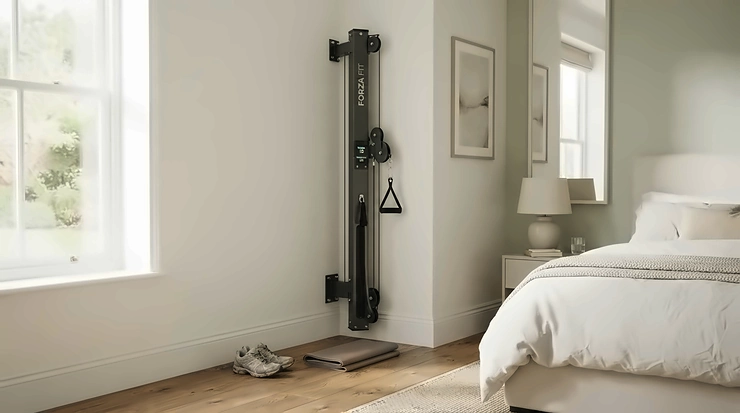
Picture the spare room. Half office, half laundry mountain, with an exercise bike gathering dust in the corner. Now picture one slim tower on the wall that lets you row, press, curl, chop and pull. That is the promise of a single cable station for small spaces, and in 2026 the idea has grown up.
A traditional cable machine is a big beast. The classic frame is described as roughly three metres wide and two metres high, which is more than most British box rooms can spare. A single cable station for small spaces flips that logic: one weight stack, one run of pulleys, one adjustable cable path, and a footprint that can shrink to about 55cm square.
This guide rounds up seven real options for UK buyers. They range from wall-hung towers to freestanding multi-gyms and one motorised trainer small enough for a rucksack. Each pick gets plain-English analysis, honest pros and cons, and the maths behind the numbers, because a “90kg stack” and 90kg of resistance are very different things. Whether you want a compact cable machine for home gym duty in a flat or a space-saving cable machine for a garage corner, there is a fit below.
One note on method. I haven’t handled these machines. The analysis rests on published specifications, retailer listings, UK buying guides and independent test reports, and I’ll flag every spot where the review evidence is thin. Prices appear as ranges because they move constantly.
Quick Comparison: Single Station Cable Machine Options at a Glance
Here is the whole field in one glance before we go deep.
| Product | Type | Resistance | Best For |
|---|---|---|---|
| Senshi Japan 90kg Multi Gym Cable Machine | Freestanding multi-station | 90kg stack | Lifters who want room to grow |
| Fit4Home 7080A | Freestanding multi-station | 68kg stack | Mid-budget all-rounders |
| HOMCOM Multi Gym Workout Station | Freestanding multi-station | 45kg stack | First-time buyers |
| Decathlon Home Gym 900 | Retractable guided gym | 60kg guided stack | Tight rooms and beginners |
| BodyCraft Cable Pull Station | Wall-mounted single pulley | 90kg stack, 2:1 or 4:1 | Smallest footprint, real cable feel |
| Taurus Design Line Single Pulley 90kg | Wall-mounted single pulley | 90kg stack, 2:1 | Design-conscious homes |
| Beyond Power VOLTRA I | Motorised, needs a mount | 5-200 lb, 1:1 | Premium minimalists |
The BodyCraft Cable Pull Station and Taurus Design Line Single Pulley 90kg give the smallest floor footprint but demand a drilled wall. The Senshi Japan 90kg Multi Gym Cable Machine, Fit4Home 7080A and HOMCOM Multi Gym Workout Station trade floor space for freedom from drills. Budget buyers will find the HOMCOM Multi Gym Workout Station the cheapest way in, though its 45kg stack is the lowest here. Anyone wanting gym-grade resistance in almost no space should look at the Beyond Power VOLTRA I, provided they budget for a mount.
💬 Just one click — help others make better buying decisions too!😊
Top 7 Compact Cable Machine for Home Gym Picks: Expert Analysis
Every pick below follows the same pattern: what the specs mean in practice, who it suits, and where the evidence runs out.
1. Senshi Japan 90kg Multi Gym Cable Machine — biggest stack in the compact class
Most compact machines make you choose between small and strong. The Senshi Japan 90kg Multi Gym Cable Machine tries to dodge that trade-off with a 90kg stack and a listing of 50-plus exercises, including lat pulldowns, chest flies, seated rows and tricep pushdowns.
A stack this size matters because small stacks are the first thing lifters outgrow. A 45kg stack feels generous in month one and cramped by month six. The steel frame and cable-driven action also mean freestanding use with no drilling, which suits renters. One caution: the stack figure is not what you feel at the handle. That depends on the cable ratio, so check the listing before assuming 90kg of pull.
On paper this is a single station cable machine for people who want a multi-gym’s variety and can spare a bedroom corner. It is less ideal for a true box room, because multi-gyms sprawl in ways wall towers don’t. I couldn’t verify a large pool of detailed customer reviews, so treat durability claims cautiously. What UK editorial coverage highlights is the balance of capacity and value.
Pros:
- ✅ Heaviest stack among the freestanding options here
- ✅ Wide exercise range from one frame
- ✅ No wall drilling required
Cons:
- ❌ Bigger floor footprint than wall-mounted towers
- ❌ Detailed long-term review evidence is limited
Price: mid-£500s range, so check current price. Good value if you will use the extra stack.
2. Fit4Home 7080A — best mid-budget all-rounder
The Fit4Home 7080A is the sensible middle child. You get a 68kg stack, chest press, butterfly arms, lat pulldown, low row, preacher curl pad and leg developer, all on a steel frame with high-density foam padding.
That 68kg stack sits in a useful sweet spot. It gives beginners and intermediates room for progressive overload without the floor demands of a heavier machine. The lat pulldown and low row also matter more than they look, because pulling movements are the hardest to replicate with bodyweight work at home. The smooth, cable-operated action and quick weight changes make it easy to move between exercises without losing momentum.
Who is it for? Buyers who want a compact home gym that covers every major muscle group without paying for stack weight they may never touch. Who should look elsewhere? Anyone wanting a pure wall-hung pulley for rehab-style or athletic cable work, because this is a classic pin-loaded multi-gym.
Review depth was thin when I looked, and I would rather say so than invent sentiment. UK editorial coverage frames it as strong on versatility for the money.
Pros:
- ✅ Covers pulling, pressing and legs in one frame
- ✅ Padded seat and backrest for longer sessions
- ✅ Freestanding, so no drilling
Cons:
- ❌ Fixed multi-gym layout is less flexible than a free pulley
- ❌ Limited verified review detail at time of research
Price: low-to-mid £300s range. Check current price. Strong value for what it covers.
3. HOMCOM Multi Gym Workout Station — lowest entry price on this list
If your budget is the binding constraint, the HOMCOM Multi Gym Workout Station is where the conversation starts. It offers a 45kg stack, chest press, butterfly press, high and low pulleys, preacher curl pad and leg developer, with a padded seat and backrest.
The 45kg stack is both the selling point and the ceiling. For someone returning to exercise or starting from scratch, 45kg is plenty for months of progress, and a pin-loaded stack makes switching exercises quick. Stronger lifters will hit that ceiling sooner, so ask yourself honestly where you will be in a year. The compact footprint is aimed at spare bedrooms, home offices and smaller garages.
Think of it as a trial run for cable-based training. You learn which movements you enjoy and whether you stick with a routine, without a four-figure outlay. If you stick with it, you can upgrade knowing exactly what you want.
Verified customer review detail was limited when I checked, so look at current buyer feedback on assembly time and padding comfort before you commit.
Pros:
- ✅ Cheapest way into stack-based cable training here
- ✅ High and low pulleys included
- ✅ Compact enough for spare rooms
Cons:
- ❌ 45kg stack caps progress for stronger lifters
- ❌ Review detail limited at time of research
Price: around £250-£280 range. Check current price. Excellent for beginners, modest headroom after that.
4. Decathlon Home Gym 900 — tightest in-use footprint of the multi-gyms
Decathlon has built a reputation for clever space-saving design, and the Decathlon Home Gym 900 is a good example. It combines a 60kg guided stack, an adjustable seat, foldable footplates and a retractable layout. UK buying guides put its in-use footprint under 2m², and it includes high and low pulleys.
The word “guided” is the quiet hero here. Guided resistance constrains the movement path, which helps new lifters learn clean technique and lowers the chance of wobbling a heavy load out of position. That makes it a friendly place for beginners and people returning to resistance training.
The trade-off is that guided machines teach you less about balance and stabilisation than a free cable. For general strength and muscle tone in a small home, that is a sensible compromise.
I couldn’t verify detailed owner-review themes, so my view rests on specifications and UK editorial coverage. Check current owner feedback before buying.
Pros:
- ✅ In-use footprint of under 2m²
- ✅ Guided stack encourages tidy technique
- ✅ Foldable footplates and adjustable seat
Cons:
- ❌ 60kg stack is modest for advanced lifters
- ❌ Less freedom than a free-moving cable
Price: mid-£400s range. Check current price. Fair value if floor space is the main constraint.
5. BodyCraft Cable Pull Station — the purest single pulley system on the list
This is the one that matches the brief most literally. The BodyCraft Cable Pull Station is a wall-mounted tower with a 90kg stack, 32 height positions, a variable 2:1 or 4:1 cable ratio and a footprint of roughly 55cm by 55cm. It cannot be used freestanding.
Here is the number that matters. At a 2:1 ratio, a stack provides half its weight at the handle, so 90kg becomes roughly 45kg. At 4:1 it drops to about 22kg. That sounds low until you remember most cable work (curls, face pulls, chops, tricep pushdowns) lives in that range. Joining both cables raises resistance, according to the listing.
What the spec sheet won’t tell you is how it feels. Smooth, fine-grained resistance suits isolation, athletic and rehab-style work. It will not replace heavy pressing. The retailer’s listing carries 95 customer reviews, and one assembly note says the pulleys and cable were manageable if you follow the diagram and fit each pulley in turn. The listing also advises against mounting the stack spacers.
Pros:
- ✅ Tiny footprint with 32 height positions
- ✅ Switchable 2:1 and 4:1 ratios
- ✅ Large review base at the retailer
Cons:
- ❌ Wall mounting is mandatory, which is awkward for renters
- ❌ Effective resistance is far below the stack figure
Price: £900-£1,300 range. Check current price. Good value for a precision tool, poor for heavy lifters.
6. Taurus Design Line Single Pulley 90kg — looks like furniture, works like a gym
Not every small space is a garage. The Taurus Design Line Single Pulley 90kg is built for living areas, with a 90kg stack, a 2:1 ratio and a range of finishes. The Design Line family offers a mirrored surface, which doubles as a form-check mirror.
The retailer notes that the dual-pulley sibling stands just 29cm off the wall. The single-pulley variant is positioned as saving even more space, so treat that as the benchmark for how little depth you’ll lose. At 2:1, expect roughly 45kg at the handle from the 90kg stack. That is enough for most upper-body and core work.
If you are comparing it with the BodyCraft Cable Pull Station, the decision is mostly about aesthetics and price. Both are wall-mounted, 90kg and capable of 2:1. The Taurus pushes the “this belongs in a living room” angle harder, while the BodyCraft offers a switchable 4:1 ratio and a larger review base.
The review pool is thin: only eight reviews were listed at the retailer at the time of research. That signals uncertainty, not poor quality.
Pros:
- ✅ Slim wall profile with mirrored finish option
- ✅ 90kg stack and 2:1 ratio
- ✅ Single-pulley variant saves extra space
Cons:
- ❌ Needs a drilled wall
- ❌ Small review pool at the retailer
Price: £1,000-£1,500 range. Check current price. Worth it if aesthetics matter, otherwise compare the BodyCraft’s flexibility first.
7. Beyond Power VOLTRA I — 200 lb of resistance in a shoebox-sized unit
The Beyond Power VOLTRA I ditches weight stacks entirely. A direct-drive motor generates resistance from 5 to 200 lb (about 2-90kg) in 1 lb steps, with a 2.6m cable and a unit weighing roughly 5.8kg.
That changes the maths. Resistance is a true 1:1, so the number on screen is what you pull. There are seven training modes, including custom curves and an isokinetic setting, and no subscription is needed for them. The catch is that the unit needs a mount, and one isn’t included. Rack mounts fit 2×2″, 3×3″ and 4×4″ uprights, and a wall-mounted upright is sold separately.
For a tiny flat it is hard to beat on footprint. Cost is the sticking point. Independent testers at Garage Gym Reviews scored it 4.3 and flagged the high price and one-year warranty. I found no customer reviews on that page, so the evidence is editorial rather than owner-based. Keep children under 13 away from it, per the maker’s safety note.
Pros:
- ✅ Up to 200 lb in a tiny, portable unit
- ✅ True 1:1 resistance with data tracking
- ✅ No subscription needed for training modes
Cons:
- ❌ Premium price before the mount is added
- ❌ Only a one-year warranty
Price: from the mid-£2,000s plus a mount. Check current price. Only worth it if space or portability is the deciding factor.
Top 7 Compared: Fitting, Footprint and Price
| Product | Fitting | Footprint note | Price range | Review evidence | Best For |
|---|---|---|---|---|---|
| Senshi Japan 90kg Multi Gym Cable Machine | Freestanding | Check listing dimensions | Mid-£500s | Editorial only | Growing lifters |
| Fit4Home 7080A | Freestanding | Check listing dimensions | Low-to-mid £300s | Editorial only | Mid-budget variety |
| HOMCOM Multi Gym Workout Station | Freestanding | Compact | Around £250-£280 | Editorial only | Beginners on a budget |
| Decathlon Home Gym 900 | Freestanding | Under 2m² in use | Mid-£400s | Editorial only | Tight rooms |
| BodyCraft Cable Pull Station | Wall-mounted | About 55cm × 55cm | £900-£1,300 | 95 retailer reviews | Precision cable work |
| Taurus Design Line Single Pulley 90kg | Wall-mounted | Slim wall depth | £1,000-£1,500 | 8 retailer reviews | Living-room gyms |
| Beyond Power VOLTRA I | Needs a mount | Unit about 32 × 14 × 10cm | Mid-£2,000s plus mount | Independent test score | Premium minimalists |
The best-evidenced option is the BodyCraft Cable Pull Station, while the thinnest is the Taurus Design Line Single Pulley 90kg. Fewer reviews means less certainty, not worse quality. The three freestanding multi-gyms cluster at the affordable end, so the real choice is between floor space and wall space. The Beyond Power VOLTRA I sits alone, charging a premium to remove both.
What Is a Single Cable Station for Small Spaces?
A single cable station for small spaces is a compact strength machine that routes one adjustable cable, or one weight stack feeding one or two cable outlets, through pulleys so you can train most muscle groups from a footprint far smaller than a gym-style crossover. Many mount on a wall, others are freestanding multi-gyms.
In practice you will meet three families. Wall-mounted towers like the BodyCraft Cable Pull Station are the slimmest. Freestanding multi-gyms like the Fit4Home 7080A bundle a stack with pressing and leg stations. Motorised units like the Beyond Power VOLTRA I replace the stack with electronics. All three can sensibly be called a single station cable machine, but they feel very different to use.
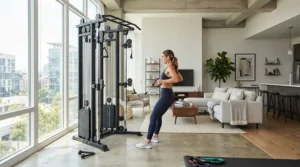
What they share is the cable’s defining trick. Because the line of pull is adjustable, you can change the angle of resistance rather than being limited to straight up and down as with free weights. A low pulley suits curls, a high pulley suits pushdowns and face pulls, and a mid-height setting suits rows and chops. That versatility, in a small package, is why this category keeps growing among UK home trainers.
Single Pulley System Explained: Ratios, Resistance and Real-World Feel
A single pulley system routes one cable path off one weight stack, and the cable ratio decides how much of that stack you actually feel. UK retailer Fitshop explains it clearly. At 1:1, a 100kg stack gives 100kg. At 2:1, it gives 50kg. At 3:1, about 33kg. At 4:1, 25kg.
Apply that to this list and the numbers shift. A 90kg stack at 2:1 on the Taurus Design Line Single Pulley 90kg delivers around 45kg at the handle. The BodyCraft Cable Pull Station can drop to about 22kg at 4:1. Higher ratios also move the cable further per inch of stack, so they feel smoother and faster, which suits lunges, chops and explosive work.
Which ratio is better? Neither. Fitshop’s guidance suggests that lifters pushing above roughly 45-50kg may outgrow 2:1 for heavy compound work, while 1:1 struggles with small increments in isolation moves, because a 5kg jump on a curl is huge. The Beyond Power VOLTRA I sidesteps this with 1:1 resistance adjustable in 1 lb steps. So the question is not “how big is the stack?” but “what will I feel at the handle, and in what increments?”
How to Choose a Single Cable Station for Small Spaces
Choosing well comes down to six checks, in this order:
- Measure the footprint and the live area. A tower may only need about 55cm square, but you also need room to stand, step back and pull. Add clearance around the machine, not just under it.
- Decide wall or freestanding. Wall-mounted units are slimmer but need drilling and a suitable wall. If you rent, a freestanding machine like the HOMCOM Multi Gym Workout Station avoids the landlord conversation.
- Check the cable ratio. Divide the stack by the ratio to find real resistance. A “90kg” label at 2:1 means roughly 45kg.
- Match the stack to your level. Beginners can live on 45-60kg stacks for a long time. Anyone already training seriously should lean toward 68-90kg or the Beyond Power VOLTRA I.
- Count height positions and attachments. More positions, such as 32 on the BodyCraft Cable Pull Station, mean finer control over the angle of pull. Check which handles and ropes come in the box.
- Read the warranty and assembly notes. Frame warranties vary and the Beyond Power VOLTRA I carries one year. Assembly notes, such as the stack-spacer advice on the BodyCraft listing, can save an hour of confusion.
Features That Actually Matter (And Those That Don’t)
Spec sheets love big numbers. Most of them mislead.
What actually matters starts with effective resistance, which means stack divided by ratio, not the headline stack. Next comes the number of height positions, which determines how many angles of pull you can reach. Third is wall-fixing quality and a clear assembly plan, because a wobbly wall tower is a hazard rather than a bargain. Finally, increments matter: if the smallest jump is a big one, curls and lateral raises become awkward.
What matters less is the “exercises included” count. A listing that claims 50-plus movements is mostly counting variations of pulling, pressing and curling you could do on any pulley. Touchscreens and apps are also optional extras. The Beyond Power VOLTRA I offers rich data tracking, but it’s only worth paying for if you will actually look at the numbers. Fancy finishes matter only if the machine lives in a room you see every day, which is the case for the Taurus Design Line Single Pulley 90kg.
My rule of thumb: pay for resistance quality, mounting security and sensible increments. Treat everything else as a bonus.
Single Cable Station for Small Spaces vs Traditional Alternatives
How does a single cable station for small spaces compare with the other ways people train at home?
| Factor | Single cable station | Adjustable dumbbells | Resistance bands | Full cable crossover |
|---|---|---|---|---|
| Floor space | Small (about 55cm square for a tower) | Very small | Minimal | Large (around 3m wide) |
| Resistance feel | Consistent through the movement | Changes with gravity | Rises as the band stretches | Consistent, heavier |
| Typical cost | £250 to £2,000+ | Moderate | Low | Several thousand pounds |
| Angle variety | High | Moderate | High | Very high |
| Best For | Small rooms wanting gym-style variety | Simple, low-cost setups | Travel and light work | Large garages |
Fitshop describes cable machines as giving consistent resistance through many exercises, and that is the key advantage over dumbbells, where the load feels different at different points of a lift. Bands are cheap and portable but ramp up tension as they stretch, so they lack the steady load of a stack. A full crossover, such as the commercial units the retailer lists at several thousand pounds, is the dream, but it needs a dream-sized room.
So the single station sits in a sweet spot: more varied than dumbbells, steadier than bands and far smaller than a crossover. For rooms under about 10m², that trade-off usually wins.
Building a Compact Home Gym Around One Station
A compact home gym doesn’t need to be a downsized commercial one. It needs a plan.
Start with the anchor, one of the machines above. Then add only what the anchor can’t do. A wall-mounted tower like the BodyCraft Cable Pull Station handles pulling, curling, pushdowns and core work, but it is weak at heavy pressing and leg loading. A simple adjustable bench and a pair of adjustable dumbbells will cover most of that gap. Freestanding units like the Fit4Home 7080A already include press and leg stations, so they need far fewer extras.
Space-saving cable machine planning is really about clearance. As a reference, one commercial wall-mounted cable column lists a 65cm × 65cm footprint but recommends a live area of about 1.2m × 1.8m. That is a heavy-duty unit, but it shows the principle: the machine’s footprint is the smaller number. Measure the space you need to stand, step back and move the cable fully.
If you need a decision shortcut: if you rent, choose a freestanding multi-gym. If you can drill and want precision, choose a wall tower. If budget is no object and floor space is the problem, choose the Beyond Power VOLTRA I.
✨ Ready to Compare Current Options?
🔍 Take your compact home gym to the next level with these carefully chosen machines. Click any highlighted product name to check current pricing and availability, and find the station that fits your room, your wall and your routine!
Practical Usage Guide: Setup, First Month and Maintenance
Amazon listings tell you what a machine does. They rarely tell you how to live with it.
Before you drill. Wall-mounted units are only as safe as their fixings. Retailers often note that wall fixings aren’t included because they depend on your wall, and one commercial listing says mounting bolts are sold separately. Identify whether your wall is masonry or plasterboard over studs, and buy fixings rated for it. If in doubt, ask a competent installer.
Assembly. Follow the diagram step by step and fit each pulley in order. For the BodyCraft Cable Pull Station, the listing says not to mount the stack spacers. Read the notes before you start, not after.
First 30 days. Start light, around half your expected effort, and learn the path of each exercise. Re-check bolts and fixings after the first week and again at the end of the month. Pick one or two movements per muscle group rather than trying all 50.
Ongoing care. Every month, check the cable for fraying, confirm the pulleys spin freely and wipe down the cable and pin. Common first-month mistakes include setting the pulley height too far from the working line and forgetting that the effective load is the stack divided by the ratio.
Small Space Training: A Simple Weekly Plan on One Station
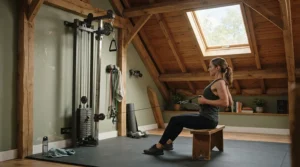
Small space training works best when it’s boringly consistent. The NHS recommends muscle-strengthening activities on two or more days a week that work all the major muscle groups: legs, hips, back, abdomen, chest, shoulders and arms.
A cable station makes that easy to organise. Here is a practical template you can run on a wall tower or a multi-gym:
- Session A (pull focus): low-pulley rows, face pulls, cable curls, standing chops.
- Session B (push and legs focus): pushdowns, cable presses if your setup allows, glute kickbacks, hinge-style pull-throughs.
Aim for two or three sets of 8-15 reps with a rest day between sessions. Twenty to thirty minutes is enough. Progress by nudging the pin one notch when the last set feels comfortable, which is why small increments matter so much on a BodyCraft Cable Pull Station or the 1 lb steps of the Beyond Power VOLTRA I.
If you haven’t exercised for a while or have a health condition, speak to your GP first. Treat this plan as a starting scaffold, not a prescription.
Real-World Scenarios: Three Buyers, Three Picks
The renter in a one-bed flat. She has about 1.5m of spare wall, a landlord who dislikes drilling, and a budget near £300. She trains three times a week for 30 minutes. A freestanding machine like the Fit4Home 7080A fits, because it needs no fixings and covers every muscle group.
The homeowner with a box room. He owns his house, has a 2m × 2.5m room and wants cable-style variety with a tidy look. A wall-mounted tower is the logical answer. The BodyCraft Cable Pull Station offers a tiny footprint and switchable ratios, while the Taurus Design Line Single Pulley 90kg suits him if the room doubles as a lounge.
The returning exerciser. She wants guided, low-fuss resistance in a spare bedroom, three sessions a week. The Decathlon Home Gym 900 and its guided stack make sense, while the HOMCOM Multi Gym Workout Station is the lower-cost route if she isn’t sure she’ll stick with it.
Decision shortcut: if you can’t drill, go freestanding. If you can drill and want fine control, go wall-mounted. If neither floor nor wall is available, consider the Beyond Power VOLTRA I with a suitable mount.
Common Mistakes When Buying a Single Cable Station for Small Spaces
Here are the pitfalls I’d watch for, based on the spec comparisons above.
- Buying on stack weight alone. A 90kg stack at 2:1 is roughly 45kg at the handle. Always do the division.
- Ignoring the ratio altogether. A high ratio feels smooth but limits heavy lifts, while 1:1 suits big compound moves.
- Forgetting the wall. The BodyCraft Cable Pull Station must be wall-mounted before use. If you rent, check permission first.
- Measuring the footprint but not the movement. A 55cm-square tower still needs room for a step-back and a full cable pull.
- Overpaying for technology you won’t use. The Beyond Power VOLTRA I is brilliant, but its extra cost only makes sense if space, portability or data genuinely matter to you.
- Treating a thin review pool as bad news. With the Taurus Design Line Single Pulley 90kg at only a handful of retailer reviews, the right move is to ask more questions, not to assume poor quality.
Long-Term Cost and Value: What You Really Pay
Purchase price is only the first number. Total cost includes fixings, attachments, a mat and any mount you need.
| Tier | Products | Price range | Value verdict | Best For |
|---|---|---|---|---|
| Entry | HOMCOM Multi Gym Workout Station | Around £250-£280 | Strong for beginners | New trainers |
| Mid | Fit4Home 7080A, Decathlon Home Gym 900, Senshi Japan 90kg Multi Gym Cable Machine | £300-£600 | Best breadth per pound | Growing lifters |
| Premium wall | BodyCraft Cable Pull Station, Taurus Design Line Single Pulley 90kg | £900-£1,500 | Precision and tiny footprint | Owners who can drill |
| Smart | Beyond Power VOLTRA I | Mid-£2,000s plus mount | Space-for-money trade | Minimalists |
Cost per use clarifies things. A machine in the mid-£500s used three times a week for three years comes to about 470 sessions, which works out near £1.10 per session. Compare that with your own gym membership before deciding.
Look at warranty length, too. The Beyond Power VOLTRA I carries one year according to independent testers, which matters for a four-figure outlay. For the wall towers, factor in fixings, and for the freestanding units, factor in a protective floor mat. Even the priciest option in this guide can be reasonable value, but only if it solves a problem you genuinely have.
Safety, Regulations and Wall-Fixing Basics
Cable machines are safe when installed and used properly, and risky when they aren’t.
For wall-mounted units, treat fixings as the safety-critical component. Use fixings suited to your wall type, confirm the load rating and re-check them regularly. If you aren’t confident drilling into masonry or studs, hire someone competent. When buying any home gym equipment in the UK, look for evidence it meets recognised standards for stationary training equipment, and ask the seller if the listing doesn’t say.
Think about who else shares your home. The maker’s safety note for the Beyond Power VOLTRA I says to keep children under 13 away, and that sensible rule applies to any cable machine with moving stacks or cables.
There is also a strong health reason to do this at all. A Public Health England evidence review found that poor muscle strength raises the risk of a fall in older adults by 76%, and it underlines the UK guidance of strengthening activity at least twice a week. A well-chosen home station makes meeting that guidance far easier.
FAQ
❓ How much floor space does a single station cable machine really need?
❓ Can I use a space-saving cable machine in a rented flat?
❓ Is a compact cable machine for home gym use strong enough to build muscle?
❓ What stack size should I choose for a compact home gym?
❓ Is a single pulley system enough for a full-body workout?
Conclusion
A single cable station for small spaces proves that you don’t need a garage to train properly. You need the right machine, the right fixings and a clear idea of how much resistance you’ll actually feel.
If you want the purest wall-mounted option, the BodyCraft Cable Pull Station is the best-evidenced pick, with its 55cm-square footprint, 32 positions and switchable 2:1 and 4:1 ratios. If looks matter, the Taurus Design Line Single Pulley 90kg brings a living-room-friendly finish. Renters and beginners are better served by freestanding stations: the HOMCOM Multi Gym Workout Station for budget, the Fit4Home 7080A for balance, the Decathlon Home Gym 900 for the tightest in-use footprint and the Senshi Japan 90kg Multi Gym Cable Machine for growth room. For those who put space and portability above cost, the Beyond Power VOLTRA I is in a class of its own, once you’ve budgeted for the mount.
Whichever you choose, do the division on that stack, measure your clearance and plan your first month before the box arrives. A small room is no obstacle to a serious routine, provided the machine suits the space.
✨ Don’t Wait Until the Spare Room Fills Up Again!
🔍 Check current pricing and availability on the machine that fits your space, then start planning your first session. Your future self (and your coat-hook exercise bike) will thank you!
Recommended for You
- Dual Cable Machine For Home Gym: 7 Best Buys, No Regrets (2026)
- Functional Trainer For Home Gym: 7 Proven Picks UK (2026)
- Cable Machine For Full Body Workout: 7 Best Picks For UK Homes (2026)
Disclaimer: This article contains affiliate links. As an Amazon Associate, I earn from qualifying purchases. If you purchase products through these links, we may earn a small commission at no additional cost to you.
✨ Found this helpful? Share it with your friends! 💬🤗
