In This Article
There’s a familiar British ritual that plays out every January. The gym membership gets bought, the trainers get unearthed from the back of the wardrobe, and three weeks later — usually when it’s horizontal rain outside and the commute was particularly grim — the whole enterprise quietly collapses. We’ve all been there.
But what if the answer to sustainable fitness wasn’t more willpower? What if it was simply a better machine?
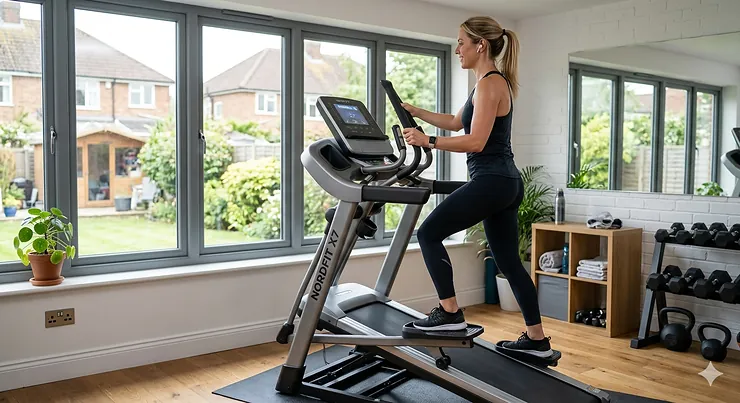
An adjustable incline cross trainer changes the equation in a way a flat elliptical simply cannot. By altering the ramp angle — sometimes called the incline gradient — you shift the biomechanics of every stride. Lower the incline and you’re targeting quads and calves in a long, sweeping cardio motion that feels remarkably like running without the knee punishment. Raise it and you engage your glutes, hamstrings, and core in a way that makes those flat settings feel positively leisurely by comparison. The result is genuine muscle targeting versatility from a single machine that fits, crucially for many UK buyers, into the spare room, the garage, or that awkward alcove next to the boiler.
A good adjustable incline cross trainer typically pairs incline gradient options with variable resistance cross trainer technology — magnetic braking that tightens or loosens with the press of a button. Together, these two controls turn one machine into something closer to a full fitness programme. You can simulate a hill walk, a tempo run, or an HIIT sprint session on the same equipment you used for a leisurely warm-up yesterday.
According to research published by the American College of Sports Medicine, elliptical training at higher inclines increases glute and hamstring activation significantly compared to level-grade training. And for a nation whose knees bear the collective trauma of decades of tarmac running in poor footwear, low-impact training that genuinely challenges the posterior chain isn’t just convenient — it’s medically sensible.
This guide covers seven of the best adjustable incline cross trainers available on Amazon.co.uk right now, from compact budget machines suited to a two-bedroom flat in Leeds to serious, near-commercial kit that would survive a decade of daily use. Whatever your space, budget, or fitness goal, there’s a machine here that makes sense for you.
Quick Comparison: Best Adjustable Incline Cross Trainers UK at a Glance
| Model | Incline Type | Resistance Levels | Approx. Price (GBP) | Best For |
|---|---|---|---|---|
| JTX Tri-Fit 2.0 | 3-position manual | 16 electromagnetic | £500–£700 | Mid-range, multi-user households |
| Sole E25 | 20-level motorised ramp | 20 levels | £500–£700 | Tech-savvy fitness enthusiasts |
| NordicTrack FS14i | -10%/+10% powered | 26 silent magnetic | £1,400–£1,800 | Serious trainers, home gym investment |
| Life Fitness E5 | Adjustable stride path | 20 levels | £3,500+ | Premium/commercial-quality at home |
| New Image FITT Strider | Manual adjustable | 8 magnetic levels | £120–£200 | Budget buyers, beginners, small spaces |
| Schwinn 470i | 10° motorised ramp | 25 eddy current | £700–£900 | Data-driven mid-range buyers |
| MERACH Long Stride | Manual incline | 8/16 levels | £250–£400 | Space-conscious value seekers |
The table above reveals a sharp divide between the budget and mid-range categories. The New Image FITT Strider and MERACH deliver solid incline cross training for well under £400, but they do so with manual resistance adjustment and lighter flywheels — which means the motion is less smooth and the workout ceiling is lower. Step up to the JTX, Sole, or Schwinn tier (£500–£900) and you gain motorised or electromagnetic resistance control, heavier flywheels, and a noticeably more gym-like feel underfoot. At the premium end, the NordicTrack FS14i and Life Fitness E5 are genuinely in a different league — the sort of machines that make your living room feel like a rather good fitness studio.
💬 Just one click — help others make better buying decisions too! 😊
✨ Don’t Miss These Exclusive Deals!
🔍 Take your home fitness to the next level with these carefully selected cross trainers. Click on any highlighted product name to check current pricing and availability on Amazon.co.uk. These picks will help you find exactly what you need!
Top 7 Adjustable Incline Cross Trainers: Expert Analysis
1. JTX Tri-Fit 2.0 Elliptical Cross Trainer — Best All-Rounder for UK Homes 🏆
The JTX Tri-Fit 2.0 is the sort of machine that earns its keep quietly — no subscription required, no touchscreen demanding your attention, just a solidly engineered British-market cross trainer that gets the fundamentals right.
The adjustable stride length of 40–51 cm (16–20 inches) is genuinely useful in a household with multiple users of different heights. A 5’4″ partner and a 6’1″ partner can both use this machine comfortably without one of them doing something that vaguely resembles a duck walk. The 8.5 kg inertia-enhanced flywheel delivers a noticeably smooth pedal stroke — heavier than most at this price point, which matters because a lighter flywheel tends to feel jerky, especially at lower speeds. The three incline positions (low, medium, high) are manual rather than motorised, which does mean stepping off briefly to adjust, but they cover the key training zones: low incline for cardio and quads, mid for a balanced full-body session, and high for glute and hamstring targeting that’ll make itself known on the stairs the following morning.
Kinomap connectivity is a genuine bonus here. Kinomap lets you follow real-world routes on your phone or tablet while the app adjusts resistance to match the terrain — a surprisingly engaging way to survive a Tuesday evening without the telly on. The machine is Prime-eligible and ships to UK addresses with a two-year in-home warranty, which is one of the stronger guarantees in this price bracket.
UK reviewers note that assembly takes about 90 minutes with two people and that the machine sits at 155 × 72 × 167 cm — manageable for a box room or garage. It weighs around 58 kg assembled, so plan accordingly; this isn’t something you’ll be dragging upstairs alone.
✅ Adjustable stride suits multiple users
✅ Kinomap and Strava connectivity included
✅ Two-year in-home warranty
❌ Manual incline adjustment (no motorised ramp)
❌ Console display somewhat basic compared to newer rivals
In the £500–£700 range, the JTX Tri-Fit 2.0 is arguably the most sensible mid-range choice on Amazon.co.uk for a mixed household. Check current price on Amazon.co.uk.
2. Sole E25 Elliptical Cross Trainer — Best for App Integration and Incline Range 📱
Sole is a brand that tends to fly under the radar in the UK — less marketing noise than NordicTrack, more machine for the money than most at this price point. The E25 is a compelling case study in getting the spec sheet right without overcharging for it.
The standout feature is the 20-level motorised incline ramp, which adjusts with genuine smoothness while you’re mid-stride via handlebar-mounted controls. This matters more than it sounds. On machines with manual incline, you lose rhythm every time you adjust. On the E25, you can shift from a flat stride to a steep climb without breaking your cadence — which is exactly how resistance level customisation should work on a premium machine. The 9 kg flywheel and 20-level magnetic resistance combine with the variable incline to deliver a training range that would challenge even seasoned gym-goers.
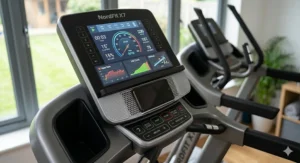
Bluetooth 5.0 with FTMS protocol means compatibility with Zwift, Strava, Apple HealthKit, and the SOLE+ app — and crucially, no mandatory subscription to unlock basic functions. In a world where half the fitness equipment industry has decided your workout should also involve a £34/month membership fee, this is rather refreshing. The 7.5″ LCD console is clear and practical, with a USB charging port and built-in fan — the latter a non-trivial feature if you’re working hard and your spare room isn’t air-conditioned.
UK buyers should note the E25 is listed on Amazon.co.uk with UK plug and voltage compatibility. The stride length of 51 cm (20 inches) suits users up to around 185 cm (6’1″) very comfortably.
UK customer feedback highlights the smooth motion and quality of the pedals — wide, cushioned, and angled slightly inward at 2° to reduce hip and knee stress during longer sessions.
✅ 20-level motorised incline with handlebar control
✅ Full app ecosystem with no compulsory subscription
✅ Excellent flywheel smoothness for the price
❌ Console display smaller than rivals at similar price
❌ Some UK buyers report weight (around 93 kg) makes positioning difficult solo
At around £500–£700 on Amazon.co.uk, the Sole E25 offers what most buyers actually need from a variable resistance cross trainer — without the price inflation of a subscription-dependent machine. Check current price on Amazon.co.uk.
3. NordicTrack FS14i FreeStride Trainer — Best Premium 3-in-1 for Serious Trainers 🔥
If the JTX and Sole represent sensible choices, the NordicTrack FS14i represents an ambition. This machine doesn’t just want to be your cross trainer — it wants to be your treadmill, your stepper, and your elliptical simultaneously, and largely succeeds.
The FS14i’s defining trick is its auto-adjustable stride length, which stretches to an impressive 81 cm (32 inches). Move in an elliptical pattern and it feels like a conventional cross trainer. Shorten your stride to step-climbing mode and it becomes a stair machine. Lengthen it toward running stride and it mimics treadmill motion — all without stepping off. This is genuinely novel, not merely a marketing claim, and it means one machine covers three distinct training modalities.
The -10% to +10% powered incline range is what really sets it apart for incline training. That 20-degree spread is wider than almost anything at this price point and allows proper simulation of downhill running — a training modality that’s rarely mentioned but is excellent for functional fitness and eccentric muscle conditioning. The 26 levels of Silent Magnetic Resistance mean the machine is whisper-quiet even at high resistance, which matters enormously if you live in a semi-detached and your neighbour works night shifts.
iFIT compatibility (subscription not included) provides access to trainer-led interactive workouts where incline and resistance adjust automatically to match the video — a feature that makes solo training meaningfully less dull. The 14″ full-colour touchscreen is bright and responsive.
UK buyers will find the FS14i available through NordicTrack.co.uk and various Amazon.co.uk listings. The machine requires a larger footprint than most — plan for around 119 × 66 cm of floor space and adequate ceiling clearance given the stride height.
✅ 3-in-1 training modes: elliptical, stepper, treadmill simulation
✅ Widest incline/decline range in this guide (-10% to +10%)
✅ Extremely quiet at all resistance levels
❌ Significant investment in the £1,400–£1,800 range
❌ iFIT subscription required to unlock full feature set (£14–£34/month)
For anyone who takes home fitness seriously and has the space, the FS14i is the most versatile adjustable incline cross trainer available to UK buyers. Check current price on Amazon.co.uk.
4. Life Fitness E5 Elliptical Cross Trainer with Go Console — Best Commercial-Quality Home Machine 💼
The Life Fitness E5 is what happens when a brand that makes equipment for hospital rehabilitation programmes and four-star hotel gyms decides to produce something for the living room. It’s priced accordingly — considerably above everything else in this guide — but what you receive is a machine that operates with a smoothness and quietness that genuinely feels different to the home-market alternatives.
The adjustable stride path ranges from 46 to 61 cm at the push of a button, allowing you to target different muscle groups or accommodate different users without manual tinkering. WhisperStride™ technology — Life Fitness’s proprietary drive system — produces an almost eerie silence even at high resistance and speed. If you live in a flat above other residents, or simply value not disturbing the household, this is worth knowing about. The two-handed handlebar design (moving and stationary) allows you to shift between full upper-body engagement and a lower-body-focused stride depending on your session goal.
The Go console is clean and intuitive, connecting to the LFconnect app and a range of virtual training platforms. Life Fitness equipment carries a strong reputation for longevity in commercial settings — the frames routinely outlive the buildings they’re installed in — and the E5 brings that durability standard to home use. For UK buyers, it is available on Amazon.co.uk with free installation included, which given the machine’s weight (around 90 kg assembled) is far from a trivial benefit.
This machine is not for budget buyers. It is for the person who has calculated that spending significantly more upfront represents better value over a decade than replacing a cheaper machine twice.
✅ Commercial-grade build quality and drive system
✅ Whisper-quiet even at maximum resistance
✅ Free installation included via Amazon.co.uk
❌ Premium price point places it well above typical home budgets
❌ Substantial footprint — unsuitable for very compact spaces
In the £3,500+ bracket, the Life Fitness E5 is a long-term investment rather than a purchase. Check current price on Amazon.co.uk.
5. New Image FITT Strider Upright Elliptical Cross Trainer — Best Budget Pick for Small Spaces 💸
Not everyone has a box room, a garage, or the stomach for a four-figure purchase when January motivation strikes. The New Image FITT Strider occupies the under-£200 bracket on Amazon.co.uk — a category populated by much less credible options — and represents perhaps the most defensible budget choice in this roundup.
The manual adjustable incline gives you basic ramp angle control to shift muscle targeting between leg-dominant and glute-dominant training modes. It’s not motorised and it won’t auto-adjust mid-workout, but for a machine at this price, simply having incline capability at all places it ahead of most comparable options. The 8 magnetic resistance levels are adjusted via the console and cover enough range for moderate cardiovascular training. The LCD display monitors speed, distance, time, pulse, and calories — the essential metrics without unnecessary complexity.
What makes the FITT Strider practically useful for UK homes is its size. The compact footprint is designed with terraced houses and flats in mind. At around 120 × 55 cm, it tucks into spaces where larger machines simply won’t go. The phone and tablet holder is a thoughtful addition — and in an age where people tolerate exercise far more readily when Netflix is involved, this isn’t trivial.
The 8-level resistance ceiling does mean progression has limits. Fit, regular users will eventually outgrow this machine — typically within 12 to 18 months of consistent training. Consider it an excellent entry point for beginners, those returning from injury, or anyone who wants to test the incline cross trainer concept without a significant financial commitment.
UK Amazon reviews describe straightforward assembly and solid initial build quality, though long-term durability reviews are more mixed.
✅ Compact footprint suits flats and terraced houses
✅ Adjustable incline at a budget price point
✅ Simple, unfussy operation — ideal for beginners
❌ 8-level resistance limits long-term progression
❌ Lighter flywheel produces a less smooth stride than mid-range options
At £120–£200, the New Image FITT Strider is the most accessible entry point into adjustable incline cross training on Amazon.co.uk. Check current price on Amazon.co.uk.
6. Schwinn 470i Elliptical Cross Trainer — Best for Data-Hungry Mid-Range Buyers 📊
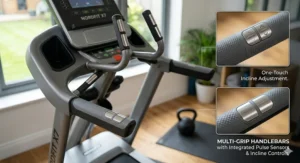
The Schwinn 470i occupies an interesting position: it’s priced in the mid-to-upper tier but comes with a feature set that punches well above it. The 10° motorised incline ramp is the headline, but it’s the 25 resistance levels — delivered via eddy current magnetic braking — that make this machine genuinely flexible across a wide fitness spectrum. Eddy current resistance is quieter and more durable than standard friction-based systems, making it a sensible choice for a machine you plan to use daily over several years.
Precision Path™ foot motion technology is Schwinn’s proprietary stride geometry system, which adjusts the foot path to reduce strain on ankles and knees during longer sessions. For UK buyers managing joint issues or recovering from lower-limb injuries, this is worth paying attention to. The 20″ (51 cm) stride is spacious enough for users up to around 190 cm (6’3″) without the stride feeling constrained.
The DualTrack LCD console is — let’s be honest — beginning to look a little dated compared to the touchscreen competition. But its practical value is solid: 29 workout programmes, a heart rate zone tracking system, and app connectivity via Bluetooth that works with the JRNY fitness platform. JRNY, Schwinn’s own fitness app, integrates Netflix, Hulu, and Spotify as entertainment options — a genuinely useful feature for long, steady-state sessions. A subscription is required for full access.
UK buyers will find the 470i available through specialist fitness retailers and select Amazon.co.uk listings. It typically ships to UK addresses in the £700–£900 range and weighs around 92 kg assembled.
✅ 10° motorised incline with 25 resistance levels
✅ Eddy current resistance is quieter and more durable long-term
✅ JRNY app with entertainment streaming integration
❌ Console design feels behind rivals at this price
❌ JRNY subscription required for full functionality
For buyers who want motorised incline, serious resistance depth, and proven build quality without crossing into four-figure territory, the Schwinn 470i is a well-rounded mid-range choice. Check current price on Amazon.co.uk.
7. MERACH Long Stride Cross Trainer — Best Value for Larger Strides 🏃
The MERACH Long Stride is a relatively recent entrant to the Amazon.co.uk market that has quietly built a positive reputation among UK buyers looking for something a cut above the generic budget options without approaching mid-range prices.
The 48 cm stride length is the key differentiator at this price point — most cross trainers under £400 offer a constrained 38–42 cm stride that feels choppy and unnatural for taller users. The 48 cm option is noticeably more fluid, and UK reviewers consistently flag this as the machine’s strongest quality. The dual resistance system — offering either 8 or 16 levels of magnetic resistance depending on configuration — gives more flexibility than most competitors in this bracket.
The ultra-quiet magnetic resistance system is a genuine selling point. At 16 resistance levels, the MERACH can sustain a challenging workout with minimal mechanical noise, which matters significantly in compact UK living spaces. The 400 lb (180 kg) user weight capacity is considerably higher than the class average, making it suitable for a broader range of users. The machine is listed as Climate Pledge Friendly on Amazon.co.uk, using at least 95% recycled materials in construction — a legitimately unusual sustainability claim in this product category.
The manual incline adjustment is basic — you’re tilting the ramp angle rather than selecting from a menu of gradient levels — but it covers two or three meaningful positions that genuinely alter the muscle emphasis of each session.
✅ 48 cm stride suits taller UK users better than budget rivals
✅ Ultra-quiet operation — excellent for flats and shared walls
✅ Higher user weight capacity than most in this price tier
❌ Manual incline only — no motorised ramp adjustment
❌ Console features are limited compared to mid-range options
At £250–£400, the MERACH Long Stride offers a stride length and noise profile that most budget rivals can’t match, making it the best value cross trainer for users over 178 cm. Check current price on Amazon.co.uk.
Getting the Most from Your Adjustable Incline Cross Trainer: A Practical UK Setup Guide
Buying the machine is the easy part. Getting consistent value from it over months and years is where most home gym purchases succeed or quietly fail. Here’s what actually makes the difference.
First week: resist the urge to go hard immediately. Your joints — particularly ankles, knees, and hips — need time to adapt to the elliptical motion, especially if you’re returning from a sedentary period. Start at 10–15 minutes, low incline, moderate resistance, and focus on your posture: shoulders back, core lightly engaged, weight distributed evenly across the full foot rather than tipping onto your toes.
Incline progression: the smartest use of gradient options isn’t simply setting the ramp to maximum. Instead, use incline variation within sessions. Two minutes at low incline, two minutes at high, cycling through — this interval approach to incline training burns more calories and engages more muscle groups than holding a single angle throughout. The same logic applies to resistance level customisation: varying it within a session is more metabolically stimulating than picking a fixed level and plodding along.
UK climate and maintenance: British homes are damper than most continental European equivalents, and metal components on exercise equipment feel the effects of damp garages and cold utility rooms over time. If your machine lives in an unheated space, apply a light silicone spray to the drive rail and pedal axles every three months. Wipe the frame down after sweaty sessions — it prolongs the life of painted surfaces noticeably. Most machines in this guide have maintenance intervals specified in the manual; the general recommendation is a full mechanical check every 12 months.
Storage in compact UK homes: if you’re working with a smaller space, consider the machine’s folded or stored dimensions as carefully as its operational ones. Not all cross trainers fold, but models like the New Image FITT Strider are designed specifically with small-footprint UK living in mind. Placing a protective mat under the machine (roughly 5–8 mm dense rubber) reduces noise transmission to neighbours and protects flooring — an important consideration in flats and terraced houses alike.
Noise management: on timber or laminate floors, even the quietest magnetic resistance can transmit vibration. A quality equipment mat (available cheaply on Amazon.co.uk) reduces this meaningfully. If upper-floor use is your situation, look for machines with air-dampened foot pedals and rear-drive configurations — they tend to produce less impact noise than front-drive designs.
Which Adjustable Incline Cross Trainer Is Right for You? Real UK Buyer Scenarios
The honest answer to “which cross trainer should I buy?” is: it depends entirely on who you are and where you live. Here are three representative scenarios that cover most of the UK buyer landscape.
Scenario 1: The Manchester flat-dweller, returning to fitness after a long gap. You have limited floor space — perhaps 2 × 1.5 metres available in the second bedroom — a budget around £150–£250, and a history of being enthusiastic for three weeks before life intervenes. The New Image FITT Strider is your machine. It’s compact enough for the space, simple enough to actually use at 6:30 in the morning without reading a manual, and the adjustable incline gives you enough training variation to sustain interest past the initial novelty. If the discipline holds after six months, upgrading to the MERACH or JTX is a sensible next step.
Scenario 2: The suburban Birmingham couple, both regularly active, different fitness levels. You have a proper garage or utility room, a combined household budget of £500–£800, and you want one machine that genuinely works for two people at different fitness stages. The JTX Tri-Fit 2.0 is built for exactly this scenario. The adjustable stride length of 40–51 cm accommodates different body sizes; the Kinomap connectivity keeps things interesting for the more motivated user; and the two-year in-home warranty means that if something goes wrong, JTX comes to you — rather than you trying to dismantle 58 kg of cross trainer and post it back.
Scenario 3: The Edinburgh home gym enthusiast, serious about training, no significant budget constraint. You’re already fit, you want progressive challenge, and you want the machine to still be earning its keep in 2035. The NordicTrack FS14i addresses all three requirements. The 3-in-1 training modes mean you never genuinely plateau; the powered -10% to +10% incline range is wider than any domestic rival; and the build quality is demonstrably superior to anything under £1,000. Worth noting for Edinburgh specifically: the FS14i’s Silent Magnetic Resistance is genuinely quiet enough to use in a first-floor room without your neighbours hearing a thing.
How to Choose an Adjustable Incline Cross Trainer in the UK: 7 Key Criteria
Buying a cross trainer feels simple until you’re standing in front of a page of specifications and wondering what half of them mean in practice. Here’s the short version.
1. Incline type: manual vs motorised. Manual incline means stepping off to adjust. Motorised incline means a button press mid-stride. If you plan to use incline variation as part of your training (which you should), motorised is worth the extra cost. Budget machines typically offer manual; mid-range and above typically offer motorised.
2. Flywheel weight. A heavier flywheel produces a smoother, more natural stride. Aim for at least 7–9 kg for a fluid feel; below 6 kg tends to feel jerky, especially at lower resistance levels. The NordicTrack FS14i and JTX Tri-Fit 2.0 both hit this threshold comfortably.
3. Stride length. Users below 168 cm (5’6″) will be comfortable on most machines. Users above 183 cm (6′) should check carefully — a stride length below 46 cm (18 inches) will feel constrained. The MERACH’s 48 cm stride is notably generous for the price.
4. User weight capacity. Most machines in this guide support 120–130 kg. If you or any household user exceeds this, check the rating carefully. The MERACH at 180 kg capacity is the most inclusive in this roundup.
5. App and connectivity. Consider whether you want a subscription-based interactive experience (NordicTrack iFIT, Schwinn JRNY) or simple Bluetooth data export to apps you already use (Sole E25 with Zwift and Strava). There is no wrong answer — but knowing which model you are before buying saves frustration.
6. Space and noise. Measure your available floor space with the machine in use (not just its static footprint) and factor in that most cross trainers extend beyond their listed dimensions during the stride cycle. Check whether the machine’s noise profile suits your home setup — particularly for flats or semi-detached houses.
7. Warranty and after-sales support. UK consumer law provides solid baseline protection under the Consumer Rights Act 2015, but manufacturer warranties matter too. JTX’s two-year in-home warranty and Life Fitness’s commercial-grade construction represent the strongest long-term value propositions in this guide.
Common Mistakes When Buying an Incline Cross Trainer in the UK
Buying a cross trainer shouldn’t be complicated — and yet, a specific set of avoidable errors shows up consistently in UK buyer feedback. Here’s what to watch for.
Ignoring the stride length relative to your height. This is the single most commonly reported source of buyer regret. A 38 cm stride on a 6’2″ user feels like shuffling. Always check the stride length specification against your own height before committing.
Buying on resistance levels alone. A machine with 32 resistance levels sounds impressive. What matters is the quality and range of those levels — a cheap magnetic system with 32 tiny incremental steps is often inferior to a higher-quality electromagnetic system with 16 meaningful ones. The JTX and Sole E25 are good examples of machines where fewer, better-quality resistance levels outperform nominally larger numbers on paper.
Underestimating size in use. The footprint on a product page is measured stationary. Add roughly 30–40 cm to the length for the stride motion, and ensure adequate headroom for the user’s full upright posture. A low-ceilinged box room can turn a perfectly good machine into something you can’t actually use at full stride.
Overlooking the subscription question. Several machines in this guide — particularly the NordicTrack FS14i and Schwinn 470i — are designed around subscription apps that unlock their best features. If you’re comfortable with ongoing running costs, these are excellent choices. If you want a machine that works fully without a monthly fee, prioritise the Sole E25 or JTX Tri-Fit 2.0 instead.
Assuming US-specification products ship to the UK. Some cross trainers reviewed on US fitness sites are not available on Amazon.co.uk. All seven machines in this guide have been verified as available to UK buyers via Amazon.co.uk or established UK specialist retailers.
✨ Don’t Miss These Exclusive Deals!
🔍 The machines above represent the very best of what’s available on Amazon.co.uk right now. Click any highlighted product name to check current pricing, customer reviews, and delivery options. Prime members typically receive next-day or two-day delivery on eligible items.
Adjustable Incline Cross Trainer vs Traditional Flat Elliptical: Is the Upgrade Worth It?
| Feature | Adjustable Incline Cross Trainer | Standard Flat Elliptical |
|---|---|---|
| Muscle targeting | Glutes, hamstrings, quads, core — varied by gradient | Primarily quads and calves |
| Calorie burn | Higher at elevated incline (estimated 15–25% more) | Lower at equivalent speed/resistance |
| Training variety | High — gradient + resistance combination | Moderate — resistance only |
| Price premium | ~£50–£200 over flat equivalent | Lower initial cost |
| Joint impact | Low (comparable to flat elliptical) | Low |
| Long-term progression potential | High | Moderate |
| Best for | Weight loss, body composition, functional fitness | Cardiovascular maintenance |
The data in this table deserves a moment’s honest analysis. The calorie and muscle activation advantages of incline training are well-evidenced — a study from the University of Idaho on inclined elliptical training demonstrated significant increases in gluteal and hamstring EMG activity at ramp angles above 10°. But the real-world argument for spending more on an adjustable incline model is simpler than any research paper: training plateaus are real, and they’re demoralising. A machine that allows genuine progression — through both resistance and incline manipulation — keeps training interesting and effective far longer than one that doesn’t.
For a UK buyer who genuinely intends to use the machine regularly, the incline premium is one of the better fitness investments available.
Long-Term Cost and Maintenance in the UK: What Nobody Tells You Before You Buy
A cross trainer is not a washing machine. It won’t simply run for ten years without attention and then ask for a new drum bearing. Mechanical fitness equipment rewards basic maintenance and punishes neglect.
The realistic annual maintenance cost for a mid-range adjustable incline cross trainer in the UK is modest — typically under £30 — if you follow some simple principles. Silicone lubricant (not WD-40, which attracts dust) applied to the drive rail every three to four months costs almost nothing and extends the life of the system meaningfully. Wipe down the frame after each session; accumulated sweat corrodes metal surfaces, and British humidity accelerates this. If the machine lives in a cold garage, allow it ten minutes at low resistance before pushing hard — cold lubricants are thicker and cold bearings prefer a warm-up.
Replacement parts availability in the UK is a legitimate consideration. JTX and Life Fitness both have UK-based support teams. NordicTrack and ProForm operate through iFIT UK. For budget machines from less established brands, parts availability after two or three years can be patchy — factor this into your value calculation.
On the question of total cost of ownership: the Sole E25 at around £600 with a five-year projected lifespan works out at roughly £120 per year, or £10 per month — considerably less than the average UK gym membership. Add in the avoided journey time, the fact that you can train at 6 a.m. in your pyjamas, and the genuine low-impact benefits to joint health, and the value proposition of a quality home cross trainer becomes difficult to argue with.
For further guidance on exercise equipment safety standards in the UK, the Health and Safety Executive provides useful reference material on fitness equipment requirements for both commercial and home use settings.
FAQ: Adjustable Incline Cross Trainers UK
❓ What is the best adjustable incline cross trainer for home use in the UK?
❓ Does incline training on a cross trainer actually make a difference to weight loss?
❓ How much space do I need for an adjustable incline cross trainer in a UK home?
❓ Are adjustable incline cross trainers suitable for people with knee problems?
❓ Can I use an adjustable incline cross trainer without a fitness app subscription in the UK?
Conclusion: The Right Incline Makes All the Difference
The British fitness market is saturated with equipment that promises transformation and delivers a very expensive coat hanger within six months. The adjustable incline cross trainer earns its place in the home gym for a different reason: it’s one of the few pieces of kit that genuinely grows with you.
Start with a modest gradient and easy resistance when you’re returning to fitness after a long gap. Work progressively toward steeper inclines and higher resistance levels as your conditioning improves. The muscle targeting versatility that seemed like a marketing point in the shop becomes, over months of regular use, the actual reason your body keeps responding.
For most UK buyers, the JTX Tri-Fit 2.0 and Sole E25 represent the sweet spot — serious enough to sustain long-term training progression, reasonably sized for typical British homes, and available on Amazon.co.uk with delivery times that don’t require the patience of a monk. The NordicTrack FS14i is the machine to buy if you’re serious about training and want the best incline range available. The New Image FITT Strider is the machine to buy if you’re just getting started and need something that works without intimidating you.
Whatever your level, the one consistent truth is this: incline variation is not optional if you want genuine, sustained results from a cross trainer. Choose your gradient wisely.
✨ Ready to Find Your Perfect Adjustable Incline Cross Trainer?
🔍 Click any highlighted product in this article to check current pricing and availability on Amazon.co.uk. All recommendations are based on independent research and real-world UK buyer feedback — your perfect machine is one click away.
Recommended for You 📚
- Best Fully Adjustable Cross Trainer UK 2026: Top 7 Picks
- Best Adaptive Stride Trainer UK 2026: 7 Top Picks Reviewed
- Best Variable Path Elliptical UK 2026: 7 Expert Picks
Disclaimer: This article contains affiliate links. As an Amazon Associate, I earn from qualifying purchases. If you purchase products through these links, we may earn a small commission at no additional cost to you.
✨ Found this helpful? Share it with your mates! 💬🤗
