
In This Article
When you’re investing anywhere from £400 to £2,500 in a cross trainer for your home, the warranty isn’t just a nice-to-have — it’s the difference between a sound investment and an expensive clothes rack gathering dust in the spare room. A lifetime warranty cross trainer signals manufacturer confidence that their frame won’t buckle, crack, or fail when you’re halfway through your morning workout on a drizzly Tuesday in March.
Here’s what most buyers overlook: the warranty structure reveals more about build quality than any marketing copy ever will. A manufacturer offering lifetime coverage on the frame isn’t gambling on cheap steel or questionable welds surviving beyond the first year. They’re backing their engineering with cold, hard cash — because warranty claims cost them dearly.
In the UK market, genuine lifetime warranty cross trainers are rarer than you’d expect. Most brands offer 1-2 years across the board, which barely covers the break-in period for serious home use. The machines we’re examining today — from established names like JTX Fitness, Life Fitness, and Sole — provide frame warranties that extend for the reasonable life expectancy of the product, with comprehensive parts coverage that transforms a risky purchase into a protected long-term investment. According to the Consumer Rights Act 2015, UK buyers are entitled to additional protections beyond manufacturer warranties, but choosing equipment with robust coverage from the outset saves considerable hassle down the line.
Quick Comparison: Top Lifetime Warranty Models
| Model | Frame Warranty | Parts Warranty | Flywheel | Stride Length | Price Range (£) | Best For |
|---|---|---|---|---|---|---|
| JTX Tri-Fit | Lifetime | 2 years | 8.5kg | 16-20″ adjustable | £800-900 | Multi-user homes |
| JTX Zenith Rise | Lifetime | 2 years | 17kg | 19″ | £750-850 | Tall users |
| Life Fitness E1 | Lifetime | 5 years | Commercial-grade | 20″ | £2,400-2,600 | Premium buyers |
| Sole E35 | Lifetime | 3 years | 11kg | 20″ | £1,400-1,600 | Mid-range quality |
| JTX Strider-X7 | 2 years (all) | 2 years | 12.5kg | 16″ | £380-450 | Budget-conscious |
| Sportstech LCX800 | Standard 2 year | 2 years | 24kg | 16.5-19.7″ | £650-750 | Tech enthusiasts |
| NordicTrack C7.5 | 5 years | 2 years | 9kg | 18″ | £700-850 | iFit users |
💬 Just one click — help others make better buying decisions too! 😊
Top 7 Lifetime Warranty Cross Trainers: Expert Analysis
1. JTX Tri-Fit 2.0 — The Goldilocks Champion
The JTX Tri-Fit 2.0 represents what happens when a British brand actually listens to home users rather than copying commercial gym equipment. That patented adjustable stride system (16-20 inches) isn’t marketing fluff — it genuinely transforms this into a cross trainer that works brilliantly whether you’re 5’2″ or 6’5″. The 8.5kg inertia-enhanced flywheel paired with electro-magnetic resistance delivers remarkably smooth motion, particularly at higher resistance levels where cheaper machines judder and clunk.
In real-world UK conditions, this machine earns its keep. The lifetime frame warranty and 2-year home repair coverage (including engineer call-outs) matter when you’re using it four times weekly through British winter gloom. The incline adjustment feature — rare at this price point — engages your glutes and core differently from flat-path training, which translates to better results and less repetitive strain. What the spec sheet won’t tell you: the sealed bearings cope admirably with damp garages and unheated conservatories, environments that destroy lesser machines within 18 months.
Customer feedback from UK buyers highlights reliability (machines still running smoothly after 3+ years), though assembly requires patience and ideally two people. The Kinomap integration works well for those who enjoy virtual routes, though the tablet holder suits devices up to about 10 inches — larger iPads wobble slightly.
Pros:
- Lifetime frame warranty with UK-based support
- Adjustable stride accommodates all heights
- Incline feature adds workout variety
Cons:
- Assembly complexity (2-3 hours realistic)
- Heavier side at 86kg (difficult to relocate)
Price range: Around £850-900 | Value verdict: The warranty-to-price ratio here is exceptional — you’re getting commercial-grade protection at mid-range pricing.
2. Life Fitness E1 Cross-Trainer — When Money Isn’t the Object
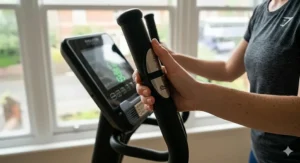
The Life Fitness E1 is what serious athletes buy when they’re tired of gym memberships and ready to invest properly. That commercial pedigree isn’t marketing — Life Fitness equips professional facilities worldwide, and this is essentially their club machine adapted for home voltage. The WhisperStride technology delivers genuinely silent operation (crucial for flats and terraced housing where neighbours share walls), whilst the 20-inch stride length and 400-pound user capacity accommodate virtually anyone.
With a lifetime frame warranty, 5-year parts coverage, and 3-year console protection, Life Fitness backs this investment more comprehensively than competitors. The 20 levels of electro-magnetic resistance provide smooth, consistent challenge from warm-up through to high-intensity intervals. What justifies the £2,400-2,600 price tag? Durability that outlasts three budget machines, plus resale value that holds remarkably well — 5-year-old E1 models still command £1,200-1,500 on the second-hand market.
UK buyers particularly appreciate the LFconnect app compatibility, which syncs workout data to popular fitness platforms without subscription fees. The Track Console variant offers straightforward operation for those who prefer physical buttons over touchscreens. One consideration: this weighs 102kg, making it a permanent fixture once positioned.
Pros:
- Commercial-grade build quality
- Exceptionally quiet operation
- Outstanding resale value
Cons:
- Premium pricing (£2,400-2,600)
- Substantial floor space required
Price range: £2,400-2,600 | Value verdict: If your budget stretches this far, you’re buying once and keeping it for potentially 15+ years.
3. JTX Zenith Rise — For Tall Users Who’ve Given Up Finding Suitable Kit
If you’re over 6’2″ and perpetually frustrated by cross trainers with cramped stride lengths, the JTX Zenith Rise was designed specifically for you. That 19-inch stride path combined with 20 levels of digital incline creates a workout that feels natural rather than the awkward shuffling motion shorter machines force on taller users. The front-drive flywheel design places the mechanism forward, reducing the footprint whilst maintaining stability — clever engineering for British homes where space is finite.
The lifetime frame warranty and 2-year in-home repair service provide peace of mind, whilst the gym-standard construction (heavy gauge steel frame, 96.5kg total weight) means this isn’t shifting mid-workout regardless of intensity. UK reviewers consistently praise the Kinomap integration, which transforms indoor sessions by syncing resistance to virtual terrain — suddenly you’re climbing Alpine passes rather than staring at your lounge wall on a rainy Wednesday evening.
What sets the Zenith Rise apart is the digital incline control. Most budget machines offer fixed geometry, but this adjusts electronically across 20 levels, targeting different muscle groups and preventing the plateau effect that kills motivation after three months. The 32 resistance levels ensure progression room for years. One note: the upward motion when using higher incline settings increases ceiling clearance requirements — anyone over 6’4″ should verify head room before purchasing.
Pros:
- Perfect for taller users (6’+ comfortable)
- Digital incline provides workout variety
- Bluetooth connectivity to fitness apps
Cons:
- Higher incline positions increase head clearance needs
- Premium pricing (£750-850)
Price range: £750-850 | Value verdict: Taller buyers struggling with cramped equipment will find this worth every penny.
4. Sole E35 Elliptical — American Quality Meets UK Availability
The Sole E35 brings American fitness engineering to the UK market with full warranty support through authorised distributors. That lifetime frame warranty extends to the motor and parts for three years — coverage that reflects Sole’s confidence in their commercial-grade components. The 11kg flywheel and 20-inch stride length provide smooth, natural motion that accommodates most users between 5′ and 6’6″ without adjustment.
In practice, the E35 performs brilliantly for steady-state cardio and interval training alike. The 20 resistance levels span genuine range from gentle rehabilitation work through to lung-busting HIIT sessions. What UK buyers particularly value is the included wireless chest strap for accurate heart rate monitoring — most competitors charge £30-50 extra for this essential. The adjustable ramp angle (0-20 levels) shifts muscle engagement, which matters tremendously for avoiding repetitive strain during frequent use.
The console offers 10 built-in programmes plus two customisable options, though the display feels somewhat dated compared to modern touchscreen competitors. Build quality is exceptional — this 77kg machine sits solid on any floor surface, and the maintenance-free ball bearings ensure quiet operation even after years of service. One consideration: whilst Sole products are available through UK retailers and Amazon.co.uk, parts occasionally ship from the US warehouse with 2-3 week delivery times for less common components.
Pros:
- Lifetime frame and motor warranty
- Included wireless chest strap
- Exceptional build quality
Cons:
- Dated console design
- Potential parts delivery delays from US
Price range: £1,400-1,600 | Value verdict: Premium pricing, but the warranty and construction justify the investment for serious users.
5. JTX Strider-X7 — Budget That Doesn’t Feel Cheap
The JTX Strider-X7 sits in that sweet spot where affordability meets genuine quality rather than corner-cutting compromise. At £380-450, this represents the entry point to proper home cross-training equipment with the JTX reliability UK buyers have come to trust. The 12.5kg flywheel delivers smoother motion than the 6-8kg flywheels typical of budget machines, whilst 16 levels of electro-magnetic resistance provide progression room for developing fitness.
With a 2-year comprehensive warranty (frame, parts, and labour), the coverage here isn’t lifetime but still surpasses the 12-month protection offered by most competitors at this price point. The 16-inch stride length suits users up to about 6’1″ comfortably — taller individuals should consider the Zenith Rise instead. What impresses UK reviewers is the build quality: this 45kg machine feels stable during use rather than wobbling like cheaper alternatives, and the alloy steel frame shows no signs of flex under the 110kg user weight limit.
The 21 pre-set programmes include intervals, heart rate control, and custom options, providing variety that maintains motivation beyond the initial enthusiasm phase. Bluetooth connectivity links to the Kinomap app, transforming boring indoor sessions into virtual rides through scenic locations. One limitation: the compact design that suits smaller UK homes also means the stride motion feels slightly more elliptical (upright) than the flatter trajectory of longer machines.
Pros:
- Excellent value under £450
- Bluetooth app connectivity
- 2-year comprehensive warranty
Cons:
- 16″ stride limits taller users
- More upright motion than premium models
Price range: £380-450 | Value verdict: The best sub-£500 option for buyers who want quality without stretching to £800+.
6. Sportstech LCX800 — German Engineering with Android Integration
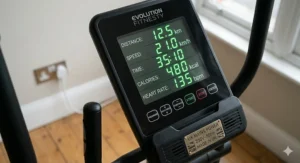
The Sportstech LCX800 approaches cross-training from a tech-first perspective, featuring an Android multifunction console with iFitShow app compatibility and six virtual scenery modes. That 24kg flywheel mass — exceptionally heavy for home equipment — delivers remarkably smooth, consistent resistance across all 16 levels. The adjustable stride system (42cm, 46cm, 50cm options) accommodates different users and training styles, whilst the double elliptic running system with ball-bearing mounted rollers ensures quiet operation.
UK availability through Amazon.co.uk provides straightforward purchasing, though the warranty structure differs from JTX and Life Fitness — you’re looking at 2 years comprehensive coverage rather than lifetime frame protection. Customer service experiences vary significantly based on Trustpilot reviews, with some UK buyers reporting excellent support whilst others encountered frustrations with parts delivery. The Android console genuinely adds value for tech-savvy users, providing workout data tracking and entertainment options that make longer sessions more engaging.
Build quality is substantial at 90kg total weight, and the noble futuristic design looks distinctly more modern than the industrial aesthetic of budget competitors. The HRC mode and pulse belt compatibility enable heart rate-controlled training, automatically adjusting resistance to maintain your target zone. One consideration: assembly complexity exceeds most competitors, with realistic setup time around 3-4 hours and definitely requiring two people.
Pros:
- Massive 24kg flywheel for smooth motion
- Android console with app integration
- Adjustable stride length system
Cons:
- Complex assembly (3-4 hours)
- Mixed customer service reports in UK
- 2-year warranty vs lifetime alternatives
Price range: £650-750 | Value verdict: The tech features justify the price for gadget enthusiasts, but warranty-focused buyers should consider JTX alternatives.
7. NordicTrack Commercial C7.5 — iFit Integration for Virtual Training
The NordicTrack Commercial C7.5 excels if interactive training motivates you more than traditional workout programmes. The iFit subscription service (additional cost after initial trial period) provides studio classes, global route simulations, and trainer-led workouts that automatically control resistance and incline. The 5-year frame warranty and 2-year parts coverage sit below lifetime alternatives, but NordicTrack’s service network across the UK provides accessible support when needed.
The 9kg flywheel feels lighter than the JTX or Sole alternatives, which some users prefer for a more responsive, less momentum-heavy experience. The 18-inch stride length accommodates most users between 5’2″ and 6’2″ comfortably, whilst 20 resistance levels and 20 incline positions provide extensive workout variety. What UK buyers particularly value is the integration with popular fitness tracking platforms — your workout data syncs seamlessly to Apple Health, Strava, and similar services.
Build quality is solid rather than exceptional at this price point, with the 75kg total weight providing stable operation without the premium heft of commercial-grade alternatives. The console is intuitive and responsive, though the iFit subscription requirement (approximately £35/month after trial) adds ongoing costs that accumulate significantly over ownership. For users who thrive on guided workouts and virtual challenges, this investment pays off through maintained motivation. For self-directed exercisers, the subscription fees might feel excessive.
Pros:
- Excellent iFit integration for guided workouts
- 5-year frame warranty
- Good UK service network
Cons:
- iFit subscription adds ongoing costs (£35/month)
- 9kg flywheel lighter than premium competitors
- 5-year warranty vs lifetime alternatives
Price range: £700-850 | Value verdict: Worthwhile if iFit’s virtual training matches your motivation style; otherwise, JTX alternatives offer better warranty protection.
How to Actually Use Your Warranty (Because Most People Don’t)
Most UK buyers invest in a lifetime warranty cross trainer, then promptly forget the warranty exists until something breaks three years later — by which point they’ve lost the receipt, never registered the product, and can’t find the serial number. Here’s how to protect your investment properly from day one.
Register Within 28 Days
Many manufacturers, particularly NordicTrack and ProForm, upgrade warranty coverage only for users who register within 28 days of purchase. That lifetime frame warranty on a NordicTrack treadmill? It’s actually just one year unless you complete online registration at their support portal. JTX offers automatic warranty activation upon purchase through their website, but Amazon.co.uk buyers should email their order confirmation to JTX customer service to ensure coverage.
Create a dedicated folder (digital or physical) containing your Amazon.co.uk order confirmation, delivery receipt, and assembly photos showing the serial number clearly. UK warranty claims require proof of purchase date, and “I bought it from Amazon about two years ago” doesn’t cut it when the manufacturer requests documentation.
Understand What’s Actually Covered
“Lifetime warranty” sounds comprehensive, but manufacturers define this carefully. The frame typically receives lifetime coverage, meaning the main structural steel components. Parts warranties (covering the flywheel, resistance mechanism, console, and drive belt) usually span 2-5 years. Labour coverage — the engineer coming to your home for repairs — often extends only 1-2 years, after which you’re paying call-out fees even for warranty parts.
For UK buyers, this matters particularly for brands shipping parts from overseas. If your Sole E35 needs a replacement console three years in (within parts warranty), you’ll receive the part free but potentially wait 2-3 weeks for US shipping. JTX’s UK warehouse stock means replacement parts typically arrive within 3-5 working days — a significant practical advantage when your workout routine has stalled. Consumer champion Which? consistently advises UK buyers to prioritise after-sales support and parts availability when selecting fitness equipment, noting that warranty coverage becomes worthless if replacement parts take months to arrive.
Proper Maintenance Prevents Claims
Most warranty exclusions centre on “normal wear and tear” — a conveniently vague phrase that lets manufacturers deny claims for neglect-related failures. Keep a simple maintenance log noting monthly checks: pedal tightness, unusual noises, resistance smoothness, console function. Photograph your cross trainer quarterly, particularly the drive mechanism and any areas showing wear.
UK homes present specific challenges that void warranties if ignored. Using a cross trainer in an uninsulated garage or conservatory where temperature swings from -5°C winter mornings to 30°C summer afternoons? Many warranties explicitly exclude “outdoor or unconditioned environments.” The moisture from British damp combined with temperature fluctuation accelerates bearing corrosion and electronic failure. Either move the equipment indoors or accept you’re operating outside warranty terms.
Clean the machine monthly with a barely-damp cloth (excessive moisture damages electronics), vacuum beneath quarterly to prevent dust accumulation in moving parts, and tighten all bolts semi-annually using the tools provided at assembly. These 20-minute tasks prevent the £150-250 service call for problems classified as “user maintenance issues” rather than manufacturing defects.
Industrial Strength Cross Trainer Home Setup: Making Commercial Quality Work in Residential Spaces
The phrase “industrial strength cross trainer home” appears frequently in UK buyer searches, revealing a fundamental tension: people want gym-quality equipment in spare bedrooms and conservatories that weren’t designed for 100kg exercise machines. Here’s how to actually make this work without structural damage, noise complaints from neighbours, or equipment failure from improper environment.
Floor Protection and Load Distribution
A fully-loaded cross trainer with a 182kg user creates approximately 250-300kg of dynamic force during high-intensity use. UK residential floors typically handle 150kg per square metre safely, but concentrated weight through four small feet exceeds this considerably. According to Building Regulations guidance, floors must support imposed loads safely, and heavy exercise equipment requires proper load distribution. Invest in a proper equipment mat — not the £15 yoga mat from Amazon, but a 6mm+ heavy-duty rubber mat designed for exercise equipment.
For upper-floor installations (flats, bedroom conversions), consider additional plywood sheeting beneath the mat to distribute load across more floor joists. Victorian and Edwardian properties with original floorboards particularly benefit from this precaution. The £40 spent on a 122cm × 183cm rubber mat and plywood base prevents the £3,000+ cost of repairing ceiling damage to the room below when 80kg of cross trainer punches through weakened joists.
Ceiling Clearance Reality Check
Manufacturer specifications list machine height, but this ignores the critical variable: your height plus stride motion. A 6’2″ user on a cross trainer with 20cm of vertical travel requires approximately 2.3 metres ceiling clearance for comfortable use. Standard UK ceiling height sits around 2.4 metres in modern homes, providing just 10cm margin — tight enough that ceiling light fittings become concussion risks during vigorous exercise.
Measure your actual available clearance before purchasing, particularly in converted loft spaces or rooms with sloped ceilings. Stand on the pedals at highest position and raise your arms overhead, then add 15cm safety margin. If this exceeds your ceiling height, either choose a cross trainer with less vertical travel (front-drive models typically offer flatter motion) or relocate to a room with adequate clearance.
Noise Transmission in Terraced Housing and Flats
Even “whisper-quiet” cross trainers generate vibration that transmits through walls and floors in attached housing. The WhisperStride technology in Life Fitness models genuinely works, reducing mechanical noise to nearly silent levels, but structural vibration still travels. For flats and terraced houses, consider additional isolation: thick rubber mat, then 12mm closed-cell foam, then plywood base, then another rubber mat beneath the cross trainer feet.
This layered approach costs approximately £60-80 in materials but transforms a potential neighbour relations nightmare into something barely audible in adjacent rooms. Schedule workouts during reasonable hours (not 6am weekends in a semi-detached), and introduce yourself to neighbours before starting. “I’ve just bought a cross trainer and I’m trying to minimise noise disturbance — please let me know if you notice any sound” creates goodwill that prevents complaints later.
The Truth About Premium Cross Trainer Worth It Calculations
The “premium cross trainer worth it” question dominates UK fitness forums, with buyers agonising whether the £800 JTX Tri-Fit genuinely delivers £600 more value than the £200 budget alternative from Amazon. Here’s the honest financial analysis that marketing departments don’t want you calculating.
Total Cost of Ownership Over 10 Years
A £200 budget cross trainer typically lasts 18-36 months before significant component failure (drive belt, resistance mechanism, or frame flex). Replacing it twice over a decade costs £600 in equipment plus £120 in assembly time (either your 6 hours at £20/hour opportunity cost, or Amazon’s professional assembly service). Total: £720 for perpetually mediocre equipment that you’ll resent using.
An £850 JTX Tri-Fit with lifetime frame warranty and UK-based service runs for 8-12+ years with only minor parts replacement. Budget £100 for a new drive belt around year six, £50 for pedal replacement around year eight. Total: £1,000 for equipment you’ll actually use because it works properly, delivering approximately 28% lower cost per year of service.
The calculation shifts dramatically when factoring in gym membership savings. A mid-range UK gym membership costs £35-45 monthly, totalling £420-540 annually. If your cross trainer genuinely replaces gym visits (rather than gathering dust after February), even the £2,500 Life Fitness E1 pays for itself within 4.5-6 years. The critical question isn’t “Is this cross trainer worth £850?” but rather “Will I use this enough to replace my gym membership?”
Resale Value Preservation
Premium brands with lifetime warranties maintain resale value remarkably well on Facebook Marketplace, Gumtrak, and eBay UK. A three-year-old JTX Tri-Fit in good condition sells for £500-600 (approximately 60-70% of original purchase price). A three-year-old budget machine might fetch £50-80 (approximately 25-40% of original price) if it still functions.
This matters enormously if your circumstances change — relocating for work, upgrading to different equipment, or simply admitting this particular fitness plan didn’t stick. That £850 JTX investment becomes an effective £250-350 cost after resale, whilst the £200 budget machine becomes a £120-150 sunk cost. Suddenly the premium option costs only £100-200 more in real terms over three years of ownership.
Health Impact Valuation
The most overlooked calculation: will you actually use the equipment consistently? A £200 cross trainer with cramped stride, noisy operation, and wobbly construction becomes a psychological barrier to exercise. “I should use the cross trainer, but it’s uncomfortable and annoying, so maybe tomorrow…” becomes the weekly refrain.
An £850 machine with smooth motion, quiet operation, and comfortable geometry removes these friction points. The £650 premium purchases regular usage, which translates to measurable health outcomes worth far more than the cash outlay. Preventing one cardiovascular event through improved fitness is worth tens of thousands in NHS savings and quality of life — suddenly that premium cross trainer looks like the bargain option.
Manufacturer Guarantee Terms That Actually Matter (And the Ones That Don’t)
UK buyers obsess over warranty length whilst ignoring the fine print that determines whether coverage actually helps when problems arise. Here’s what genuinely matters in manufacturer guarantee terms versus marketing noise designed to look impressive.
In-Home Service vs Return-to-Depot Repair
JTX and Life Fitness offer in-home repair service where an engineer comes to your property, diagnoses issues, and completes repairs on-site during the coverage period. This matters tremendously for 80-100kg cross trainers that can’t fit in your Toyota Yaris for transport to a service centre. Competitors offering “return to depot” repair save money by making warranty claims so inconvenient that most buyers never bother.
For UK buyers, in-home service becomes particularly valuable in Scotland, Wales, Northern Ireland, and rural England where the nearest authorised service centre might sit 60+ miles away. Transporting a cross trainer this distance, even in a hired van, costs £80-120 before any actual repair work begins. A warranty that includes engineer call-outs within the first 2-3 years provides genuine value rather than theoretical coverage you’ll never actually use.
Parts Availability and Geographic Stock
Sole Fitness ships many replacement parts from US warehouses, creating 2-3 week delivery times that leave your cross trainer unusable whilst you wait. JTX maintains UK warehouse stock for common components (drive belts, pedals, console parts), enabling 3-5 working day replacement. For equipment you’re using 3-5 times weekly, the difference between 4 days and 18 days without access significantly impacts your fitness routine continuation.
Check manufacturer websites for UK-based customer service contacts. If the support email routes to a generic US address or customer service number sits in California time zones, expect longer response times and potential complications with UK-specific 230V electrical components. Brands with dedicated UK support teams (JTX Fitness, Life Fitness UK, Sole UK distributors like New-Level) resolve issues faster and understand British consumer protections under the Consumer Rights Act 2015.
Non-Transferable Warranties and Second-Hand Purchases
Most lifetime warranties are non-transferable, meaning they apply only to the original purchaser. This matters if you’re considering a second-hand cross trainer from Facebook Marketplace or Gumtrak to save money. That three-year-old JTX Tri-Fit advertised for £500 might seem like a bargain, but without warranty transfer, you’re purchasing an out-of-warranty machine that could require £200+ in parts and service if the drive belt or resistance mechanism fails next month.
For some buyers, particularly those with mechanical aptitude who can source and install replacement parts independently, this represents acceptable risk for 40-50% savings. For most UK buyers, purchasing new with full warranty protection costs more upfront but significantly reduces long-term financial risk. The exception: commercial equipment being sold off by closing gyms, which often includes remaining warranty coverage if properly documented with the original purchase date and serial number.
Long-Term Investment Fitness: The 10-Year Equipment Strategy
Most UK buyers approach home fitness equipment with a 1-2 year time horizon, unconsciously planning for the January motivation surge that fades by March. The “long-term investment fitness” mindset flips this entirely, asking instead: what equipment purchase sets me up for consistent exercise through the next decade of life changes?
Equipment That Adapts to Changing Fitness Levels
The adjustable stride system in the JTX Tri-Fit exemplifies adaptable design — it accommodates your current fitness level and ability range, then grows with you as strength and endurance improve. Beginners start with shorter stride at lower resistance, building cardiovascular base without joint strain. Six months later, longer stride at moderate resistance develops muscular endurance. Two years in, maximum stride with high resistance provides HIIT intensity that would injure an unprepared beginner.
This adaptability prevents the common pitfall of outgrowing your equipment after 12-18 months, then facing the choice between continuing with insufficient challenge or spending another £800 on upgraded kit. Machines with 16-20 resistance levels and adjustable geometry provide headroom for literally years of progressive overload — the foundation of long-term fitness development.
Joint-Friendly Exercise Through Ageing
Cross trainers (elliptical trainers) deliver cardiovascular and muscular benefits with substantially less impact than running, cycling, or rowing. This matters enormously as you age through your 30s, 40s, and 50s when joint preservation becomes critical for maintaining activity into later life. The £850 invested at age 35 in a quality cross trainer potentially enables three decades of consistent low-impact exercise, preventing the mobility limitations that plague sedentary adults by age 65-70.
From a health economics perspective, this represents extraordinary value. According to NHS guidance on physical activity, regular cardiovascular exercise reduces risk of type 2 diabetes by approximately 50%, cardiovascular disease by 30-40%, and all-cause mortality by approximately 30%. The £850 cross trainer investment potentially adds healthy years to life expectancy worth literally hundreds of thousands in quality-adjusted life years (QALYs) when calculated using standard health economic models.
Family Usage and Multi-Generational Value
A cross trainer with adjustable stride and comprehensive user profiles accommodates different family members simultaneously. The JTX Tri-Fit, Zenith Rise, and Life Fitness E1 all support multiple user profiles, storing individual workout histories, preferences, and progress tracking. This transforms a personal exercise machine into family fitness equipment that serves teenagers building athletic conditioning, adults managing weight and cardiovascular health, and older users maintaining mobility and bone density.
The 150kg user weight limits typical of premium models accommodate virtually all adult users safely, whilst the low-impact motion suits everyone from recovering from injury through to elite athletes maintaining conditioning between outdoor training. This multi-generational functionality extends effective lifespan enormously — even if you personally lose interest after five years, the equipment continues serving other family members rather than becoming obsolete.
Parts Replacement Coverage: What Actually Fails and When
Understanding typical component failure timelines transforms warranty evaluation from abstract coverage periods into practical financial planning. Here’s what actually breaks on cross trainers, approximately when, and whether your warranty will cover it.
Drive Belt Deterioration (Years 4-7)
The drive belt connecting the flywheel to the resistance mechanism represents the highest-stress component in cross trainer operation, transmitting user force with every stride whilst flexing through the pulley system. Budget machines use standard rubber belting that cracks and frays after 800-1,200 hours of use (approximately 4-6 years at 3-4 hours weekly). Premium machines employ reinforced poly-V belts rated for 2,000+ hours.
Most warranties exclude drive belts as “normal wear items” after year two, meaning you’re purchasing replacements out of pocket. JTX charges approximately £35-45 for replacement drive belts with UK delivery, whilst some competitors charge £60-80 plus international shipping. DIY replacement is feasible for mechanically inclined owners (45-60 minutes with basic tools), whilst professional service runs £80-120 for labour plus parts.
Budget £50-70 for one drive belt replacement over 10 years of ownership for premium machines, or potentially two replacements (£100-140 total) for budget equipment experiencing higher stress from less robust drive systems.
Console Electronics Failure (Years 3-6)
Electronic consoles fail more frequently than mechanical components, particularly in UK homes where damp and temperature fluctuation stress circuit boards and LCD displays. Condensation forming inside the console during winter mornings in unheated rooms shorts connections, whilst summer heat warps plastic housings and loosens solder joints.
Premium brands (Life Fitness, Sole, higher-end JTX models) provide 3-5 year console warranties covering complete electronic failure. Budget brands typically cover only 12-24 months, leaving you purchasing a £100-150 replacement console or operating with a dead display (which still allows basic resistance adjustment on most machines, just without workout data tracking).
For UK buyers, this argues strongly for machines with extended console coverage or brands offering reasonably-priced replacement consoles with straightforward DIY installation. JTX’s console replacement process involves disconnecting four wires and four mounting screws — achievable for most owners following their YouTube tutorial. Some competitors require partial frame disassembly, effectively mandating professional service for console replacement.
Pedal and Handlebar Grip Replacement (Years 5-10)
Rubber pedal surfaces and foam handlebar grips deteriorate gradually through use, showing wear patterns where users step and grip most frequently. This represents purely cosmetic degradation that doesn’t affect function, but can become unpleasant once rubber tearing or foam compression reaches advanced stages.
Most manufacturers sell replacement pedals for £40-80 per pair and handlebar grips for £20-35 per set, treating these as accessory sales rather than warranty items. Budget £60-100 over 10 years for refreshing these wear surfaces, treating it as periodic maintenance rather than unexpected expense. Some users continue operating with worn grips and pedals indefinitely if they don’t mind the aesthetics, making this entirely optional spending.
Resistance Mechanism Failure (Rare in Quality Equipment)
Electromagnetic resistance systems in premium cross trainers rarely fail completely within 10-15 years, but occasionally develop uneven resistance application (smooth at levels 1-8, jerky at 9-16) or complete dropout where specific resistance levels stop engaging. This typically stems from control board issues rather than the electromagnetic brake itself.
Budget magnetic resistance systems using physical pad positioning experience more frequent problems — pads wear thin over 3-5 years of intensive use, reducing resistance effectiveness and potentially creating grinding noises. Replacement magnetic pads cost £25-40 plus installation, falling outside most warranty coverage after year two.
Premium electromagnetic systems justify their cost through longevity and consistent performance across years of use. The £600 premium for a Life Fitness E1 over a budget alternative includes approximately £150-200 value in more robust resistance engineering that won’t require replacement or repair through normal equipment lifespan.
FAQ: Lifetime Warranty Cross Trainers UK
❓ Are lifetime warranties actually lifetime, or is there a catch?
❓ Do I void my warranty using a cross trainer in an unheated garage in the UK?
❓ Can I transfer a lifetime warranty when selling my cross trainer second-hand?
❓ Which brands actually honour lifetime warranties without hassle for UK buyers?
❓ What's the typical lifespan of a cross trainer with proper maintenance in the UK?
Conclusion: Buying Once and Buying Right
The lifetime warranty cross trainer market in the UK separates sharply into genuine long-term investments and marketing-heavy budget alternatives that collapse under sustained use. After examining warranty structures, component quality, and real-world UK buyer experiences, three clear winners emerge for different buyer profiles.
For most UK buyers balancing cost and quality, the JTX Tri-Fit at £800-900 provides the optimal warranty-to-price ratio. That lifetime frame warranty paired with 2-year comprehensive coverage and UK-based service support delivers peace of mind without the £2,500 premium commanded by commercial-grade alternatives. The adjustable stride accommodates multi-user homes brilliantly, whilst the incline system provides workout variety that sustains motivation through years of use.
Budget-conscious buyers willing to accept shorter warranty coverage should examine the JTX Strider-X7 at £380-450, which sacrifices lifetime frame protection but delivers JTX build quality and reliability at nearly half the Tri-Fit’s price. This represents the genuine entry point to equipment that withstands regular use rather than decorative fitness equipment destined for spare room exile after six months.
Premium buyers seeking absolute best-in-class equipment and willing to invest accordingly can’t fault the Life Fitness E1 at £2,400-2,600. That commercial pedigree translates to equipment outlasting multiple budget machine replacements, with warranty coverage and resale value justifying the substantial upfront cost for serious long-term fitness commitment.
The fundamental question isn’t “Which lifetime warranty cross trainer costs less?” but rather “Which investment actually serves my fitness goals through the next decade?” Answer that honestly, and the correct purchase becomes immediately obvious. Your future self — fitter, healthier, and benefiting from years of consistent low-impact cardiovascular exercise — will thank you for choosing wisely today.
Recommended for You
- 7 Best Heavy Duty Cross Trainer Home UK 2026
- Most Reliable Cross Trainers UK: 7 Built to Last (2026)
- 7 Best Simple Cross Trainer for Beginners UK 2026
Disclaimer: This article contains affiliate links. As an Amazon Associate, I earn from qualifying purchases. If you purchase products through these links, we may earn a small commission at no additional cost to you.
✨ Found this helpful? Share it with your mates! 💬🤗
