
In This Article
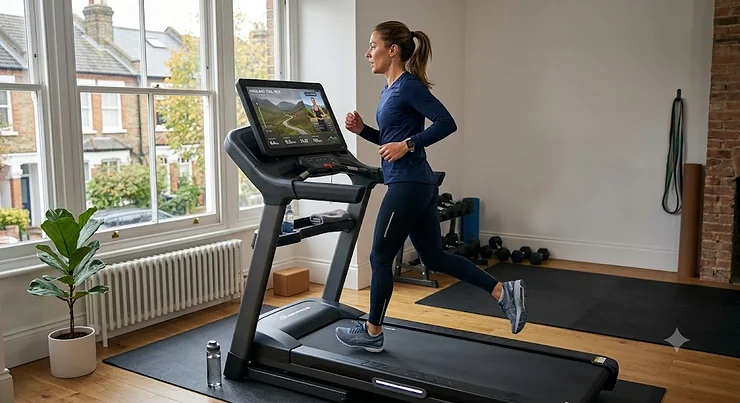
A smart treadmill is a motorised running machine built around a connected screen, app, or sensor system that adapts your workout, streams entertainment, or hands you a coach-led session instead of a blank wall to stare at. That’s it, really — no smoke and mirrors, just a belt, a motor, and a brain bolted on top. If you’ve spent any time browsing fitness kit lately, you’ll have noticed the word “smart” gets slapped on everything from £300 under-desk walking pads to £2,000 studio-grade machines with screens the size of a laptop. Some of that is marketing fluff. Some of it genuinely changes how consistently you exercise, which is the only metric that actually matters in the long run.
We’ve spent time digging through spec sheets, aggregated review sentiment, and real UK retail listings to find the best smart treadmill for different budgets and different reasons for buying one. Whether you’re chasing a proper iFit treadmill experience with automatic incline, hunting for the best treadmill with app support so you’re not locked into one ecosystem, or simply want a treadmill with screen technology that lets you binge Netflix while logging your steps, there’s a sensible pick below. According to the NHS physical activity guidelines for adults, hitting 150 minutes of moderate intensity activity a week measurably lowers your risk of heart disease and stroke, and a treadmill sat in your spare room removes the single biggest excuse — British weather — from that equation.
This guide covers connected fitness equipment across three price tiers: budget walking pads for flats and home offices, mid-range machines that balance a genuine running deck with app flexibility, and premium touchscreen treadmills built for daily coach-led treadmill workouts. We’ve also dug into the practical stuff nobody tells you before you buy — subscription costs, noise levels, what happens when your Wi-Fi drops mid-session, and how to actually maintain one of these things so it doesn’t die in year two.
Quick Comparison Table
| Product | Best For | Screen/App | Motor | Price Range |
|---|---|---|---|---|
| NordicTrack Commercial 1750 | Serious iFit users wanting decline training | 16″ iFit touchscreen | 4.25 CHP | £1,900-£2,100 |
| Bowflex Treadmill 22 | Streaming Netflix/Prime mid-run | 22″ HD touchscreen, JRNY | 4.0 CHP | £2,200-£2,500 |
| JTX Sprint 7 | No-subscription British-built all-rounder | Kinomap/Zwift via tablet | 3.0 HP | £950-£1,150 |
| NordicTrack EXP 7i | Cheapest genuine iFit experience | 7″ iFit touchscreen | 2.6 CHP | £700-£900 |
| Echelon Stride 50 RCX | Streaming treadmill classes on a budget | Echelon Fit app (BYO device) | 2.0 CHP | £950-£1,050 |
| Sole F63 | Buyers who hate subscriptions | Sole+ app, Bluetooth | 3.0 CHP | £1,000-£1,250 |
| UREVO Strol 2E | Small flats and home offices | Smart APP control | 2.5 HP | Under £350 |
Looking at the spread above, the gap between the cheapest and priciest options isn’t really about how well the belt runs — it’s about how much of the workout the machine does for you. Budget picks like the UREVO Strol 2E hand you the app and let you drive; premium machines like the NordicTrack Commercial 1750 take the wheel entirely, adjusting speed and incline without you touching a button. Neither approach is objectively “better” — it depends whether you find automation motivating or intrusive, something worth testing in your head before you spend four figures on it.
💬 Just one click — help others make better buying decisions too! 😊
Top 7 Smart Treadmills: Expert Analysis
1. NordicTrack Commercial 1750 — deepest iFit integration and true decline training
The NordicTrack Commercial 1750 is the treadmill most reviewers point to when they talk about what a proper iFit treadmill should feel like, and the reason comes down to one number most competitors don’t offer: -3% decline. Paired with a 12% incline ceiling, that range lets the machine physically mimic downhill running, not just uphill grinding, which matters if you’re training for anything with elevation change. The 4.25 CHP motor drives speeds up to 20kph without labouring, and the 55 x 152cm deck gives taller runners genuine room to extend their stride without clipping the console.
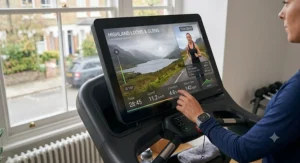
What most buyers overlook about this model is that the screen isn’t just for scenery — the 16-inch pivoting touchscreen tilts to face the floor for off-treadmill strength and mobility sessions, effectively turning the machine into a home-gym hub rather than a single-purpose device. Based on the spec comparison with cheaper NordicTrack models, the jump in motor size and deck width here is what justifies the price gap, not just the bigger screen. This is the pick for someone who runs three or more times a week and wants the treadmill to feel less like a chore and more like an event.
Reviewers consistently report that the RunFlex cushioning strikes a firmer, more road-like balance than NordicTrack’s softer T Series decks, which serious runners tend to prefer even if it’s marginally less forgiving on the joints. A recurring theme in aggregated feedback is frustration that the screen is largely inert without an active iFit subscription — manual mode works fine, but you’re paying for tech you’re not using if you don’t subscribe.
Pros:
- ✅ Genuine -3% to 12% decline/incline range, rare at this price
- ✅ 16″ pivoting screen doubles as an off-treadmill workout hub
- ✅ 4.25 CHP motor handles sustained interval sessions easily
Cons:
- ❌ Screen features are largely locked behind an iFit subscription
- ❌ At roughly 130kg assembled, it’s not a machine you reposition often
At around £1,900-£2,100 (check current price for live availability), it sits at the upper end of home-use pricing, but for anyone who’ll genuinely use the decline training and automatic terrain matching, it represents strong value against similarly specced commercial-grade rivals.
2. Bowflex Treadmill 22 — best touchscreen for streaming binge-runs
If your idea of a good treadmill session involves catching up on a boxset rather than following a trainer up a virtual Alp, the Bowflex Treadmill 22 is built for you. Its headline feature is the 22-inch HD touchscreen, one of the largest fitted to any home treadmill, and it pairs with the JRNY app to stream Netflix, Hulu-style content, and Zwift alongside trainer-led classes. The 4.0 CHP motor and 22 x 60-inch deck put it firmly in commercial-adjacent territory, and the -5% to 20% incline/decline range is the widest on this list by a clear margin.
Here’s what the spec sheet won’t tell you: that huge incline range is genuinely useful for hill-focused strength work, not just a marketing number. Based on our comparison research, the Easy SoftDrop folding mechanism is a meaningful practical touch given how much this treadmill weighs — folding treadmills at this weight class often feel unwieldy, and this one doesn’t. This is the machine for a household that wants one screen doing double duty as an entertainment system and a training platform, particularly if multiple people will use it for different things.
A common thread in aggregated review sentiment is that Bowflex’s customer service and long-term reliability track record trails some competitors, even though the hardware itself scores well on raw performance testing. That’s worth weighing against the undeniably impressive on-paper spec sheet before committing.
Pros:
- ✅ Largest touchscreen on this list at 22 inches
- ✅ Widest incline/decline range for genuine hill training
- ✅ Robust triangulated frame stays stable at high speeds
Cons:
- ❌ JRNY subscription needed to unlock full streaming features
- ❌ Reported inconsistencies in long-term customer support
Expect to pay in the £2,200-£2,500 range, making it a direct rival to the NordicTrack Commercial 1750 above — the decision largely comes down to whether you value screen size (Bowflex) or decline realism and iFit’s content library (NordicTrack) more highly.
3. JTX Sprint 7 — the no-subscription British-built all-rounder
The JTX Sprint 7 takes a different approach entirely: no built-in touchscreen, no forced subscription, just a genuinely well-built treadmill that connects to Kinomap and Zwift through your own tablet propped on the included holder. Designed and warrantied by a UK company with a West Sussex showroom, it’s earned a reputation as one of the most trusted mid-range machines on the British market, reportedly rated 4.8 stars across hundreds of Trustpilot reviews.
What most buyers overlook here is the deck quality. The 145 x 51cm running surface sits on a 6-point Cushionstep cushioning system that reviewers repeatedly single out as noticeably softer underfoot than rival decks at this price, which matters enormously if you’re running several times a week and care about long-term joint comfort. The 2.5-3.0 HP motor handles a 12.4mph top speed without strain, and the 12% powered incline auto-adjusts to match routes when paired with Kinomap. Reviewers consistently note that this is one of the sturdiest folding treadmills available under £1,200 — the 85kg frame simply doesn’t wobble at pace the way lighter competitors do.
Aggregated feedback does flag that Kinomap’s free tier is fairly limited compared with paid platforms like iFit or Zwift’s own subscription, so you’ll want to budget for a Kinomap or Zwift membership separately if you want the full interactive route experience rather than just basic connectivity.
Pros:
- ✅ 3-year in-home warranty, among the best in its class
- ✅ Cushionstep deck reduces joint impact noticeably
- ✅ No forced subscription — works fully standalone
Cons:
- ❌ No built-in screen; you supply your own tablet
- ❌ Free Kinomap tier is thin on content variety
At around £950-£1,150, the Sprint 7 remains one of the strongest value propositions in this entire roundup, particularly for buyers who resent being funnelled into a monthly fee just to use the treadmill they’ve already paid for.
4. NordicTrack EXP 7i — the cheapest genuine iFit treadmill
For anyone who wants to try the iFit ecosystem without committing to Commercial-series pricing, the NordicTrack EXP 7i is the obvious entry point. It shares the same core iFit software as its pricier siblings — automatic trainer control, Google Maps-based route replication, ActivePulse heart-rate adjustment — on a smaller 7-inch touchscreen and a more modest 2.6 CHP motor.
Based on the spec comparison, this is unmistakably a walking-and-light-jogging machine rather than a serious runner’s treadmill: the 51 x 152cm belt and sub-3.0 CHP motor put a ceiling on sustained fast running that the pricier Commercial models don’t have. What most buyers overlook is that this limitation is actually the point — NordicTrack designed the EXP 7i specifically to introduce iFit at a lower price, not to compete on raw running performance. The tilting screen and device rack combination is a clever touch, letting you switch between iFit workouts and your own tablet content depending on the day.
Reviewers consistently note the incline motor is noticeably louder than the main drive motor, which can be jarring during interval sessions, and the lack of a cooling fan is a recurring minor complaint. Still, for someone testing whether trainer-led, auto-adjusting workouts actually suit them before spending on a flagship model, it’s hard to beat.
Pros:
- ✅ Full iFit software on NordicTrack’s cheapest touchscreen model
- ✅ Sturdy steel frame despite the entry-level price point
- ✅ Device rack lets you bypass iFit entirely if preferred
Cons:
- ❌ Incline motor is noticeably louder than the drive motor
- ❌ Modest 10mph top speed limits it for serious runners
Typically found in the £700-£900 range (watch for retailer sales, where it’s occasionally spotted closer to £700), this is the pragmatic pick for testing the iFit treadmill concept before committing serious money.
5. Echelon Stride 50 RCX — best value for streaming treadmill classes
The Echelon Stride 50 RCX occupies an interesting middle ground: a genuinely capable 2.0 CHP (3.0 HP peak) motor with a 12.5mph top speed and 15 levels of incline, paired with the Echelon Fit app rather than a built-in screen on the base model. That means you prop your own phone or tablet on the console to access live and on-demand streaming treadmill classes, which keeps the hardware price down considerably compared with the screen-equipped RCX-22 variant.
What the spec sheet won’t tell you, but reviewer feedback consistently suggests, is that the Echelon Fit app’s class library — while solid — doesn’t yet rival the sheer volume and production polish of iFit or Peloton’s back catalogue. On the flip side, a common thread in aggregated sentiment is genuine enthusiasm for how compact this treadmill folds; several owners specifically praise being able to store it under a bed, a real advantage for London flats and other tight UK living spaces where a permanently-installed treadmill simply isn’t practical.
The trade-off buyers should weigh honestly: the Echelon Fit subscription runs as a rolling monthly cost on top of the hardware, and cancelling drops you back to basic manual mode with no trainer-led content at all.
Pros:
- ✅ 15 incline levels and a proper running-capable motor
- ✅ Folds impressively flat for small UK living spaces
- ✅ Wireless charging pad and LED deck lighting included
Cons:
- ❌ Subscription required for the full class library
- ❌ Class catalogue is smaller than iFit or Peloton’s
At roughly £950-£1,050 for the standard RCX, it undercuts the screen-equipped RCX-22 by around £500 while sharing the same motor, making it the smarter buy unless a built-in display is a genuine must-have for you.
6. Sole F63 — the best treadmill for buyers who hate subscriptions
The Sole F63 takes the opposite philosophy to nearly everything else on this list: no built-in touchscreen, no push toward a monthly plan, just a durable 3.0 CHP motor and a 20 x 60-inch running deck that consistently earns praise as one of the sturdiest machines under £1,300. It connects via Bluetooth to the free Sole+ app for tracking, and syncs with MyFitnessPal, Fitbit, and Apple Health, giving you connected fitness equipment functionality without locking you into paid content.
Based on the spec comparison, the Cushion Flex Whisper Deck is claimed to reduce joint impact by around 40% versus pavement — a figure that’s hard to independently verify, but aggregated reviewer sentiment consistently describes the deck as noticeably supportive during longer sessions, which lines up with the marketing claim even if the precise percentage should be taken as indicative rather than gospel. The lifetime frame and motor warranty is genuinely unusual at this price and speaks to Sole’s confidence in build quality.
Reviewers consistently flag two mild criticisms: some wobble is noticeable during heavy, sustained running at the very top of the speed range, and the incline mechanism is a step behind rival machines in smoothness. Neither is a dealbreaker for the intended audience — walkers, joggers, and newer runners who want durability over flashy tech.
Pros:
- ✅ Lifetime warranty on frame and motor, rare at this price
- ✅ No subscription required for any core functionality
- ✅ Bluetooth syncs with major third-party fitness apps
Cons:
- ❌ Noticeable wobble during heavy running at top speed
- ❌ Incline adjustment feels less refined than rivals
Priced around £1,000-£1,250 depending on retailer promotions, the F63 is the treadmill to recommend to anyone who’s tired of “smart” being a euphemism for “another subscription.”
7. UREVO Strol 2E — best space-saving app-controlled walking pad
Not everyone has room for a full-sized running deck, and that’s where the UREVO Strol 2E earns its place on this list. It’s a folding 2-in-1 walking pad rather than a traditional treadmill, designed to slide under a desk or sofa and controlled through a dedicated smart app that tracks steps, distance, and calories from a phone rather than an onboard screen. Dual LED displays keep basic stats visible without needing your phone propped up constantly.
What most buyers overlook about walking pads generally is that they’re built for a fundamentally different use case than running treadmills — this is about accumulating daily steps while working from home, not training for a 10K. Based on that context, the Strol 2E does its intended job well: quiet operation suitable for shared flats, a compact folded footprint, and genuine plug-and-play setup with no assembly headaches. Reviewers in this category consistently note that walking pads like this one shouldn’t be pushed into jogging speeds regularly, as the smaller belt motors aren’t built for sustained higher-impact use.
Aggregated feedback across similar under-desk models highlights that app connectivity occasionally lags on older phones, and the safety key mechanism, while a sensible feature, is easy to lose track of. For its intended purpose — nudging your daily activity up while you work — it’s a sensible, low-commitment entry into connected fitness equipment.
Pros:
- ✅ Compact folding design ideal for flats and home offices
- ✅ Smart app tracks steps, distance and calories automatically
- ✅ Genuinely quiet operation for shared or thin-walled homes
Cons:
- ❌ Not built for running or sustained jogging speeds
- ❌ App connectivity can occasionally lag on older phones
Typically listed under £350, it’s the most accessible entry point on this list for anyone who wants a treadmill with app tracking but doesn’t have space — or budget — for a full running machine.
Top 7 Smart Treadmills: Full Spec Comparison
| Product | Motor | Incline Range | Top Speed | Deck Size | Warranty Highlight |
|---|---|---|---|---|---|
| NordicTrack Commercial 1750 | 4.25 CHP | -3% to 12% | 20kph | 55 x 152cm | Lifetime frame |
| Bowflex Treadmill 22 | 4.0 CHP | -5% to 20% | 12mph | 56 x 152cm | Lifetime frame & motor |
| JTX Sprint 7 | 3.0 HP | 0-12% | 12.4mph | 51 x 145cm | 3-year in-home repair |
| NordicTrack EXP 7i | 2.6 CHP | 0-12% | 10mph | 51 x 140cm | Lifetime frame |
| Echelon Stride 50 RCX | 2.0 CHP (3.0 peak) | 0-15 levels | 12.5mph | 56 x 145cm | 5-year motor |
| Sole F63 | 3.0 CHP | 0-15% | 12mph | 51 x 152cm | Lifetime frame & motor |
| UREVO Strol 2E | 2.5 HP | Fixed | 7.6mph | Compact pad | Standard 1-year |
Reading across the incline and motor columns, a clear pattern emerges: the two most expensive machines — the Bowflex Treadmill 22 and NordicTrack Commercial 1750 — are the only ones offering true decline capability, which is the feature that separates a treadmill from a treadmill that can genuinely simulate outdoor terrain. If decline training isn’t a priority, the JTX Sprint 7 and Sole F63 deliver comparable incline range and deck size for roughly half the price, simply without the screen.
Setting Up Your Smart Treadmill: A Practical Usage Guide
Getting a smart treadmill delivered is the easy part; getting the most out of it in the first month is where most buyers either build a habit or quietly relegate it to a very expensive clothes rail. Start with placement: leave at least a metre of clear space behind the belt for safety, and position it near a power socket rather than trailing an extension lead across a walking route — a genuinely common cause of accidents that’s entirely avoidable. If your model has a touchscreen, avoid direct sunlight hitting the panel, which can wash out visibility and, over time, affect the display.
During the first week, resist the urge to jump straight into a coach-led treadmill workout at full intensity. Most smart treadmills, particularly iFit and JRNY-enabled models, include a calibration or orientation walk that gets you used to how the belt accelerates and how automatic incline adjustments feel underfoot — skipping this is the single most common reason new owners feel unsteady early on. Register your warranty within the window specified (often 28 days) since several brands, including NordicTrack, only offer full parts-and-labour cover if you do this promptly.
For app-connected models, pair your heart-rate monitor and headphones before your first proper session rather than fumbling with Bluetooth mid-run. Belt maintenance matters more than people expect: most manufacturers recommend lubricating the deck every three to six months depending on usage frequency, and letting the belt run dry is the fastest way to void a motor warranty prematurely. A common mistake in the first 30 days is over-tightening the belt after noticing minor side-slip — usually a lubrication issue, not a tension one, so check the manual before reaching for a wrench.
Which Smart Treadmill Buyer Are You? Real-World Scenarios
The flat-dwelling remote worker. If you’re based in a one-bedroom flat with limited floor space and want to break up long working days with movement, a full-sized treadmill is overkill. The UREVO Strol 2E or a similar walking pad slides under a desk and folds away completely when guests come round, and its app tracks daily step totals without demanding a structured training block.
The subscription-fatigued household. If your Netflix, Spotify, and gym membership already feel like enough recurring costs, the JTX Sprint 7 or Sole F63 deliver strong running performance and connected tracking without adding another monthly bill to the pile. Both work perfectly as standalone machines from day one.
The data-driven home athlete. For someone training for a specific event and craving structured, automatically-adjusting sessions, the NordicTrack Commercial 1750 earns its price tag. iFit’s automatic terrain matching and heart-rate zone training genuinely replace a chunk of what a personal trainer would otherwise charge for, particularly across a multi-month training block.
The household that shares the treadmill. If multiple people with different goals — one wants HIIT, another wants a gentle evening walk while watching a boxset — will use the same machine, the Bowflex Treadmill 22‘s large screen and flexible app support (JRNY plus your own streaming logins) handles that variety better than a single-purpose fitness app ever could.
How to Choose the Best Smart Treadmill for Your Home
Choosing between these machines comes down to five practical criteria, each worth weighing before you check out:
- Motor size for your training style. Anything under 2.5 CHP is realistically a walking-and-light-jogging motor; if you plan to run regularly, look for 3.0 CHP or higher to avoid premature wear.
- Deck size relative to your height. A 60-inch deck length suits most runners over 5’10”, while shorter decks under 145cm can feel cramped at pace regardless of your speed.
- Subscription tolerance. Decide honestly whether you’ll pay a recurring app fee. If not, prioritise machines like the JTX Sprint 7 or Sole F63 that work fully without one.
- Screen size versus space. Larger touchscreens look impressive in photos but dominate small rooms; measure your space before assuming bigger is better.
- Incline/decline range for your goals. Hill training and marathon-style terrain simulation genuinely benefit from decline capability, which only the premium tier here offers.
- Folding mechanism and storage reality. Be honest about whether you’ll actually fold it away daily — hydraulic soft-drop systems are far less hassle than manual lift mechanisms if you will.
- Warranty depth, not just length. A lifetime frame warranty means little if labour and parts cover expires after a year; read the fine print on what’s actually covered.
According to Which?’s independent treadmill testing, panels of testers ranging from casual joggers to marathon runners assess stability, comfort, and how easily settings can be adjusted mid-run, which broadly mirrors the criteria above and reinforces that stability at pace matters just as much as the tech sitting on the console.
iFit vs Kinomap vs JRNY vs Echelon Fit: Which App Ecosystem Wins?
The app you’re tied to matters arguably more than the treadmill itself, since it shapes every session you’ll do for years. iFit, used by NordicTrack and ProForm, offers the deepest content library — over 10,000 workouts including automatically-adjusting global routes — but locks its best features behind a Pro subscription running roughly £34-£39 a month for a family plan. Reviewers consistently note it’s the most immersive option but also the priciest ongoing commitment.
JRNY, Bowflex’s platform, leans more heavily on app-based personalisation and works well alongside third-party streaming logins you already pay for, which appeals to people who don’t want to duplicate a Netflix subscription through a fitness app specifically. Kinomap, used by JTX and several budget brands, is free at a basic tier and paid for full route access, but its content library is noticeably thinner than iFit’s — a fair trade-off if you’re prioritising treadmill hardware over software polish. Echelon Fit sits in between: solid production values on its coach-led treadmill workout classes, priced competitively, but with a smaller back catalogue than the market leaders.
What most buyers overlook is that none of these apps are truly interchangeable — a Kinomap-compatible treadmill won’t run iFit’s automatic terrain adjustment, and vice versa — so choosing your app ecosystem should genuinely come before choosing your treadmill model, not after.
Common Mistakes When Buying a Smart Treadmill
The single most common mistake, according to aggregated retailer and reviewer commentary, is buying based on screen size alone and ignoring motor rating entirely — a stunning touchscreen sat on top of a 2.0 CHP motor will still struggle if you’re a regular runner rather than a walker. A close second is underestimating delivery and doorway logistics; several of the premium machines on this list weigh well over 100kg and require two-person delivery, and buyers frequently discover too late that the box won’t fit through a narrow hallway or up a tight staircase.
Another recurring pitfall is committing to an annual app subscription before testing the free trial thoroughly, only to find the content style doesn’t suit your training preferences. Equally common is ignoring the folded footprint on so-called “space-saving” treadmills — many fold vertically but remain surprisingly deep, so measure the folded dimensions, not just the unfolded running area, before assuming it’ll tuck away neatly.
Finally, buyers regularly skip reading the warranty’s labour clause, assuming a “lifetime warranty” headline covers everything, when in practice it often applies only to the frame and motor, with parts and callout labour capped at one or two years unless registered promptly.
Coach-Led Workouts vs Streaming Classes: What’s the Real Difference?
These two terms get used almost interchangeably in marketing copy, but they describe genuinely different training experiences. A coach-led treadmill workout, as offered through iFit, JRNY, and Echelon Fit, involves a trainer’s programming actively controlling your treadmill’s speed and incline in real time, so you follow their pacing without touching a button — the machine effectively runs the session for you. Streaming treadmill classes, by contrast, are typically pre-recorded or live sessions you watch and follow manually, adjusting your own settings to match instructor cues, closer to a gym class experience than an automated one.
Based on the spec comparison across this list, the premium NordicTrack and Bowflex models lean hardest into automatic coach-led control, while the Echelon Stride and JTX Sprint 7 lean more toward streamed, self-directed classes. Neither approach is objectively superior — automated control suits people who find manual adjustment distracting mid-run, while self-directed streaming suits people who prefer retaining full control over their own pacing. What most buyers overlook is that automated coach-led sessions require a strong, stable Wi-Fi connection to function properly; a patchy signal can cause the treadmill to lag behind the video feed, which several reviewers flag as genuinely disorientating mid-sprint.
Long-Term Cost & Maintenance of Connected Fitness Equipment
The sticker price is only the starting point with any smart treadmill. Factor in belt lubrication supplies (typically £10-£15 every few months), any subscription costs, which range from free (Sole+, manual Kinomap) to roughly £30-£40 monthly for full iFit or Echelon Fit Premier access, and eventual belt replacement, which most machines need somewhere between three and seven years depending on usage frequency and maintenance discipline.
Over a three-year ownership period, a subscription-free machine like the JTX Sprint 7 or Sole F63 can end up genuinely cheaper than a lower-upfront-cost iFit treadmill once monthly fees are totalled, even though the initial outlay looks similar. On the other hand, if the coach-led content is what keeps you consistently using the machine — and consistency is what actually delivers fitness results — the subscription cost may be money well spent rather than an avoidable expense. It’s a genuinely personal calculation, and worth running the maths honestly before assuming the cheaper hardware is automatically the better long-term value.
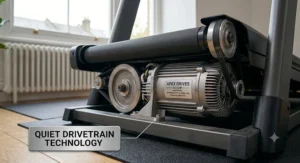
Basic upkeep extends the life of any of these machines considerably: vacuum underneath the belt monthly to prevent dust building up around the motor, check bolts for looseness every few months given the vibration from regular use, and keep the machine away from damp environments like unheated garages, which several manufacturers explicitly warn can damage electronics and void warranties.
Safety, Space and Setting Up a Smart Treadmill in a UK Home
UK homes tend to be smaller than their American counterparts, so space planning deserves genuine thought before ordering a machine with a 22-inch touchscreen. Measure ceiling height too, not just floor space — several premium treadmills raise the console noticeably when unfolded, and taller runners can find headroom tighter than expected in rooms with lower period-property ceilings. Electrical safety matters as well: these machines draw meaningful power, particularly under sustained load, so plugging into a dedicated socket rather than a shared extension lead reduces both fire risk and the chance of nuisance trips.
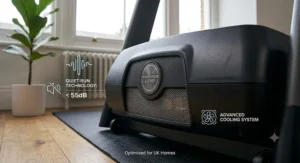
Flooring is another commonly overlooked factor. A dedicated rubber gym mat beneath any treadmill protects both your flooring and the machine’s motor from vibration-related wear, and it meaningfully reduces noise transfer to rooms below — a genuine consideration in flats and terraced houses. If you have young children or pets in the home, treadmill safety keys and console locks are worth using consistently, not just when you remember to.
The UK Chief Medical Officers’ physical activity guidelines report sets out the amount and type of activity people should be doing for health benefits, and a well-placed, properly maintained treadmill removes several of the practical barriers — weather, daylight hours, gym opening times — that commonly get in the way of hitting those targets consistently through a British winter.
Frequently Asked Questions
❓ Do smart treadmills need Wi-Fi to work?
❓ Is an iFit treadmill worth the subscription cost?
❓ Can I use my own tablet instead of a built-in screen?
❓ How much space does a smart treadmill actually need?
❓ Are walking pads a good alternative to a full treadmill with screen?
Conclusion
There’s no single best smart treadmill, only the best one for how you’ll actually use it — which is worth being honest with yourself about before you spend anywhere from £350 to £2,500. If budget and space are tight, the UREVO Strol 2E gets you moving without commitment. If you resent subscriptions on principle, the JTX Sprint 7 and Sole F63 deliver serious running performance with nothing extra to pay monthly. And if you want the full immersive, coach-led experience with a screen that genuinely transforms the session, the NordicTrack Commercial 1750 and Bowflex Treadmill 22 remain the two machines worth the premium.
Whichever you land on, the research consistently points to one thing above all: the treadmill you’ll actually use several times a week beats the treadmill with the most impressive spec sheet sitting unused in the corner. Match the machine to your realistic habits, not your aspirational ones, and the rest tends to follow.
✨ Don’t Miss These Exclusive Deals!
🔍 Take your home fitness routine to the next level with these carefully selected smart treadmills. Click on any highlighted product to check current pricing and availability. These machines will help you build authentic, lasting fitness habits your whole family will benefit from!
Recommended for You
- 7 Best Incline Treadmill Picks for 2026 (Steep to Budget, UK)
- Walking Pad vs Under Desk Treadmill: 7 Real Picks for 2026
- Best Walking Pad 2026: 7 Under-Desk Treadmills Worth Buying
Disclaimer: This article contains affiliate links. As an Amazon Associate, I earn from qualifying purchases. If you purchase products through these links, we may earn a small commission at no additional cost to you.
✨ Found this helpful? Share it with your friends! 💬🤗
